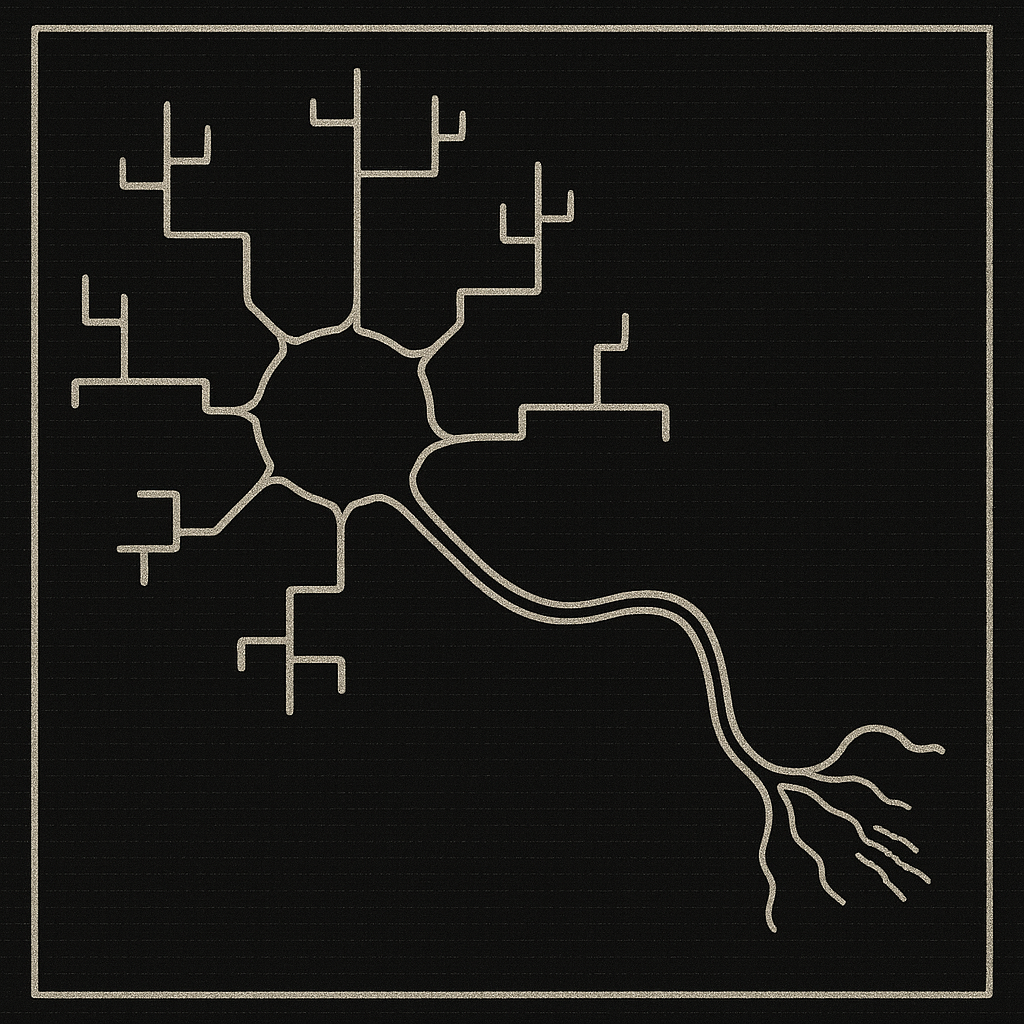
THE MACHINERY OF LEARNING
A Complete Guide to How the Brain Rebuilds Itself
How Neural Architecture Actually Changes
What follows is not a study guide.
It is not a productivity method. Not a memory hack. Not another article telling you to use flashcards.
It is mechanism.
The actual physical process by which your brain rewires itself in response to experience.
Most people treat learning as though it were input. Information goes in. Knowledge comes out. Like filling a container. Like copying a file.
This is wrong at every level.
Learning is not reception. It is construction. Destruction and reconstruction. The physical alteration of neural tissue in response to specific error signals that most people never see operating.
This document is the machinery underneath.
What the brain actually does when it changes.
Not what to do about it.
PART ONE: THE WIRING RULE
The Law That Governs All Learning
In 1949, Donald Hebb proposed a principle so fundamental it became the single most cited idea in neuroscience.
Neurons that fire together wire together.
This is not metaphor. It is physical mechanism.
When neuron A fires and consistently contributes to firing neuron B, the synaptic connection between them strengthens. The molecular machinery at the junction point physically changes. More neurotransmitter is released. More receptors appear on the receiving side. The signal gets louder.
The reverse is also true.
Neurons that fire apart wire apart.
Connections that are not co-activated weaken. Receptors retract. Neurotransmitter production drops. The signal fades.
This is the fundamental law of neural change. Every form of learning, from a baby grasping an object to a physicist deriving equations, operates on this principle.
The Molecular Machinery
The strengthening process has a name. Long-term potentiation. LTP.
First demonstrated by Terje Lomo and Tim Bliss in 1973. They stimulated neural pathways in rabbit hippocampi and watched the connections get stronger. Measurably. Physically. For hours. Then days.
Here is what actually happens at the synapse.
    THE LTP CASCADE

    ┌──────────────────────────────────────────────────────┐
    │                  PRESYNAPTIC NEURON                   │
    │                                                      │
    │    Fires repeatedly → releases glutamate             │
    └──────────────────────────────────────────────────────┘
                            │
                            ▼
    ┌──────────────────────────────────────────────────────┐
    │                  SYNAPTIC CLEFT                       │
    │                                                      │
    │    Glutamate floods the gap                          │
    └──────────────────────────────────────────────────────┘
                            │
                            ▼
    ┌──────────────────────────────────────────────────────┐
    │                POSTSYNAPTIC NEURON                    │
    │                                                      │
    │    Step 1: AMPA receptors activate (fast signal)     │
    │    Step 2: Depolarization unblocks NMDA receptors    │
    │    Step 3: Calcium floods through NMDA channels      │
    │    Step 4: CaMKII activates → new AMPA receptors     │
    │            inserted into membrane                    │
    │    Step 5: Connection permanently strengthened       │
    │                                                      │
    └──────────────────────────────────────────────────────┘
The NMDA receptor is the coincidence detector. It only opens when two conditions are met simultaneously: glutamate is present (the presynaptic neuron fired) AND the postsynaptic neuron is already depolarized (it was recently active too).
Both neurons must be active at roughly the same time.
This is Hebb’s rule implemented in molecular hardware.
The calcium that floods through the NMDA channel triggers a cascade of protein synthesis. New receptor molecules are manufactured and inserted into the membrane. The synapse physically grows larger. More surface area. More connection points.
The signal between these two neurons is now louder than before.
This is what learning looks like at the scale of molecules.
The Timing Window
The co-activation must happen within a narrow window.
Spike-timing-dependent plasticity. STDP. Discovered in the late 1990s.
If the presynaptic neuron fires just before the postsynaptic neuron (within roughly 20 milliseconds), the connection strengthens. This is the direction of causation. A caused B. Strengthen.
If the order reverses, the connection weakens. B happened before A. A did not cause B. Weaken.
    SPIKE-TIMING-DEPENDENT PLASTICITY

    Firing
    Rate        PRESYNAPTIC FIRES FIRST
    Change              │
                        │    ┌──────────────────┐
                        │    │   STRENGTHEN      │
         ───────────────┼────┴──────────────────┴────────
                        │    ┌──────────────────┐
                        │    │   WEAKEN          │
                        │    └──────────────────┘
                        │
                   POSTSYNAPTIC FIRES FIRST

         ◄──────────────┼──────────────►
           -40 ms       0 ms       +40 ms

               TIMING WINDOW
Twenty milliseconds. That is the window in which causation is inferred and connections are altered.
The brain does not just learn associations. It learns causal direction. And it does so at millisecond resolution.
PART TWO: THE ERROR SIGNAL
Learning Is Not About Getting It Right
The brain does not learn from success.
It learns from error.
Specifically, from the difference between what it predicted and what actually happened. This difference has a name in computational neuroscience: prediction error.
When prediction matches reality, nothing happens. No signal. No update. No learning.
When prediction fails, error signal fires. The brain updates its model. Connections shift. This is learning.
    THE LEARNING SIGNAL

    ┌────────────────────────┐     ┌────────────────────────┐
    │      PREDICTED         │     │       ACTUAL           │
    │      OUTCOME           │     │       OUTCOME          │
    │                        │     │                        │
    └────────────────────────┘     └────────────────────────┘
                │                              │
                └──────────────┬───────────────┘
                               │
                               ▼
                    ┌─────────────────────┐
                    │     COMPARISON      │
                    └─────────────────────┘
                               │
                 ┌─────────────┴─────────────┐
                 │                           │
                 ▼                           ▼
        ┌────────────────┐         ┌────────────────┐
        │    MATCH       │         │   MISMATCH     │
        │                │         │                │
        │  No signal     │         │  Error signal  │
        │  No update     │         │  Model updates │
        │  No learning   │         │  THIS IS       │
        │                │         │  LEARNING      │
        └────────────────┘         └────────────────┘
The Teaching Chemical
Dopamine is the carrier of this signal.
Wolfram Schultz demonstrated this in the 1990s with single-neuron recordings in monkeys. Dopamine neurons do not respond to reward. They respond to the difference between expected reward and received reward.
Better than expected: dopamine burst. Signal says “update the model, this path leads somewhere.”
Exactly as expected: nothing. Model is already correct. Nothing to learn.
Worse than expected: dopamine dip below baseline. Signal says “this prediction was wrong, revise it.”
The magnitude of the error determines the magnitude of the update.
Large prediction error. Large model change. Rapid learning.
Small prediction error. Small model change. Fine-tuning.
Zero prediction error. Zero change. Mastery.
This is why the tenth repetition of something you already know produces almost nothing. The prediction is already accurate. There is no error to drive an update.
And this is why genuine surprise, genuine failure, genuine novelty produces the deepest encoding. The error signal is large. The update is proportional.
The Cerebellum and the Basal Ganglia
The prediction error signal operates through different hardware depending on what is being learned.
The cerebellum handles motor prediction errors. It continuously compares intended movement with actual movement, computing the difference in real time. Every stumble, every missed note, every overshot reach generates a cerebellar error signal that adjusts the motor program.
The basal ganglia handle reward prediction errors. They learn which actions, in which contexts, lead to which outcomes. Dopamine signals from the ventral tegmental area and substantia nigra drive these updates.
The hippocampus handles contextual prediction errors. When the environment violates expectations, hippocampal circuits flag the mismatch and begin encoding the new pattern.
    THREE ERROR SYSTEMS

         CEREBELLUM              BASAL GANGLIA           HIPPOCAMPUS
              │                       │                       │
              ▼                       ▼                       ▼
    ┌─────────────────┐     ┌─────────────────┐     ┌─────────────────┐
    │                 │     │                 │     │                 │
    │  Motor error    │     │  Reward error   │     │  Context error  │
    │                 │     │                 │     │                 │
    │  "My hand went  │     │  "That action   │     │  "This place    │
    │   left when I   │     │   got less than │     │   is different  │
    │   meant right"  │     │   expected"     │     │   than before"  │
    │                 │     │                 │     │                 │
    │  Updates:       │     │  Updates:       │     │  Updates:       │
    │  Motor programs │     │  Action values  │     │  Spatial maps   │
    │  Timing         │     │  Habits         │     │  Episode memory │
    │  Coordination   │     │  Preferences    │     │  Context models │
    │                 │     │                 │     │                 │
    └─────────────────┘     └─────────────────┘     └─────────────────┘
Three systems. Same principle. Different domains.
The brain does not have one learning mechanism. It has a family of error-correction systems, each tuned to a different type of prediction.
PART THREE: THE THREE STAGES
The Architecture of Skill Acquisition
In 1967, Paul Fitts and Michael Posner described three stages that every learner passes through. Not as metaphor. As observable shifts in how the brain processes the task.
Stage 1: Cognitive
Everything is conscious. Every movement, every decision, every adjustment requires explicit attention. The prefrontal cortex is heavily active. Working memory is loaded to capacity. Performance is slow, inconsistent, effortful.
The learner is building an initial model. Generating predictions for the first time. Every action produces large prediction errors. Every error demands conscious correction.
Stage 2: Associative
Patterns begin to consolidate. The gross errors have been corrected. Now the learner refines. Smaller errors. More consistent output. Less conscious effort required. The prefrontal cortex begins to release its grip. Subcortical structures start taking over.
The transition from explicit to implicit processing has begun.
Stage 3: Autonomous
The skill runs without conscious intervention. The basal ganglia and cerebellum execute the program. The prefrontal cortex is free. Performance is fast, consistent, requiring minimal attention.
The learner can now do the task while holding a conversation. While thinking about something else. While barely noticing they are doing it at all.
    THE THREE STAGES OF SKILL ACQUISITION

    COGNITIVE                ASSOCIATIVE              AUTONOMOUS
    ┌──────────────┐        ┌──────────────┐        ┌──────────────┐
    │ Conscious    │        │ Transitional │        │ Automatic    │
    │ Effortful    │   →    │ Refining     │   →    │ Effortless   │
    │ Error-heavy  │        │ Consolidating│        │ Fluent       │
    └──────────────┘        └──────────────┘        └──────────────┘

    BRAIN ACTIVITY:

    Prefrontal   ████████████████    ████████████         ████
    Cortex       (maximum load)      (declining)          (minimal)

    Basal        ████                ████████████         ████████████████
    Ganglia      (minimal)           (increasing)         (dominant)

    Prediction   ████████████████    ████████████         ████
    Error Rate   (large, frequent)   (smaller)            (rare)
This is not a timeline. Some skills take hours. Some take years. The transition speed depends entirely on the complexity of the prediction model being built and the quality of the error signals available.
But the sequence is invariant.
Conscious construction. Then gradual transfer. Then automatic execution.
Every skill. Every domain. Every person.
PART FOUR: THE CONSOLIDATION ENGINE
Short-Term to Long-Term
A memory trace begins unstable.
The initial synaptic changes from LTP are fragile. They depend on temporary molecular modifications. Phosphorylation of existing proteins. Changes that can be undone.
For the trace to persist, it must be consolidated.
Consolidation is a two-phase process.
Synaptic consolidation happens within hours. New proteins are synthesized. New receptor molecules are built from scratch and inserted into the membrane. Dendritic spines physically change shape. They grow larger. They develop more complex morphology. The connection becomes structurally permanent.
This requires gene transcription. The signal from the synapse must travel to the nucleus, activate specific genes, produce specific proteins, and ship those proteins back to the specific synapse that triggered the process.
Block protein synthesis during this window, and the memory fails to consolidate. It vanishes. The experience happened but left no permanent trace.
Systems consolidation happens over days, weeks, months. The memory gradually transfers from hippocampus to neocortex. From temporary storage to permanent architecture.
    THE TWO PHASES OF CONSOLIDATION

    ┌──────────────────────────────────────────────────────┐
    │              SYNAPTIC CONSOLIDATION                   │
    │                                                      │
    │    Timescale: minutes to hours                       │
    │                                                      │
    │    Signal → nucleus → gene transcription →           │
    │    protein synthesis → structural change              │
    │                                                      │
    │    Result: synapse physically strengthened            │
    └──────────────────────────────────────────────────────┘
                            │
                      hours to days
                            │
                            ▼
    ┌──────────────────────────────────────────────────────┐
    │              SYSTEMS CONSOLIDATION                    │
    │                                                      │
    │    Timescale: days to months                         │
    │                                                      │
    │    Hippocampus → replays → teaches neocortex →       │
    │    cortical connections form → hippocampus            │
    │    gradually releases                                │
    │                                                      │
    │    Result: memory embedded in cortical structure      │
    └──────────────────────────────────────────────────────┘
The hippocampus is not permanent storage. It is a temporary holding area. A fast learner that captures patterns quickly but must offload them to the slower, more distributed neocortical network for long-term retention.
This offloading does not happen during waking hours.
It happens during sleep.
PART FIVE: THE REPLAY SYSTEM
What Sleep Actually Does for Learning
Sleep is not rest for the brain. Not in any meaningful computational sense.
During slow-wave sleep, the hippocampus replays the day’s experiences. The same patterns of neural firing that occurred during learning reactivate. Compressed. Accelerated. Often at six to seven times the original speed.
These replays are not random. They are coordinated with three specific brain rhythms.
Slow oscillations. Neocortical waves that cycle between states of high activity (up states) and silence (down states). Roughly one cycle per second.
Sleep spindles. Thalamocortical bursts at 12 to 15 Hz. Brief, intense volleys of activity that facilitate synaptic plasticity in cortical neurons.
Sharp-wave ripples. Hippocampal bursts at 100 to 200 Hz. These carry the compressed replay content.
The three nest inside each other.
    THE NESTING ARCHITECTURE OF SLEEP CONSOLIDATION

    SLOW OSCILLATION (~1 Hz)
    ┌──────────────────────────────────────────────────────┐
    │                                                      │
    │    UP STATE                          DOWN STATE      │
    │    ████████████████████              ░░░░░░░░░░      │
    │         │                                            │
    │         │                                            │
    │    SLEEP SPINDLE (12-15 Hz)                          │
    │    ┌──────────────────────────┐                      │
    │    │  ∿∿∿∿∿∿∿∿∿∿∿∿∿∿∿∿∿∿∿   │                      │
    │    │       │                  │                      │
    │    │  SHARP-WAVE RIPPLE      │                      │
    │    │  (100-200 Hz)           │                      │
    │    │  ┌──────────────────┐   │                      │
    │    │  │  ≋≋≋≋≋≋≋≋≋≋≋≋≋≋  │   │                      │
    │    │  │  Memory content  │   │                      │
    │    │  │  replays here    │   │                      │
    │    │  └──────────────────┘   │                      │
    │    └──────────────────────────┘                      │
    │                                                      │
    └──────────────────────────────────────────────────────┘
During the up state of the slow oscillation, a sleep spindle fires. Nested within the spindle, a sharp-wave ripple carries compressed hippocampal content to the neocortex. The spindle opens a plasticity window in cortical neurons. The ripple delivers the content. The cortical synapses update.
This is why sleep after learning is not optional. It is part of the learning process itself. The replay is the mechanism by which temporary hippocampal traces become permanent cortical structure.
Deprive someone of sleep after learning and the consolidation fails. Not because they are tired. Because the replay never happened. The hippocampus never taught the neocortex. The trace stays temporary and decays.
PART SIX: THE FORGETTING FUNCTION
Forgetting Is Not Failure
In 1885, Hermann Ebbinghaus measured his own memory for nonsense syllables at various intervals after learning.
The result: a steep exponential decay. Fifty percent lost within thirty minutes. Seventy to eighty percent gone within twenty-four hours.
This is the forgetting curve. And nearly everyone interprets it as a problem. A deficiency. Something to overcome.
This interpretation is backwards.
Forgetting is not the system failing. Forgetting is the system working.
    THE FORGETTING CURVE

    Retention
         │
    100% │████
         │    ████
         │        ███
     75% │           ██
         │             ██
         │               █
     50% │                █
         │                 ██
         │                   ██
     25% │                     ███████████████████████
         │
         │
         └──────────────────────────────────────────────►
              │     │     │          │              │
             20m   1hr   9hr       24hr           6 days
Storage Strength vs. Retrieval Strength
Robert Bjork’s New Theory of Disuse explains what is actually happening.
Every memory has two independent properties.
Storage strength. How deeply embedded the memory is. How rich its connections. How structurally integrated into existing knowledge. Storage strength only increases. It never decreases. Once something is encoded into the network with sufficient synaptic change, it stays.
Retrieval strength. How accessible the memory is right now. How quickly and easily it can be activated. Retrieval strength fluctuates. It increases with recent use and decreases with disuse.
The forgetting curve tracks retrieval strength, not storage strength.
The memory is still there. The pathway to it has grown quiet.
    THE TWO STRENGTHS

    ┌──────────────────────────────────────────────────────┐
    │              STORAGE STRENGTH                        │
    │                                                      │
    │    ████████████████████████████████████████████      │
    │                                                      │
    │    Only increases. Never declines.                   │
    │    Determined by depth of encoding,                  │
    │    number of connections, integration                │
    │    with existing knowledge.                          │
    │                                                      │
    └──────────────────────────────────────────────────────┘

    ┌──────────────────────────────────────────────────────┐
    │              RETRIEVAL STRENGTH                       │
    │                                                      │
    │    ████████████░░░░░░░░░░░░░░░░░░░░░░░░░░░░░░       │
    │              ▲                                       │
    │              │                                       │
    │    Fluctuates with use. High after practice.         │
    │    Decays with disuse. Restored by retrieval.        │
    │                                                      │
    └──────────────────────────────────────────────────────┘
And here is the critical insight.
When retrieval strength is low and storage strength is high, the act of successfully retrieving the memory produces more learning than when retrieval strength is already high.
Struggling to remember something you know but cannot easily access produces a larger learning signal than effortlessly recalling something at the front of your mind.
Forgetting creates the conditions for deeper learning.
The system does not fail by forgetting. It creates difficulty. And difficulty is what strengthens the trace.
PART SEVEN: THE DIFFICULTY PARADOX
Why Harder Encoding Produces Better Learning
Robert and Elizabeth Bjork identified a category of conditions they called desirable difficulties. Conditions that make learning feel harder in the moment but produce stronger, more durable, more transferable memories.
Four have robust empirical support.
Spacing. Distributing practice across time rather than massing it. Studying something today, then again in three days, then again in ten days. Each return visit requires retrieval from increasingly faded accessibility. Each successful retrieval strengthens the trace more than the last.
Interleaving. Mixing practice of different skills or topics rather than blocking them. Instead of practicing A, A, A, then B, B, B, practice A, B, A, B. This forces discrimination. Forces the learner to identify which strategy applies. Forces prediction and error at a higher level.
Retrieval practice. Testing yourself rather than re-reading. Pulling the memory out rather than pushing it in again. Every retrieval is a reconstruction event that strengthens the network of connections.
Generation. Producing an answer before being told it. Even when the answer is wrong. The act of generating a prediction, then encountering the correction, produces larger prediction error than passively receiving information. Larger error, larger update.
    THE DIFFICULTY PARADOX

    EASY ENCODING                    HARD ENCODING
    (feels productive)               (feels like struggle)

    ┌──────────────────┐            ┌──────────────────┐
    │  Massed practice │            │  Spaced practice │
    │  Blocked topics  │            │  Interleaved     │
    │  Re-reading      │            │  Self-testing    │
    │  Passive receipt │            │  Generation      │
    └──────────────────┘            └──────────────────┘
           │                               │
           ▼                               ▼
    ┌──────────────────┐            ┌──────────────────┐
    │  PERFORMANCE     │            │  PERFORMANCE     │
    │                  │            │                  │
    │  High during     │            │  Low during      │
    │  practice        │            │  practice        │
    │                  │            │                  │
    │  Low on delayed  │            │  High on delayed │
    │  test            │            │  test            │
    └──────────────────┘            └──────────────────┘
This creates a fundamental illusion.
The conditions that make learning feel easy produce poor retention. The conditions that make learning feel difficult produce excellent retention.
Performance during practice is inversely correlated with long-term learning.
The student who re-reads the chapter three times feels confident. The student who closes the book and tries to recall feels uncertain. On the test a week later, the second student outperforms the first.
The feeling of fluency is not learning. It is the absence of prediction error. And the absence of prediction error is the absence of the signal that drives learning.
PART EIGHT: THE SPEED LAYER
Myelination
There is a second structural change that learning produces. Not at the synapse. Along the axon.
Myelin is a fatty insulation sheath that wraps around neural fibers. Produced by oligodendrocytes in the central nervous system. Each wrap of myelin forces electrical signals to jump between gaps in the insulation, a process called saltatory conduction.
The result: signal speed increases by up to 100 times. From roughly 1.5 meters per second in bare axons to 150 meters per second in fully myelinated fibers.
    SIGNAL SPEED AND MYELINATION

    UNMYELINATED AXON:

    ─────────────────────────────────────────────►
    Signal crawls along entire length
    ~1.5 m/s

    MYELINATED AXON:

    ═══╪═══╪═══╪═══╪═══╪═══╪═══╪═══╪═══╪═══╪══►
        ↑       ↑       ↑       ↑       ↑
      Signal JUMPS between nodes
      ~150 m/s

    Speed increase: ~100x
Practice Builds Insulation
Myelination is activity-dependent.
Oligodendrocytes preferentially myelinate axons that are electrically active. Axons that fire repeatedly get wrapped. Axons that remain silent do not.
The more a circuit fires, the more myelin it accumulates. The more myelin, the faster and more synchronous the signals. The faster the signals, the more precisely timed the neural coordination.
Studies of professional musicians show significantly more white matter in circuits connecting auditory cortex, motor cortex, and corpus callosum compared to non-musicians. The volume of extra white matter correlates with hours of practice. Especially practice begun before age seven.
This is not just speed. It is timing precision. Neural circuits that must fire in synchrony require myelination to keep their signals coordinated across distance. Without sufficient myelin, signals from different parts of a circuit arrive at different times. The pattern degrades. The skill falters.
    MYELINATION AND PRACTICE

    Practice
    Hours
         │
    HIGH │    ████████████████████████  ← Professional musician
         │    ████████████████████████    (10,000+ hours)
         │
    MED  │    ██████████████  ← Dedicated amateur
         │    ██████████████    (2,000-5,000 hours)
         │
    LOW  │    █████  ← Casual practitioner
         │    █████    (<500 hours)
         │
         └─────────────────────────────────────────────
                WHITE MATTER VOLUME IN RELEVANT CIRCUITS
Myelination explains something important about learning that synaptic plasticity alone cannot.
Synaptic plasticity determines which connections exist and how strong they are. Myelination determines how fast and how precisely those connections operate.
Both are required. The wiring must be correct AND fast.
A circuit with the right connections but insufficient myelination produces the jerky, halting performance of the beginner. The notes are correct but the timing is off. The movements are right but the coordination is rough.
Myelination is the difference between knowing and fluency.
PART NINE: THE SCHEMA MACHINE
Chunking
In 1973, William Chase and Herbert Simon studied chess masters.
The masters could glance at a chess position for five seconds and reproduce it nearly perfectly. Novices could place only a few pieces correctly.
But here is the finding that mattered.
When the pieces were placed randomly, the masters performed no better than novices.
The masters did not have better memories. They had better schemas. Organized knowledge structures that compressed complex patterns into single mental units.
Where a novice saw 32 individual pieces requiring 32 memory slots, the master saw five or six familiar configurations. Pawn structures. Opening patterns. Tactical motifs. Each chunk occupied one slot in working memory.
Same information. Radically different encoding.
The Working Memory Bottleneck
Working memory holds approximately four items simultaneously. Not seven. Nelson Cowan corrected Miller’s original estimate in 2001.
Four.
This is the bottleneck through which all new learning must pass.
If the material exceeds four chunks, working memory overflows. Processing degrades. Learning fails.
But what counts as a “chunk” depends entirely on what schemas already exist.
    SCHEMA COMPRESSION

    NOVICE PROCESSING:

    ┌───┐ ┌───┐ ┌───┐ ┌───┐ ┌───┐ ┌───┐ ┌───┐ ┌───┐
    │ a │ │ b │ │ c │ │ d │ │ e │ │ f │ │ g │ │ h │
    └───┘ └───┘ └───┘ └───┘ └───┘ └───┘ └───┘ └───┘

    8 items → exceeds working memory → overload


    EXPERT PROCESSING:

    ┌───────────────────┐ ┌───────────────────┐
    │  Pattern 1: abcd  │ │  Pattern 2: efgh  │
    └───────────────────┘ └───────────────────┘

    2 chunks → within working memory → fluent processing
This is why background knowledge is the single strongest predictor of learning speed.
Not intelligence. Not motivation. Not study habits.
Background knowledge.
Because background knowledge is the schema library. More schemas means more compression. More compression means more information fits through the four-slot bottleneck. More throughput means faster model building. Faster model building means faster learning.
The rich get richer. Not through talent. Through compression.
Cognitive Load
John Sweller formalized this as cognitive load theory in the 1980s.
Three types of load compete for working memory space.
Intrinsic load. The inherent complexity of the material itself. Determined by the number of elements that must be held in mind simultaneously and their interactions.
Extraneous load. The complexity introduced by how the material is presented. Confusing layouts. Redundant information. Split attention between multiple sources.
Germane load. The effort devoted to building and integrating schemas. The productive load. The work that actually produces learning.
Total load cannot exceed working memory capacity.
    THE COGNITIVE LOAD EQUATION

    Working Memory Capacity (fixed)
    ┌──────────────────────────────────────────────┐
    │                                              │
    │  ██████████  ████████████  ████████████████  │
    │  Intrinsic   Extraneous    Germane           │
    │  (material)  (presentation)(schema building) │
    │                                              │
    └──────────────────────────────────────────────┘

    If intrinsic + extraneous fills capacity:
    → Zero room for germane processing
    → Zero schema building
    → Zero learning

    Despite effort. Despite time. Despite intention.
This is why expertise matters for learning. As schemas develop, intrinsic load drops. A physics equation that consumed all four working memory slots for a novice occupies one slot for an expert. The freed capacity goes to germane processing. More schema building. More integration.
Learning accelerates with learning.
The initial investment is the most expensive. Every subsequent step is cheaper because the architecture for compression already exists.
PART TEN: THE TRANSFER PROBLEM
The Most Stubborn Finding in Learning Science
Learning rarely transfers.
Skills learned in one context fail to apply in another. Knowledge acquired in one domain stays locked inside that domain. This is the most replicated, most frustrating finding in a century of learning research.
Near transfer. Applying knowledge to situations very similar to the training context. Same domain, slightly different parameters. This works reliably.
Far transfer. Applying knowledge to situations structurally similar but superficially different from training. Different domain, same underlying principle. This almost never happens spontaneously.
    THE TRANSFER GRADIENT

    Transfer
    Success
         │
    HIGH │████████████████
         │                ████
         │                    ████
    MED  │                        ████
         │                            ████
         │                                ████
    LOW  │                                    ████████████
         │
         └──────────────────────────────────────────────────►
              NEAR                                    FAR
              (same domain,                     (different domain,
               similar context)                  same principle)
Why Transfer Fails
The reason is structural.
Knowledge is not stored as abstract principles floating free from context. It is stored as patterns embedded in specific neural circuits, associated with specific cues, bound to specific contexts.
When the context changes, the retrieval cues change. The right knowledge exists in the network. But the pathways that would activate it are not triggered by the new situation.
A student who has mastered probability in a statistics class may fail to apply the same principles in a medical diagnosis scenario. The math is identical. The context is different. The cues do not match. The schema does not activate.
    WHY TRANSFER FAILS

    TRAINING CONTEXT                  NEW CONTEXT

    ┌──────────────────────┐        ┌──────────────────────┐
    │  Cue A               │        │  Cue X               │
    │  Cue B               │        │  Cue Y               │
    │  Cue C               │        │  Cue Z               │
    │                      │        │                      │
    │  → activates         │        │  → activates ???     │
    │    Schema S          │        │    Schema S not      │
    │                      │        │    retrieved         │
    └──────────────────────┘        └──────────────────────┘

    Same underlying principle.
    Different surface features.
    Different retrieval cues.
    Schema exists but stays dormant.
This is not a flaw. It is a design constraint.
Context-binding makes retrieval fast and accurate in the training environment. The price is poor generalization to novel environments.
The brain optimizes for the common case. Most of the time, the context where you learned something is the context where you need it. Transfer is the exception. And the architecture reflects that.
What Enables Transfer
When transfer does occur, specific conditions are present.
Multiple examples from different contexts that share the same deep structure. Analogical comparison that forces extraction of the underlying principle. Explicit abstraction away from surface features.
Each of these operations forces the brain to build a schema that is less context-bound. More abstract. More portable.
But abstraction has a cost. Abstract schemas are harder to retrieve. They lack the rich contextual cues that make concrete memories accessible. The very features that make transfer possible also make the knowledge harder to access.
Another tradeoff. Another constraint the machinery imposes.
PART ELEVEN: THE COMPLETE PICTURE
The Unified Framework
Everything connects.
    THE COMPLETE MACHINERY OF LEARNING

    ┌──────────────────────────────────────────────────────────┐
    │                                                          │
    │                    EXPERIENCE                            │
    │                                                          │
    │    Action in the world produces sensory feedback         │
    │                                                          │
    └──────────────────────────────────────────────────────────┘
                              │
                              ▼
    ┌──────────────────────────────────────────────────────────┐
    │                                                          │
    │                 PREDICTION ERROR                         │
    │                                                          │
    │    Brain compares prediction against outcome             │
    │    Mismatch generates teaching signal                    │
    │                                                          │
    └──────────────────────────────────────────────────────────┘
                              │
              ┌───────────────┼───────────────┐
              │               │               │
              ▼               ▼               ▼
    ┌──────────────┐  ┌──────────────┐  ┌──────────────┐
    │   SYNAPTIC   │  │  MYELINATION │  │    SCHEMA    │
    │   CHANGE     │  │              │  │   FORMATION  │
    │              │  │  Axons wrap  │  │              │
    │  Hebbian     │  │  in myelin   │  │  Patterns    │
    │  plasticity  │  │  for speed   │  │  compress    │
    │  LTP / LTD   │  │  and timing  │  │  into chunks │
    │              │  │              │  │              │
    └──────────────┘  └──────────────┘  └──────────────┘
              │               │               │
              └───────────────┼───────────────┘
                              │
                              ▼
    ┌──────────────────────────────────────────────────────────┐
    │                                                          │
    │                   CONSOLIDATION                          │
    │                                                          │
    │    Synaptic: protein synthesis locks in changes          │
    │    Systems: sleep replay transfers to neocortex          │
    │                                                          │
    └──────────────────────────────────────────────────────────┘
                              │
                              ▼
    ┌──────────────────────────────────────────────────────────┐
    │                                                          │
    │                 CHANGED BRAIN                            │
    │                                                          │
    │    New predictions. New model. New behavior.             │
    │    Old predictions overwritten or suppressed.            │
    │    The organism is different than before.                │
    │                                                          │
    └──────────────────────────────────────────────────────────┘
The Operating Constraints
    THE BOUNDARIES OF LEARNING

    ┌──────────────────────────────────────────────────────────┐
    │   CONSTRAINT 1: PREDICTION ERROR REQUIREMENT             │
    │                                                          │
    │   No error, no learning. Repetition of mastered          │
    │   material produces zero update signal. The system       │
    │   only changes when its predictions fail.                │
    │                                                          │
    └──────────────────────────────────────────────────────────┘

    ┌──────────────────────────────────────────────────────────┐
    │   CONSTRAINT 2: WORKING MEMORY BOTTLENECK                │
    │                                                          │
    │   ~4 items maximum. All new information must pass        │
    │   through this limit. Schemas compress information       │
    │   but building schemas requires capacity that            │
    │   does not yet exist.                                    │
    │                                                          │
    └──────────────────────────────────────────────────────────┘

    ┌──────────────────────────────────────────────────────────┐
    │   CONSTRAINT 3: CONSOLIDATION REQUIREMENT                │
    │                                                          │
    │   Learning is not complete when practice ends.           │
    │   Protein synthesis, sleep replay, and systems           │
    │   consolidation must occur. Skip any step and            │
    │   the trace remains fragile or decays.                   │
    │                                                          │
    └──────────────────────────────────────────────────────────┘

    ┌──────────────────────────────────────────────────────────┐
    │   CONSTRAINT 4: THE TRANSFER LIMIT                       │
    │                                                          │
    │   Knowledge is context-bound by default. Transfer        │
    │   requires explicit abstraction, which makes the         │
    │   knowledge harder to retrieve. Generality and           │
    │   accessibility trade against each other.                │
    │                                                          │
    └──────────────────────────────────────────────────────────┘

    ┌──────────────────────────────────────────────────────────┐
    │   CONSTRAINT 5: THE DIFFICULTY INVERSION                 │
    │                                                          │
    │   Conditions that feel easy produce weak encoding.       │
    │   Conditions that feel hard produce strong encoding.     │
    │   Subjective fluency is inversely related to             │
    │   actual learning. The felt sense deceives.              │
    │                                                          │
    └──────────────────────────────────────────────────────────┘
The Paradoxes
Three paradoxes sit at the core of learning.
The error paradox. Learning requires error. But the system is designed to minimize error. As learning succeeds, it destroys the conditions that produced it. Mastery is the elimination of the signal that creates mastery.
The difficulty paradox. Harder encoding produces better learning. But working memory has fixed limits. Too much difficulty overwhelms the system entirely. The optimal zone is narrow: hard enough to generate prediction error, easy enough to process it.
The forgetting paradox. Forgetting enables deeper re-learning. But if retrieval strength drops too low, the memory becomes inaccessible even though storage strength remains high. The system needs forgetting to improve, but too much forgetting destroys access to what was learned.
    THE THREE PARADOXES

    ◄────────────────────────────────────────────────────────►

    TOO EASY                OPTIMAL ZONE              TOO HARD
    (no error,              (prediction errors         (overwhelm,
     no learning)            within processing          no processing,
                             capacity)                  no learning)

    ████░░░░░░░░░░░░░░░░████████████████░░░░░░░░░░░░░░░░████

                        ◄──────────────►
                         Learning happens
                         only in this band
The machinery of learning is self-limiting.
It cannot operate without error. It cannot operate with too much error. It destroys its own fuel as it succeeds. It requires sleep to finish what waking started. It binds knowledge to context while the organism needs that knowledge to be free.
These are not problems to solve. They are features of the architecture. The system works within these constraints or it does not work at all.
Final Synthesis
Learning is physical.
Not metaphorical. Not abstract. Physical.
Synapses change their structure. Genes transcribe proteins. Myelin wraps axons. Neural assemblies replay during sleep. Working memory bottlenecks constrain throughput. Prediction errors drive updates that prediction accuracy then eliminates.
The brain does not absorb information. It rebuilds itself in response to the difference between what it expected and what it encountered. Then it consolidates those changes through molecular cascades and sleep-dependent replay. Then it compresses the results into schemas that free capacity for the next round.
This process has constraints that cannot be circumvented.
You cannot learn without error. You cannot consolidate without sleep. You cannot transfer without abstraction. You cannot compress without prior knowledge. You cannot process more than four novel elements simultaneously.
These are not limitations of effort or character. They are specifications of the hardware.
The student who feels stupid because new material is hard is experiencing the system working correctly. The prediction errors are large because the model is new. The working memory is full because the schemas do not yet exist. The performance is poor because the circuits are not yet myelinated.
This is not failure. This is the opening phase of construction.
And the student who feels fluent after re-reading the chapter three times has confused recognition with reconstruction. The predictions match because the material is familiar, not because it has been encoded. No error, no learning. Fluency without retrieval is an empty signal.
The machinery does not care how it feels.
It cares whether prediction errors were generated, whether consolidation occurred, whether schemas were built.
That is learning.
Not the feeling of learning.
The physical reorganization of neural tissue in response to the failure of prediction.
Nothing more.
Nothing less.
CITATIONS
Foundational Neuroscience
Hebbian Learning and Synaptic Plasticity
Hebb, D.O. (1949). The Organization of Behavior: A Neuropsychological Theory. Wiley.
Citri, A. & Malenka, R.C. (2008). “Synaptic Plasticity: Multiple Forms, Functions, and Mechanisms.” Neuropsychopharmacology, 33:18-41. https://www.nature.com/articles/1301559
Bi, G.Q. & Poo, M.M. (1998). “Synaptic modifications in cultured hippocampal neurons: dependence on spike timing, synaptic strength, and postsynaptic cell type.” Journal of Neuroscience, 18(24):10464-10472.
Long-Term Potentiation
Bliss, T.V.P. & Lomo, T. (1973). “Long-lasting potentiation of synaptic transmission in the dentate area of the anaesthetized rabbit following stimulation of the perforant path.” Journal of Physiology, 232(2):331-356.
Malenka, R.C. & Bear, M.F. (2004). “LTP and LTD: An Embarrassment of Riches.” Neuron, 44(1):5-21. https://www.cell.com/fulltext/S0896-6273(04)00608-7
Abraham, W.C. et al. (2019). “Is plasticity of synapses the mechanism of long-term memory storage?” npj Science of Learning, 4:9. https://www.nature.com/articles/s41539-019-0048-y
Prediction Error and Learning
Dopamine and Reward Prediction Error
Schultz, W. (2016). “Dopamine reward prediction error coding.” Dialogues in Clinical Neuroscience, 18(1):23-32. https://pubmed.ncbi.nlm.nih.gov/27069377/
Schultz, W. (1998). “Predictive reward signal of dopamine neurons.” Journal of Neurophysiology, 80(1):1-27. https://journals.physiology.org/doi/full/10.1152/jn.1998.80.1.1
Schultz, W. et al. (1997). “A Neural Substrate of Prediction and Reward.” Science, 275(5306):1593-1599.
Predictive Processing
Walsh, K.S. et al. (2020). “Evaluating the neurophysiological evidence for predictive processing as a model of perception.” Annals of the New York Academy of Sciences. https://pmc.ncbi.nlm.nih.gov/articles/PMC7187369/
Sprevak, M. (2023). “An Introduction to Predictive Processing Models of Perception and Decision-Making.” Topics in Cognitive Science. https://onlinelibrary.wiley.com/doi/10.1111/tops.12704
Skill Acquisition and Motor Learning
Stages of Learning
Fitts, P.M. & Posner, M.I. (1967). Human Performance. Brooks/Cole.
Tenison, C. & Anderson, J.R. (2016). “Modeling the Distinct Phases of Skill Acquisition.” Journal of Experimental Psychology: Learning, Memory, and Cognition, 42(5):749-767.
Motor Learning Systems
Caligiore, D. et al. (2019). “The super-learning hypothesis: Integrating learning processes across cortex, cerebellum and basal ganglia.” Neuroscience & Biobehavioral Reviews, 100:19-34. https://www.sciencedirect.com/science/article/pii/S0149763418305530
Doyon, J. et al. (2009). “Contributions of the basal ganglia and functionally related brain structures to motor learning.” Behavioural Brain Research, 199(1):61-75.
Memory Consolidation and Sleep
Systems Consolidation
Diekelmann, S. & Born, J. (2010). “The memory function of sleep.” Nature Reviews Neuroscience, 11:114-126.
Klinzing, J.G. et al. (2019). “Mechanisms of systems memory consolidation during sleep.” Nature Neuroscience, 22:1598-1610.
Antony, J.W. & Paller, K.A. (2017). “Hippocampal Contributions to Declarative Memory Consolidation During Sleep.” Northwestern University. https://faculty.wcas.northwestern.edu/paller/AntonyPaller2017.pdf
Sleep Replay
Ngo, H.V. et al. (2023). “Augmenting hippocampal-prefrontal neuronal synchrony during sleep enhances memory consolidation in humans.” Nature Neuroscience. https://www.nature.com/articles/s41593-023-01324-5
Rasch, B. & Born, J. (2013). “About sleep’s role in memory.” Physiological Reviews, 93(2):681-766.
Forgetting and Desirable Difficulties
New Theory of Disuse
Bjork, R.A. & Bjork, E.L. (1992). “A new theory of disuse and an old theory of stimulus fluctuation.” In Healy, A.F. et al. (Eds.), From Learning Processes to Cognitive Processes: Essays in Honor of William K. Estes. Erlbaum.
Desirable Difficulties
Bjork, E.L. & Bjork, R.A. (2011). “Making things hard on yourself, but in a good way: Creating desirable difficulties to enhance learning.” In Gernsbacher, M.A. et al. (Eds.), Psychology and the Real World. Worth Publishers. https://bjorklab.psych.ucla.edu/wp-content/uploads/sites/13/2016/04/EBjork_RBjork_2011.pdf
Forgetting Curve
Ebbinghaus, H. (1885/1913). Memory: A Contribution to Experimental Psychology. Teachers College, Columbia University.
Murre, J.M.J. & Dros, J. (2015). “Replication and Analysis of Ebbinghaus’ Forgetting Curve.” PLOS ONE, 10(7):e0120644. https://pmc.ncbi.nlm.nih.gov/articles/PMC4492928/
Working Memory and Cognitive Load
Working Memory Capacity
Cowan, N. (2001). “The magical number 4 in short-term memory: A reconsideration of mental storage capacity.” Behavioral and Brain Sciences, 24(1):87-114.
Cowan, N. (2010). “The Magical Mystery Four: How is Working Memory Capacity Limited, and Why?” Current Directions in Psychological Science, 19(1):51-57. https://www.ncbi.nlm.nih.gov/pmc/articles/PMC2864034/
Cognitive Load Theory
Sweller, J. (2011). “Cognitive Load Theory.” In Mestre, J.P. & Ross, B.H. (Eds.), Psychology of Learning and Motivation, 55:37-76.
Sweller, J. (1988). “Cognitive load during problem solving: Effects on learning.” Cognitive Science, 12(2):257-285.
Myelination and White Matter
Activity-Dependent Myelination
McKenzie, I.A. et al. (2014). “Motor skill learning requires active central myelination.” Science, 346(6207):318-322.
Fields, R.D. (2008). “White Matter Matters.” Scientific American, 298(3):54-61.
Sampaio-Baptista, C. et al. (2013). “Motor skill learning induces changes in white matter microstructure and myelination.” Journal of Neuroscience, 33(50):19499-19503. https://pubmed.ncbi.nlm.nih.gov/24336716/
Chunking and Expertise
Chess Expertise
Chase, W.G. & Simon, H.A. (1973). “Perception in chess.” Cognitive Psychology, 4(1):55-81.
Transfer of Learning
Barnett, S.M. & Ceci, S.J. (2002). “When and where do we apply what we learn? A taxonomy for far transfer.” Psychological Bulletin, 128(4):612-637.
Gentner, D. et al. (2003). “Learning and Transfer: A General Role for Analogical Encoding.” Journal of Educational Psychology, 95(2):393-408. https://groups.psych.northwestern.edu/gentner/papers/GentnerLoewensteinThompson03.pdf
BDNF and Exercise
Neurogenesis
Cotman, C.W. & Berchtold, N.C. (2002). “Exercise: a behavioral intervention to enhance brain health and plasticity.” Trends in Neurosciences, 25(6):295-301. https://www.cell.com/trends/neurosciences/fulltext/S0166-2236(02)02143-4
Sleiman, S.F. et al. (2016). “Exercise promotes the expression of brain derived neurotrophic factor (BDNF) through the action of the ketone body beta-hydroxybutyrate.” eLife, 5:e15092. https://elifesciences.org/articles/e15092
Document compiled from peer-reviewed neuroscience, cognitive psychology, and learning science literature.
Related Machineries
- THE MACHINERY OF MEMORY. Learning writes the traces that memory stores. The LTP cascade, prediction error encoding, sleep replay, schemas, chunking, and the working memory bottleneck are shared machinery operating on different timescales for different purposes.
- THE MACHINERY OF MASTERY. Mastery is learning carried to the autonomous stage. The Fitts-Posner transfer, myelination, chunking, prediction error as teaching signal, and sleep consolidation described here are the same forces that produce expert performance when sustained over years.
- THE MACHINERY OF SLEEP. Sleep is the second half of the learning process. The slow oscillation, spindle, and sharp-wave ripple nesting that consolidates hippocampal traces into neocortex runs exclusively during NREM sleep. Without it, the day’s learning decays.
- THE MACHINERY OF HABIT. Habit is what learning becomes when it compiles into the dorsolateral striatum. The same Hebbian plasticity, myelination, and dopamine prediction error signal that drive learning drive the chunking of behavior into automatic sequences.