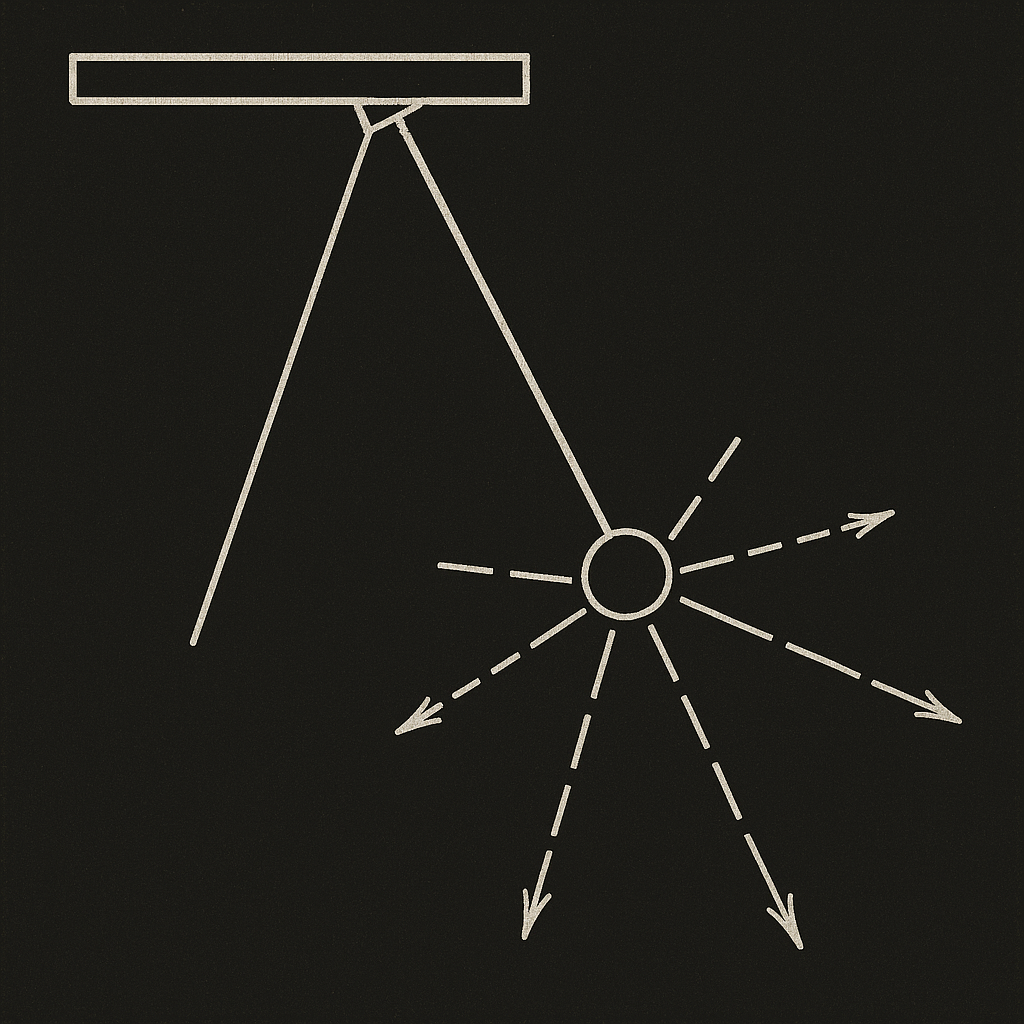
THE MACHINERY OF OSCILLATION
A Complete Guide to Rhythmic Return
How the Universe Pulses Rather Than Sits Still
What follows is not advice.
It is not a productivity system. Not a framework for finding your rhythm. Not a metaphor about balance.
It is mechanism.
The actual machinery of back and forth. The mathematics that governs why a pendulum swings, why your heart beats, why economies boom and crash, why populations of wolves and rabbits chase each other through time. The architecture that makes the universe pulse rather than settle.
Most people encounter oscillation as a metaphor. Ups and downs. Ebbs and flows. Cycles of life.
But oscillation is not metaphor. It is physics. It is the most common motion in the universe. And the reason it occurs is both simple and profound.
This document is that seeing.
Nothing more.
What you do with it is your business.
PART ONE: THE RESTORING FORCE
Why Things Swing Back
Everything begins with one principle.
Displace a system from equilibrium. A force arises that pushes it back.
That force is proportional to how far the system has been displaced. Twice the displacement, twice the force. Three times the displacement, three times the force.
This is Hooke’s Law. Published in 1678. The foundation of all oscillatory motion.
F = -kx
F is the restoring force. k is the stiffness of the system. x is the displacement. The negative sign means the force always opposes the displacement.
Pull the spring right. The force pushes left. Push it left. The force pushes right.
Always back toward center.
The Overshoot Problem
Here is where oscillation is born.
The restoring force accelerates the system back toward equilibrium. As it approaches center, the force weakens. At equilibrium, the force is zero.
But the system does not stop.
It arrives at equilibrium with velocity. Momentum carries it past center, overshooting into displacement on the other side. Now the restoring force activates again, pulling it back. It accelerates toward center, arrives with velocity, overshoots again.
Back and forth. Forever.
    THE BIRTH OF OSCILLATION

    Displacement
         │
         │  ┌──── Displaced right
    (+)  │  │     Force pushes left
         │  │         │
         │  │         ▼
    ─────┼──┴─────────────────────────── Equilibrium
         │            │
    (-)  │            │     Overshoots left
         │            └──── Force pushes right
         │
         └────────────────────────────────────► Time

    The system never rests at center.
    It always arrives with velocity.
    Velocity means overshoot.
    Overshoot means oscillation.
This is not a special case. It is the general case. Any system with a restoring force and inertia will oscillate. A mass on a spring. A pendulum in gravity. An electron in an electromagnetic field. A molecule vibrating in a crystal lattice.
The universe does not settle. It swings.
The Solution
The differential equation for simple harmonic motion is:
d²x/dt² = -(k/m)x
Its solution is always sinusoidal:
x(t) = A cos(ωt + φ)
Where A is the amplitude. ω is the angular frequency. φ is the phase.
The sine function is not chosen for convenience. It is the only function whose second derivative is proportional to its own negative. The mathematics has no other solution.
Oscillation does not merely happen to be sinusoidal. Sinusoidal motion is what displacement plus restoring force plus inertia produces. Necessarily. Universally.
PART TWO: THE THREE REGIMES OF DECAY
Nothing Oscillates Forever
Pure oscillation requires zero friction. Zero air resistance. Zero internal dissipation.
These conditions do not exist.
Every real oscillator loses energy. The question is how fast.
The rate of energy loss determines which of three regimes the system enters. These three regimes are separated by a single parameter: the damping ratio ζ. And the behavior in each regime is qualitatively different.
The Three Fates
    THE DAMPING REGIMES

    Displacement
         │
         │  UNDERDAMPED (ζ < 1)
         │  ╱╲    ╱╲
    (+)  │ ╱  ╲  ╱  ╲   ╱╲
         │╱    ╲╱    ╲ ╱  ╲──────
    ─────┼────────────────────────── Equilibrium
         │
         │
         │  CRITICALLY DAMPED (ζ = 1)
         │
    (+)  │╲
         │  ╲
         │    ╲───────────────────
    ─────┼────────────────────────── Equilibrium
         │
         │
         │  OVERDAMPED (ζ > 1)
         │
    (+)  │╲
         │  ╲
         │    ╲
         │      ╲─────────────────
    ─────┼────────────────────────── Equilibrium
         │
         └────────────────────────────────► Time
Underdamped. The system oscillates, but each swing is smaller. The envelope of the oscillation decays exponentially. A tuning fork. A child on a swing losing height. A plucked guitar string fading to silence.
Critically damped. The system returns to equilibrium as fast as possible without overshooting. No oscillation. Just the fastest possible collapse back to center. A door closer engineered to shut smoothly. A shock absorber calibrated precisely.
Overdamped. The system returns to equilibrium without oscillating, but slowly. The damping is so heavy that the system creeps back to center like it is moving through honey.
The boundary between oscillation and no oscillation is a knife edge. One parameter. Below it: rhythm. Above it: monotonic decay.
The Quality Factor
The quality factor Q measures how many oscillations a system completes before its energy decays significantly.
A tuning fork has Q around 1,000. It rings for thousands of cycles before falling silent.
A car suspension has Q around 0.5. It does not oscillate at all. By design.
A quartz crystal oscillator has Q above 10,000. It loses almost no energy per cycle. This is why clocks work.
    QUALITY FACTOR AND PERSISTENCE

    Energy
    Remaining
         │
    100% │████
         │████  Q = 10,000 (quartz crystal)
         │████████████████████████████████████████
         │
     50% │████
         │████  Q = 100 (tuning fork)
         │████████████████████████
         │
     10% │████
         │████  Q = 5 (pendulum in air)
         │████████████
         │
         └──────────────────────────────────────► Cycles
              10    100   1000   10000
High Q means the oscillator is selective. It rings at one frequency and rejects all others. Low Q means the oscillator responds broadly but dies fast.
This tradeoff is fundamental. Selectivity and persistence are the same thing. A system that resonates sharply also resonates long.
PART THREE: THE SELF-SUSTAINING OSCILLATOR
Limit Cycles
Simple harmonic motion is conservative. It preserves energy. Add damping and it dies.
But some systems do not die.
They oscillate indefinitely. Not because they lack friction, but because they actively pump energy into the oscillation from an external source.
The heartbeat. The ticking of a clock. The firing of a neuron. The flashing of a firefly.
These are limit cycle oscillators.
Van der Pol’s Discovery
In 1927, Balthasar van der Pol found stable oscillations in vacuum tube circuits at Philips. The circuit did something unexpected. It settled into a fixed rhythm regardless of where it started.
Push it far from equilibrium. It spirals inward to the cycle. Start it near rest. It spirals outward to the same cycle.
    THE LIMIT CYCLE ATTRACTOR

    ┌───────────────────────────────────────────┐
    │                                           │
    │         ╱──── ───╲                        │
    │        ╱   LIMIT   ╲                      │
    │       │    CYCLE     │  ◄── All initial   │
    │       │   (stable    │      conditions    │
    │        ╲   orbit)   ╱       converge      │
    │         ╲────────╱          here          │
    │              ▲                            │
    │              │                            │
    │    Start far away:                        │
    │    spiral inward to cycle                 │
    │                                           │
    │    Start near center:                     │
    │    spiral outward to cycle                │
    │                                           │
    └───────────────────────────────────────────┘
The limit cycle is an attractor. It pulls the system toward a specific amplitude and frequency regardless of initial conditions. Perturb the system. It returns to the cycle.
This is fundamentally different from simple harmonic motion, where the amplitude depends on how hard the system was pushed initially.
The limit cycle chooses its own amplitude.
The Mechanism
The Van der Pol oscillator has nonlinear damping. When the amplitude is small, the damping is negative. Energy flows into the system. The oscillation grows.
When the amplitude is large, the damping is positive. Energy flows out. The oscillation shrinks.
There exists exactly one amplitude where energy input equals energy output. The system locks onto it.
    ENERGY BALANCE IN LIMIT CYCLES

    Energy
    Flow
         │
         │       Energy IN
    (+)  │       (negative damping)
         │       ████████████
         │       ████████████
    ─────┼───────────────────────────── Balance point
         │                   ████████
         │                   ████████
    (-)  │                   Energy OUT
         │                   (positive damping)
         │
         └──────────────────────────────────► Amplitude
              Small              Large

    The system settles where input = output.
    This is the limit cycle amplitude.
The heart operates on this principle. It is not merely responding to a stimulus. It is a self-sustaining oscillator. The sinoatrial node generates its own rhythm. Perturb it. It returns. Damage it partially. It compensates. The oscillation is structurally stable.
PART FOUR: COUPLING AND SYNCHRONIZATION
The Kuramoto Threshold
Oscillators rarely exist alone. They exist in populations. And when oscillators interact, something remarkable happens.
Yoshiki Kuramoto formalized it in 1975.
Take N oscillators. Each has its own natural frequency. Couple them weakly. At first, nothing coherent happens. Each oscillator runs on its own clock, and the population is incoherent.
Increase the coupling strength.
At a critical threshold, a sudden transition occurs. A fraction of the oscillators snap into phase alignment. They begin to oscillate together. As coupling increases further, more oscillators join. Eventually, the entire population synchronizes.
    THE SYNCHRONIZATION TRANSITION

    Order
    Parameter
    (coherence)
         │
    1.0  │                          ██████████████
         │                       ███
         │                     ██
         │                   ██
    0.5  │                  █
         │                 █
         │                █
         │               █
    0.0  │████████████████
         │
         └──────────────────────────────────────►
                         Kc
                    Coupling Strength

         Kc = critical coupling threshold
         Below Kc: incoherence
         Above Kc: spontaneous synchronization
This is a phase transition. Below the threshold, the system is disordered. Above it, order emerges spontaneously. The transition is sharp. Not gradual.
Where Synchronization Happens
Fireflies in Southeast Asian mangroves flash in unison. Thousands of insects, each with its own internal clock, locking phase until entire riverbanks pulse with light.
Neurons in the brain synchronize into gamma oscillations (30-100 Hz) during attention and working memory. The binding of percepts into coherent experience requires phase-locked neural populations.
Cardiac pacemaker cells in the sinoatrial node synchronize their individual oscillations to produce a single coordinated heartbeat.
Pendulum clocks mounted on the same wall synchronize through vibrations transmitted through the wood. Christiaan Huygens noticed this in 1665.
Power grid generators must maintain synchrony at 50 or 60 Hz across entire continents. Desynchronization causes blackouts.
The mathematics is the same in every case. Coupled oscillators. A critical threshold. Spontaneous order.
Chimera States
In 2002, Kuramoto and Battogtokh discovered something that should not exist.
A population of identical oscillators, identically coupled, splitting into two groups. One synchronized. One desynchronized. Coexisting stably.
Order and disorder, side by side, in a perfectly symmetric system.
These are chimera states. Named after the mythological creature composed of incompatible parts.
    CHIMERA STATE

    ┌─────────────────────┐  ┌─────────────────────┐
    │                     │  │                     │
    │    SYNCHRONIZED     │  │   DESYNCHRONIZED    │
    │                     │  │                     │
    │  Phase: locked      │  │  Phase: drifting    │
    │  Frequency: same    │  │  Frequency: varied  │
    │  Order: high        │  │  Order: low         │
    │                     │  │                     │
    │  ● ● ● ● ● ● ● ●  │  │  ● ●  ●  ● ●  ●   │
    │  (all aligned)      │  │  (all scattered)    │
    │                     │  │                     │
    └─────────────────────┘  └─────────────────────┘

    Same system. Same coupling. Same oscillators.
    Symmetry breaks spontaneously.
This discovery shattered the assumption that symmetry in the rules guarantees symmetry in the outcome. A uniform population under uniform coupling can spontaneously generate non-uniform behavior.
The system chooses to break its own symmetry.
PART FIVE: OSCILLATION FAR FROM EQUILIBRIUM
Prigogine’s Insight
Classical thermodynamics says equilibrium is the destination. Entropy increases. Order dissolves. The system settles.
Ilya Prigogine saw something different.
Systems far from equilibrium do not merely degrade. They can spontaneously generate structure. Pattern. Oscillation.
The key is energy flow. A system that receives energy from outside and dissipates it can maintain organized behavior that would be impossible at equilibrium.
These are dissipative structures. Order sustained by throughput.
The Belousov-Zhabotinsky Reaction
In 1951, Boris Belousov mixed citric acid with bromate in the presence of a cerium catalyst and watched the solution oscillate between yellow and clear. Back and forth. Repeatedly.
No one believed him. Chemical reactions were supposed to proceed monotonically toward equilibrium. Oscillation violated the prevailing understanding.
It took a decade before Anatol Zhabotinsky confirmed the phenomenon and mapped the mechanism. The reaction involves competing autocatalytic pathways. One pathway dominates until it depletes a shared resource. Then the other pathway takes over. It dominates until it depletes its resource. Then the first returns.
    CHEMICAL OSCILLATION MECHANISM

    ┌──────────────────────────────────────────────┐
    │                                              │
    │  PATHWAY A dominates                         │
    │  Produces product X                          │
    │  Consumes resource R                         │
    │           │                                  │
    │           ▼                                  │
    │  Resource R depleted                         │
    │           │                                  │
    │           ▼                                  │
    │  PATHWAY B takes over                        │
    │  Produces product Y                          │
    │  Regenerates resource R                      │
    │  Consumes resource S                         │
    │           │                                  │
    │           ▼                                  │
    │  Resource S depleted                         │
    │           │                                  │
    │           ▼                                  │
    │  PATHWAY A takes over again                  │
    │           │                                  │
    │           ▼                                  │
    │  [CYCLE REPEATS]                             │
    │                                              │
    └──────────────────────────────────────────────┘
When the reaction occurs in a thin layer rather than a well-stirred vessel, it produces spatial patterns. Concentric rings. Spirals. Traveling waves of chemical concentration propagating across the dish.
Pattern and rhythm, emerging from nothing but chemistry and energy flow.
This is not metaphor for life. It is the physics underneath life. Biological oscillation runs on the same principle. Competing pathways. Shared resources. Delayed feedback. Sustained by energy throughput.
PART SIX: THE PREDATOR AND THE PREY
Lotka-Volterra Dynamics
In the 1920s, Alfred Lotka and Vito Volterra independently arrived at the same equations. Two populations coupled through predation produce perpetual oscillation.
The logic is circular. And the circularity is the engine.
Abundant prey feeds predator growth. Growing predators consume prey faster. Prey declines. Predators, now starving, decline too. With fewer predators, prey recovers. With more prey, predators recover. The cycle repeats.
Neither population reaches equilibrium. Both oscillate. The predator peak lags behind the prey peak. Always chasing. Never catching.
    PREDATOR-PREY OSCILLATION

    Population
         │
         │     ╱╲         ╱╲         ╱╲
         │    ╱  ╲       ╱  ╲       ╱  ╲       Prey
         │   ╱    ╲     ╱    ╲     ╱    ╲
         │  ╱      ╲   ╱      ╲   ╱      ╲
         │ ╱        ╲ ╱        ╲ ╱        ╲
         │╱          ╳          ╳          ╲
         │       ╱  ╱ ╲╲   ╱  ╱ ╲╲
         │      ╱  ╱    ╲╲╱  ╱    ╲╲      Predator
         │     ╱──╱      ╲──╱      ╲╲
         │
         └──────────────────────────────────► Time

    The predator peak always lags the prey peak.
    Cause chases effect through time.
The lynx and the snowshoe hare in the Canadian boreal forest. Hudson’s Bay Company fur trading records from the 1840s through the 1930s show this oscillation clearly. A roughly 10-year cycle. Hare numbers peak. Lynx numbers peak one to two years later. Hare numbers crash. Lynx numbers crash. The pattern repeats across nearly a century of data.
The oscillation is not the failure of the system to find balance. The oscillation IS the balance. Two populations locked in a dance where neither leads and neither follows, because each is simultaneously cause and effect of the other.
PART SEVEN: FOURIER’S DECOMPOSITION
Every Signal Is Oscillation
In 1822, Joseph Fourier published a claim that seemed absurd.
Any function can be decomposed into a sum of sine waves.
Any function. A square wave. A sawtooth. A heartbeat. A stock price. A photograph. The temperature of the ocean. The vibration of a bridge. Human speech.
All of it. Sine waves added together.
    FOURIER DECOMPOSITION

    ┌──────────────────────────────────────────────┐
    │                                              │
    │  COMPLEX SIGNAL                              │
    │  (any shape)                                 │
    │         ╱╲  ╱╲╱╲                             │
    │  ──────╱  ╲╱    ╲──────                      │
    │                                              │
    └──────────────────────────────────────────────┘
                        │
                        │ decompose
                        ▼
    ┌──────────────────────────────────────────────┐
    │                                              │
    │  = Sine wave at frequency f₁                 │
    │    ~~~~~~~~~~~~~~~~~~~~                      │
    │                                              │
    │  + Sine wave at frequency f₂                 │
    │    ~~~~~~~~~~~~~~~~~~~~~~~~~~~~              │
    │                                              │
    │  + Sine wave at frequency f₃                 │
    │    ~~~~~~~~~~~~~~~~~~~~~~~~~~~~~~~~~~~~~~~~  │
    │                                              │
    │  + ...                                       │
    │                                              │
    └──────────────────────────────────────────────┘
This is not a mathematical trick. It is a statement about the structure of reality.
Oscillation is the basis set of the universe. The way physicists decompose forces into x, y, and z components, Fourier showed that any signal decomposes into oscillatory components at different frequencies.
The implications are total.
Sound is superposition of oscillations at different frequencies. That is what timbre is. A violin and a trumpet playing the same note differ only in which frequencies are present and at what amplitudes.
Light is the same. Color is frequency. White light is the superposition of all visible frequencies.
Quantum mechanics goes further. Every particle is described by a wave function. The universe at its most fundamental level is oscillation.
Time Domain and Frequency Domain
The same information exists in two representations.
The time domain shows what happens when. The frequency domain shows what oscillations are present and how strong they are.
    TWO VIEWS OF THE SAME REALITY

    TIME DOMAIN                 FREQUENCY DOMAIN

    Amplitude                   Amplitude
         │                           │
         │  ╱╲╱╲  ╱╲╱╲              │  ██
         │ ╱    ╲╱    ╲             │  ██  ██
         │╱            ╲            │  ██  ██
    ─────┼──────────────────   ─────┼──────────────
         │                          │  ██  ██  ██
         │                          │
         └──────────► Time          └──────────► Frequency
                                       f₁  f₂  f₃

    Same information. Different encoding.
    Neither is more "real" than the other.
This duality is not limited to signals. It appears across physics.
Position and momentum. Time and energy. The Heisenberg uncertainty principle is a direct consequence of the Fourier relationship between conjugate variables. The more precisely a signal is localized in time, the more spread out it must be in frequency. The more precisely it is localized in frequency, the more spread out it must be in time.
Oscillation is not one phenomenon among many. It is the coordinate system in which the universe is most naturally expressed.
PART EIGHT: THE OSCILLATING ECONOMY
Kondratiev Waves
In 1926, Nikolai Kondratiev published his analysis of capitalist economies. He found long waves. Roughly 40 to 60 years from peak to peak. Boom to bust to boom.
Each wave is driven by a cluster of technological innovations. The steam engine. The railroad. Electricity. The automobile. The microprocessor.
The pattern follows a recognizable sequence.
    THE KONDRATIEV WAVE

    Economic
    Output
         │
         │         SUMMER            AUTUMN
         │        (overheating)     (stagnation)
         │            ╱╲
         │           ╱  ╲
         │   SPRING ╱    ╲
         │  (growth)      ╲
         │  ╱              ╲  WINTER
         │ ╱                ╲ (contraction)
         │╱                  ╲
    ─────┼────────────────────╲────────────────
         │                     ╲        ╱
         │                      ╲      ╱
         │                       ╲────╱
         │
         └──────────────────────────────────► Time
              ~40-60 years per cycle
Spring. New technology emerges. Early adopters gain advantage. Capital flows toward innovation. Growth accelerates.
Summer. Technology matures. Overinvestment begins. Speculation inflates asset prices. The system overheats.
Autumn. Growth slows. The gap between financial value and real value widens. Instability builds.
Winter. Contraction. The old paradigm exhausts itself. Capital is destroyed. The system resets. Conditions for the next innovation cluster emerge from the wreckage.
Kondratiev was executed by the Soviet state in 1938. His crime was demonstrating that capitalism renews itself rather than collapsing.
The Mechanism Is the Same
Economic oscillation follows the same structural logic as mechanical oscillation.
A displacing force. Investment exceeding sustainable return. Innovation disrupting existing equilibria.
A restoring force. Debt becoming unsustainable. Overcapacity depressing returns. Competition eroding margins.
Inertia. Momentum of capital flows. Institutional commitment to existing trajectories. The time it takes to build and to stop building.
Overshoot. The economy does not return gently to equilibrium. It overshoots into contraction, just as the pendulum overshoots into the opposite displacement.
Displacement. Restoring force. Inertia. Overshoot.
The pendulum. The economy. The population cycle. The chemical reaction.
Same architecture. Different substrates.
PART NINE: BIOLOGICAL CLOCKS
The Circadian Architecture
Every cell in every organism that has been studied contains an oscillator.
The master clock sits in the suprachiasmatic nucleus (SCN) of the hypothalamus. Roughly 20,000 neurons, each running its own molecular oscillation. These individual oscillators synchronize through coupling, producing a coherent circadian signal.
The mechanism is a negative feedback loop with time delay.
Genes CLOCK and BMAL1 activate transcription of genes Period (Per) and Cryptochrome (Cry). The PER and CRY proteins accumulate. When they reach sufficient concentration, they inhibit CLOCK/BMAL1. Their own production stops. The proteins degrade. Inhibition lifts. CLOCK/BMAL1 activate again.
One cycle takes approximately 24 hours.
    THE MOLECULAR CLOCK

    ┌──────────────────────────────────────────────┐
    │                                              │
    │  CLOCK/BMAL1 genes                           │
    │       │                                      │
    │       │  activate                            │
    │       ▼                                      │
    │  PER/CRY genes transcribed                   │
    │       │                                      │
    │       │  proteins accumulate                  │
    │       │  (hours of delay)                    │
    │       ▼                                      │
    │  PER/CRY proteins reach threshold            │
    │       │                                      │
    │       │  inhibit                             │
    │       ▼                                      │
    │  CLOCK/BMAL1 suppressed                      │
    │       │                                      │
    │       │  PER/CRY proteins degrade            │
    │       │  (hours of delay)                    │
    │       ▼                                      │
    │  Inhibition lifts                            │
    │       │                                      │
    │       └──────────► CLOCK/BMAL1 activate      │
    │                    again [CYCLE REPEATS]      │
    │                                              │
    └──────────────────────────────────────────────┘

    Total cycle time: ~24 hours
    Precision: within minutes per day
The SCN master clock entrains peripheral clocks throughout the body. Liver, kidney, heart, muscle, fat. Each tissue has its own oscillator, synchronized to the master through hormonal and neural signals.
The body is not a single clock. It is a population of coupled oscillators. Like fireflies. Like the Kuramoto model. The master clock provides the coupling that keeps them coherent.
When you cross time zones, the master clock resets within a day or two. But the peripheral clocks take longer. Liver, gut, and muscle clocks can take four to seven days to resynchronize. Jet lag is not one clock being wrong. It is many clocks being wrong by different amounts. Internal desynchrony.
Neural Oscillations
The brain oscillates at multiple frequencies simultaneously.
| Band | Frequency | Associated With |
|---|---|---|
| Delta | 0.5-4 Hz | Deep sleep, unconscious processing |
| Theta | 4-8 Hz | Memory encoding, navigation |
| Alpha | 8-13 Hz | Relaxed wakefulness, inhibition |
| Beta | 13-30 Hz | Active thinking, motor control |
| Gamma | 30-100 Hz | Attention, binding, working memory |
These are not separate systems. They nest. Gamma oscillations ride on top of theta oscillations. The phase of the slower oscillation modulates the amplitude of the faster one. This is cross-frequency coupling. Information is encoded not just in which frequencies are present, but in how they relate to each other temporally.
    NESTED OSCILLATIONS

    Theta (slow):
    ╱╲        ╱╲        ╱╲        ╱╲
   ╱  ╲      ╱  ╲      ╱  ╲      ╱  ╲
  ╱    ╲    ╱    ╲    ╱    ╲    ╱    ╲
 ╱      ╲  ╱      ╲  ╱      ╲  ╱      ╲
╱        ╲╱        ╲╱        ╲╱        ╲

    Gamma bursts (fast) nested in theta peaks:
    ╱╲        ╱╲        ╱╲        ╱╲
   ╱~~╲      ╱~~╲      ╱~~╲      ╱~~╲
  ╱~~~~╲    ╱~~~~╲    ╱~~~~╲    ╱~~~~╲
 ╱      ╲  ╱      ╲  ╱      ╲  ╱      ╲
╱        ╲╱        ╲╱        ╲╱        ╲

    ~~ = gamma oscillation burst

    The slow wave provides windows.
    The fast wave carries content within those windows.
Consciousness may require specific patterns of oscillatory coupling across brain regions. Anesthesia disrupts these patterns. Sleep reorganizes them. Seizures are pathological synchronization, where too many neurons oscillate in lockstep.
The brain is an orchestra of oscillators. Health is coordination. Disease is desynchronization. Or hypersynchronization. Both are failure modes.
PART TEN: THE CONSTRAINTS
Why Oscillation Exists
Oscillation requires three things. Exactly three.
A restoring force. Something that pushes the system back when displaced.
Inertia. Something that causes the system to overshoot equilibrium rather than stopping at it.
A timescale mismatch. The restoring force and the inertia operate on different timescales, creating lag. Without lag, the system would settle instantly. With lag, it overshoots.
Remove any one, and oscillation ceases.
    THE THREE REQUIREMENTS

    ┌──────────────────┐
    │                  │
    │  RESTORING       │
    │  FORCE           │
    │                  │
    │  Pushes back     │
    │  toward center   │
    │                  │
    └────────┬─────────┘
             │
             ▼
    ┌──────────────────┐
    │                  │
    │  INERTIA         │
    │                  │
    │  Carries past    │
    │  center          │
    │                  │
    └────────┬─────────┘
             │
             ▼
    ┌──────────────────┐
    │                  │
    │  TIMESCALE       │
    │  MISMATCH        │
    │                  │
    │  Delay between   │
    │  force and       │
    │  response        │
    │                  │
    └──────────────────┘

    All three present: oscillation.
    Any one absent: monotonic behavior.
The Energy Budget
Sustained oscillation requires sustained energy flow. A conservative oscillator can run on its initial energy, but friction is universal. Real oscillators dissipate.
To persist, an oscillator must either:
Receive energy from outside (driven oscillation). Or pump energy from a reservoir through nonlinear dynamics (self-sustained oscillation, limit cycles).
The biological clock is fueled by ATP from metabolism. The heartbeat is fueled by ion gradients maintained by metabolic pumps. Predator-prey cycles are fueled by solar energy entering through photosynthesis. Economic cycles are fueled by human labor and natural resource extraction.
Every oscillation has an energy source. Cut the source and the oscillation dies. The rhythm is not free. It is paid for.
The Stability Spectrum
Not all oscillations are equally robust.
    STABILITY OF OSCILLATORY SYSTEMS

    Fragile                                     Robust
    ◄─────────────────────────────────────────────►

    Simple              Driven              Limit
    harmonic            oscillation         cycle
    motion

    Amplitude           Amplitude           Amplitude
    set by initial      set by              set by
    conditions          driving force       system itself

    Any perturbation    Perturbation        Perturbation
    changes amplitude   temporarily         corrected
    permanently         disrupts            automatically

    No energy           Energy from         Energy from
    input or            external            internal
    dissipation         periodic force      nonlinear
                                            feedback
The limit cycle is the most robust form of oscillation. It actively corrects perturbations. Push it off the cycle, it returns. This is why biological oscillators are almost always limit cycles. A heartbeat that changed amplitude permanently after every bump would kill the organism.
PART ELEVEN: THE COMPLETE PICTURE
The Unified Architecture
Everything connects.
    THE COMPLETE OSCILLATION FRAMEWORK

    ┌─────────────────────────────────────────────────────────┐
    │                                                         │
    │                  THE PRINCIPLE                           │
    │                                                         │
    │    Displacement + restoring force + inertia =           │
    │    periodic return. The universe oscillates because     │
    │    equilibrium is approached with momentum.             │
    │                                                         │
    └─────────────────────────────────────────────────────────┘
                              │
              ┌───────────────┼───────────────┐
              │               │               │
              ▼               ▼               ▼
    ┌─────────────────┐ ┌─────────────┐ ┌─────────────────┐
    │                 │ │             │ │                 │
    │   CONSERVATIVE  │ │   DRIVEN    │ │  SELF-SUSTAINED │
    │                 │ │             │ │                 │
    │  No energy      │ │  External   │ │  Internal       │
    │  input or loss  │ │  periodic   │ │  nonlinear      │
    │                 │ │  forcing    │ │  energy pump    │
    │  Idealization.  │ │             │ │                 │
    │  Never real.    │ │  Resonance  │ │  Limit cycles.  │
    │                 │ │  possible.  │ │  Biology.       │
    │                 │ │             │ │  Hearts.        │
    │                 │ │             │ │  Clocks.        │
    └─────────────────┘ └─────────────┘ └─────────────────┘
              │               │               │
              └───────────────┼───────────────┘
                              │
                              ▼
    ┌─────────────────────────────────────────────────────────┐
    │                                                         │
    │                  WHEN COUPLED                            │
    │                                                         │
    │    Individual oscillators form populations.              │
    │    Above a critical coupling strength,                   │
    │    synchronization emerges spontaneously.                │
    │    The transition is sharp. A phase transition           │
    │    from disorder to order.                               │
    │                                                         │
    └─────────────────────────────────────────────────────────┘
A pendulum in a clock. A molecule in a crystal. A neuron in a brain. A firefly in a swarm. A stock in a market. A predator chasing prey. A gene turning itself on and off.
Same mathematics. Same architecture. Same three ingredients.
Displacement. Restoring force. Inertia.
Why the Universe Oscillates
The deepest question is why oscillation is so pervasive.
The answer is structural. Stable equilibria exist throughout nature. Any small displacement from a stable equilibrium generates a restoring force. And any system with mass, capacitance, inductance, or any other form of inertia will overshoot.
The conditions for oscillation are the conditions for stability itself. Anywhere a system is stable, it is potentially oscillatory. The universe does not oscillate despite being stable. It oscillates because it is stable.
Fourier showed that oscillation is the natural basis for decomposing signals. Quantum mechanics showed that matter itself is wave-like at the fundamental level. The vacuum of empty space oscillates with zero-point energy. Even the cosmic microwave background is a snapshot of oscillations frozen in place 13.8 billion years ago.
The pendulum swings because it must.
Not by choice. Not by design. Not by metaphor.
By mathematics. By the structure of displacement and return. By the fact that arriving at equilibrium with velocity means passing through it rather than stopping at it.
Oscillation is not something the universe does.
Oscillation is something the universe is.
Final Synthesis
Oscillation is displacement meeting restoring force meeting inertia.
This is not metaphor. It is mathematics.
    THE OPERATING MAP

    ════════════════════════════════════════════════════════════

    SUBSTRATE            RESTORING FORCE       INERTIA

    Mass on spring       Spring tension        Mass
    Pendulum             Gravity               Mass
    LC circuit           Capacitor voltage     Inductor current
    Predator-prey        Starvation            Population lag
    Economy              Debt/overcapacity     Capital momentum
    Gene network         Protein inhibition    Transcription delay
    Chemical reaction    Resource depletion    Reaction kinetics
    Neural circuit       Inhibitory feedback   Synaptic delay
    Climate              Albedo feedback       Ocean thermal mass

    ════════════════════════════════════════════════════════════

    Same equation. Different variables.
    The oscillation does not care what it is made of.
The spring does not know it is a spring. The economy does not know it is an economy. The gene does not know it is a gene.
The oscillation happens because the structure demands it. Three ingredients present, rhythm follows. Three ingredients absent, stillness follows.
Understanding this changes nothing about the oscillation. The pendulum does not swing differently because it is observed.
But seeing the architecture beneath the rhythm reveals something. The boom is not triumph. The bust is not failure. The peak is not victory. The trough is not defeat.
They are phases. Of a motion that has no preference for any phase over any other.
The system swings because it must.
That is all there is.
CITATIONS
Classical Mechanics and Oscillation Theory
Harmonic Oscillator Foundations
MIT OpenCourseWare. “Physics III: Vibrations and Waves, Chapter 1: Harmonic Oscillation.” MIT. https://ocw.mit.edu/courses/8-03sc-physics-iii-vibrations-and-waves-fall-2016/
Morin, D. “Oscillations.” Chapter 1, Waves and Oscillations. Harvard University. https://davidmorin.physics.fas.harvard.edu/resource/waves-oscillations
Damping and Quality Factor
“Q factor.” Wikipedia. https://en.wikipedia.org/wiki/Q_factor
MIT OpenCourseWare. “RES.8-009: Introduction to Oscillations and Waves, Lecture 4: Damped Oscillations.” MIT, Summer 2017. https://ocw.mit.edu/courses/res-8-009-introduction-to-oscillations-and-waves-summer-2017/
Nonlinear Oscillators and Limit Cycles
Van der Pol Oscillator
Van der Pol, B. (1927). “Forced Oscillations in a Circuit with Nonlinear Resistance.” Philosophical Magazine, 3:65-80.
“Van der Pol oscillator.” Wikipedia. https://en.wikipedia.org/wiki/Van_der_Pol_oscillator
“Limit Cycles.” Physics LibreTexts. https://phys.libretexts.org/Bookshelves/Classical_Mechanics/Variational_Principles_in_Classical_Mechanics_(Cline)/04:_Nonlinear_Systems_and_Chaos/4.04:_Limit_Cycles
Synchronization and Coupled Oscillators
Kuramoto Model
Kuramoto, Y. (1975). “Self-entrainment of a population of coupled non-linear oscillators.” International Symposium on Mathematical Problems in Theoretical Physics.
“Kuramoto model.” Wikipedia. https://en.wikipedia.org/wiki/Kuramoto_model
Rodrigues, F.A., et al. (2016). “The Kuramoto model in complex networks.” Physics Reports, 610:1-98. https://arxiv.org/abs/1511.07139
Chimera States
Kuramoto, Y. & Battogtokh, D. (2002). “Coexistence of coherence and incoherence in nonlocally coupled phase oscillators.” Nonlinear Phenomena in Complex Systems, 5(4):380-385.
Synchronization in Power Grids
Dorfler, F. & Bullo, F. (2013). “Synchronization in complex oscillator networks and smart grids.” Proceedings of the National Academy of Sciences, 110(6):2005-2010. https://pmc.ncbi.nlm.nih.gov/articles/PMC3568350/
Dissipative Structures and Chemical Oscillations
Belousov-Zhabotinsky Reaction
“Belousov-Zhabotinsky reaction.” Wikipedia. https://en.wikipedia.org/wiki/Belousov%E2%80%93Zhabotinsky_reaction
Marchetti, C., et al. (2021). “Belousov-Zhabotinsky type reactions: the non-linear behavior of chemical systems.” Journal of Mathematical Chemistry. https://link.springer.com/article/10.1007/s10910-021-01223-9
Prigogine’s Dissipative Structures
Prigogine, I. & Stengers, I. (1984). Order Out of Chaos: Man’s New Dialogue with Nature. Bantam Books.
“Prigogine’s Dissipative Structures.” Modern Physics. https://modern-physics.org/prigogines-dissipative-structures/
Biological Oscillations
Circadian Rhythms
Mohawk, J.A., et al. (2012). “Central and Peripheral Circadian Clocks in Mammals.” Annual Review of Neuroscience, 35:445-462. https://pmc.ncbi.nlm.nih.gov/articles/PMC2735866/
Colwell, C.S. (2011). “Linking neural activity and molecular oscillations in the SCN.” Nature Reviews Neuroscience, 12:553-569. https://pmc.ncbi.nlm.nih.gov/articles/PMC4660252/
“Molecular regulations of circadian rhythm and implications for physiology and diseases.” Signal Transduction and Targeted Therapy (2022). https://www.nature.com/articles/s41392-022-00899-y
Neural Oscillations
Buzsaki, G. (2006). Rhythms of the Brain. Oxford University Press.
Canolty, R.T. & Knight, R.T. (2010). “The functional role of cross-frequency coupling.” Trends in Cognitive Sciences, 14(11):506-515.
Population Dynamics
Lotka-Volterra
Lotka, A.J. (1925). Elements of Physical Biology. Williams & Wilkins.
Volterra, V. (1926). “Fluctuations in the abundance of a species considered mathematically.” Nature, 118:558-560.
“Lotka-Volterra equations.” Wikipedia. https://en.wikipedia.org/wiki/Lotka%E2%80%93Volterra_equations
Economic Oscillation
Kondratiev Waves
Kondratiev, N.D. (1926). “The Long Waves in Economic Life.” Review of Economic Statistics (English translation, 1935).
“Kondratiev wave.” Wikipedia. https://en.wikipedia.org/wiki/Kondratiev_wave
“Long-Wave Economic Cycles: The Contributions of Kondratieff, Kuznets, Schumpeter, Kalecki, Goodwin, Kaldor, and Minsky.” Social Studies (2020). https://www.sociostudies.org/almanac/articles/long-wave_economic/
Fourier Analysis
Signal Decomposition
Fourier, J.B.J. (1822). Theorie analytique de la chaleur. Firmin Didot.
“Fourier analysis.” Wikipedia. https://en.wikipedia.org/wiki/Fourier_analysis
Kulkarni, S. “Chapter 4: Frequency Domain and Fourier Transforms.” Princeton University. https://www.princeton.edu/~cuff/ele201/kulkarni_text/frequency.pdf
Document compiled from comprehensive research across physics, mathematics, dynamical systems theory, biology, and economics.