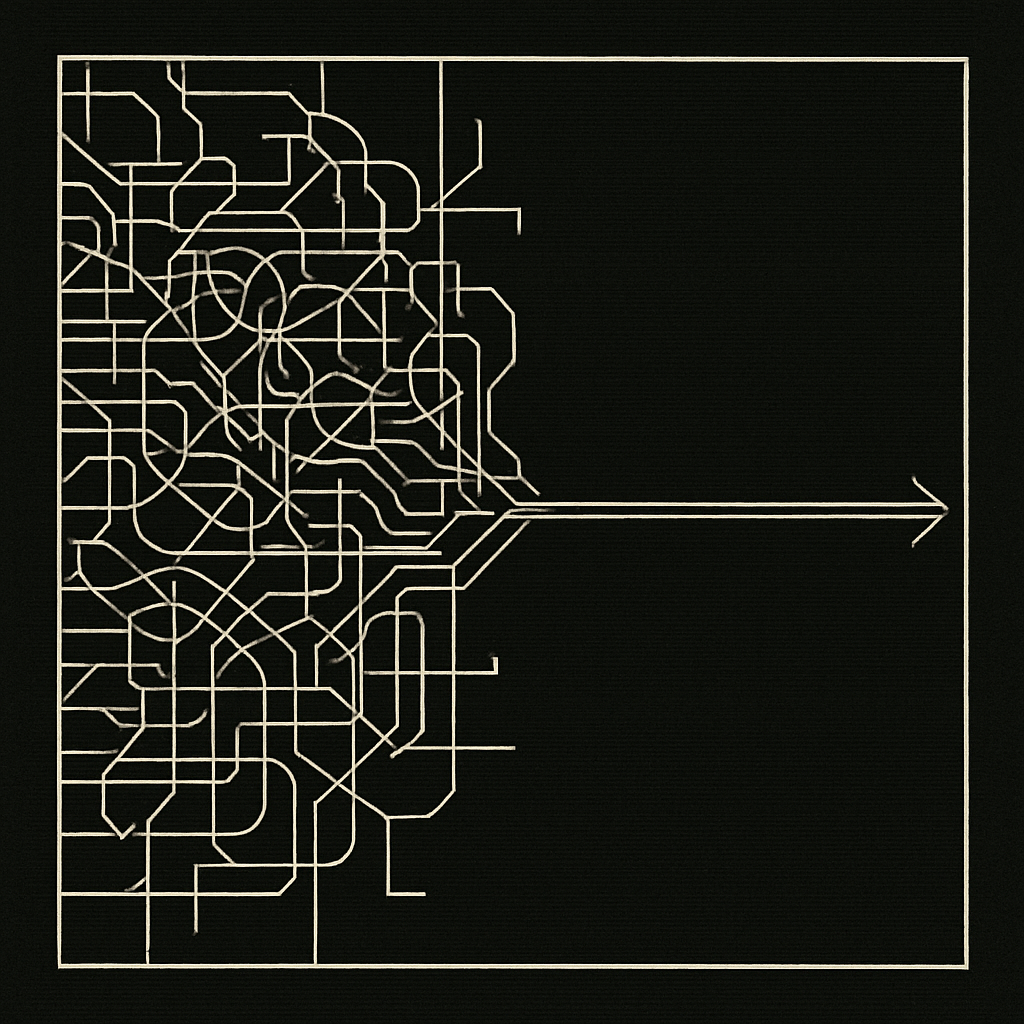
THE MACHINERY OF SIGNAL AND NOISE
A Complete Guide to the Separation Problem
How the Universe Distinguishes What Matters from What Doesn’t
What follows is not advice.
It is not a data science tutorial. Not a lesson in statistics. Not a framework for “cutting through the noise” or “finding clarity.”
It is mechanism.
The actual machinery underneath every act of measurement, communication, perception, and inference. The fundamental problem that every system in the universe must solve. From a radio telescope listening for pulsars to a single neuron deciding whether to fire. From a cell reading its own genome to a financial market pricing an asset.
Every system that processes information faces the same problem.
Something in the data matters. Something does not. Telling them apart is the hardest problem in the universe.
Most people think of signal and noise as obvious categories. Signal is the thing you want. Noise is the garbage. Separate them and you’re done.
This misunderstanding runs deep. The boundary between signal and noise is not given. It is constructed. And the mathematics of that construction reveals the deepest limits of what can be known.
This document is that seeing.
Nothing more.
What you do with it is your business.
PART ONE: THE SEPARATION PROBLEM
Nothing Is Intrinsically Signal
Here is the thing that disturbs people when they understand it.
There is no such thing as signal without an observer. No such thing as noise without a question.
The same data stream is signal to one system and noise to another. The radio frequency that carries your phone call is interference to an astronomer. The thermal vibration that scrambles an electrical measurement is the measurement itself to a thermometer. The background mutation rate that corrupts genomic replication is the raw material of evolution.
Signal is data that resolves a specific question. Noise is everything else.
This is not a philosophical subtlety. It is the foundational axiom of information theory, signal processing, and statistical inference. And it means that the separation problem is not about the data. It is about the relationship between the data and the question.
The Formal Definition
Claude Shannon made this precise in 1948.
A communication channel has a source, a channel, and a receiver. The source generates a message. The channel corrupts it. The receiver must recover what was sent.
    THE COMMUNICATION CHANNEL

    ┌──────────────┐          ┌──────────────┐          ┌──────────────┐
    │              │          │              │          │              │
    │    SOURCE    │────────► │   CHANNEL    │────────► │   RECEIVER   │
    │              │          │              │          │              │
    │  Generates   │          │  Corrupts    │          │  Must        │
    │  message     │          │  with noise  │          │  recover     │
    │              │          │              │          │  message     │
    └──────────────┘          └──────────────┘          └──────────────┘
                                     ▲
                                     │
                              ┌──────────────┐
                              │              │
                              │    NOISE     │
                              │              │
                              │  Random      │
                              │  corruption  │
                              │              │
                              └──────────────┘
The message is signal. The corruption is noise. The receiver’s job is separation.
But Shannon’s genius was not just naming this structure. It was proving that the separation has a hard ceiling. A limit beyond which no cleverness, no algorithm, no technology can push.
That limit depends on exactly one ratio.
The ratio of signal power to noise power.
The Ratio
Signal-to-noise ratio. SNR. The most important number in the universe.
It is not a metaphor when people use this phrase. It is a direct reference to a physical quantity that governs every measurement, every communication, every inference.
    THE SIGNAL-TO-NOISE RATIO

                Signal Power
    SNR  =  ─────────────────
                Noise Power

    In decibels:

    SNR(dB)  =  10 × log₁₀(Signal Power / Noise Power)


    ┌──────────────────────────────────────────────────────────┐
    │                                                          │
    │    SNR = 0 dB       Signal and noise equally strong      │
    │                     Cannot distinguish them               │
    │                                                          │
    │    SNR = 10 dB      Signal 10× stronger                  │
    │                     Clear detection possible              │
    │                                                          │
    │    SNR = 20 dB      Signal 100× stronger                 │
    │                     High-fidelity recovery                │
    │                                                          │
    │    SNR = -10 dB     Noise 10× stronger                   │
    │                     Signal buried. Still recoverable      │
    │                     with the right mathematics            │
    │                                                          │
    └──────────────────────────────────────────────────────────┘
That last line is the one that matters.
A signal weaker than the noise surrounding it can still be recovered. Not always. Not perfectly. But under specific conditions, with specific techniques, signals buried far below the noise floor can be extracted.
This is not magic. It is the mathematics of structure versus randomness.
Noise is random. Signal has structure. And structure, even when faint, leaves fingerprints that randomness does not.
PART TWO: THE SHANNON LIMIT
The Ceiling That Cannot Be Broken
Shannon’s greatest theorem, the one that created the modern world, is this.
Every communication channel has a maximum rate at which information can be transmitted reliably. This rate depends on the bandwidth and the signal-to-noise ratio. And no encoding scheme, no matter how sophisticated, can exceed it.
The formula:
    SHANNON-HARTLEY THEOREM

    C = B × log₂(1 + SNR)

    Where:
        C   = Channel capacity (bits per second)
        B   = Bandwidth (Hz)
        SNR = Signal-to-noise ratio (linear, not dB)


    ┌──────────────────────────────────────────────────────────┐
    │                                                          │
    │   WHAT THIS MEANS                                        │
    │                                                          │
    │   Double the bandwidth → double the capacity             │
    │   Double the SNR → add one bit per Hz of capacity        │
    │                                                          │
    │   Bandwidth scales linearly                              │
    │   SNR scales logarithmically                             │
    │                                                          │
    │   You cannot fight noise by cranking up power alone.     │
    │   The returns diminish. Always.                          │
    │                                                          │
    └──────────────────────────────────────────────────────────┘
This theorem is not approximate. It is exact. It is provably optimal. No future technology can exceed it. No alien civilization has beaten it. It is a law of mathematics, not of engineering.
Below the Shannon limit, error-free communication is possible. Above it, errors are inevitable.
Every WiFi network, every cellular tower, every satellite link, every fiber optic cable operates somewhere below this ceiling. The entire history of telecommunications engineering is the story of getting closer to it.
The Noisy-Channel Coding Theorem
Shannon proved something even more surprising.
As long as the transmission rate stays below channel capacity, there exist encoding schemes that can make the error probability arbitrarily small. Not zero. But as close to zero as you want.
This was shocking in 1948. Engineers believed that noise imposed a hard floor on error rates. That below a certain quality of channel, reliable communication was simply impossible.
Shannon proved them wrong.
The noise does not determine whether communication is possible. It determines how fast communication is possible. At any noise level, with any SNR above zero, you can communicate reliably. You just have to communicate slowly enough.
    THE FUNDAMENTAL TRADEOFF

    Rate
    (bits/sec)
         │
         │
         │  ┌──────────────────────────────────────────────┐
    C ───┤  │          CHANNEL CAPACITY                    │
         │  └──────────────────────────────────────────────┘
         │
         │         RELIABLE REGION
         │         Error → 0 with long enough codes
         │
         │─ ─ ─ ─ ─ ─ ─ ─ ─ ─ ─ ─ ─ ─ ─ ─ ─ ─ ─ ─ ─ ─ ─
         │
         │         UNRELIABLE REGION
         │         Errors unavoidable regardless of coding
         │
         │
         └──────────────────────────────────────────────────► SNR
This is the first deep truth.
Noise does not destroy information. It taxes it. The tax is paid in speed. Transmit slowly enough and you can say anything through any amount of noise.
But transmit too fast and the noise wins. Permanently. Irreversibly.
PART THREE: THE NOISE FLOOR
The Universe Has a Baseline
Noise is not an imperfection. Not a failure of engineering. Not something that could, in principle, be eliminated.
Noise is thermodynamic. It arises from the fundamental nature of matter at non-zero temperature.
In 1928, John B. Johnson measured it. Harry Nyquist derived it theoretically. Every conductor at any temperature above absolute zero generates voltage fluctuations from the random thermal motion of its electrons.
    JOHNSON-NYQUIST NOISE

    V² = 4 k_B T R Δf

    Where:
        V²    = Mean square noise voltage
        k_B   = Boltzmann constant (1.38 × 10⁻²³ J/K)
        T     = Temperature (Kelvin)
        R     = Resistance (Ohms)
        Δf    = Bandwidth (Hz)


    AT ROOM TEMPERATURE (290 K):

    Noise power density = -174 dBm/Hz

    This is the noise floor of the universe
    at room temperature.

    Every measurement system on Earth
    operates above this floor.
This is not a practical limitation. It is a physical law. The fluctuation-dissipation theorem, proven by Herbert Callen and Theodore Welton in 1951, shows that any system capable of dissipating energy must also generate noise. Dissipation and fluctuation are the same phenomenon viewed from different directions.
A resistor that can absorb energy must also radiate energy as noise. A molecule that can absorb a photon must also emit photons randomly. A neuron that can fire in response to a stimulus must also fire spontaneously.
The ability to respond and the tendency to fluctuate are mathematically inseparable.
The Quantum Floor
Below thermal noise, there is another floor.
Heisenberg’s uncertainty principle imposes an absolute minimum on measurement noise. You cannot simultaneously know a particle’s position and momentum with arbitrary precision. You cannot measure an electromagnetic field without adding at least half a quantum of noise.
    THE NOISE HIERARCHY

    Noise
    Power
         │
    HIGH │    ████████████████████████████  ← Environmental noise
         │    ████████████████████████████    (interference, vibration,
         │                                     electromagnetic pickup)
         │
    MED  │    ████████████████████  ← Thermal noise
         │    ████████████████████    (Johnson-Nyquist)
         │    ████████████████████    Irreducible at T > 0
         │
    LOW  │    ██████████  ← Shot noise
         │    ██████████    (discrete nature of
         │                   charge and photons)
         │
    MIN  │    ████  ← Quantum noise
         │    ████    (Heisenberg uncertainty)
         │    ████    Irreducible. Period.
         │
         └──────────────────────────────────────────────
Each floor is absolute within its domain. You can eliminate environmental noise with shielding. You can reduce thermal noise by cooling. You can average out shot noise with more particles.
But you cannot eliminate quantum noise. It is the price of measurement itself. The act of observing a system is the act of coupling to it, and coupling means noise.
This is not engineering. This is physics. The universe itself is noisy, and no measurement can be quieter than the universe allows.
PART FOUR: THE DETECTION BOUNDARY
The Four Outcomes
Every act of detection is a decision. Is there a signal present, or not?
The decision has four possible outcomes.
    SIGNAL DETECTION MATRIX

                              REALITY
                     ┌─────────────┬─────────────┐
                     │   Signal    │  No Signal   │
                     │   Present   │   Present    │
         ┌───────────┼─────────────┼─────────────┤
         │  "Signal  │             │              │
    D    │  present" │    HIT      │ FALSE ALARM  │
    E    │           │             │  (Type I)    │
    C    ├───────────┼─────────────┼─────────────┤
    I    │    "No    │             │              │
    S    │  signal"  │    MISS     │   CORRECT    │
    I    │           │  (Type II)  │  REJECTION   │
    O    │           │             │              │
    N    └───────────┼─────────────┼─────────────┘
                     │             │
                     └─────────────┘
This matrix governs everything. Medical diagnosis. Radar detection. Spam filtering. Scientific hypothesis testing. Criminal trials. Neural firing decisions. Every system that must decide “is this signal or noise” faces exactly these four outcomes.
The problem is that you cannot minimize both errors simultaneously.
The Tradeoff
Lower your threshold for detection and you catch more signals. But you also trigger more false alarms.
Raise your threshold and you eliminate false alarms. But you miss more real signals.
This is not a failure of the detection system. It is a mathematical necessity that arises whenever signal and noise distributions overlap.
    THE OVERLAP PROBLEM

    Probability
         │
         │         NOISE              SIGNAL
         │        DISTRIBUTION       DISTRIBUTION
         │
         │           ╱╲                  ╱╲
         │          ╱  ╲                ╱  ╲
         │         ╱    ╲              ╱    ╲
         │        ╱      ╲            ╱      ╲
         │       ╱        ╲          ╱        ╲
         │      ╱          ╲        ╱          ╲
         │     ╱            ╲      ╱            ╲
         │    ╱              ╲    ╱              ╲
         │   ╱                ╲  ╱                ╲
         │──╱──────────────────╲╱──────────────────╲──►
         │                      ▲
         │                      │
         │                  OVERLAP ZONE
         │
         │          In this zone, the same measurement
         │          could have come from either distribution.
         │          Perfect separation is impossible.
The receiver operating characteristic, the ROC curve, traces every possible tradeoff between hit rate and false alarm rate for a given level of signal strength.
    THE ROC CURVE

    Hit
    Rate
    (sensitivity)
         │
    1.0  │                                    ●────────
         │                              ●─────
         │                         ●────
         │                    ●────
         │               ●────
         │          ●────            ← High SNR (good detection)
    0.5  │    ●────
         │  ╱
         │╱                          ← Chance line (SNR = 0)
         │                              No detection ability
         │
    0.0  └──────────────────────────────────────────────►
         0.0                                           1.0
                      False Alarm Rate
                      (1 - specificity)
A perfect detector hugs the upper left corner. A useless detector rides the diagonal. Everything real falls between.
The area under this curve is a single number that captures how well a system can separate signal from noise regardless of where it sets its threshold. This number, d-prime in its sensitivity form, depends on one thing.
How far apart the signal and noise distributions are, measured in units of their spread.
More separation means easier detection. Less separation means harder detection. Zero separation means impossible detection.
And what determines the separation?
Signal-to-noise ratio.
Always.
PART FIVE: THE OPTIMAL FILTER
The Shape of Extraction
If you know what a signal looks like, you can build the perfect tool for finding it.
This tool is the matched filter. Discovered independently by multiple researchers during World War II for radar detection, it is provably optimal. No other linear filter can achieve a higher output SNR.
The matched filter works by correlating the incoming data with a template of the expected signal. Where the data matches the template, the output peaks. Where it does not, the output stays low.
    THE MATCHED FILTER

    Input:     Signal buried in noise

    ┌──────────────────────────────────────────────────────┐
    │  ~~∧~~∧∧~∧~∧∧~~∧~~~∧~∧~~∧∧~∧~∧~~∧~∧∧~~∧~~∧∧~∧~  │
    │                  (looks like pure noise)              │
    └──────────────────────────────────────────────────────┘
                              │
                              ▼
    ┌──────────────────────────────────────────────────────┐
    │                   MATCHED FILTER                     │
    │                                                      │
    │    Contains a copy of the expected signal shape       │
    │    Correlates it against the input at every point    │
    │    Maximum output SNR guaranteed by Neyman-Pearson   │
    └──────────────────────────────────────────────────────┘
                              │
                              ▼
    Output:    Clear peak at signal location

    ┌──────────────────────────────────────────────────────┐
    │  ──────────────────────╱╲─────────────────────────── │
    │                       ╱  ╲                           │
    │                      ╱    ╲                          │
    │              SIGNAL HERE                             │
    └──────────────────────────────────────────────────────┘
The key result. The maximum output SNR of a matched filter depends only on the total energy of the signal and the noise spectral density. Not on the signal shape. A chirp, a pulse, a sine wave, a complex waveform. If they have the same energy, they produce the same peak SNR after matched filtering.
Shape does not determine detectability. Energy does.
This is why LIGO could detect gravitational waves. The signal was buried thousands of times below the noise floor. But the researchers knew the waveform shape predicted by general relativity. They built matched filters for thousands of template shapes. And when a black hole merger rippled through spacetime, the matched filter pulled the signal out of the noise.
When You Don’t Know the Shape
The matched filter requires knowing what the signal looks like. Most of the time, you do not know.
Norbert Wiener solved this problem in 1940. The Wiener filter does not need the signal shape. It needs the statistical properties of both signal and noise: their power spectra.
    THE WIENER FILTER

    ┌──────────────────────────────────────────────────────┐
    │                                                      │
    │   KNOWN:                                             │
    │     • Power spectrum of the signal class             │
    │     • Power spectrum of the noise                    │
    │                                                      │
    │   COMPUTES:                                          │
    │     • Optimal frequency-by-frequency weighting       │
    │     • Amplifies frequencies where signal dominates   │
    │     • Suppresses frequencies where noise dominates   │
    │                                                      │
    │   MINIMIZES:                                         │
    │     • Mean square error between estimate and truth   │
    │                                                      │
    └──────────────────────────────────────────────────────┘


    Frequency response of the Wiener filter:

              Signal Power Spectrum
    H(f) = ──────────────────────────────────────
            Signal Power Spectrum + Noise Power Spectrum


    At frequencies where signal >> noise:  H(f) → 1  (pass)
    At frequencies where noise >> signal:  H(f) → 0  (block)
    At frequencies where they're equal:    H(f) = 0.5 (compromise)
The Wiener filter reveals a deep truth. Optimal filtering is always a compromise. At every frequency, the filter must weigh how much signal it would gain against how much noise it would admit. There is no free lunch. Every bit of signal recovered brings some noise with it. The optimal filter is the one that minimizes the total damage.
When the Signal Moves
Signals evolve. The target moves. The system state changes. Static filters cannot track dynamic signals.
Rudolf Kalman solved this in 1960. The Kalman filter is a recursive Bayesian estimator that updates its belief about the signal in real time, balancing two sources of information: a model of how the signal evolves and the noisy measurements coming in.
    THE KALMAN CYCLE

    ┌─────────────────────────────┐
    │                             │
    │    PREDICT                  │
    │                             │
    │    Use the model to         │
    │    predict the next state   │
    │    and its uncertainty      │
    │                             │
    └──────────────┬──────────────┘
                   │
                   ▼
    ┌─────────────────────────────┐
    │                             │
    │    MEASURE                  │
    │                             │
    │    Receive noisy            │
    │    observation from         │
    │    the real world           │
    │                             │
    └──────────────┬──────────────┘
                   │
                   ▼
    ┌─────────────────────────────┐
    │                             │
    │    UPDATE                   │
    │                             │
    │    Blend prediction and     │
    │    measurement, weighted    │
    │    by their uncertainties   │
    │                             │
    │    More certain prediction  │
    │    → trust the model        │
    │                             │
    │    More certain measurement │
    │    → trust the data         │
    │                             │
    └──────────────┬──────────────┘
                   │
                   └──────────────── (repeat)
The Kalman filter is the optimal estimator when the system is linear and the noise is Gaussian. It is used in every aircraft navigation system, every satellite, every GPS receiver, every autonomous vehicle. It guided Apollo to the Moon.
The deep principle is the same in all three filters. Extraction is always a bet. A bet that weighs what you expect against what you observe, scaled by how much you trust each.
PART SIX: THE SPECTRUM OF NOISE
Not All Noise Is Equal
White noise has equal power at all frequencies. Like white light containing all wavelengths equally. Each moment is independent of every other. No memory. No correlation. Pure randomness.
Most real-world noise is not white.
    THE NOISE SPECTRUM

    Power
    Spectral
    Density
         │
         │█
         │█ █
         │█ █ █
    HIGH │█ █ █ █
         │█ █ █ █ █
         │█ █ █ █ █ █
         │█ █ █ █ █ █ █ █
    MED  │█ █ █ █ █ █ █ █ █ █
         │█ █ █ █ █ █ █ █ █ █ █ █ █ █
    LOW  │█ █ █ █ █ █ █ █ █ █ █ █ █ █ █ █ █ █ █ █
         │█ █ █ █ █ █ █ █ █ █ █ █ █ █ █ █ █ █ █ █
         │
         └──────────────────────────────────────────────► f
           Low                                     High
           frequency                           frequency

         1/f NOISE (PINK NOISE)
         Power is inversely proportional to frequency.
         Low frequencies dominate.
Pink noise, or 1/f noise, has a power spectrum inversely proportional to frequency. Lower frequencies carry more power. Slower changes dominate faster ones.
This pattern appears everywhere.
River discharge fluctuations. Heart rate variability. Neural firing patterns. Stock market movements. Quasar light emissions. Traffic flow. Musical compositions. Voltage fluctuations in resistors. Earthquake frequency distributions.
    WHERE 1/f NOISE APPEARS

    ┌──────────────────────────────────────────────────────┐
    │                                                      │
    │   PHYSICS                                            │
    │   Resistor voltage fluctuations                      │
    │   Quasar luminosity variations                       │
    │   Seismic background                                 │
    │                                                      │
    │   BIOLOGY                                            │
    │   Heart rate variability                              │
    │   Single-neuron firing intervals                     │
    │   Ion channel conductance                            │
    │                                                      │
    │   COMPLEX SYSTEMS                                    │
    │   River discharge                                    │
    │   Traffic flow                                       │
    │   Financial markets                                  │
    │   Internet traffic                                   │
    │                                                      │
    │   HUMAN PRODUCTION                                   │
    │   Musical rhythm and pitch                           │
    │   Speech amplitude                                   │
    │   Text word frequencies (Zipf's law)                 │
    │                                                      │
    └──────────────────────────────────────────────────────┘
Per Bak, Chao Tang, and Kurt Wiesenfeld showed in 1987 that 1/f noise is a signature of self-organized criticality. Systems that naturally evolve to a critical state, poised between order and chaos, produce power-law fluctuations. The sandpile model. Add grains one at a time. Avalanches of all sizes. The size distribution follows a power law. The temporal fluctuations follow 1/f.
The ubiquity of 1/f noise is telling us something. Most complex systems sit near criticality. Their noise is not random. It has structure. Long-range correlations. Memory spanning scales.
And this means something for the separation problem. In a 1/f noise environment, the slow drifts are the loudest noise. The hardest signals to extract are the slow ones. The ones that look like the noise itself.
The Color of Noise
    NOISE TAXONOMY BY SPECTRAL SLOPE

    Name        Spectrum      Correlation     Example
    ─────────────────────────────────────────────────────────
    White       Flat          None            Thermal noise
    Pink (1/f)  1/f           Long-range      Heart rate
    Red (1/f²)  1/f²         Very long       Brownian motion
    Blue        f             Anti-correlated Dithered audio
    Violet      f²            Strongly anti   Derivative of
                                              white noise

    Power
         │
         │\
         │ \  Red (1/f²)
         │  \
         │   \.
         │    ·\  Pink (1/f)
         │      ·\.
         │        ··──── White (flat)
         │              ··───.
         │                    ··── Blue (f)
         │                        ···── Violet (f²)
         │
         └──────────────────────────────────────────► f
Each color of noise implies a different relationship between past and present. White noise has no memory. Pink noise remembers on all timescales. Red noise wanders. Blue noise changes direction too often.
The optimal filter for each is different. The detection strategy for each is different. A filter designed for white noise will fail catastrophically in pink noise, because it will mistake the long-range correlations for signal.
Knowing the noise is as important as knowing the signal.
PART SEVEN: THE PARADOX OF BENEFICIAL NOISE
Stochastic Resonance
Here is a result that violates intuition.
Sometimes adding noise improves signal detection.
Not metaphorically. Physically. Measurably. Provably.
The phenomenon is called stochastic resonance. It was discovered in 1981 by Roberto Benzi, Alfonso Sutera, and Angelo Vulpiani while studying ice age periodicity. They found that the weak orbital forcing of Milankovitch cycles, too faint to drive glaciation transitions alone, could be amplified by climatic noise to produce the observed 100,000-year cycle.
The mechanism requires three ingredients.
    THE THREE INGREDIENTS OF STOCHASTIC RESONANCE

    ┌──────────────────────────────────────────────────────┐
    │                                                      │
    │   1. A WEAK SIGNAL                                   │
    │      Too faint to cross the detection threshold      │
    │      alone                                           │
    │                                                      │
    │   2. A NONLINEAR THRESHOLD                           │
    │      The system does not respond until input          │
    │      exceeds a critical value                        │
    │                                                      │
    │   3. NOISE                                           │
    │      Random fluctuations that occasionally push      │
    │      the subthreshold signal over the barrier        │
    │                                                      │
    └──────────────────────────────────────────────────────┘
The weak signal alone cannot cross the threshold. But the signal plus noise can, on the occasions when the noise happens to push in the same direction as the signal.
When the noise is too weak, crossings are rare. The signal is still lost.
When the noise is too strong, crossings happen constantly. The signal is buried in false triggers.
At an intermediate noise level, the crossings are synchronized with the signal. The output locks onto the input. SNR peaks.
    STOCHASTIC RESONANCE CURVE

    Output
    SNR
         │
         │              ┌──────┐
         │             ╱        ╲
         │            ╱          ╲
    HIGH │           ╱            ╲
         │          ╱              ╲
         │         ╱                ╲
    MED  │        ╱                  ╲
         │       ╱                    ╲
         │      ╱                      ╲
    LOW  │─────╱                        ╲──────
         │
         └──────────────────────────────────────────►
              Low          Optimal          High
                     Noise Intensity
This is not a curiosity. It appears in biological systems. Crayfish mechanoreceptors detect weaker water vibrations when background noise is added. Paddlefish find plankton more efficiently in moderately noisy electrical environments. Human tactile sensitivity improves with small mechanical vibrations applied to the fingertips.
The nervous system appears to exploit this. Neural circuits operate near threshold by design. Background synaptic noise is not a bug in the system. It is the noise level tuned to the stochastic resonance peak.
The Deeper Principle
Stochastic resonance reveals something about the relationship between signal and noise that the linear theory misses.
In linear systems, noise is always destructive. More noise, less signal. Always.
In nonlinear systems, the relationship is richer. Noise can amplify. Noise can synchronize. Noise can enable transitions that would not otherwise occur.
    LINEAR VS NONLINEAR NOISE RESPONSE

    LINEAR SYSTEM:
    ┌──────────────────────────────────────────────────────┐
    │                                                      │
    │   More noise → worse performance                     │
    │   Always. Monotonically. No exceptions.              │
    │                                                      │
    └──────────────────────────────────────────────────────┘

    NONLINEAR SYSTEM:
    ┌──────────────────────────────────────────────────────┐
    │                                                      │
    │   More noise → worse performance (usually)           │
    │   EXCEPT at the resonance point, where               │
    │   noise and signal cooperate constructively.          │
    │                                                      │
    │   The threshold creates a nonlinearity.              │
    │   The nonlinearity creates the possibility           │
    │   of constructive noise.                             │
    │                                                      │
    └──────────────────────────────────────────────────────┘
Most real systems are nonlinear. Neurons have thresholds. Markets have tipping points. Cells have activation barriers. Ecosystems have collapse thresholds.
In every nonlinear system, noise is not merely an obstacle. It is a participant. The question is not how to eliminate it. The question is what level optimizes the system’s function.
PART EIGHT: THE BAYESIAN ENGINE
Prior Meets Evidence
The deepest framework for the signal-noise problem is Bayesian inference.
You have a prior belief about what the signal might be. You receive noisy data. You update your belief.
The mathematics is Bayes’ theorem.
    BAYES' THEOREM

                        P(data | hypothesis) × P(hypothesis)
    P(hypothesis | data) = ──────────────────────────────────────
                                       P(data)

    In words:

    POSTERIOR  =  LIKELIHOOD × PRIOR  /  EVIDENCE


    ┌──────────────────┐     ┌──────────────────┐
    │                  │     │                  │
    │      PRIOR       │     │    LIKELIHOOD    │
    │                  │     │                  │
    │  What you knew   │     │  How well the    │
    │  before the      │  ×  │  data fits each  │
    │  data arrived    │     │  hypothesis      │
    │                  │     │                  │
    └────────┬─────────┘     └────────┬─────────┘
             │                        │
             └────────────┬───────────┘
                          │
                          ▼
             ┌──────────────────────┐
             │                      │
             │      POSTERIOR       │
             │                      │
             │  What you know now   │
             │  after seeing the    │
             │  data                │
             │                      │
             └──────────────────────┘
The prior represents what you know before measurement. The likelihood represents how the data relates to each possible hypothesis. The posterior is the updated belief.
In high SNR, the data dominates. The prior barely matters. The evidence speaks for itself.
In low SNR, the prior dominates. The data is too noisy to override what you already knew.
    THE PRIOR-DATA BALANCE

    SNR
    Level        Prior Weight       Data Weight      Result

    Very high    ██                 ██████████████   Data dominates
                                                    Prior irrelevant

    Moderate     ██████             ██████████       Blend of both

    Very low     ██████████████     ██               Prior dominates
                                                    Data barely
                                                    registers
This is the mechanism beneath every judgment under uncertainty. A doctor hearing a rare symptom. An investor reading an earnings report. A neuron integrating synaptic inputs. Each one runs Bayes’ theorem, implicitly or explicitly. Weighting what was expected against what was observed. Scaled by the noise.
The Cramér-Rao Bound
How well can you estimate a signal parameter from noisy data?
There is a hard limit.
The Cramér-Rao bound states that the variance of any unbiased estimator cannot be smaller than the inverse of the Fisher information.
    THE CRAMÉR-RAO BOUND

    Var(θ̂)  ≥  1 / I(θ)

    Where:
        θ̂     = Your best estimate of the parameter
        Var   = How much your estimate fluctuates
        I(θ)  = Fisher information about θ in the data


    ┌──────────────────────────────────────────────────────┐
    │                                                      │
    │   Fisher information measures how much the           │
    │   probability distribution of the data changes       │
    │   when the parameter changes.                        │
    │                                                      │
    │   High Fisher information:                           │
    │     Small parameter change → large data change       │
    │     → easy to estimate                               │
    │                                                      │
    │   Low Fisher information:                            │
    │     Large parameter change → small data change       │
    │     → hard to estimate                               │
    │                                                      │
    │   The bound is tight. Efficient estimators           │
    │   achieve it exactly.                                │
    │                                                      │
    └──────────────────────────────────────────────────────┘
Fisher information is the sensitivity of the data to the signal. If changing the signal barely changes what you observe, the data contains little information about the signal. No amount of statistical cleverness can overcome this.
The Cramér-Rao bound and the Shannon limit are siblings. Both define hard ceilings. Shannon limits how fast you can communicate. Cramér-Rao limits how precisely you can estimate. Both are functions of signal-to-noise ratio. Both are unreachable by brute force but approachable by optimal design.
PART NINE: BIOLOGICAL NOISE
The Cell’s Dilemma
Every living cell faces the signal-noise problem.
Gene expression is fundamentally stochastic. Transcription factors bind and unbind randomly. RNA polymerase initiates at random intervals. mRNA molecules degrade probabilistically. Translation produces proteins in bursts.
The result: genetically identical cells in identical environments express different amounts of every protein. The cell-to-cell variation is not measurement error. It is real, physical noise arising from the small-number statistics of molecular reactions.
    SOURCES OF GENE EXPRESSION NOISE

    ┌──────────────────────────────────────────────────────┐
    │                                                      │
    │   INTRINSIC NOISE                                    │
    │                                                      │
    │   Randomness in the biochemical reactions of         │
    │   gene expression itself                             │
    │                                                      │
    │   • Transcription initiation (random)                │
    │   • mRNA degradation (random)                        │
    │   • Translation (bursty)                             │
    │   • Protein folding (probabilistic)                  │
    │                                                      │
    │   Scales as 1/√N where N = molecule count            │
    │   Worse for low-abundance genes                      │
    │                                                      │
    └──────────────────────────────────────────────────────┘

    ┌──────────────────────────────────────────────────────┐
    │                                                      │
    │   EXTRINSIC NOISE                                    │
    │                                                      │
    │   Fluctuations in the cellular environment           │
    │   shared by all genes                                │
    │                                                      │
    │   • Ribosome concentration                           │
    │   • RNA polymerase availability                      │
    │   • Cell cycle stage                                 │
    │   • Metabolic state                                  │
    │                                                      │
    │   Correlated across genes                            │
    │   Dominant at high expression levels                 │
    │                                                      │
    └──────────────────────────────────────────────────────┘
Michael Elowitz and Stanislas Leibler separated these two noise sources experimentally in 2002. They put two different fluorescent reporters under the control of the same promoter in E. coli. Correlated fluctuations between the reporters measured extrinsic noise. Uncorrelated fluctuations measured intrinsic noise.
Both were substantial. Cells are noisy. Deeply, unavoidably noisy.
Noise as Strategy
Here is where it gets surprising.
Some of the noise is not a problem to be solved. It is a strategy to be exploited.
A clonal population of bacteria facing an antibiotic can hedge its bets through noise. Random fluctuations in gene expression push some cells into a slow-growing, antibiotic-tolerant state, persister cells, before the antibiotic arrives. Not through sensing. Not through signaling. Through noise.
    NOISE-DRIVEN BET HEDGING

    Identical genomes, identical environment

    ┌──────────────────────────────────────────────────────┐
    │                                                      │
    │   CELL POPULATION                                    │
    │                                                      │
    │   Normal growth state:  ████████████████████  95%    │
    │                                                      │
    │   Persister state:      ██                    5%     │
    │   (noise-driven)                                     │
    │                                                      │
    └──────────────────────────────────────────────────────┘
                              │
                    Antibiotic arrives
                              │
                              ▼
    ┌──────────────────────────────────────────────────────┐
    │                                                      │
    │   Normal cells:    DEAD                              │
    │                                                      │
    │   Persister cells: ██  SURVIVE                       │
    │                                                      │
    │   Population recovers from the survivors             │
    │                                                      │
    └──────────────────────────────────────────────────────┘
The noise creates phenotypic diversity without genetic diversity. The population explores multiple states simultaneously. Some states are suboptimal now but essential later. Evolution does not eliminate this noise. Evolution tunes it.
In multicellular development, gene expression noise combined with positive feedback creates cellular differentiation. A stem cell sitting at a bistable decision point. Noise pushes it one way or the other. One daughter becomes a skin cell. Another becomes a neuron. Same genome. Same starting conditions. Different noise.
Noise is the mechanism by which a deterministic genome produces a stochastic organism.
PART TEN: THE CONSTRAINTS
The Five Walls
Every system that separates signal from noise operates within absolute constraints.
    ┌──────────────────────────────────────────────────────────┐
    │                                                          │
    │   CONSTRAINT 1: THE SHANNON LIMIT                        │
    │                                                          │
    │   C = B × log₂(1 + SNR)                                 │
    │                                                          │
    │   No encoding can exceed channel capacity.               │
    │   Noise sets the ceiling on information rate.            │
    │   Below the limit: arbitrarily reliable.                 │
    │   Above the limit: irreversibly corrupted.               │
    │                                                          │
    └──────────────────────────────────────────────────────────┘

    ┌──────────────────────────────────────────────────────────┐
    │                                                          │
    │   CONSTRAINT 2: THE NOISE FLOOR                          │
    │                                                          │
    │   Thermal noise at T > 0 is irreducible.                 │
    │   Quantum noise at any T is irreducible.                 │
    │   The universe itself has a minimum noise level.         │
    │   Measurement cannot be quieter than physics allows.     │
    │                                                          │
    └──────────────────────────────────────────────────────────┘

    ┌──────────────────────────────────────────────────────────┐
    │                                                          │
    │   CONSTRAINT 3: THE CRAMÉR-RAO BOUND                     │
    │                                                          │
    │   Var(θ̂) ≥ 1/I(θ)                                       │
    │                                                          │
    │   No estimator can beat Fisher information.              │
    │   The data contains a finite amount of information       │
    │   about any parameter. Precision has a floor.            │
    │                                                          │
    └──────────────────────────────────────────────────────────┘

    ┌──────────────────────────────────────────────────────────┐
    │                                                          │
    │   CONSTRAINT 4: THE DETECTION TRADEOFF                   │
    │                                                          │
    │   Sensitivity and specificity are in tension.            │
    │   Reducing false alarms increases misses.                │
    │   Reducing misses increases false alarms.                │
    │   Only higher SNR relaxes the tradeoff.                  │
    │                                                          │
    └──────────────────────────────────────────────────────────┘

    ┌──────────────────────────────────────────────────────────┐
    │                                                          │
    │   CONSTRAINT 5: THE AVERAGING LIMIT                      │
    │                                                          │
    │   Averaging N independent samples improves SNR           │
    │   by √N. Not by N. By the square root of N.             │
    │                                                          │
    │   To double your precision, you need four times          │
    │   the data. To improve tenfold, a hundredfold.           │
    │                                                          │
    │   Diminishing returns are the law, not the exception.    │
    │                                                          │
    └──────────────────────────────────────────────────────────┘
These are not engineering limitations. They are not problems awaiting solutions. They are theorems. Proven from axioms. Inviolable.
Every system that claims to separate signal from noise better than these bounds allow is either wrong, cheating (using prior information not accounted for), or measuring something different than claimed.
The Averaging Law
The fifth constraint deserves special attention because it governs every practical measurement.
If you measure something once, you get signal plus noise.
If you measure it N times and average, the signal stays the same (it is the same every time), but the noise partially cancels (it is random and different each time).
    THE SQUARE ROOT LAW

    SNR improvement = √N

    ┌─────────────────────────────────────────────────────┐
    │                                                     │
    │   Measurements    SNR Improvement    Cost           │
    │                                                     │
    │        1               1×            baseline       │
    │        4               2×            4× time        │
    │       16               4×           16× time        │
    │      100              10×          100× time        │
    │   10,000             100×       10,000× time        │
    │                                                     │
    │   Each doubling of precision costs a quadrupling    │
    │   of effort.                                        │
    │                                                     │
    └─────────────────────────────────────────────────────┘
This is why experimental physics takes decades. Why clinical trials need thousands of patients. Why astronomical surveys run for years. The signal is there. The instruments are good enough. But the noise demands patience. And patience scales as the square of the desired improvement.
There is no shortcut. Only integration time.
PART ELEVEN: THE COMPLETE PICTURE
The Unified Framework
Everything connects.
    THE SIGNAL-NOISE FRAMEWORK

    ┌──────────────────────────────────────────────────────────┐
    │                                                          │
    │                    THE QUESTION                          │
    │                                                          │
    │    Defines what counts as signal                         │
    │    Everything else is noise                              │
    │                                                          │
    └──────────────────────────────────────────────────────────┘
                              │
              ┌───────────────┼───────────────┐
              │               │               │
              ▼               ▼               ▼
    ┌────────────────┐ ┌────────────────┐ ┌────────────────┐
    │                │ │                │ │                │
    │   DETECTION    │ │  ESTIMATION    │ │   INFERENCE    │
    │                │ │                │ │                │
    │  Is signal     │ │ What is the    │ │ What does it   │
    │  present?      │ │ signal value?  │ │ mean?          │
    │                │ │                │ │                │
    │  SDT, ROC      │ │ Filters,       │ │ Bayes,         │
    │  d-prime       │ │ Cramér-Rao     │ │ posteriors     │
    │                │ │                │ │                │
    └────────────────┘ └────────────────┘ └────────────────┘
              │               │               │
              └───────────────┼───────────────┘
                              │
                              ▼
    ┌──────────────────────────────────────────────────────────┐
    │                                                          │
    │                    THE LIMIT                             │
    │                                                          │
    │    Shannon capacity for communication                    │
    │    Cramér-Rao for estimation                             │
    │    Noise floor for measurement                           │
    │    ROC curve for detection                               │
    │                                                          │
    │    All are functions of one quantity: SNR                 │
    │                                                          │
    └──────────────────────────────────────────────────────────┘
The separation problem is not a single problem. It is three problems that share a structure.
Detection asks: is there something there? The answer is a binary: yes or no. The quality of the answer is measured by the ROC curve.
Estimation asks: what exactly is there? The answer is a number. The quality of the answer is bounded by Cramér-Rao.
Inference asks: given what I detected and estimated, what should I believe? The answer is a probability distribution. The quality is determined by how well the prior and the data were integrated.
All three are governed by SNR. All three have hard limits. All three improve with the same currency: more signal, less noise, or better use of what you have.
The Translation Table
| Common Understanding | Actual Mechanism |
|---|---|
| “Too much noise” | SNR too low for the desired detection or estimation task |
| “Clear signal” | High SNR. Signal distribution well-separated from noise |
| “Finding the signal in the noise” | Applying a filter whose shape matches the signal’s structure |
| “Noise cancellation” | Estimating the noise component and subtracting it. Only works when noise is correlated or structured |
| “Improving precision” | Increasing Fisher information through better measurement design or more data (√N law) |
| “Reading between the lines” | Bayesian inference. Using prior information to extract meaning from low-SNR data |
| “Gut feeling” | Pattern matching against priors accumulated over a lifetime. Works when priors are good. Fails when they’re not |
| “Overthinking” | Fitting noise. Treating random variation as if it contains signal. The overfitting problem |
The Paradox
Noise is not the opposite of signal.
Noise is the context in which signal exists.
Without noise, the concept of signal has no meaning. A world of pure signal is a world of pure predictability. Nothing to detect. Nothing to estimate. Nothing to learn.
Without signal, noise has no structure to reveal. A world of pure noise is a world of maximum entropy. Nothing to separate. Nothing to extract. Nothing to know.
    THE SIGNAL-NOISE CONTINUUM

    ◄──────────────────────────────────────────────────────►

    PURE SIGNAL                                    PURE NOISE

    • Completely                                   • Completely
      predictable                                    random
    • Zero information                             • Maximum entropy
      content (you                                 • Zero extractable
      already know it)                               pattern
    • No learning                                  • No learning
      possible                                       possible

                            │
                            ▼

                    THE USEFUL REGIME

              Signal embedded in noise.
              Structure mixed with randomness.
              Something to find. Something to fight.

              This is where all measurement lives.
              This is where all knowledge comes from.
              This is the only place learning happens.
Pure signal is trivial. Pure noise is hopeless. Everything interesting happens in between.
The entire machinery of science, perception, communication, and thought exists because the universe is neither perfectly ordered nor perfectly random. It is a mixture. And that mixture is the precondition for knowledge itself.
Final Synthesis
The universe is a noisy channel.
This is not metaphor. It is the most literal description available.
Every physical system generates thermal fluctuations. Every measurement disturbs what it measures. Every communication channel corrupts what passes through it. Every inference begins with incomplete, noisy data.
The mathematics of this situation is complete. Shannon derived the communication limits. Fisher and Cramér-Rao derived the estimation limits. Neyman and Pearson derived the detection limits. Bayes derived the inference framework. Kalman, Wiener, and the matched filter solved the extraction problem.
These results are not approximations. They are exact. They define what is possible and what is not. No future breakthrough in algorithms, no advance in hardware, no revolution in thinking will push past the Shannon limit or beat the Cramér-Rao bound or escape the noise floor.
What changes is how close we get.
The history of measurement technology is the history of approaching these limits. From crude instruments that waste most of the available information to optimal detectors that extract every last bit.
The gap between current practice and theoretical limit is always the interesting space. It is where engineering lives. Where science advances. Where knowledge grows.
Signal and noise is the oldest problem. Every organism that ever sensed its environment solved some version of it. Every eye that evolved, every ear that developed, every chemoreceptor that formed, was an answer to the question: what matters, what doesn’t, and how can you tell?
The mathematics did not create this problem.
It revealed it.
The machinery was always running.
Now you can see it.
CITATIONS
Information Theory and Channel Capacity
Shannon’s Foundational Work
Shannon, C.E. (1948). “A Mathematical Theory of Communication.” Bell System Technical Journal, 27(3):379-423, 27(4):623-656. https://www.essrl.wustl.edu/~jao/itrg/shannon.pdf
Shannon-Hartley Theorem
Shannon, C.E. (1949). “Communication in the Presence of Noise.” Proceedings of the IRE, 37(1):10-21.
Noisy-Channel Coding Theorem
“Noisy-channel coding theorem.” Wikipedia. https://en.wikipedia.org/wiki/Noisy-channel_coding_theorem
MIT Explanation of the Shannon Limit
“Explained: The Shannon limit.” MIT News, Massachusetts Institute of Technology. https://news.mit.edu/2010/explained-shannon-0115
Thermal Noise and Physical Limits
Johnson-Nyquist Noise
Johnson, J.B. (1928). “Thermal Agitation of Electricity in Conductors.” Physical Review, 32(1):97-109.
Nyquist, H. (1928). “Thermal Agitation of Electric Charge in Conductors.” Physical Review, 32(1):110-113.
“Johnson-Nyquist noise.” Wikipedia. https://en.wikipedia.org/wiki/Johnson%E2%80%93Nyquist_noise
Fluctuation-Dissipation Theorem
Callen, H.B. & Welton, T.A. (1951). “Irreversibility and Generalized Noise.” Physical Review, 83(1):34-40.
“Fluctuation-dissipation theorem.” Wikipedia. https://en.wikipedia.org/wiki/Fluctuation%E2%80%93dissipation_theorem
Signal Detection Theory
Foundational SDT
Green, D.M. & Swets, J.A. (1966). Signal Detection Theory and Psychophysics. New York: Wiley.
“Detection theory.” Wikipedia. https://en.wikipedia.org/wiki/Detection_theory
Heeger, D. (1997). “Signal Detection Theory.” NYU Center for Neural Science. https://www.cns.nyu.edu/~david/handouts/sdt/sdt.html
Optimal Filtering
Matched Filter
Turin, G.L. (1960). “An introduction to matched filters.” IRE Transactions on Information Theory, 6(3):311-329.
“Matched filter.” Wikipedia. https://en.wikipedia.org/wiki/Matched_filter
Wiener Filter
Wiener, N. (1949). Extrapolation, Interpolation, and Smoothing of Stationary Time Series. MIT Press.
“Wiener filter.” Wikipedia. https://en.wikipedia.org/wiki/Wiener_filter
Kalman Filter
Kalman, R.E. (1960). “A New Approach to Linear Filtering and Prediction Problems.” Journal of Basic Engineering, 82(1):35-45.
“Kalman filter.” Wikipedia. https://en.wikipedia.org/wiki/Kalman_filter
Stochastic Resonance
Original Theory
Benzi, R., Sutera, A. & Vulpiani, A. (1981). “The mechanism of stochastic resonance.” Journal of Physics A, 14(11):L453.
Biological Applications
Moss, F., Ward, L.M. & Sannita, W.G. (2004). “Stochastic resonance and sensory information processing: a tutorial and review of application.” Clinical Neurophysiology, 115(2):267-281.
McDonnell, M.D. & Abbott, D. (2009). “What Is Stochastic Resonance? Definitions, Misconceptions, Debates, and Its Relevance to Biology.” PLoS Computational Biology, 5(5):e1000348. PMC2660436. https://pmc.ncbi.nlm.nih.gov/articles/PMC2660436/
Neural Signal Detection
Stacey, W.C. & Bhatt, D.D. (2014). “Stochastic Resonance with Colored Noise for Neural Signal Detection.” PLOS One, 9(3):e91345. PMC3954722. https://pmc.ncbi.nlm.nih.gov/articles/PMC3954722/
1/f Noise and Self-Organized Criticality
Self-Organized Criticality
Bak, P., Tang, C. & Wiesenfeld, K. (1987). “Self-organized criticality: An explanation of the 1/f noise.” Physical Review Letters, 59(4):381-384.
Pink Noise Ubiquity
“Pink noise.” Wikipedia. https://en.wikipedia.org/wiki/Pink_noise
Estimation Theory and Fundamental Bounds
Fisher Information and Cramér-Rao Bound
Cramér, H. (1946). Mathematical Methods of Statistics. Princeton University Press.
Rao, C.R. (1945). “Information and the accuracy attainable in the estimation of statistical parameters.” Bulletin of the Calcutta Mathematical Society, 37:81-91.
“Cramér-Rao bound.” Wikipedia. https://en.wikipedia.org/wiki/Cram%C3%A9r%E2%80%93Rao_bound
Stanford Lecture Notes on Fisher Information
“Lecture 15: Fisher information and the Cramér-Rao bound.” Stanford University, Stats 200. https://web.stanford.edu/class/stats200/Lecture15.pdf
Biological Noise and Gene Expression
Intrinsic and Extrinsic Noise
Elowitz, M.B., Levine, A.J., Siggia, E.D. & Swain, P.S. (2002). “Stochastic Gene Expression in a Single Cell.” Science, 297(5584):1183-1186.
Swain, P.S., Elowitz, M.B. & Siggia, E.D. (2002). “Intrinsic and extrinsic contributions to stochasticity in gene expression.” PNAS, 99(20):12795-12800. https://www.pnas.org/doi/10.1073/pnas.162041399
Gene Expression Noise Review
Raser, J.M. & O’Shea, E.K. (2005). “Noise in Gene Expression: Origins, Consequences, and Control.” Science, 309(5743):2010-2013. PMC1360161. https://pmc.ncbi.nlm.nih.gov/articles/PMC1360161/
Cellular Decision-Making
Pal, M. (2024). “Living in a noisy world: origins of gene expression noise and its impact on cellular decision-making.” FEBS Letters. https://febs.onlinelibrary.wiley.com/doi/10.1002/1873-3468.14898
Statistical Physics of Signal Estimation
Phase Transitions in Signal Recovery
Merhav, N. & Guo, D. (2010). “Statistical Physics of Signal Estimation in Gaussian Noise: Theory and Examples of Phase Transitions.” IEEE Transactions on Information Theory, 56(3):1400-1416. https://ieeexplore.ieee.org/document/5429116
Bayesian Inference
Bayesian Signal Processing
“A nonlinear updating algorithm captures suboptimal inference in the presence of signal-dependent noise.” Scientific Reports, 8:12845 (2018). https://www.nature.com/articles/s41598-018-30722-0
Nonlinear Bayesian Filtering and Perception
Kutschireiter, A., et al. (2017). “Nonlinear Bayesian filtering and learning: a neuronal dynamics for perception.” Scientific Reports, 7:8722. https://www.nature.com/articles/s41598-017-06519-y
Document compiled from foundational information theory, statistical signal processing, thermodynamics, estimation theory, and molecular biology research.
Related Machineries
- THE MACHINERY OF INFORMATION. Information is resolved uncertainty. Signal is data that resolves a specific question. The Shannon limit on channel capacity is the direct consequence of noise corrupting information flow. Signal-to-noise ratio determines channel capacity. The two are the same subject viewed from different angles.
- THE MACHINERY OF ENTROPY. Entropy is the source of noise. Thermal noise arises from the second law. The noise floor of the universe is set by temperature and the Boltzmann constant. Every irreducible noise source traces back to thermodynamic entropy.
- THE MACHINERY OF COMPRESSION. Compression separates structure from randomness. Signal is the compressible part of data. Noise is the incompressible part. Optimal compression and optimal filtering are solving the same problem from opposite directions.
- THE MACHINERY OF ATTENTION. Attention is biological signal detection. Precision weighting in predictive processing is the brain’s version of the Wiener filter. High-precision error signals are treated as signal. Low-precision ones are treated as noise.