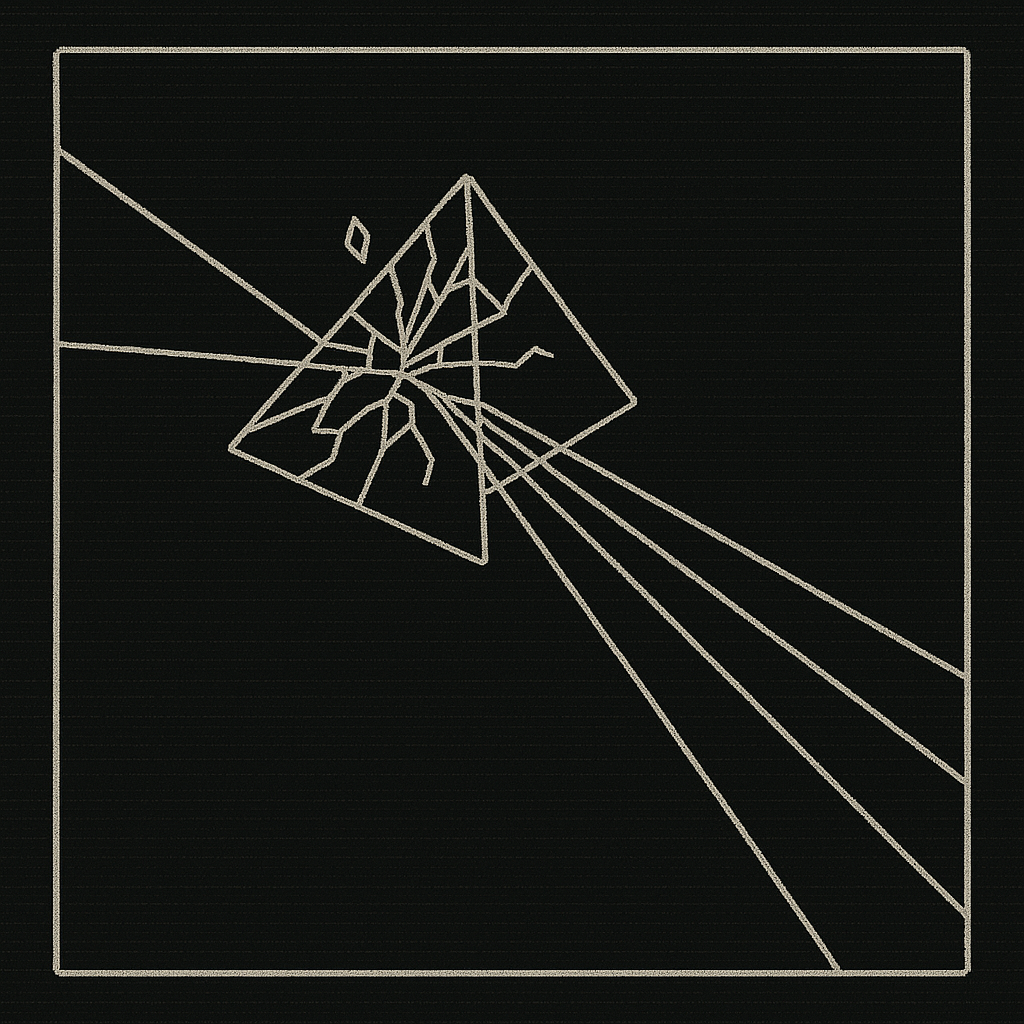
THE MACHINERY OF TRANSFORMATION
A Complete Guide to Discontinuous Becoming
How One State Ends and Another Begins
What follows is not advice.
It is not a self-help framework. Not a guide to reinvention. Not a sequence of habits to install or a mindset to adopt. Not a chapter in a personal growth book.
It is mechanism.
The actual machinery underneath every true change that has ever happened. In any medium. At any scale. In water as it freezes. In iron as it magnetizes. In a caterpillar as it dissolves. In a mind that will never be what it was yesterday. The reorganization by which one stable form gives way to another without passing through every point between them.
Most people use the word transformation as if it means significant improvement. A large change. A noticeable difference from before.
This is not what transformation is.
Transformation is a phase change. A discontinuous jump from one attractor to another. The irreversible end of one organized state and the beginning of a different one. It cannot be measured by the magnitude of the change. It is measured by whether the system could return.
A system that bends and springs back has not transformed. It has been disturbed.
A system that has crossed a threshold beyond which the old configuration is no longer available. That has lost the form it was in. That cannot, by any amount of effort, resume the shape it held before. That system has transformed.
This document is that seeing.
Nothing more.
What you do with it is your business.
PART ONE: THE DISCONTINUITY
Change Is Not Transformation
Most change is continuous. A gradient. A slow drift along a parameter. The room cools by a degree. A muscle strengthens by a percent. A habit erodes. A relationship warms. These are variations within a stable form.
Transformation is the collapse of the form itself.
It is the difference between water getting colder and water becoming ice. The former is quantitative. You can point to a thermometer and measure it. The latter is qualitative. At some precise temperature, the molecules stop sliding past one another and lock into a lattice. A new substance exists where the old one was. No amount of additional cooling would have produced ice without that crossing. No amount of cooling below freezing undoes it back into what it was.
The gradient is continuous. The transformation is not.
    CONTINUOUS CHANGE vs TRANSFORMATION

    CONTINUOUS CHANGE                   TRANSFORMATION

    quantity                            quantity
         │                                   │
         │         ╱                         │         ┌─────
         │        ╱                          │         │
         │       ╱                           │         │
         │      ╱                            │         │
         │     ╱                             │_________│
         │    ╱                              │
         │   ╱                               │
         └─────────────► time                └─────────────► time

    Smooth drift along                  Jump from one state
    a single parameter                  to a different state

    Reversible                          One-way
    No new form appears                 New form replaces old
The distinction is not a matter of speed. A slow transformation is still a transformation. A fast change is still change. What matters is whether the system passed through a threshold that ended one state and began another.
Attractors and Basins
Every stable state in every system is an attractor. A configuration the system returns to when perturbed. A valley in the space of possible arrangements.
Water at room temperature is an attractor. Perturb it with a finger. It settles back. The molecules keep sliding. Whatever shape the container provides, the water fills it.
Ice is a different attractor. Perturb it with a hand. It resists. The molecules stay in the lattice. The shape persists.
Between attractors lie ridges. The system cannot rest on a ridge. It falls into one basin or another.
    THE LANDSCAPE OF STATES

    energy
        │
        │           ╱▔▔▔▔▔╲      ╱▔▔▔▔▔╲
        │          ╱       ╲    ╱       ╲
        │         ╱         ╲  ╱         ╲
        │   ╲    ╱           ╲╱           ╲    ╱
        │    ╲  ╱             ╳             ╲  ╱
        │     ╲╱                             ╲╱
        │     state A        ridge        state B
        │    (attractor)    (unstable)   (attractor)
        │
        └─────────────────────────────────────────► configuration

    A system can rest in A. It can rest in B.
    It cannot rest on the ridge between them.

    Transformation is the crossing of that ridge.
Within an attractor, continuous change is possible. The water can warm or cool, rise or fall, swirl or still. These are excursions inside the basin. The form does not end.
To transform, the system must leave the basin. Climb the ridge. Fall into a different basin. Once in the new basin, excursions inside that basin are again possible. But the old basin is no longer the home.
Transformation is the movement between basins. The ridge crossing. The fall into new territory.
PART TWO: THE PHASE TRANSITION
The Critical Point
In 1937, Lev Landau wrote down a theory of phase transitions that organizes the entire field. His framework asks a single question about any system that can exist in more than one organized state. Is there an order parameter that is zero in one phase and nonzero in the other?
For magnetism, the order parameter is magnetization. Above the Curie temperature, iron has no net magnetization. The individual atomic spins point in all directions. They cancel. Below the Curie temperature, the spins align. A net magnetization appears.
For water, the order parameter is the crystalline ordering of molecules. Above zero Celsius, the molecules move freely. Below, they lock into a lattice.
The transformation happens at a single, precise temperature. The critical point.
    THE ORDER PARAMETER AT A PHASE TRANSITION

    order
    parameter M
        │
        │    ▓▓▓▓
        │    ▓▓▓▓▓
        │     ▓▓▓▓▓▓
        │      ▓▓▓▓▓▓▓▓
        │        ▓▓▓▓▓▓▓▓▓▓
    ZERO│           ▓▓▓▓▓▓▓▓▓▓▓▓▓▓▓▓▓▓▓▓▓▓▓▓▓▓
        │                             │
        │    ordered phase            │    disordered phase
        │    (magnetized,             │    (unmagnetized,
        │     crystalline)            │     fluid)
        │                             │
        └─────────────────────────────┼────────────────►
                                 critical point        temperature
                                (Tc, Curie point,
                                 freezing point)
Approach the critical point from the ordered side. The order parameter shrinks. At the critical point itself, it vanishes. Cross the critical point. The ordered phase ceases to exist as a stable state.
This is not a feature of a few special systems. It is a universal structure. Superconductivity has a critical temperature. Superfluidity has one. Liquid crystals have one. The transition from paramagnet to ferromagnet has one. The transition from liquid to gas has one. Every organized form has a threshold at which the organization fails.
The Latent Heat
A phase transition is not just a change in properties. It is a discontinuous change in the amount of energy the system contains at a given temperature.
Heat ice at zero Celsius. The temperature does not rise. The ice melts. All the energy goes into breaking the lattice. Only after the last of the ice is gone does the water begin to warm.
This energy is the latent heat. The hidden cost of crossing the threshold. The price of the transformation.
    LATENT HEAT

    temperature
        │                                     ╱
        │                                    ╱
    100 │          ████████ boiling ████████╱
        │                                  ╱
        │                                 ╱ water
        │                                ╱
        │                               ╱
      0 │    ████ melting ████████████╱
        │                            ╱
        │                           ╱ ice
        │                          ╱
        └─────────────────────────────────────► energy added

                 │            │
                 │            │
         latent heat    latent heat
         of fusion      of vaporization
         (ice → water)  (water → steam)

    During a transition, energy enters but
    temperature does not rise. The energy
    restructures the form.
For water to ice, 334 joules per gram. For water to steam, 2,257 joules per gram. These are not metaphors. They are measured quantities. Transformation costs energy, and the energy does not register as warming. It goes into the reorganization itself.
Any system that transforms pays a latent heat. An energy that disappears into the restructuring rather than into any observable movement.
This connects directly to THE MACHINERY OF ENTROPY. A phase transition is a jump in entropy. The new phase has a different number of accessible microstates. The energy that vanishes into latent heat is the energy that permits that jump.
The Ising Model
The simplest mathematical model of a phase transition is the Ising model. Ernst Ising studied it in 1924. It is a grid of spins, each pointing up or down. Neighbors prefer to align with each other.
At high temperature, thermal agitation wins. The spins point randomly. No net magnetization. Disorder.
At low temperature, alignment wins. A domain forms. Its neighbors align with it. Their neighbors align with them. The whole lattice tips one way.
    THE ISING MODEL

    T >> Tc (HOT, DISORDERED)          T << Tc (COLD, ORDERED)

    ↑ ↓ ↑ ↓ ↑ ↓ ↑ ↓                    ↑ ↑ ↑ ↑ ↑ ↑ ↑ ↑
    ↓ ↑ ↑ ↓ ↓ ↑ ↓ ↑                    ↑ ↑ ↑ ↑ ↑ ↑ ↑ ↑
    ↑ ↓ ↓ ↑ ↓ ↑ ↑ ↓                    ↑ ↑ ↑ ↑ ↑ ↑ ↑ ↑
    ↓ ↑ ↓ ↑ ↑ ↓ ↓ ↑                    ↑ ↑ ↑ ↑ ↑ ↑ ↑ ↑
    ↑ ↓ ↑ ↓ ↓ ↑ ↑ ↓                    ↑ ↑ ↑ ↑ ↑ ↑ ↑ ↑
    ↓ ↑ ↓ ↑ ↑ ↓ ↓ ↑                    ↑ ↑ ↑ ↑ ↑ ↑ ↑ ↑

    No net direction.                  All spins aligned.
    Symmetry intact.                   Symmetry broken.
    Average magnetization = 0.         Average magnetization = nonzero.
At the exact critical temperature, something remarkable happens. The correlation length diverges. Every spin is correlated with every other spin. Fluctuations exist at every scale. A tiny change in temperature flips the whole lattice.
This is the phenomenon of critical opalescence. Near the liquid-gas critical point, light scatters off density fluctuations of every size. The fluid turns milky. The system has no preferred scale. It has become all scales at once.
At criticality, the distinction between the two phases dissolves. The system is maximally sensitive. A breath changes everything.
Transformation, in the Ising view, is what happens when the critical threshold is crossed. Above it, the system cannot hold the old form. Below it, the new form is inevitable.
PART THREE: THE BIFURCATION
The Saddle-Node
In dynamical systems, a bifurcation is the point at which the structure of possible states changes. Parameters that were smooth suddenly rearrange what the system can do.
The simplest bifurcation is the saddle-node. Two equilibria approach each other. They collide. They vanish. A system that had two possible resting states now has none on that side.
    THE SADDLE-NODE BIFURCATION

    BEFORE                AT BIFURCATION         AFTER

    equilibria             merging                vanished

         ●                     ●                     .
         │                     │                     .
    (stable)                   .                     .
         │                     .                     .
    (unstable)                 .                     .
         │                     .                     .
         ○                     ○                     .

    parameter = a           parameter = a*        parameter = b

    Two resting states      They collide.         Neither exists.
    coexist.                The system must       The system must
                            find somewhere        flow somewhere
                            else.                 new.
A system resting on one of those equilibria is stable until the parameter reaches the critical value. Then the equilibrium disappears beneath it. There is no neighboring state to fall into gradually. The system must travel across the state space to whatever attractor remains.
This is why transformation often feels sudden even when the forces that produced it were gradual. The parameter drifted for months or years. Nothing changed. Then the equilibrium dissolved and the system, with nowhere to rest, moved.
Catastrophe Theory
René Thom formalized this in the 1960s under the name catastrophe theory. His insight was that sudden, discontinuous changes in a system’s behavior can be understood as smooth changes in underlying parameters combined with the topology of equilibrium manifolds.
The cusp catastrophe is the canonical example. Two parameters. A control surface that folds over on itself.
    THE CUSP CATASTROPHE

         state
           │           ╱──────────  upper sheet
           │          ╱
           │         ╱      (continuous movement here)
           │        ╱
           │       ╱
           │      ╱ ← fold line
           │     ╳     (a sudden drop is here)
           │      ╲
           │       ╲
           │        ╲
           │         ╲
           │          ╲
           │           ╲──────────  lower sheet
           │
           └─────────────────────────► control parameter

    Move along the upper sheet. The system changes smoothly.
    Cross the fold. The upper sheet ends.
    The system falls to the lower sheet. Instantly.

    No continuous path between them exists at that point.
On the upper sheet, the system responds smoothly to changes in the control parameter. But near the fold, a small additional change in the parameter causes the upper sheet to end. The system, no longer able to rest on the upper sheet, falls to the lower sheet. The drop is sudden. It traverses a region of state space the system never occupied.
This geometry is the same geometry as a phase transition. The same geometry as a mind that tolerates a situation for years and then one day cannot. The same geometry as a stock market that rises steadily and then crashes. The same geometry as an empire that endures and then collapses.
The underlying machinery is: smooth parameter change, discontinuous response, because the topology of stable states is itself discontinuous.
PART FOUR: THE DISSIPATIVE STRUCTURE
Far from Equilibrium
Classical thermodynamics describes systems near equilibrium. Small deviations. Linear responses. Predictable relaxation back to the resting state.
Ilya Prigogine’s work, which earned him the Nobel Prize in 1977, extended thermodynamics to systems pushed far from equilibrium. Systems fed a steady flow of energy. Systems that cannot return to rest because the flow keeps driving them.
At some threshold of driving, these systems do something new. They spontaneously organize.
    NEAR EQUILIBRIUM vs FAR FROM EQUILIBRIUM

    NEAR EQUILIBRIUM                    FAR FROM EQUILIBRIUM

    ┌──────────────────────┐            ┌──────────────────────┐
    │                      │            │  ◉  ◉  ◉  ◉  ◉   │
    │  .  .  .  .  .       │            │ ◉  ◉  ◉  ◉  ◉  ◉     │
    │  .  .  .  .  .       │            │  ◉  ◉  ◉  ◉  ◉   │
    │  .  .  .  .  .       │            │ ◉  ◉  ◉  ◉  ◉  ◉     │
    │  .  .  .  .  .       │            │  ◉  ◉  ◉  ◉  ◉   │
    │                      │            │                      │
    │  Small fluctuations  │            │  Organized structure │
    │  around a mean       │            │  appears from flow   │
    │                      │            │                      │
    │  No structure        │            │  Macroscopic pattern │
    │  emerges             │            │  sustained by energy │
    │                      │            │                      │
    └──────────────────────┘            └──────────────────────┘
Heat a shallow pan of oil from below. Near equilibrium, the heat conducts upward smoothly. Nothing organized appears. Push harder. At a specific rate of heating, convection cells spontaneously form. Hexagonal patterns. Rayleigh-Bénard cells. A macroscopic order that did not exist a moment ago.
This order is not an accident. It is more efficient at transporting heat than conduction alone. The system has reorganized to handle the flow.
Prigogine called these dissipative structures. Organized patterns that exist only because energy flows through them. Stop the flow and the pattern dissolves.
Life is a dissipative structure. A flame is one. A hurricane is one. The cells in the pan are one. Every organized thing that endures far from equilibrium is one.
Reorganization under Load
The critical insight is that transformation is not only possible far from equilibrium. It is obligatory.
A system under steady, increasing load cannot maintain any one structure indefinitely. At some threshold, the structure that served at lower loads becomes unstable. The flow overwhelms it. The system does not collapse into disorder. It rearranges into a new structure capable of handling the new flow.
    SUCCESSIVE BIFURCATIONS UNDER INCREASING LOAD

    load level     structure

       zero       ┌──────────────────┐
                  │                  │
                  │  Stable rest     │
                  │                  │
                  └──────────────────┘

       low        ┌──────────────────┐
                  │    ╱╲    ╱╲      │
                  │   ╱  ╲  ╱  ╲     │
                  │  ╱    ╲╱    ╲    │
                  │                  │
                  │  Simple pattern  │
                  └──────────────────┘

       medium     ┌──────────────────┐
                  │  ╱╲╱╲╱╲╱╲╱╲╱╲    │
                  │  ╲╱╲╱╲╱╲╱╲╱╲╱    │
                  │  ╱╲╱╲╱╲╱╲╱╲╱╲    │
                  │                  │
                  │  Finer pattern   │
                  └──────────────────┘

       high       ┌──────────────────┐
                  │  ░▒▓█▓▒░▒▓█▓▒░   │
                  │  ▓█▓░▒▓█▓░▒▓█▓   │
                  │  ░▒▓█▓▒░▒▓█▓▒░   │
                  │                  │
                  │  Turbulent       │
                  │  cascade         │
                  └──────────────────┘

    Each transition is a discontinuous reorganization.
    The old structure cannot handle the new load.
    A new structure emerges to handle it.
This is why enduring pressure often produces transformation rather than failure. The pressure drives the system past thresholds it would never reach under gentle conditions. Each threshold strips away a structure and installs a new one. The final structure is not recognizable from the starting one.
A person who has been through a war is not a person who has been through more peace. A nervous system that has absorbed years of training is not a nervous system that has been untrained with more effort. Something reorganized. The load forced a different structure. That structure is now the one the system operates with.
See THE MACHINERY OF EMERGENCE for the companion principle. New order appears at the level of reorganization, not at the level of parts.
PART FIVE: THE METAMORPHOSIS
Imaginal Discs and Histolysis
Biology has a canonical example of transformation. Holometabolous insects. Butterflies, moths, beetles, flies, wasps, bees. Four hundred thousand species of them. A quarter of all described animal life on Earth.
Each of them does something extraordinary inside the pupal case.
The caterpillar does not grow wings. It does not lengthen, harden, or reshape its existing body. It dissolves.
Inside the pupa, the larval tissues are broken down by enzymes. A process called histolysis. Most of the caterpillar’s organs, muscles, and body structures are digested into a nutrient-rich slurry. What existed as a caterpillar ceases to exist as a caterpillar.
Within that slurry, structures called imaginal discs survive. These are clusters of cells that were present in the caterpillar but never activated. Each disc corresponds to a part of the adult body. The eye disc. The wing discs. The leg discs. The antenna discs.
When the larval body has been dissolved enough, the imaginal discs begin to proliferate. They use the slurry as fuel. They build the adult body from inside the dissolution.
    HOLOMETABOLOUS METAMORPHOSIS

    CATERPILLAR            PUPA                 ADULT

    ┌─────────────┐        ┌─────────────┐      ┌─────────────┐
    │   ╭───╮     │        │             │      │     ╱╲╱╲    │
    │  ╱     ╲    │        │  ░░░░░░░░   │      │   ╱╲    ╱╲  │
    │  │  ●●  │   │   ──►   │  ░ slurry░  │ ──►  │  │  ╳╳  │  │
    │  │      │   │        │  ░ with   ░ │      │  │      │   │
    │   ╲____╱    │        │  ░ discs  ░ │      │  │  ●●  │   │
    │             │        │  ░░░░░░░░   │      │  ╲      ╱   │
    │             │        │             │      │   ╲____╱    │
    └─────────────┘        └─────────────┘      └─────────────┘

    Larval tissue          Dissolved by           Adult body
    intact                 histolysis             built from
                                                  imaginal discs
    Muscles, organs,       Only specific           Almost nothing
    cuticle                cells preserved         of the caterpillar
    functioning                                    remains
The caterpillar does not become a butterfly. The caterpillar is destroyed so that the butterfly can be built from what was hidden inside it.
Memory persists, remarkably, in some cases. Studies have shown that moths retain learned associations from their caterpillar stage. Some neural structures survive the dissolution. But the body that held those memories is gone. The organism that wakes is genetically the same individual and experientially a different creature.
What the Metamorphosis Teaches
The biological architecture of metamorphosis encodes a general principle.
Transformation from one form to another, when the forms are genuinely different, is not accomplished by gradually reshaping the old form. It is accomplished by dissolving the old form while preserving a minimal core, and building the new form around that core.
The parts of the caterpillar that had to die died. The parts that could seed the new form survived.
Any system attempting transformation without loss is not transforming. It is renovating. Renovation preserves the structure. Transformation replaces it.
This is hard to accept. The caterpillar, if it could understand its situation, would not want to dissolve. It would want wings added. Legs extended. Eyes improved. Those are renovation fantasies. Metamorphosis is not available on those terms.
See THE MACHINERY OF MORTALITY for why. The death of a form is structurally necessary for the emergence of a different form. A system cannot simultaneously be two incompatible things. One must end for the other to begin.
PART SIX: THE QUANTUM CHANGE
Sudden Conversion
For the dedicated treatment, see THE MACHINERY OF SUDDEN CONVERSION.
William James, in 1902, published The Varieties of Religious Experience. He devoted two chapters to a phenomenon he called sudden conversion. People who, in a matter of hours or minutes, ceased to be one kind of person and became another.
The change was not the accumulation of insight. Not the slow working of therapy. Not the result of a campaign of self-improvement. It was a discontinuous reorganization of what the person valued, feared, desired, and attended to.
James catalogued cases. A drunkard who, in a moment, lost all interest in alcohol and never resumed drinking. A man obsessed with status who, over the course of a single conversation, no longer cared. A woman paralyzed by scrupulosity who, in an instant, was calm.
He observed that the changes persisted. Years later, the converts remained in the new configuration. They had not reverted. The old attractor was no longer available to them.
    JAMES'S OBSERVATION

    BEFORE                                AFTER

    ┌──────────────────┐                  ┌──────────────────┐
    │                  │                  │                  │
    │  Self-system     │                  │  Self-system     │
    │  organized       │                  │  organized       │
    │  around X        │                  │  around Y        │
    │                  │     SUDDENLY     │                  │
    │  Anxiety,        │   ─────────►    │  Peace,          │
    │  obsession,      │                  │  clarity,        │
    │  compulsion      │                  │  indifference    │
    │  about X         │                  │  to what was     │
    │                  │                  │  all-important   │
    └──────────────────┘                  └──────────────────┘

    The change was not prepared by gradual effort.
    The change persisted. The old pattern did not return.
    The person could not explain how.
James was careful not to interpret these reports. He was a psychologist. He wanted to describe what happened, not adjudicate whether the cause was divine or psychological. His framework was the divided self. A self with incompatible centers of gravity, one visible and dominant, one suppressed. When the suppressed center rose, the visible one collapsed. Not gradually. At once.
Quantum Change Research
William Miller and Janet C’de Baca, clinical psychologists, revisited this in the 1990s and 2000s under the name quantum change. They interviewed people who reported sudden, dramatic, permanent personal reorganizations.
Their work documented the regularities. The changes were typically sudden, taking minutes or hours at most. Involved a sense of revelation or insight. Felt happened-to rather than done-by. Produced relief from long-standing patterns that years of effort had not dissolved. Persisted over follow-up periods of many years.
The people who reported quantum change were not more suggestible. They were not from particular religions, classes, or personality types. They did not converge on a single trigger. Some reported it during prayer. Some during crisis. Some during ordinary moments. Some during illness. Some during ingestion of psychedelic substances.
The commonality was in the structure, not the content. A period of intolerable incoherence. A moment of reorganization. A persisting new configuration.
More recent research on psilocybin-assisted therapy has reproduced this pattern under controlled conditions. Roland Griffiths and colleagues at Johns Hopkins showed that a single high-dose session can produce lasting shifts in personality traits, smoking cessation rates, fear of death in terminally ill patients, and depressive symptoms. The changes are not incremental. They are stepwise. The measurements differ in kind between before and after.
    QUANTUM CHANGE STRUCTURE

    time
      │
      │  ▔▔▔▔▔▔▔▔▔▔▔▔▔▔▔ pre-event state ▔▔▔▔▔▔
      │
      │       (intolerable incoherence
      │        or precipitating moment)
      │
      │                  │
      │                  ▼
      │          ╔═══════════════╗
      │          ║  REORGANIZATION ║
      │          ║  (minutes to    ║
      │          ║   hours)        ║
      │          ╚═══════════════╝
      │                  │
      │                  ▼
      │
      │  ________________ post-event state _________
      │
      │
      └────────────────────────────────────────────►

    Not a gradual climb. A step function.
    Most attempts at gradual change fail because they
    try to drag the whole system continuously across
    a gap that is fundamentally discontinuous.
The neuroscience is still being mapped. Imaging studies of people under psilocybin show unusual integration between brain networks normally segregated. The default mode network, which scaffolds the stable sense of self, shows reduced activity and altered connectivity. The system’s habitual organizing structures relax. For a period, the old attractor is not binding. When the system reintegrates, it can land in a different configuration.
The ordinary version of this happens without substances, in lives that reach an intolerable tension. A precipitating event. A conversation. A death. A realization. The default mode loosens its grip. The old configuration cannot reassert. A new one establishes. By the time the system has reintegrated, it is a different system.
PART SEVEN: THE PARADIGM SHIFT
Kuhn’s Anomaly
Thomas Kuhn, in The Structure of Scientific Revolutions (1962), described a pattern in the history of science that parallels phase transitions at the level of ideas.
Normal science operates within a paradigm. A shared set of assumptions, problems, methods, and expected forms of answer. Practitioners work inside this paradigm. They accumulate results. They solve puzzles. The paradigm grows.
Anomalies accumulate. Observations that do not fit. At first, they are handled as exceptions, measurement errors, cases requiring further refinement. The paradigm absorbs them by adjusting small components.
At some point, the accumulated anomalies can no longer be absorbed. The adjustments required to save the paradigm become more convoluted than the paradigm’s explanatory power. The paradigm enters crisis.
In crisis, alternatives emerge. New frameworks that had been marginal. Outlier theories. The community debates. And then, typically within a generation, a new paradigm replaces the old one. The old paradigm does not gradually transform into the new. It is abandoned. Its practitioners either convert or retire. The new paradigm becomes the ground of normal science until its own anomalies accumulate.
    KUHN'S CYCLE

    ┌──────────────────────┐
    │                      │
    │   NORMAL SCIENCE     │
    │                      │
    │   Puzzle-solving     │
    │   within paradigm    │
    │                      │
    └──────────────────────┘
             │
             ▼
    ┌──────────────────────┐
    │                      │
    │   ANOMALIES          │
    │                      │
    │   Exceptions         │
    │   accumulate         │
    │                      │
    └──────────────────────┘
             │
             ▼
    ┌──────────────────────┐
    │                      │
    │   CRISIS             │
    │                      │
    │   Paradigm no        │
    │   longer absorbs     │
    │   anomalies          │
    │                      │
    └──────────────────────┘
             │
             ▼
    ┌──────────────────────┐
    │                      │
    │   REVOLUTION         │
    │                      │
    │   Paradigm shift.    │
    │   Old framework      │
    │   abandoned, not     │
    │   modified.          │
    │                      │
    └──────────────────────┘
             │
             ▼
          (new paradigm becomes
           the new normal science)
Kuhn’s key observation was that successive paradigms are not commensurable. They do not translate cleanly into each other. Concepts that were central in one vanish in the next. Concepts that did not exist in the old paradigm become unavoidable in the new.
This is the signature of transformation at any scale. The language that described the old state is inadequate to describe the new. You cannot explain the butterfly in caterpillar terms.
The Same Structure
The Kuhnian cycle is a phase transition at the level of collective mind. Normal science is the ordered phase. Anomalies are perturbations. Crisis is the approach to the critical point, where the correlation length diverges and every practitioner is correlated with every other on the question of what to do. Revolution is the crossing.
This is why paradigm shifts feel impossible until they are underway. Inside the old paradigm, the anomalies look like problems to be solved. The shape of their accumulation, the pattern that suggests the paradigm itself is wrong, is invisible from within.
Only from the new paradigm can the old one be seen as a paradigm at all. Inside it, it was simply how things were.
PART EIGHT: THE SACRIFICE
Why Something Must End
The old form and the new form are not compatible configurations of the same substrate. They are different organizations of the same parts. Both organizations cannot coexist because each requires the parts to be arranged differently.
Water cannot be both liquid and ice at the same location. The molecules must be either sliding past each other or locked in a lattice. The two states compete for the same molecules. One must yield.
A mind cannot simultaneously organize around two incompatible centers. A person oriented toward external validation cannot also be oriented toward internal integrity without the two orientations producing contradictory actions in the same situations. One orientation must lose in order for the other to govern.
    WHY TRANSFORMATION IS NOT ADDITIVE

    OLD FORM               NEW FORM

    Organized around X     Organized around Y

    Same parts, arranged one way vs another way

    ┌──────────────┐                  ┌──────────────┐
    │              │                  │              │
    │  ░░░░░░░░░░  │   not combinable  │  ▓▓▓▓▓▓▓▓▓▓  │
    │  ░░░░░░░░░░  │                  │  ▓▓▓▓▓▓▓▓▓▓  │
    │  ░░░░░░░░░░  │                  │  ▓▓▓▓▓▓▓▓▓▓  │
    │              │                  │              │
    └──────────────┘                  └──────────────┘

    The old arrangement must be unmade
    before the new arrangement can be made.

    You cannot keep both.
This is the sacrifice at the heart of transformation. Not a symbolic gesture. A structural requirement.
The parts of the caterpillar that had to dissolve had to actually dissolve. Not be deprioritized. Not be renamed. Dissolved. Because the butterfly body required the molecules and the space those parts were occupying.
The parts of the old self that must end in a mind’s transformation must actually end. The habits, the stories, the compulsions, the centers of concern. Not merely be supplemented by new commitments while the old ones persist. The new organization requires the substrate those old parts were using.
The Cost Is Not Optional
The latent heat of a phase transition is not a matter of preference. It is determined by the thermodynamics of the two phases. There is a minimum energy cost to cross.
The imaginal disc cannot build the butterfly without the slurry the larval body becomes. The enzymes that perform histolysis are not negotiable. The dissolution is part of the construction.
The sacrifice in a mind’s transformation is not a moral requirement added for dramatic effect. It is the structural cost of exiting one attractor and entering another. Whatever organized the old self must come apart enough for something else to organize. The intensity of what comes apart is proportional to how organized the old self was.
Systems that had very little coherent organization can transform easily. There was little to dissolve. Systems that had highly coherent organization transform only through commensurate dissolution. The more real the old form, the more real the cost of leaving it.
See THE MACHINERY OF SUFFERING for the phenomenology. The pain of transformation is the phenomenology of the sacrifice. It is what dissolution feels like from inside the thing being dissolved.
PART NINE: THE IRREVERSIBILITY
Hysteresis
A second key feature of phase transitions is hysteresis. The path into a state and the path out are not symmetric.
Cool water. It freezes at zero Celsius. Heat the ice. It melts at zero Celsius. In this case, the transition points coincide. But in many systems, they do not.
Magnetize iron. Remove the applied field. The iron stays magnetized. It does not return to the unmagnetized state by reversing the process that magnetized it. It requires a different process to demagnetize.
    HYSTERESIS

    magnetization M
        │
        │            ╱──────  saturated in +
        │           ╱
        │          ╱
        │         ╱
        │   ────╱ ← forward path
        │   ╱
        │  ╱
        │ ╱
    0 ──┼─────────────────────────► applied field H
        │                     ╱
        │                    ╱
        │                   ╱
        │                  ╱
        │                 ╱ ← backward path
        │      ──────────╱
        │     ╱
        │────╱ saturated in -

    The state at zero field depends on history.
    Going up and coming back down trace different paths.
    The system remembers where it has been.
Hysteresis is memory in physical form. The material’s current state encodes a history. It cannot be reset without doing work that did not have to be done during the original magnetization.
Transformation exhibits the same structure. The path out of the old form is not the reverse of the path back to it. Once the caterpillar has dissolved and the butterfly has emerged, there is no procedure by which the butterfly becomes a caterpillar. Not because the process would be slow but because the topology of states does not permit it. The transformation is one-way.
Why You Cannot Go Back
The second law of thermodynamics constrains all macroscopic transformations. Entropy increases globally. Local reductions in entropy, such as the formation of ice, are paid for by larger increases elsewhere.
A transformation’s irreversibility is an instance of this. The new state has been reached by a path that generated entropy along the way. To return, the system would have to walk the path backwards, recovering that entropy. Which it cannot. Entropy does not uncollect.
In minds, the same principle applies. A person who has had a realization cannot unrealize it. A person who has seen through a story cannot unsee through it. The realization is a permanent shift in the organization of their predictive model. The act of reorganizing cannot be undone because the old organization depended on structures that no longer exist inside the new one.
This is why enduring transformation feels heavier than temporary change. The felt weight is accurate. The system has actually moved. The door it came through has closed behind it.
PART TEN: THE INSTANT
The Threshold Is a Point
One of the most common observations about transformation is that it happens in an instant. The precipitating moment is brief. The change itself feels immediate.
This is consistent with the machinery, not anomalous.
A threshold is a point in parameter space. Crossing a point takes no finite interval. The buildup to the crossing can be slow. The parameter drifts for years. The anomalies accumulate. The strain grows. The ridge is approached. All of this is preparation. It is not the transformation. The transformation is the crossing.
    PREPARATION vs TRANSFORMATION

    parameter over time
         │
         │                   ●← transformation
         │                 ╱
         │               ╱
         │             ╱
         │           ╱
         │         ╱    ← preparation
         │       ╱         (long, gradual)
         │     ╱
         │   ╱
         │ ╱
         └──────────────────────────────► time

    The preparation may take years.
    The transformation, at the threshold, is instantaneous.
    Confusing the two is the source of most misunderstandings
    about how change works.
This has two implications.
First, long periods in which nothing appears to be changing are not necessarily periods in which nothing is happening. The parameter may be approaching the threshold. Each drop of accumulated pressure is a step closer. The system is not stuck. It is loading.
Second, the transformation itself is not where the preparation lives. The instant of crossing is brief. The work was done in the approach. Attempting to make the instant longer, or the crossing gentler, or the shift more gradual, is a category error. The instant is a threshold. It has no duration. What has duration is the path to it.
A Side Comment on Validity
An objection sometimes arises. If transformation happens in an instant, how can it be real? Surely real change takes time. Surely something sudden is shallow.
This objection confuses two questions. Whether a transformation is genuine is not the same question as how long it took.
A phase transition takes no time in an idealized system. The water becomes ice at the critical temperature. The transition is real. It is not shallow because it was fast. It is whatever it is because of the physics underneath.
The validity of a transformation is established by what persists afterward. Did the old state become unavailable. Did the system settle into a new attractor. Does the new configuration hold under perturbation. Does it show the hysteresis that marks a genuine phase boundary.
If yes, the transformation was real, regardless of how long the threshold crossing took. If no, what happened was not transformation. It was a disturbance. The system has returned to where it was.
The duration of the crossing does not point to the machinery. It is a consequence of the fact that thresholds are points. Not every point-like event is a transformation. But every transformation is point-like at its threshold.
PART ELEVEN: THE COMPLETE PICTURE
The Unified Framework
Everything connects.
    THE TRANSFORMATION FRAMEWORK

    ┌─────────────────────────────────────────────────────────┐
    │                                                         │
    │                  TRANSFORMATION                         │
    │                                                         │
    │   A discontinuous jump from one stable attractor        │
    │   to another. Irreversible. Instant at the threshold.   │
    │   Purchased by the dissolution of the old form.         │
    │                                                         │
    └─────────────────────────────────────────────────────────┘
                              │
              ┌───────────────┼───────────────┐
              │               │               │
              ▼               ▼               ▼
    ┌─────────────────┐ ┌─────────────────┐ ┌─────────────────┐
    │                 │ │                 │ │                 │
    │  THE APPROACH   │ │  THE CROSSING   │ │  THE NEW FORM   │
    │                 │ │                 │ │                 │
    │  Load builds.   │ │  Threshold is   │ │  System settles │
    │  Parameter      │ │  reached.       │ │  into new       │
    │  drifts. Strain │ │  Old attractor  │ │  attractor.     │
    │  accumulates.   │ │  destabilizes.  │ │                 │
    │                 │ │  System falls   │ │  Hysteresis     │
    │  Correlation    │ │  to new basin.  │ │  locks in the   │
    │  length grows.  │ │                 │ │  new state.     │
    │                 │ │  Latent heat    │ │                 │
    │  May take years.│ │  paid.          │ │  Old state no   │
    │                 │ │                 │ │  longer         │
    │                 │ │  Duration: point│ │  available.     │
    │                 │ │                 │ │                 │
    └─────────────────┘ └─────────────────┘ └─────────────────┘
              │               │               │
              └───────────────┼───────────────┘
                              │
                              ▼
    ┌─────────────────────────────────────────────────────────┐
    │                                                         │
    │                THE SACRIFICE                            │
    │                                                         │
    │   The old form dissolves enough for the new one         │
    │   to be constructed from the freed substrate. The       │
    │   cost is structural. It cannot be paid in any          │
    │   other currency.                                       │
    │                                                         │
    └─────────────────────────────────────────────────────────┘
Phase transitions give us the physics. Bifurcations give us the dynamical topology. Dissipative structures give us the role of flow. Metamorphosis gives us the biological pattern. Quantum change gives us the psychological signature. Paradigm shifts give us the collective version.
They are one machinery, observed at different scales.
The Translation Table
| Common Understanding | Actual Mechanism |
|---|---|
| “Transformation is a big change” | Transformation is a discontinuous jump between attractors |
| “Real change takes time” | The approach takes time. The crossing is instantaneous. |
| “I need to work on myself” | The old attractor must be destabilized, not reinforced in a new direction |
| “I want to keep what I like and change the rest” | The old form and the new form are different organizations of the same substrate. Both cannot be kept. |
| “If I just try hard enough” | Force inside the old basin cannot cross the ridge. The threshold is reached or it is not. |
| “I’ve changed so many times already” | Most reported change is excursion within an attractor, not transformation between attractors. True transformations are rare. |
| “Sudden change is shallow” | The threshold is a point. Duration and depth are independent. |
| “I’ll change gradually” | Continuous change produces continuous change. Discontinuous change requires a threshold. |
| “Nothing is happening” | Preparation can be invisible. The parameter may be approaching the critical point. |
The Deepest Statement
Transformation is what a system does when it can no longer be what it was.
Not what it chooses to do. Not what it attempts. What it does because the old organization has become untenable and the new one is the nearest stable configuration reachable from the unstable state at the threshold.
The system does not author the transformation. The topology of stable states, combined with the history of parameter drift, determines where the system falls when it falls.
This is why transformations feel happened-to rather than done-by. Because they are. The agent experiences them rather than producing them. What the agent can influence is the approach. Whether the loads accumulate. Whether the parameter drifts. Whether the anomalies mount or are suppressed. Whether the pressure builds or is released.
The crossing itself is not under agent control. It is the response of the system to the state of the field.
The question underneath transformation is therefore never how to change. It is whether the approach is being made. Whether the loads are being absorbed or deflected. Whether the system is being pushed toward its thresholds or kept comfortably inside the attractor it already inhabits.
Comfortable systems do not transform. They have no reason to leave the basin they are in.
Systems under tension that cannot be released transform. They have nowhere else to go.
That is the machinery.
It runs whether you understand it or not.
Understanding it changes nothing about how it operates.
But it changes what you see when you look.
CITATIONS
Phase Transitions and Critical Phenomena
Landau Theory of Phase Transitions
Landau, L.D. (1937). “On the theory of phase transitions.” Zh. Eksp. Teor. Fiz., 7:19-32.
Stanley, H.E. (1971). Introduction to Phase Transitions and Critical Phenomena. Oxford University Press.
Ising Model and Critical Opalescence
Ising, E. (1925). “Beitrag zur Theorie des Ferromagnetismus.” Zeitschrift für Physik, 31(1):253-258.
Onsager, L. (1944). “Crystal Statistics. I. A Two-Dimensional Model with an Order-Disorder Transition.” Physical Review, 65(3-4):117-149.
Bifurcations and Catastrophe Theory
Dynamical Systems Bifurcations
Strogatz, S.H. (2015). Nonlinear Dynamics and Chaos. Westview Press, 2nd edition.
Catastrophe Theory
Thom, R. (1975). Structural Stability and Morphogenesis. W.A. Benjamin.
Zeeman, E.C. (1976). “Catastrophe Theory.” Scientific American, 234(4):65-83.
Dissipative Structures
Prigogine’s Nonequilibrium Thermodynamics
Prigogine, I. (1977). “Time, Structure and Fluctuations.” Nobel Lecture. https://www.nobelprize.org/prizes/chemistry/1977/prigogine/lecture/
Prigogine, I. & Stengers, I. (1984). Order Out of Chaos: Man’s New Dialogue with Nature. Bantam.
Nicolis, G. & Prigogine, I. (1977). Self-Organization in Nonequilibrium Systems. Wiley.
Metamorphosis and Imaginal Discs
Holometabolous Insect Development
Truman, J.W. & Riddiford, L.M. (1999). “The origins of insect metamorphosis.” Nature, 401:447-452.
Lowe, T., Garwood, R.J., et al. (2013). “Metamorphosis revealed: time-lapse three-dimensional imaging inside a living chrysalis.” Journal of the Royal Society Interface, 10(84). https://royalsocietypublishing.org/doi/10.1098/rsif.2013.0304
Memory Retention Across Metamorphosis
Blackiston, D.J., Silva Casey, E., & Weiss, M.R. (2008). “Retention of memory through metamorphosis: can a moth remember what it learned as a caterpillar?” PLoS ONE, 3(3):e1736. https://journals.plos.org/plosone/article?id=10.1371/journal.pone.0001736
Quantum Change and Sudden Conversion
William James’s Original Treatment
James, W. (1902). The Varieties of Religious Experience. Longmans, Green, and Co. Lectures IX and X on Conversion.
Modern Quantum Change Research
Miller, W.R. & C’de Baca, J. (2001). Quantum Change: When Epiphanies and Sudden Insights Transform Ordinary Lives. Guilford Press.
Miller, W.R. (2004). “The phenomenon of quantum change.” Journal of Clinical Psychology, 60(5):453-460.
Psilocybin and Personality Change
Griffiths, R.R., Richards, W.A., McCann, U., & Jesse, R. (2006). “Psilocybin can occasion mystical-type experiences having substantial and sustained personal meaning and spiritual significance.” Psychopharmacology, 187(3):268-283.
MacLean, K.A., Johnson, M.W., & Griffiths, R.R. (2011). “Mystical experiences occasioned by the hallucinogen psilocybin lead to increases in the personality domain of openness.” Journal of Psychopharmacology, 25(11):1453-1461.
Griffiths, R.R., Johnson, M.W., et al. (2016). “Psilocybin produces substantial and sustained decreases in depression and anxiety in patients with life-threatening cancer.” Journal of Psychopharmacology, 30(12):1181-1197.
Default Mode Network and Ego Dissolution
Carhart-Harris, R.L., et al. (2012). “Neural correlates of the psychedelic state as determined by fMRI studies with psilocybin.” PNAS, 109(6):2138-2143. https://www.pnas.org/doi/10.1073/pnas.1119598109
Paradigm Shifts
Kuhn’s Structure of Scientific Revolutions
Kuhn, T.S. (1962). The Structure of Scientific Revolutions. University of Chicago Press.
Kuhn, T.S. (1977). The Essential Tension: Selected Studies in Scientific Tradition and Change. University of Chicago Press.
Hysteresis and Irreversibility
Ferromagnetic Hysteresis
Bertotti, G. (1998). Hysteresis in Magnetism: For Physicists, Materials Scientists, and Engineers. Academic Press.
Second Law and Irreversibility
Callen, H.B. (1985). Thermodynamics and an Introduction to Thermostatistics. Wiley, 2nd edition.
Document compiled from comprehensive research across statistical mechanics, nonlinear dynamics, developmental biology, psychology of religion, clinical psychology, psychedelic research, and the history and philosophy of science.
Related Machineries
- THE MACHINERY OF ENTROPY. A phase transition is a discontinuous jump in entropy. The latent heat paid at the threshold is the entropy cost of the new configuration. Transformation is always entropy-permitted reorganization.
- THE MACHINERY OF EMERGENCE. The new form that appears after transformation is emergent. It cannot be described in the vocabulary of the old form. Its properties are not present in the parts until the parts are reorganized into the new whole.
- THE MACHINERY OF CONSTRAINTS. The release of a constraint is often what drives a transformation. A system that was held in one attractor by a boundary condition reorganizes when the boundary yields. The structure of the new form is shaped by which constraints now apply.
- THE MACHINERY OF MORTALITY. The sacrifice in transformation is a local death. The organism in the pupa dies as caterpillar. The self in quantum change dies as the self it was. The necessity of endings is the same machinery that makes mortality generative.
- THE MACHINERY OF SUFFERING. Suffering is often the phenomenology of a transformation in progress. The old form dissolving. The system loading toward a threshold. Pain experienced from inside the thing being unmade.
- THE MACHINERY OF EQUILIBRIUM. Equilibrium is the absence of drive toward transformation. A system at rest in its attractor has no reason to leave it. Transformation requires a departure from equilibrium, driven by flow or accumulated tension.
- THE MACHINERY OF DECISION MAKING. At a bifurcation, the system must choose between basins. That choice is the decision the transformation makes. The appearance of agency is the experience of being the thing that fell one way rather than the other.
- THE MACHINERY OF SUDDEN CONVERSION. The specific case of transformation that completes inside an hour rather than across years. The James and quantum-change phenomena belong to this category. The mechanism beneath the receptivity window, the external signal, and the substrate-level reorganization.
- THE MACHINERY OF HYSTERESIS. Hysteresis is the structural memory that makes transitions between states asymmetric, explaining why the path forward and the path back are never the same.
- THE MACHINERY OF ATTRACTOR. Transformation is a jump between attractors. The old stable state and the new stable state are both attractors of the same dynamical system. The basin geometry determines which perturbations are absorbed and which are transformative.