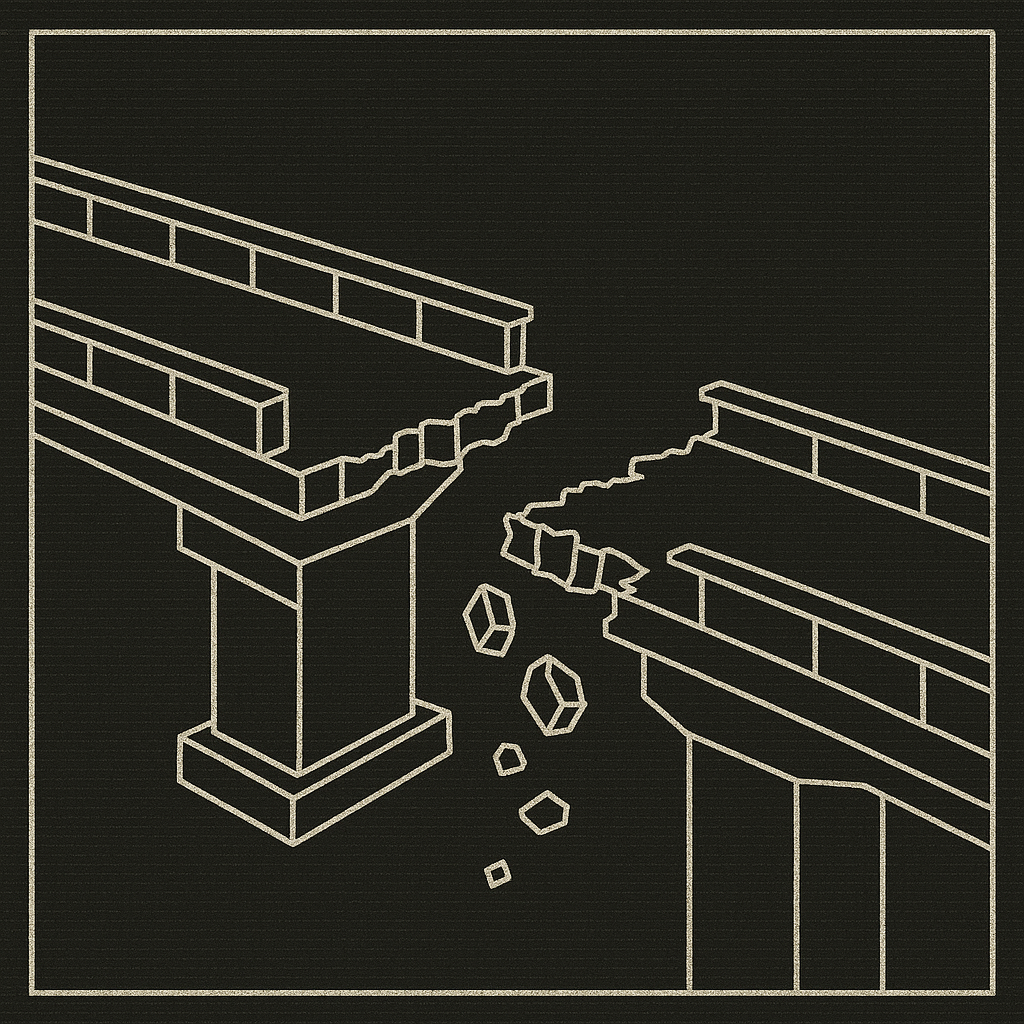
THE MACHINERY OF RISK
A Complete Guide to What Actually Kills Businesses
Why the Thing That Ends You Is Never the Thing You Measured
What follows is not advice.
It is not a risk management framework. Not a checklist. Not a matrix of likelihood-times-impact squares color-coded green, yellow, red. Not a consultant’s deck about enterprise risk mitigation.
It is mechanism.
The actual machinery that determines which businesses survive and which do not. The structural properties of exposure that decide, before the crisis arrives, whether the organization absorbs the shock or is destroyed by it. The mathematics underneath the intuition. The physics underneath the spreadsheet.
Most operators misunderstand risk at a foundational level. They think risk is a probability. They build models. They buy insurance. They diversify. And then the thing that ends them is something that was never in the model, never in the scenario plan, never contemplated by the consultant who sold them the risk matrix.
This happens because risk operates on principles that are invisible to conventional business thinking. The principles are structural, mathematical, and almost universally violated by the standard playbook.
This document describes those principles.
What the operator reading it does next is their business.
PART ONE: THE REFRAME
Risk Is Not Probability
The word “risk” points, in most operator minds, at a number. A percentage. The chance that something bad happens. The risk of the product failing is 20%. The risk of the hire not working out is 30%. The risk of the market turning is 15%.
This frame is fatally incomplete.
Risk is not the probability of a bad outcome. Risk is the magnitude of the irreversible consequence multiplied by the operator’s exposure to it. A 1% chance of losing everything is not a small risk. It is the largest risk that exists. A 90% chance of losing a week’s revenue is a nuisance. The probability was higher. The risk was lower.
The distinction is not semantic. It is the difference between operators who survive decades and operators who blow up in year three. The ones who blow up almost always had a story about how the probability was low. The probability was low. The exposure was total.
    RISK: THE ACTUAL FUNCTION

    ┌────────────────────────────────────────────────────────┐
    │                                                        │
    │  Risk  !=  Probability of bad outcome                  │
    │                                                        │
    │  Risk  =  f(Magnitude, Irreversibility, Exposure)      │
    │                                                        │
    └────────────────────────────────────────────────────────┘

    ┌────────────────────┐  ┌────────────────────┐  ┌────────────────────┐
    │                    │  │                    │  │                    │
    │     MAGNITUDE      │  │  IRREVERSIBILITY   │  │      EXPOSURE      │
    │                    │  │                    │  │                    │
    │  How large is      │  │  Can the damage    │  │  What fraction     │
    │  the loss          │  │  be undone         │  │  is at stake       │
    │                    │  │                    │  │                    │
    └────────────────────┘  └────────────────────┘  └────────────────────┘

    1% chance of ruin  >  50% chance of a bad quarter
The operator who internalizes this stops asking “what are the odds” and starts asking “what is my exposure if I am wrong.” The first question has no reliable answer in most business situations. The second question always has one.
PART TWO: THE TWO KINDS
Knight’s Distinction
In 1921, Frank Knight published Risk, Uncertainty, and Profit and drew a line that most of economics has been trying to blur ever since.
Risk is a situation where the probabilities are known or knowable. The casino knows the house edge. The insurance company knows the actuarial tables. The manufacturer knows the defect rate from historical data. The probabilities can be measured, estimated, or calculated from a known distribution.
Uncertainty is a situation where the probabilities are not known and cannot be known. No amount of data resolves it because the situation has never occurred before, or because the system is too complex for probability assignment. A competitor launches technology no one has seen. A regulatory change rewrites the industry’s economics overnight. A pandemic.
Most business decisions live in uncertainty, not risk.
But most business thinking uses tools designed for risk.
    KNIGHT'S DISTINCTION (1921)

    ┌──────────────────────────────┐  ┌──────────────────────────────┐
    │                              │  │                              │
    │            RISK              │  │         UNCERTAINTY          │
    │                              │  │                              │
    │  Probabilities are known     │  │  Probabilities are unknown   │
    │  or estimable                │  │  and unknowable              │
    │                              │  │                              │
    │  Historical data exists      │  │  No precedent exists         │
    │  Distribution is stable      │  │  Distribution is unknown     │
    │  Outcomes can be listed      │  │  Outcomes cannot be listed   │
    │                              │  │                              │
    │  Examples:                   │  │  Examples:                   │
    │  - Insurance pricing         │  │  - New market entry          │
    │  - Manufacturing defects     │  │  - Disruptive technology     │
    │  - Casino odds               │  │  - Regulatory upheaval      │
    │                              │  │                              │
    │  Tools: statistics,          │  │  Tools: optionality,         │
    │  hedging, diversification    │  │  antifragility, reserves     │
    │                              │  │                              │
    └──────────────────────────────┘  └──────────────────────────────┘
The failure mode is applying risk tools to uncertainty problems. The operator who runs a scenario analysis with three cases (optimistic, base, pessimistic) and assigns probabilities to each has not managed uncertainty. They have converted uncertainty into fake risk by inventing numbers. The spreadsheet looks precise. The precision is theater.
Knight’s deeper insight was that profit itself comes from uncertainty. If the probabilities were known, competition would price them in and eliminate the profit opportunity. Profit is the return to bearing uncertainty that others cannot or will not bear. The operator who avoids all uncertainty has also eliminated the source of all above-normal return.
| The relationship between uncertainty and [[THE_MACHINERY_OF_LEVERAGE | leverage]] runs in both directions. Leverage amplifies returns from bearing uncertainty. It also amplifies ruin from misjudging uncertainty. The operator’s job is not to eliminate uncertainty. It is to structure exposure so that ruin is impossible while the upside remains intact. |
PART THREE: THE ERGODICITY PROBLEM
The Deepest Error in Risk Thinking
In 2019, Ole Peters published a paper in Nature Physics that identified the foundational error underneath most of economic theory’s treatment of risk.
The error is assuming that the expected value of a gamble (what would happen on average across many parallel players) is the same as the time-average outcome for a single player playing repeatedly.
In mathematical terms: most economic models assume ergodicity. Real economic life is non-ergodic.
Here is what that means in plain language.
Imagine a bet. A coin is flipped. Heads, wealth increases by 50%. Tails, wealth decreases by 40%.
The expected value across a population is positive. Take a thousand people, have them each flip once, and the average outcome is a 5% gain. This is the ensemble average. It looks good.
Now take one person and have them flip a thousand times in sequence.
After enough flips, that single person goes broke. The time average is negative. The compound growth rate is negative because multiplicative losses hit harder than multiplicative gains. A 50% gain followed by a 40% loss does not return to even. It leaves the player at 90% of where they started. Repeat and converge toward zero.
    THE ERGODICITY TRAP

    ENSEMBLE AVERAGE (1000 people, one flip each):

    Average outcome:  +5% per flip
    Verdict:  "Take the bet"


    TIME AVERAGE (one person, 1000 flips in sequence):

    Flip 1:   $100   x 1.50  =  $150    (heads)
    Flip 2:   $150   x 0.60  =  $90     (tails)
    Flip 3:   $90    x 1.50  =  $135    (heads)
    Flip 4:   $135   x 0.60  =  $81     (tails)

    Compound rate per two-flip cycle:  -10%
    Verdict:  "This bet destroys you"


    ┌──────────────────────────────────────────────────┐
    │                                                  │
    │  The ensemble says: take the bet.                │
    │  The time average says: the bet ruins you.       │
    │                                                  │
    │  Economics uses the ensemble.                    │
    │  The operator lives in the time average.         │
    │                                                  │
    └──────────────────────────────────────────────────┘
This is why ruin changes everything.
In an ensemble average, ruin is just another data point. One player goes broke, the average barely moves because the winners offset them.
In the time average, ruin is an absorbing state. Once wealth hits zero, there is no next round. Recovery from ruin is impossible. The game is permanently over.
Every business decision that involves multiplicative outcomes (most do, because gains and losses compound over time) is non-ergodic. The expected value across many parallel operators is irrelevant. The only thing that matters is the time-average path of the single operator making the decision.
This is why “most startups fail but the expected return is positive” is a true statement that is useless to any individual founder. The expected return is an ensemble average. The individual founder lives one path through time. If that path hits zero, the positive expected value of the ensemble provides no comfort.
The Ruin Constraint
The ergodicity problem produces one non-negotiable structural rule.
Avoid ruin.
Not because ruin is unpleasant. Because ruin is absorbing. After ruin, there are no more decisions to make. All future optionality collapses to zero. The game is over.
This means that any strategy with a non-trivial probability of ruin, no matter how high its expected value, is structurally inferior to any strategy that avoids ruin and has a positive time-average growth rate.
| The operator who bets 80% of [[THE_MACHINERY_OF_CASHFLOW | cash reserves]] on one expansion because the expected return is 3x is playing the ensemble game in a time-average world. Some percentage of operators making that bet will succeed spectacularly. Some percentage will go under. The ones who go under do not get to play again. |
    THE RUIN BOUNDARY

    Wealth
         │
         │████████████
    HIGH │            ████
         │                ████
         │                    ████
    MED  │                        ████
         │                            ████
         │                                ████
    LOW  │                                    ████
         │                                        ████
         │── ── ── ── ── ── ── ── ── ── ── ── ── ── ── ──
         │                          RUIN LINE
         │                    (absorbing state:
         │                     no future decisions)
         │
         └──────────────────────────────────────────────────►
                                                        Time

    Below the ruin line, all optionality is zero.
    The game is permanently over.
The ruin line is not bankruptcy in the legal sense. It is the uncle point. The point where accumulated losses force exit. Where the operator runs out of cash, credibility, or willingness to continue. The uncle point is reached long before mathematical zero in almost every real business.
PART FOUR: THE DISTRIBUTION
Most Risk Is Not Gaussian
The standard risk model in business assumes the bell curve. Normal distribution. Most outcomes cluster around the mean. Tails are thin. Extreme events are so rare they can be ignored.
Nassim Taleb has spent decades documenting why this is catastrophically wrong in most domains that matter.
Business outcomes, financial returns, market movements, project cost overruns, competitive disruptions, and catastrophic failures all follow fat-tailed distributions. Power laws and Pareto distributions, not Gaussian curves. In fat-tailed distributions, extreme events are rare but not as rare as the bell curve predicts, and their magnitude is vastly larger than the bell curve allows.
Flyvbjerg et al. (2022) demonstrated this empirically for IT project cost overruns. Overruns follow a power-law distribution: a large number of projects with relatively small overruns and a fat tail of projects with extreme overruns. Managers who assume a normal distribution of cost overruns are unwittingly exposing their organizations to extreme risk by severely underestimating the probability of catastrophic blowouts.
The same pattern appears across domains.
| Event magnitude | Gaussian prediction | Fat-tailed reality |
|---|---|---|
| 3-sigma event | 1 in 370 | 1 in 50 to 100 |
| 4-sigma event | 1 in 16,000 | 1 in 250 to 500 |
| 5-sigma event | 1 in 1,700,000 | 1 in 1,000 to 5,000 |
| 6-sigma event | 1 in 1,000,000,000 | Happens regularly |
The 2008 financial crisis was, under Gaussian assumptions, a 25-sigma event. Under those assumptions it should not happen once in the lifetime of the universe. It happened.
The catastrophe principle for heavy-tailed distributions explains why. When a large total loss occurs, it is almost always because one single event caused most of the damage. Not an accumulation of small losses. One hurricane. One failed expansion. One regulatory change. One competitor. The tail event dominates. Everything else is rounding error.
    THE CATASTROPHE PRINCIPLE

    ┌──────────────────────────────────────────────────────┐
    │                                                      │
    │  In thin-tailed domains:                             │
    │  Total risk = sum of many small events               │
    │                                                      │
    │  In fat-tailed domains:                              │
    │  Total risk = one massive event                      │
    │  (everything else is noise)                          │
    │                                                      │
    │  Most business domains are fat-tailed.               │
    │  Most business models assume thin tails.             │
    │                                                      │
    └──────────────────────────────────────────────────────┘
The operator who builds risk management for the average case has prepared for everything except the thing that actually kills the business. The average case does not kill businesses. The tail event does. The entire apparatus of risk management is only as valuable as its ability to handle the tail. If it ignores the tail, it handles nothing that matters.
PART FIVE: THE PERCEPTION ENGINE
How Humans Actually Process Risk
In 1979, Daniel Kahneman and Amos Tversky published Prospect Theory and documented how humans actually make decisions under risk. The findings were so far from the rational-actor model that Kahneman won the Nobel Prize in Economics for describing the distance.
The core finding: humans do not process gains and losses symmetrically. Losses loom larger than equivalent gains. The pain of losing $1,000 is roughly twice the pleasure of gaining $1,000. This asymmetry is not a bias that can be trained away. It is the shape of the value function itself.
    THE VALUE FUNCTION (Kahneman & Tversky, 1979)


    Perceived
    Value                  GAINS
         │
         │                    ___________
         │               ___/
         │           ___/
         │        __/
         │      _/
         │    _/
    ─────┼───/────────────────────────────────
         │  /                         Outcome
         │ /
         │/
        /│
       / │
      /  │
     /   │       LOSSES
    /    │       (steeper slope)
         │

    The same $100 lost hurts roughly 2x
    as much as $100 gained feels good.
This is the value function. It has three properties that shape every risk decision an operator makes.
Reference dependence. People evaluate outcomes relative to a reference point, not in absolute terms. A salary of $120,000 feels good if the previous salary was $100,000. The same salary feels terrible if the previous salary was $150,000. The number did not change. The reference point did.
Loss aversion. Losses are weighted roughly twice as heavily as equivalent gains. This means the operator will take irrational risks to avoid locking in a loss, and will take insufficient risks when sitting on a gain.
Diminishing sensitivity. The difference between gaining $100 and gaining $200 feels larger than the difference between gaining $1,100 and gaining $1,200. The curve flattens. This means large gains and large losses are both underweighted relative to small ones near the reference point.
The four quadrants of risk behavior that emerge from prospect theory map directly onto operator decision patterns:
    FOUR QUADRANTS OF RISK BEHAVIOR

                          GAINS                  LOSSES
                    ┌──────────────────────┐┌──────────────────────┐
                    │                      ││                      │
    HIGH            │  RISK AVERSE         ││  RISK SEEKING        │
    PROBABILITY     │                      ││                      │
                    │  Take the sure gain  ││  Gamble to avoid     │
                    │  over the larger     ││  a certain loss.     │
                    │  expected value.     ││  Throw good money    │
                    │                      ││  after bad.          │
                    │                      ││                      │
                    ├──────────────────────┤├──────────────────────┤
                    │                      ││                      │
    LOW             │  RISK SEEKING        ││  RISK AVERSE         │
    PROBABILITY     │                      ││                      │
                    │  Buy lottery tickets ││  Buy insurance       │
                    │  despite negative    ││  against rare        │
                    │  expected value.     ││  catastrophes.       │
                    │                      ││                      │
                    └──────────────────────┘└──────────────────────┘
The upper-right quadrant is where operators destroy the most value. High probability of a loss. Risk-seeking behavior. The failing project that keeps getting funded. The underperforming location that stays open another quarter. The bad hire that does not get fired because firing crystallizes the loss. In each case, the operator gambles to avoid acknowledging the certain loss. The gamble usually makes the loss larger.
The lower-right quadrant is the only one where human instinct aligns with structural wisdom. Buying insurance against rare catastrophic events is both emotionally natural and structurally correct. The instinct to avoid tail risk is the one place where loss aversion works in the operator’s favor.
PART SIX: THE COUPLING ARCHITECTURE
Normal Accidents
In 1984, Charles Perrow published Normal Accidents after studying the Three Mile Island nuclear incident. His finding was structural. Some systems are built in a way that makes accidents inevitable. Not because anyone makes a mistake. Because the system’s architecture guarantees that small failures will occasionally combine in ways that no one predicted.
Two variables determine whether a system lives in normal-accident territory.
Interactive complexity. The degree to which components interact in non-linear, non-obvious ways. In a complex system, a failure in one subsystem can cascade into a different subsystem through pathways that no single operator can foresee.
Tight coupling. The degree to which processes are time-dependent and cannot tolerate delay, slack, or workaround. In a tightly coupled system, once a failure sequence begins, it must be resolved within a narrow window or it cascades beyond recovery.
    PERROW'S MATRIX (1984)

                          LOOSE                  TIGHT
                          COUPLING               COUPLING
                    ┌──────────────────────┐┌──────────────────────┐
                    │                      ││                      │
    LINEAR          │  SAFE ZONE           ││  MANAGEABLE          │
    INTERACTIONS    │                      ││                      │
                    │  Most small          ││  Assembly lines,     │
                    │  businesses,         ││  dams, some          │
                    │  simple services     ││  manufacturing       │
                    │                      ││                      │
                    ├──────────────────────┤├──────────────────────┤
                    │                      ││                      │
    COMPLEX         │  TRICKY              ││  NORMAL ACCIDENT     │
    INTERACTIONS    │                      ││  TERRITORY           │
                    │  Universities,       ││  Nuclear plants,     │
                    │  R&D labs,           ││  financial markets,  │
                    │  mining operations   ││  tightly integrated  │
                    │                      ││  supply chains       │
                    │                      ││                      │
                    └──────────────────────┘└──────────────────────┘
The lower-right quadrant is where businesses die from failures they never saw coming. High interactive complexity means the failure arrives through an unexpected pathway. Tight coupling means there is no time to intervene once the cascade begins. The operator gets a signal that something is wrong and by the time they understand what, the damage is done.
Perrow noted a counterintuitive finding about redundancy. Adding safety systems to a complex, tightly coupled system can increase risk rather than reduce it. Three mechanisms. First, redundancy adds complexity, creating new interaction pathways for failure. Second, redundancy creates the illusion of safety, leading operators to push the system harder. Third, redundancy diffuses responsibility among operators, each assuming the backup will catch the error.
| This maps directly onto [[THE_MACHINERY_OF_OPERATIONS | operational architecture]]. A multi-location ghost kitchen operation with tightly integrated inventory, shared vendor contracts, and centralized tech is more interactively complex and more tightly coupled than a single location. When a supply chain failure hits, it hits everywhere simultaneously. The diversification that looks like risk reduction on a spreadsheet is actually correlated exposure masquerading as independence. |
The Swiss Cheese Model
James Reason formalized the defense-in-depth view of failure in 1990. His Swiss cheese model describes how accidents require the simultaneous failure of multiple independent defenses.
Each layer of defense is a slice of Swiss cheese. Each slice has holes. The holes are in different positions. Most of the time, a hazard that penetrates one layer is caught by the next. The accident occurs only when the holes align across every layer simultaneously, allowing the hazard to pass through all defenses and reach the outcome.
    THE SWISS CHEESE MODEL (Reason, 1990)

    HAZARD ──────────────────────────────────────► ACCIDENT
                │         │         │         │
                ▼         ▼         ▼         ▼
             Layer 1   Layer 2   Layer 3   Layer 4

    Each layer is a defense. Each has holes.
    The holes are in different positions.
    Most hazards are stopped by at least one layer.

    Accident occurs only when holes align
    across all layers simultaneously.

    ┌──────────────────────────────────────────────────────┐
    │                                                      │
    │  Layer 1: Organizational culture and incentives      │
    │  Layer 2: Management oversight and process           │
    │  Layer 3: Operational checks and safeguards          │
    │  Layer 4: Individual judgment and execution          │
    │                                                      │
    └──────────────────────────────────────────────────────┘
The model has one implication that operators routinely miss. The holes are not static. They move. They open and close based on fatigue, workload, morale, turnover, and organizational pressure. A defense that was solid last quarter has new holes this quarter because the person who maintained it quit and was not replaced. A process that caught errors reliably now has a hole because the team is understaffed and cutting corners to hit a deadline.
The dangerous moment is not when a single hole appears. The dangerous moment is when organizational pressure simultaneously opens holes in multiple layers at once. A cash crunch (Layer 1 pressure), leading to reduced oversight (Layer 2 hole), leading to skipped checks (Layer 3 hole), leading to a fatigued employee making a judgment error (Layer 4 hole). The holes aligned. Not because anyone made one catastrophic decision. Because the system was under pressure and every layer degraded simultaneously.
PART SEVEN: THE HOMEOSTASIS TRAP
The Risk Thermostat
In 1982, Gerald Wilde published the Theory of Risk Homeostasis. The finding is uncomfortable.
People maintain a target level of risk. Like a thermostat maintaining temperature. When external safety measures reduce risk below the target, people compensate by taking more risk until the perceived level returns to the set point. When risk rises above the target, people compensate by being more cautious.
The evidence is robust. Drivers with ABS brakes drive faster and closer to other cars, offsetting the safety improvement. Workers given better safety equipment take more chances. Smokers who switch to “light” cigarettes smoke more of them. Motorcycle helmet mandates in some studies did not reduce fatalities because riders compensated with higher speeds.
    THE RISK THERMOSTAT (Wilde, 1982)

    ┌──────────────────────────────────┐
    │                                  │
    │      TARGET RISK LEVEL           │
    │      (set by perceived           │
    │       reward of risky action)    │
    │                                  │
    └────────────────┬─────────────────┘
                     │
                     ▼
    ┌──────────────────────────────────┐
    │                                  │
    │      COMPARE PERCEIVED RISK      │
    │      AGAINST TARGET              │
    │                                  │
    └────────────────┬─────────────────┘
                     │
           ┌─────────┴─────────┐
           │                   │
           ▼                   ▼
    ┌──────────────┐    ┌──────────────┐
    │              │    │              │
    │  BELOW       │    │  ABOVE       │
    │  TARGET      │    │  TARGET      │
    │              │    │              │
    │  Take more   │    │  Take fewer  │
    │  risk        │    │  risks       │
    │              │    │              │
    └──────┬───────┘    └──────┬───────┘
           │                   │
           └─────────┬─────────┘
                     │
                     ▼
    ┌──────────────────────────────────┐
    │                                  │
    │      RISK LEVEL RETURNS          │
    │      TO TARGET                   │
    │                                  │
    └──────────────────────────────────┘
The implication for operators is direct. Adding a safety mechanism to a business does not automatically make the business safer. It makes the business safer only if the operator’s behavior does not change in response.
A business that builds a six-month cash reserve does not become safer if the reserve emboldens the operator to take larger bets. A business that hires a compliance officer does not become safer if the rest of the team stops thinking about compliance. A business that buys insurance against a specific risk does not become safer if the insurance makes the operator careless about that risk.
The safety measure reduces risk. The behavioral compensation restores it. The thermostat returns to its set point.
| The only way to actually change the risk level is to change the set point itself. Change what the operator perceives as an acceptable level of exposure. Change the target, not the insulation. This is why [[THE_MACHINERY_OF_TRUST | trust]] and culture move risk more than checklists and safety procedures. They change the thermostat. The procedures just change the insulation. |
PART EIGHT: THE TRANSFER PROBLEM
Skin in the Game
Nassim Taleb formalized the concept in a 2013 paper and a 2018 book. The core insight is structural.
When the person making the decision does not bear the consequences of that decision, risk is systematically mispriced. The decision maker captures the upside. Someone else absorbs the downside. This separation of consequence from authority is the generator of most catastrophic risk in business.
    THE AGENCY ASYMMETRY

    ┌──────────────────────────────┐  ┌──────────────────────────────┐
    │                              │  │                              │
    │        THE AGENT             │  │       THE PRINCIPAL          │
    │        (manager, advisor,    │  │       (owner, investor,      │
    │         intermediary)        │  │        customer)             │
    │                              │  │                              │
    │  Gets: fees, salary, bonus   │  │  Gets: residual upside       │
    │  Pays: nothing if it fails   │  │  Pays: all the downside      │
    │                              │  │                              │
    │  Incentive: maximize volume  │  │  Incentive: maximize value   │
    │  of decisions                │  │  per decision                │
    │                              │  │                              │
    └──────────────────────────────┘  └──────────────────────────────┘
The mechanism operates everywhere.
The real estate developer who builds with other people’s money captures profits from successful projects and walks away from failures. The failed projects destroy the investors’ capital, not the developer’s. The developer’s incentive is to build as many projects as possible, not to build the right ones.
The financial advisor who earns commissions on transactions has no structural incentive to recommend holding cash even when holding cash is the correct risk decision. The advisor’s downside for recommending a bad investment is a mildly awkward conversation. The client’s downside is a destroyed retirement.
The senior executive with a golden parachute has a different risk profile than the business they manage. The executive can take a bet that risks the company’s survival because their personal downside is capped by the exit package. The shareholders absorb the tail risk. The executive absorbs none of it.
Taleb’s heuristic is simple. Anyone making a decision that can generate harm for others should be required to bear exposure to that harm. Skin in the game is not a moral principle. It is an information-theoretic filter. It ensures that the person with the most information about the risk (the decision maker) is also the person with the strongest incentive to price it correctly.
Without this filter, risk is hidden, transferred, and compounded until it detonates in the tails. The 2008 financial crisis was, at its structural core, a skin-in-the-game failure. Mortgage originators who bore no risk from the loans they originated had no incentive to assess the risk accurately. They originated volume. The risk was transferred through securitization to investors who could not see it. The system was designed to separate the person who made the risk from the person who held the risk. When the tail event arrived, the holders were destroyed.
PART NINE: THE SIZING FUNCTION
The Kelly Criterion
In 1956, John Kelly published a formula at Bell Labs that answers the question most operators never ask precisely enough: given an edge, how much of the bankroll do you bet?
The Kelly criterion maximizes the geometric growth rate of wealth over time. It produces the fraction of capital that should be allocated to any opportunity where the expected value is positive.
The formula for a simple binary bet: f* = (bp - q) / b, where b is the odds received, p is the probability of winning, q is the probability of losing (1-p), and f* is the fraction of capital to bet.
The shape of the growth function is what matters.
    THE KELLY FUNCTION

    Growth
    Rate
         │
         │            ┌────────┐
         │           /          \
    MAX  │         /    KELLY    \
         │        /   FRACTION    \
         │       /      (f*)       \
         │      /                   \
         │     /                     \
    0%   │────/───────────────────────\────────
         │   /                         \
         │  /                           \
    NEG  │ /                             \
         │/                               \
         │
         └──────────────────────────────────────►
                                        Bet Size
           0%          f*          50%       100%

    Below f*: safe but slower growth
    At f*: maximum growth rate
    Above f*: increasing volatility destroys returns
    At 100%: guaranteed ruin
Two observations matter for operators.
First, the Kelly fraction is almost always smaller than intuition suggests. An opportunity with a 60% chance of doubling the investment and a 40% chance of losing it has a Kelly fraction of 20%. The operator who bets 50% of capital on this opportunity will grow faster in the short run but will go broke in the long run. Overbetting is structurally identical to having no edge at all.
Second, the Kelly fraction assumes perfect knowledge of the probability. In business, probabilities are never known perfectly. Fractional Kelly (betting half or a third of the Kelly amount) is the standard adjustment for uncertainty about the edge. Half Kelly captures approximately 75% of the maximum growth rate while cutting variance dramatically.
The Barbell
Taleb extends the sizing logic into a structural principle. The barbell strategy.
The problem with “medium risk” assets is that their risk profile is fragile. The risk estimate depends on the model being correct. In fat-tailed domains, the model is wrong. The medium-risk position explodes in the tails.
The barbell avoids the middle entirely.
    THE BARBELL STRUCTURE

    ◄──────────────────────────────────────────────────────►

    ULTRA-SAFE                                  SPECULATIVE
    (85-90%)                                    (10-15%)

    ████████████████████████████████████         ████████
    ████████████████████████████████████         ████████
    ████████████████████████████████████         ████████

    Cash, treasuries,               Small bets with
    reserves, insurance             convex payoffs,
                                    unbounded upside

                  ← NOTHING IN THE MIDDLE →

    The middle looks "moderate" but is the most
    dangerous position. Medium-risk exposure has
    fragile payoffs that detonate in the tails.
One end of the barbell is ultra-safe. Cash. Reserves. Instruments that survive any scenario. The other end is ultra-speculative. Small bets with asymmetric payoff structures. Limited downside (the bet size is small). Unlimited or large upside (the payoff if it works is many multiples of the bet).
The middle is empty. No “moderate risk” positions. No balanced portfolios of medium exposure. The moderate position is the most dangerous because it is the one whose risk estimate is most sensitive to model error. A small error in the risk model of a “medium risk” position can convert it into a total loss.
| The barbell connects to [[THE_MACHINERY_OF_STRATEGY | strategic]] thinking directly. The operator who maintains a fortress of cash reserves (safe end) while running small, fast, cheap experiments on new markets, products, or channels (speculative end) is structurally antifragile. The safe end ensures survival. The speculative end ensures exposure to positive tail events. The combination cannot be killed by a downturn and will benefit from an unexpected upside. |
PART TEN: THE SURVIVORSHIP FILTER
The Invisible Cemetery
The population of failed businesses is invisible.
The operator who looks around at the competitive landscape and concludes that the risk of failure is manageable is drawing conclusions from survivors. The ones who failed are not at the conference. They are not in the case study. They did not write the book. They do not appear in the data set.
Survivorship bias systematically understates risk and overstates the reliability of observable strategies. The visible success was not produced by the strategy alone. It was produced by the strategy plus the absence of any of the tail events that killed the invisible majority. The strategy gets the credit. The luck gets ignored.
Abraham Wald’s insight during World War II illustrates the mechanism. The military examined returning bombers to see where they had been hit, and proposed adding armor to the areas with the most bullet holes. Wald pointed out the error. The planes that were hit in those areas survived. The planes hit in the areas with no bullet holes did not return. The correct action was to armor the areas with no visible damage, because damage there was lethal.
The same structure applies to business risk assessment. The operator who studies only surviving businesses and asks “what did they do right” is studying the equivalent of returned bombers. The answer tells them nothing about where the lethal risk actually lives. The lethal risk is in the places they cannot see because the businesses that encountered it are gone.
Every risk model built from historical data of surviving entities understates risk. The data does not contain the failures. The failures are the most informative observations about where risk actually lives. And they are systematically absent from the sample.
PART ELEVEN: OPERATOR NOTES
The most dangerous risks are the ones not on the risk register. The thing that ends the business is almost never the thing the operator was tracking. It is the exposure that was assumed to be zero because no one thought to ask about it.
| Cash reserves are the simplest antifragility mechanism. Every month of runway is a month of optionality. The operator who carries six months of reserves has six months to respond to any shock. The operator carrying two weeks has two weeks. The response quality is proportional to the response window, and the response window is proportional to the reserves. See [[THE_MACHINERY_OF_CASHFLOW | The Machinery of Cashflow]] for the full mechanism. |
Concentrated risk with high upside is only rational if the operator can survive the downside without hitting the ruin boundary. The question “what happens if this fails completely” must have an answer that does not include “the business ends.” If it does, the bet is too large regardless of the expected return.
Multi-location operators face correlated risk that is invisible on per-unit analysis. A regulatory change, a supply chain failure, or a platform policy shift hits every location simultaneously. The portfolio that looks diversified on a spreadsheet contains correlated tail exposure that the spreadsheet does not show. The correlation surfaces only during the crisis, which is exactly when it matters.
| Speed of information is risk infrastructure. The operator who learns about a problem on day one has options. The operator who learns about it on day thirty has none. The gap between when a risk materializes and when the operator knows about it is the most underinvested layer in most businesses. Real-time visibility into [[THE_MACHINERY_OF_OPERATIONS | operations]] is not a luxury. It is the time buffer between a problem and ruin. |
The biggest risk transfer in most small businesses is from owner to employees during a cash crunch. The employees bear the risk of delayed compensation, reduced hours, or sudden unemployment. They did not choose this exposure. They have no structural hedge against it. The operator who recognizes this asymmetry manages risk differently than the operator who does not.
| Risk and [[THE_MACHINERY_OF_SCALE | scale]] interact non-linearly. Scaling a business introduces tight coupling and interactive complexity where none existed before. The single-unit operation with loose coupling and linear interactions moves into Perrow’s normal-accident quadrant as it adds locations, shared systems, and centralized processes. The risk profile transforms qualitatively, not just quantitatively. |
PART TWELVE: THE COMPLETE PICTURE
The Unified Framework
Everything connects.
    THE COMPLETE RISK FRAMEWORK

    ┌──────────────────────────────────────────────────────────┐
    │                                                          │
    │                       RISK                               │
    │                                                          │
    │    Not probability. Not expected value.                   │
    │    The magnitude of irreversible loss the operator       │
    │    is exposed to, in a non-ergodic world                 │
    │    with fat-tailed distributions.                        │
    │                                                          │
    └──────────────────────────────────────────────────────────┘
                              │
              ┌───────────────┼───────────────┐
              │               │               │
              ▼               ▼               ▼
    ┌──────────────────┐┌──────────────────┐┌──────────────────┐
    │                  ││                  ││                  │
    │    PERCEPTION    ││    STRUCTURE     ││    TRANSFER      │
    │                  ││                  ││                  │
    │  Loss aversion   ││  Tight coupling  ││  Moral hazard    │
    │  Framing         ││  Complexity      ││  Agency cost     │
    │  Survivorship    ││  Homeostasis     ││  Risk hiding     │
    │                  ││                  ││                  │
    └──────────────────┘└──────────────────┘└──────────────────┘
              │               │               │
              └───────────────┼───────────────┘
                              │
                              ▼
    ┌──────────────────────────────────────────────────────────┐
    │                                                          │
    │                THE OPERATOR'S CONSTRAINT                 │
    │                                                          │
    │    Size bets to survive. Structure exposure for          │
    │    convexity. Never outsource the consequences           │
    │    of your own decisions.                                │
    │                                                          │
    └──────────────────────────────────────────────────────────┘
Risk is mismeasured because the distribution is wrong (fat tails, not Gaussian).
Risk is misperceived because the brain is wrong (loss aversion, framing, survivorship).
Risk is mismanaged because the structure is wrong (tight coupling, homeostasis, complexity).
Risk is mispriced because the incentives are wrong (agency, transfer, moral hazard).
These four failures are independent. They compound. An operator can correct one and still be destroyed by the other three.
The business that survives is not the one that took the least risk. It is the one that structured its exposure correctly. Safe enough to never hit the ruin boundary. Speculative enough to capture positive tail events. Simple enough that failures do not cascade. Aligned enough that the people making decisions bear the consequences of those decisions.
Risk is not what happens to the business.
Risk is how the business is built.
The business that handles the average case handles nothing that matters. The tail is where businesses live or die. The entire architecture of survival is designed around a single question: when the tail event arrives, and it will, is the structure built to absorb it or be destroyed by it?
That is not a question about probability.
It is a question about design.
CITATIONS
Foundational Theory
Risk vs. Uncertainty
Knight, F.H. (1921). Risk, Uncertainty, and Profit. Hart, Schaffner & Marx. https://oll.libertyfund.org/titles/knight-risk-uncertainty-and-profit
Ergodicity Economics
Peters, O. (2019). “The ergodicity problem in economics.” Nature Physics, 15, 1216-1221. https://www.nature.com/articles/s41567-019-0732-0
Fat Tails and Power Laws
Statistical Consequences
Taleb, N.N. (2020). Statistical Consequences of Fat Tails: Real World Preasymptotics, Epistemology, and Applications. STEM Academic Press.
Antifragility
Taleb, N.N. (2012). Antifragile: Things That Gain from Disorder. Random House.
Power Laws in Economics
Gabaix, X. (2009). “Power Laws in Economics and Finance.” Annual Review of Economics, 1, 255-294. https://pages.stern.nyu.edu/~xgabaix/papers/pl-ar.pdf
IT Project Cost Overruns
Flyvbjerg, B. et al. (2022). “The Empirical Reality of IT Project Cost Overruns: Discovering A Power-Law Distribution.” Journal of Management Information Systems, 39(3). https://www.tandfonline.com/doi/full/10.1080/07421222.2022.2096544
Behavioral Economics and Risk Perception
Prospect Theory
Kahneman, D. & Tversky, A. (1979). “Prospect Theory: An Analysis of Decision under Risk.” Econometrica, 47(2), 263-291. https://web.mit.edu/curhan/www/docs/Articles/15341_Readings/Behavioral_Decision_Theory/Kahneman_Tversky_1979_Prospect_theory.pdf
Loss Aversion in Business
Reflections on Daniel Kahneman’s Contributions to Risk Management. GARP (2024). https://www.garp.org/risk-intelligence/culture-governance/reflections-daniel-kahnemans-240412
Organizational Accidents and System Failure
Normal Accidents
Perrow, C. (1984). Normal Accidents: Living with High-Risk Technologies. Basic Books. https://en.wikipedia.org/wiki/Normal_Accidents
Swiss Cheese Model
Reason, J. (1990). Human Error. Cambridge University Press. https://pmc.ncbi.nlm.nih.gov/articles/PMC8514562/
Reason, J. (2000). “Human error: models and management.” BMJ, 320, 768-770. https://pmc.ncbi.nlm.nih.gov/articles/PMC1117770/
Risk Compensation and Homeostasis
Risk Homeostasis Theory
Wilde, G.J.S. (1982). “The Theory of Risk Homeostasis: Implications for Safety and Health.” Risk Analysis, 2(4), 209-225. https://onlinelibrary.wiley.com/doi/abs/10.1111/j.1539-6924.1982.tb01384.x
Wilde, G.J.S. (1998). “Risk homeostasis theory: an overview.” Injury Prevention, 4, 89-91. https://pubmed.ncbi.nlm.nih.gov/9666358/
Skin in the Game and Agency
Risk Transfer
Taleb, N.N. & Sandis, C. (2013). “The Skin In The Game Heuristic for Protection Against Tail Events.” https://arxiv.org/abs/1308.0958
Taleb, N.N. (2018). Skin in the Game: Hidden Asymmetries in Daily Life. Random House.
Bet Sizing and Portfolio Strategy
Kelly Criterion
Kelly, J.L. (1956). “A New Interpretation of Information Rate.” Bell System Technical Journal, 35(4), 917-926.
Whelan, K. (2023). “Fortune’s Formula or the Road to Ruin? The Generalized Kelly Criterion.” https://www.karlwhelan.com/Papers/KellyJuly2023.pdf
Concentration vs. Diversification
Thiel, P. (2014). Zero to One: Notes on Startups, or How to Build the Future. Crown Business.
Survivorship Bias
Structural Bias
Survivorship Bias. The Decision Lab. https://thedecisionlab.com/biases/survivorship-bias
Small Business Failure
Everett, J. & Watson, J. (1998). “Small Business Failure and External Risk Factors.” Small Business Economics, 11(4), 371-390. https://link.springer.com/article/10.1023/A:1008065527282
Document compiled from foundational economic theory, peer-reviewed behavioral economics and organizational psychology research, and applied risk management literature.