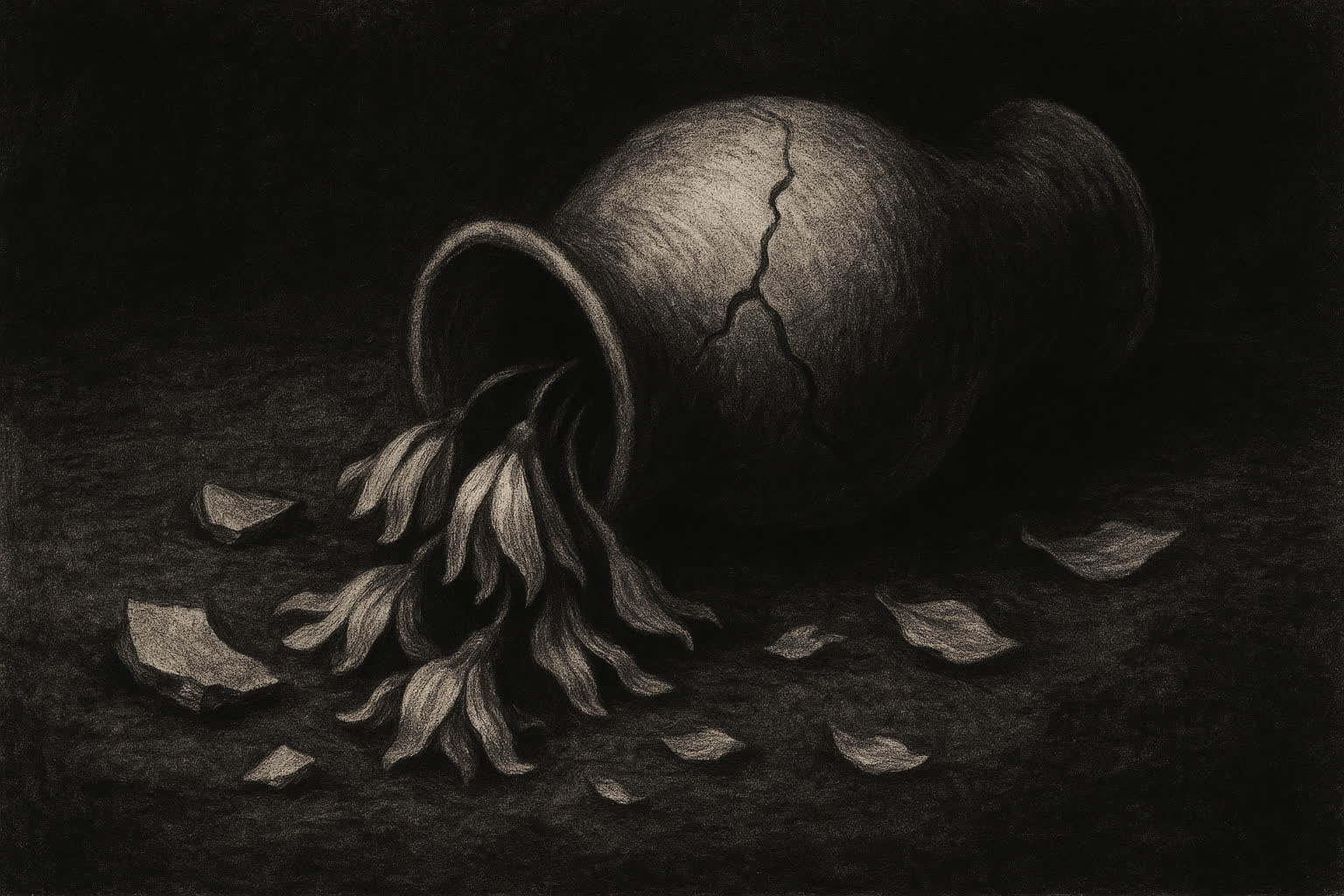
THE DISCOURSE OF ANGER
You were not angry.
You were hurt.
And the hurt moved so fast into the anger that you never saw it pass through.
That is the sentence I spent years trying to say to the right people at the right time and it never landed because by the time someone is angry the part of them that could hear the sentence is the part the anger has already shut down.
I am going to say it here anyway.
Not because I think it will land.
Because the alternative is watching another decade of people I care about destroy things they built with their own hands and then stand in the rubble feeling right.
I have been that person.
I have stood in a room and said the sentence that ended something that mattered to me, and while I was saying it I was more certain than I had been about anything in months, and the certainty felt like clarity, and the clarity felt like finally seeing the truth, and the truth was not the truth.
It was a narrowing.
The anger had closed every part of my vision except the part that confirmed the anger.
I could see the offense.
I could see the blame.
I could not see anything else.
Not because I chose not to.
Because the thing that runs anger does not leave the rest visible.
It does not show you the full room.
It shows you the target.
That is its job.
The target is all you get.
And because the target is all you get, you feel certain.
The certainty is the cruelest part.
Not the heat.
Not the shaking.
Not the thing you said that you cannot take back.
The feeling that you are finally seeing clearly, that the fog has lifted and what is underneath is obvious and the obvious thing is that someone has wronged you and the wronging must be answered.
That feeling is manufactured.
It is the output of a system that narrows your attention and floods your blood and suppresses the part of your brain that would check whether any of this is as clean as it feels.
I watched myself trust that feeling for years.
I watched it cost me things I am not getting back.
And the worst part is that afterward, when the chemicals cleared and the narrowing opened and I could see the full room again, I could feel how wrong the certainty had been.
The anger may have had real ground underneath it.
But the certainty about what to do with it was wrong every time.
Every time.
The anger said act now.
Do not wait.
The waiting is weakness and the acting is strength and the strength is what makes you feel like you again.
And I acted.
And the acting felt like arrival.
And the arrival was destruction.
And the destruction felt clean for about twenty minutes.
And then the twenty minutes ended and I was standing in a room where something that used to be whole was now in pieces and my hands were the ones that broke it.
People talk about anger as if it is a problem of control.
As if there is a technique, a count to ten, a breathing pattern, a way of holding the steering wheel while the car is already off the road.
The car was off the road before you knew you were in the car.
By the time you feel angry, the system has already fired.
The part of you that could have checked the certainty was outrun by hundreds of milliseconds and is now sitting quiet in a corner watching you do the thing you are about to regret.
I do not have a technique.
What I have is a thing I noticed, and the noticing took years, and it did not come from a book or a person on a stage with a headset.
Underneath every anger I have ever felt was a pain I did not want to feel.
Every time.
Rejection.
Shame.
The feeling of being small when someone made me feel small.
The feeling of being unseen by someone I needed to be seen by.
The pain arrived first.
The pain was soft and open and it made me feel like a thing that could be broken.
And then, before I could sit with it for even one full second, the anger came and covered it.
Covered it so fast I did not know the pain was ever there.
The anger said this is not pain.
This is power.
This is you, standing up.
This is you, refusing to take it.
And I believed it.
I believed the anger was the truth and the pain was the weakness and the weakness had to be replaced by force.
The force was the mask.
The pain was the face.
I spent years wearing the mask and calling it my face.
I watch people do this every day.
The man who rages at his wife because the alternative is feeling the rejection underneath the rage.
The parent who shouts because the shouting covers the terror of not being enough for the person they made.
None of them are angry.
All of them are hurt.
The anger is the story the hurt tells so it does not have to be the hurt.
I cannot fix this by writing about it.
The seeing does not stop the firing.
The circuit is faster than the seeing.
Every time.
But the seeing does one thing.
After the chemicals run, after the twenty minutes pass and the narrowing opens and the full room comes back.
The seeing lets you find the pain before the anger buries it again.
Not fix the pain.
Find it.
Sit with it.
Let it be soft and open and breakable, which is everything the anger exists to prevent you from feeling.
The few people I know who have changed their relationship with this did not learn a technique.
They got tired.
They got tired of standing in rooms full of broken things feeling right.
They got tired of the mask.
Not because they chose to get tired.
Because the cost got high enough that the tiredness arrived on its own.
And when it arrived, they stopped following the anger to the place it wanted to take them.
Not every time.
Not even most of the time.
But sometimes.
And sometimes was enough to see the face underneath.
And the face was the one that had been there the whole time.
Waiting.
Soft.
Unbearable.
Theirs.
The mechanism this discourse stands next to lives in The Machinery of Anger.