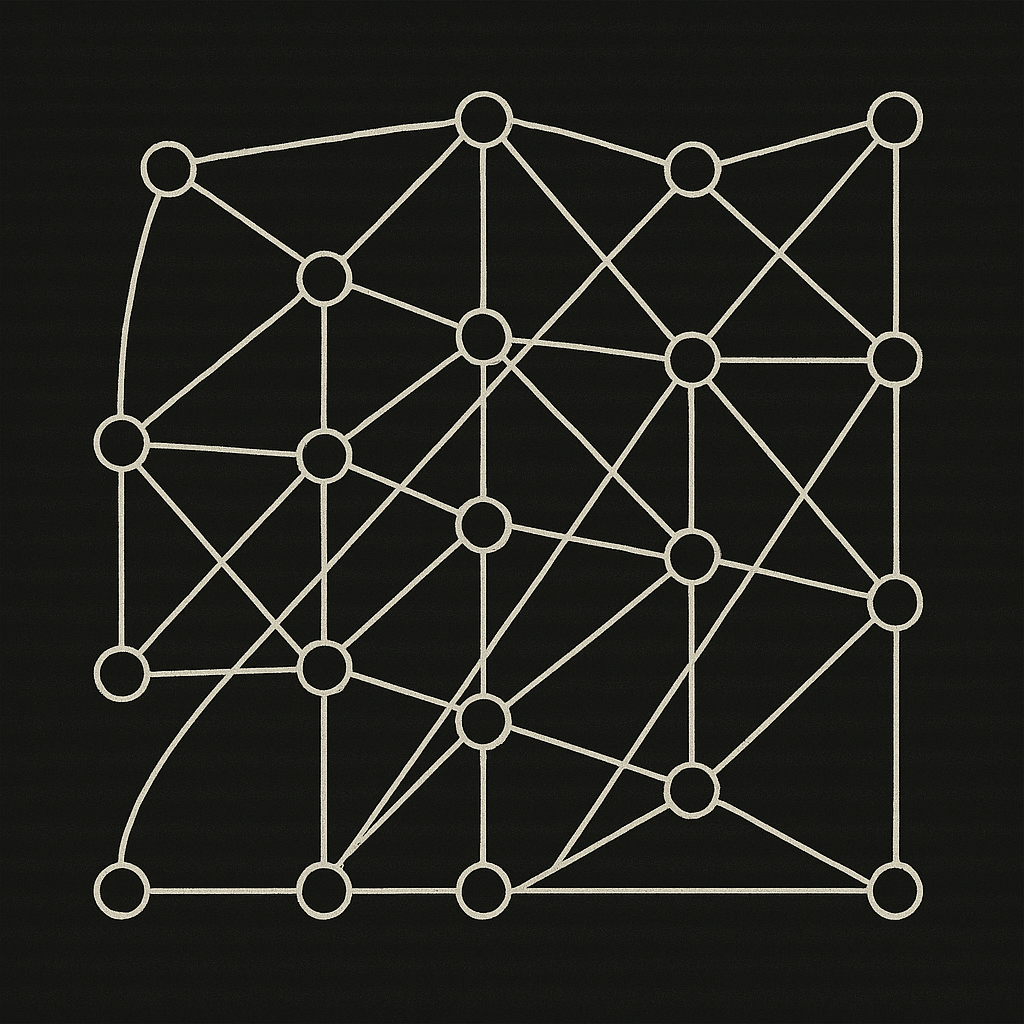
THE MACHINERY OF LOCALITY
A Complete Guide to Nearness
How the Constraint That Runs Everything Actually Works
What follows is not advice.
It is not a framework for thinking locally. Not a strategy for decentralization. Not a systems-thinking exercise dressed up in physics clothing.
It is mechanism.
The actual constraint underneath everything that moves, changes, communicates, or computes. The reason heat flows. The reason evolution gets stuck. The reason markets know things no planner can know. The reason the brain is built from columns instead of from a single processor.
Everything that happens, happens somewhere. And what happens somewhere can only affect what is nearby. Until it propagates.
This is the deepest structural fact about reality. More fundamental than energy, entropy, or information. Those things obey locality. Locality does not obey them.
This document is that seeing.
Nothing more.
What you do with it is your business.
PART ONE: THE UNIVERSE HAS NO CENTER
Nothing Acts at a Distance
For two thousand years, physics assumed that forces could reach across space instantly.
Newton’s gravity pulled the Moon toward Earth with no delay. No mechanism between them. No signal traveling the gap. Just action at a distance. Instant. Everywhere. Simultaneous.
Newton himself was uncomfortable with this. He wrote to Richard Bentley in 1693: “That gravity should be innate, inherent, and essential to matter, so that one body may act upon another at a distance through a vacuum, without the mediation of anything else… is to me so great an absurdity that I believe no man who has in philosophical matters a competent faculty of thinking can ever fall into it.”
He was right to be uncomfortable.
It took two more centuries to fix. Maxwell showed that electromagnetic forces propagate through fields at the speed of light. Einstein showed that nothing propagates faster. Not light. Not gravity. Not information. Not causality itself.
The principle of locality: an object is influenced only by its immediate surroundings. For a cause at one point to produce an effect at another, something must carry the influence through the space between them. Continuously. At finite speed.
There is no skipping ahead.
The Speed Limit
    THE LOCALITY CONSTRAINT

    ┌─────────────────────────────────────────────────┐
    │                                                 │
    │  For any event A to cause event B:              │
    │                                                 │
    │  1. Something must travel from A to B           │
    │  2. It must pass through every point between    │
    │  3. It cannot exceed the speed of light         │
    │  4. B cannot be affected before it arrives      │
    │                                                 │
    │  No exceptions in classical physics.            │
    │  No workarounds. No shortcuts.                  │
    │                                                 │
    └─────────────────────────────────────────────────┘
This is not just a speed limit on things that move.
It is a speed limit on causation itself.
If a star explodes fifty light-years away, you are safe for fifty years. Not because the debris takes time to reach you. Because the fact that it happened cannot reach you faster than light. The explosion does not exist in your causal reality until light from it arrives.
Locality means the universe is sewn together stitch by stitch. Point to adjacent point. No teleportation. No broadcast. No omniscience. Just neighbors talking to neighbors, and the conversation propagating outward at a finite rate.
PART TWO: THE LIGHT CONE
The Shape of What Can Affect You
Every event in spacetime has a boundary. A horizon beyond which nothing can have caused it, and nothing it does can reach.
This boundary is the light cone.
    THE LIGHT CONE

                          FUTURE
                           /|\
                          / | \
                         /  |  \
                        /   |   \
                       / CAN|    \
                      / REACH     \
                     / THIS |      \
                    / EVENT |       \
    ───────────────/────────┼────────\─────────── NOW
                   \        │       /
                    \ WAS   │      /
                     \ ABLE │     /
                      \ TO  │    /
                       \REACH   /
                        \THIS| /
                         \ │  /
                          \│ /
                          PAST

    Everything outside the cone: causally disconnected.
    Nothing there can affect here. Nothing here can affect there.
    The cone expands at the speed of light.
The light cone is not a metaphor. It is the actual structure of causal reality.
Two events separated by more space than light could cross in the time between them are causally disconnected. They cannot influence each other. They cannot even agree on which one happened first. Different observers moving at different velocities will disagree on the temporal ordering.
Simultaneity is not a fact about the universe. It is a fact about your reference frame.
Locality makes the universe local. Not as a preference. As a geometric necessity.
What This Means
The light cone creates a hard partition in reality.
Every event divides all of spacetime into three regions: the causal past (events that could have influenced it), the causal future (events it could influence), and the elsewhere (events it can never touch).
    CAUSAL STRUCTURE OF EVERY EVENT

    ┌──────────────────────────────────────────────────┐
    │                                                  │
    │  CAUSAL FUTURE                                   │
    │  Everything this event can still influence        │
    │  Grows outward at c                              │
    │                                                  │
    ├──────────────────────────────────────────────────┤
    │                                                  │
    │  THE ELSEWHERE                                   │
    │  Causally disconnected                           │
    │  Cannot be influenced or influence               │
    │  Might as well be a different universe           │
    │                                                  │
    ├──────────────────────────────────────────────────┤
    │                                                  │
    │  CAUSAL PAST                                     │
    │  Everything that could have influenced it        │
    │  Contracted inward at c                          │
    │                                                  │
    └──────────────────────────────────────────────────┘
This is why locality is more fundamental than most principles. Conservation laws, thermodynamic laws, symmetry principles. They all operate within the light cone. Locality defines which events get to participate in the same physics.
PART THREE: THE GRADIENT
How Things Move Locally
If nothing acts at a distance, how does anything move?
Gradients.
A gradient is a local difference in concentration, temperature, pressure, or potential between adjacent points. Things flow down gradients. Not because some distant destination pulls them. Because the local neighborhood pushes.
Fourier’s law of heat conduction: heat flux is proportional to the negative local temperature gradient.
Not “heat flows from hot regions to cold regions.” That describes the outcome. The mechanism is local. Each point passes energy to the point next to it if there is a temperature difference between them. That is all. The point does not know about the cold wall two meters away. It only knows about its immediate neighbors.
    LOCAL HEAT TRANSPORT

    Temperature:  100°    80°    60°    40°    20°

                   ▼       ▼       ▼       ▼
                  ┌───┐   ┌───┐   ┌───┐   ┌───┐   ┌───┐
                  │ A │──►│ B │──►│ C │──►│ D │──►│ E │
                  └───┘   └───┘   └───┘   └───┘   └───┘

    Each cell only knows its neighbors.
    A passes heat to B because A is hotter than B.
    B passes heat to C because B is hotter than C.
    No cell knows the global temperature distribution.
    The global flow emerges from local differences.
Fick’s law of diffusion. Darcy’s law of fluid flow through porous media. Ohm’s law of electrical current. All the same structure. All local. The current at any point depends only on the gradient at that point. Not on distant conditions.
This is the machinery of transport. Not commands from a center. Not attraction from a destination. Just local differences, resolved one neighbor at a time, cascading outward.
The Diffusion Equation
The diffusion equation is locality written in mathematics.
The rate of change at any point depends only on the curvature of the field at that point. The second derivative. How the value at this point compares to the average of its immediate neighbors.
If a point is cooler than its neighbors, heat flows in. If hotter, heat flows out. That is the entire computation. Repeated at every point simultaneously.
No global awareness required.
    DIFFUSION AS LOCAL COMPUTATION

    ┌─────────────────────────────────────────────────┐
    │                                                 │
    │  At each point x, at each moment t:             │
    │                                                 │
    │  1. Compare your value to your neighbors        │
    │  2. If higher: give some away                   │
    │  3. If lower:  receive some                     │
    │  4. Repeat                                      │
    │                                                 │
    │  Result: smooth spreading over time             │
    │  No point needs to know the global state        │
    │                                                 │
    └─────────────────────────────────────────────────┘

    Time →

    t=0:    ░░░░░░████████░░░░░░
    t=1:    ░░░░▒▒▓▓████▓▓▒▒░░░░
    t=2:    ░░▒▒▓▓▓▓████▓▓▓▓▒▒░░
    t=3:    ▒▒▒▓▓▓▓▓████▓▓▓▓▓▒▒▒
    t=∞:    ▓▓▓▓▓▓▓▓▓▓▓▓▓▓▓▓▓▓▓▓

    Equilibrium: uniform distribution
This is how physical reality resolves imbalances. Not by fiat. Not by plan. By each point doing one simple thing: comparing itself to its neighbors and adjusting.
PART FOUR: LOCAL RULES, GLOBAL PATTERN
The Cellular Automaton
The purest demonstration of locality is the cellular automaton.
A grid of cells. Each cell has a state. Each cell updates according to a rule that looks only at its immediate neighbors.
No cell knows the state of distant cells. No cell receives instructions from a controller. No cell has a map of the grid.
And yet.
Conway’s Game of Life. Four rules. Birth, survival, death, based only on how many of a cell’s eight neighbors are alive.
From these four local rules: gliders that move across the grid. Oscillators that pulse. Spaceships that travel. Structures that build other structures. A system capable of universal computation.
Everything that can be computed by any computer can be computed by cells following local rules.
    CELLULAR AUTOMATA: LOCAL INPUT, GLOBAL OUTPUT

    ┌──────────────┐    ┌──────────────┐    ┌──────────────┐
    │              │    │              │    │              │
    │  EACH CELL   │    │  EACH CELL   │    │  EACH CELL   │
    │  sees only   │    │  sees only   │    │  sees only   │
    │  neighbors   │    │  neighbors   │    │  neighbors   │
    │              │    │              │    │              │
    └──────┬───────┘    └──────┬───────┘    └──────┬───────┘
           │                   │                   │
           └───────────────────┼───────────────────┘
                               │
                               ▼
    ┌──────────────────────────────────────────────────────┐
    │                                                      │
    │               GLOBAL PATTERN EMERGES                 │
    │                                                      │
    │  Gliders, oscillators, spaceships, computers         │
    │  None of which any individual cell "knows about"     │
    │                                                      │
    └──────────────────────────────────────────────────────┘
Rule 110
In 2004, Matthew Cook proved that Rule 110, an elementary cellular automaton, is Turing complete.
Rule 110 is one-dimensional. Each cell is either 0 or 1. Each cell’s next state depends on its current state and the states of its two immediate neighbors. Three inputs. One output. Eight possible combinations. One fixed lookup table.
From this: universal computation.
The simplest possible local rule. The most powerful possible global behavior.
This is the deepest statement about locality and complexity. You do not need a central processor. You do not need global communication. You do not need a blueprint. Local rules, applied uniformly, can generate any computable pattern.
Complexity is not imported from above. It emerges from below. From neighbors talking to neighbors.
PART FIVE: THE LOCAL KNOWLEDGE PROBLEM
Hayek’s Insight
In 1945, Friedrich Hayek published “The Use of Knowledge in Society.” It is one of the most important papers ever written about locality in human systems.
His argument: the knowledge required to coordinate an economy does not exist in any single place. It is dispersed across millions of minds. Each person knows things about their local conditions that no central authority can ever aggregate.
The baker knows the quality of the flour that arrived this morning. The trucker knows which roads are closed. The farmer knows which field drained poorly last week. The customer knows what she felt like eating today.
This knowledge is local. It is contextual. It is often inarticulable. It cannot be transmitted to a central planning office in time to be useful. And even if it could be transmitted, the office could not process it. The combinatorial explosion of local conditions across millions of agents exceeds any computational capacity.
    THE KNOWLEDGE DISTRIBUTION

    CENTRAL PLANNING:

    ┌─────────────────────────────────────────────────┐
    │                                                 │
    │              CENTRAL PLANNER                    │
    │   Must know everything to decide well           │
    │                                                 │
    └──────────────────────┬──────────────────────────┘
                           │
             ┌─────────────┼─────────────┐
             │             │             │
             ▼             ▼             ▼
        ┌─────────┐  ┌─────────┐  ┌─────────┐
        │ Agent 1 │  │ Agent 2 │  │ Agent 3 │
        │ local   │  │ local   │  │ local   │
        │ info ██ │  │ info ██ │  │ info ██ │
        └─────────┘  └─────────┘  └─────────┘

    Information must flow UP before decisions flow DOWN.
    Latency. Compression loss. Bandwidth limit.


    PRICE SYSTEM:

        ┌─────────┐  ┌─────────┐  ┌─────────┐
        │ Agent 1 │──│ Agent 2 │──│ Agent 3 │
        │ local   │  │ local   │  │ local   │
        │ info ██ │  │ info ██ │  │ info ██ │
        │ decides │  │ decides │  │ decides │
        │ locally │  │ locally │  │ locally │
        └─────────┘  └─────────┘  └─────────┘
             │             │             │
             └─────────────┼─────────────┘
                           │
                           ▼
                  ┌───────────────┐
                  │     PRICE     │
                  │  Compressed   │
                  │  signal of    │
                  │  all local    │
                  │  conditions   │
                  └───────────────┘

    Each agent acts on local knowledge.
    Prices propagate summary information.
    No center needed.
The price system is a local coordination mechanism. Each buyer and seller makes decisions based on local conditions, including the price signal. The price signal itself emerges from the aggregate of local decisions. No one computes it centrally. It arises from the interaction.
This is locality in economic systems. The same principle that makes heat flow without a thermostat makes markets coordinate without a planner.
The Failure Mode
Central planning fails not because planners are stupid. It fails because locality is a structural constraint. The information needed for good decisions exists only at the point of action. By the time it travels to a center and back, it has decayed. The flour has been used. The road has been cleared. The customer has gone home.
Every attempt to centralize inherently local information introduces latency, compression loss, and misalignment. The larger the system, the worse the mismatch.
This is not an argument about politics. It is physics applied to information flow.
PART SIX: THE NETWORK SHORTCUT
Small Worlds
If locality means everything must propagate through neighbors, how does the world feel so connected?
In 1998, Duncan Watts and Steven Strogatz published a paper that formalized the answer: small-world networks.
Most networks are neither purely local (regular lattices where each node connects only to its nearest neighbors) nor purely random (where connections are distributed uniformly regardless of distance). They are something in between.
High local clustering. Short global path lengths.
    THREE NETWORK ARCHITECTURES

    REGULAR (purely local):
    ○─○─○─○─○─○─○─○─○─○
    │                   │
    └───────────────────┘

    Every node connects only to neighbors.
    High clustering. Long path lengths.
    Information must traverse every link.


    RANDOM (no locality):
    ○──────────○    ○──○
    │          │    │
    ○    ○─────○    ○──────○
              │            │
    ○─────────○────────────○

    Connections ignore distance.
    Low clustering. Short path lengths.
    No local structure.


    SMALL-WORLD (locality + shortcuts):
    ○─○─○─○─○─○─○─○─○─○
    │       ╲       ╱   │
    └───────────────────┘

    Mostly local connections.
    A few long-range shortcuts.
    High clustering AND short path lengths.
The human social network is a small-world network. Most of your connections are local. People in your neighborhood, your workplace, your social circle. But a few connections bridge distant clusters. A college friend who moved to Tokyo. A cousin in Berlin. A former colleague now in a different industry.
These rare long-range links do something extraordinary. They collapse the effective diameter of the network. Six degrees of separation. Not because everyone connects to everyone. Because a few bridges connect local clusters to distant ones.
The Architecture of Propagation
Small-world networks solve a fundamental tension.
Local processing requires local connectivity. Dense neighborhoods where information circulates quickly between nearby nodes.
Global coordination requires long-range connectivity. Bridges that carry signals across the network.
Purely local networks have the first but not the second. Information propagates slowly. Purely random networks have the second but not the first. Local computation is impossible.
Small-world architecture gives both. Most links serve local processing. A few links serve global coordination. The system is both locally coherent and globally connected.
    THE SMALL-WORLD SOLUTION

    ┌─────────────────────────────────────────────────┐
    │                                                 │
    │  LOCAL CONNECTIONS (majority):                  │
    │  ███████████████████████████████████████  (95%) │
    │  High clustering, local computation             │
    │                                                 │
    │  LONG-RANGE SHORTCUTS (minority):               │
    │  ████  (5%)                                     │
    │  Short path lengths, global coordination        │
    │                                                 │
    │  Result: local coherence + global reach         │
    │                                                 │
    └─────────────────────────────────────────────────┘
The brain is a small-world network. Cortical columns process locally. Long-range white matter tracts connect distant regions. Most synaptic connections are short-range. A few are long-range. The architecture mirrors the mathematics exactly.
PART SEVEN: THE TRAP OF LOCAL OPTIMA
The Hill-Climbing Problem
Locality constrains not just communication. It constrains optimization.
Imagine a fitness landscape. A surface where every point represents a configuration, and height represents performance. Evolution, learning, market competition. All operate by hill-climbing. Make a small local change. If performance improves, keep it. If not, discard it.
This is local search. Only nearby configurations can be evaluated. Only small steps can be taken. The optimizer cannot teleport to a distant peak. It can only walk uphill from where it stands.
And here is the trap.
    THE LOCAL OPTIMA TRAP

    Fitness
         │
         │                                ████
         │                               █    █
    GLOBAL│                              █      █
    MAX   │                             █        █
         │           ████              █
         │          █    █            █
    LOCAL │         █      █         █
    MAX   │        █        █       █
         │       █          █     █
         │      █            █   █
         │     █              █ █
         │    █                █
         │   █
         │
         └───────────────────────────────────────► Config

         ▲
         │
    You are here.
    Every local step leads downhill.
    The global maximum is over there.
    But you cannot see it.
    And you cannot reach it without going down first.
A local optimizer stops at any local maximum. It cannot distinguish a local peak from the global peak. Both feel the same from the top. Every direction leads down.
Evolution gets stuck on local optima. Organisms are well-adapted to their immediate niche but far from the best possible design. The constraint is locality. Evolution cannot evaluate configurations that are not adjacent to the current one.
Markets get stuck on local optima. An industry converges on a standard that is not the best possible technology. But switching costs create a valley between the current peak and the better one. QWERTY. VHS. The internal combustion engine for a century.
Neural networks get stuck on local optima. Gradient descent follows the local slope. If the loss surface is rugged, the optimizer finds a nearby minimum and stops. It cannot know whether a better minimum exists beyond the next valley.
The Cost of Escaping
To escape a local optimum, you must go downhill first.
You must accept worse performance before you can find better performance. You must cross the valley.
This requires one of three things:
Randomness. Shake the system hard enough to dislodge it from its peak. In evolution, this is mutation and genetic drift. In optimization, this is simulated annealing. In human systems, this is crisis.
Resources. Sustain the cost of reduced performance while crossing the valley. Only systems with surplus can afford the journey.
Bridging. Build a connection that spans the valley without crossing it. In networks, this is the long-range shortcut. In technology, this is the breakthrough that reframes the landscape entirely.
    THREE ESCAPE MECHANISMS

    ┌──────────────────┐  ┌──────────────────┐  ┌──────────────────┐
    │                  │  │                  │  │                  │
    │   RANDOMNESS     │  │    RESOURCES     │  │    BRIDGING      │
    │                  │  │                  │  │                  │
    │  Shake the       │  │  Absorb the      │  │  Reframe the     │
    │  system off      │  │  cost of going   │  │  landscape       │
    │  its peak        │  │  down before up  │  │  entirely        │
    │                  │  │                  │  │                  │
    │  Mutation        │  │  Surplus energy  │  │  Paradigm shift  │
    │  Noise           │  │  Slack capacity  │  │  New dimension   │
    │  Crisis          │  │  Patient capital │  │  Reframing       │
    │                  │  │                  │  │                  │
    └──────────────────┘  └──────────────────┘  └──────────────────┘
All three are expensive. Locality makes optimization cheap but complete optimization impossible. This is the fundamental tradeoff.
PART EIGHT: LOCAL ARCHITECTURE IN BIOLOGY
The Morphogen Gradient
In 1952, Alan Turing published “The Chemical Basis of Morphogenesis.” He showed that local chemical interactions between diffusing molecules could produce spatial patterns.
No blueprint required.
A morphogen is a signaling molecule that diffuses from a source. Cells do not receive instructions from a master plan. They read the local concentration of the morphogen and respond accordingly. High concentration near the source. Low concentration far away. The gradient creates positional information.
A cell does not know where it is in the body. It knows the local morphogen concentration. That is sufficient.
    MORPHOGEN GRADIENT AND CELL FATE

    Source                                         Distance →
      │
      ▼
    ████████████████████████░░░░░░░░░░░░░░░░░░░░░░░░░░░░░░
    ████████████████░░░░░░░░░░░░░░░░░░░░░░░░░░░░░░░░░░░░░░
    ████████████░░░░░░░░░░░░░░░░░░░░░░░░░░░░░░░░░░░░░░░░░░
    ████████░░░░░░░░░░░░░░░░░░░░░░░░░░░░░░░░░░░░░░░░░░░░░░

    ┌──────────┐  ┌──────────┐  ┌──────────┐  ┌──────────┐
    │  FATE A  │  │  FATE B  │  │  FATE C  │  │  FATE D  │
    │  high    │  │  medium  │  │  low     │  │  trace   │
    │  conc.   │  │  conc.   │  │  conc.   │  │  conc.   │
    └──────────┘  └──────────┘  └──────────┘  └──────────┘

    Each cell reads LOCAL concentration.
    No cell reads a blueprint.
    Pattern emerges from diffusion + threshold response.
Turing showed something more. Two morphogens with different diffusion rates and opposite effects (one activating, one inhibiting) can spontaneously generate periodic patterns. Stripes. Spots. Waves. Not from a template. From local reaction and local diffusion.
The leopard’s spots are not painted on. They emerge from local chemistry.
Cortical Columns
The neocortex is built from columns. Vertical cylinders of neurons approximately 300 micrometers in diameter. Each column processes information locally.
Neurons within a column are densely interconnected. Neurons between nearby columns communicate regularly. Neurons in distant columns rarely communicate directly.
Local processing. Local circuitry. Local computation.
The column does not know what the brain is doing. It knows what its inputs are saying and what its neighbors are saying. From this local processing, multiplied across millions of columns, cognition emerges.
    CORTICAL ARCHITECTURE

    ┌──────┐  ┌──────┐  ┌──────┐  ┌──────┐  ┌──────┐
    │      │  │      │  │      │  │      │  │      │
    │ Col  │──│ Col  │──│ Col  │──│ Col  │──│ Col  │
    │  1   │  │  2   │  │  3   │  │  4   │  │  5   │
    │      │  │      │  │      │  │      │  │      │
    │ ░░░░ │  │ ░░░░ │  │ ░░░░ │  │ ░░░░ │  │ ░░░░ │
    │ ░░░░ │  │ ░░░░ │  │ ░░░░ │  │ ░░░░ │  │ ░░░░ │
    │ ░░░░ │  │ ░░░░ │  │ ░░░░ │  │ ░░░░ │  │ ░░░░ │
    └──────┘  └──────┘  └──────┘  └──────┘  └──────┘
       │                                       │
       └──────── long-range white matter ──────┘

    Dense local connections between adjacent columns.
    Sparse long-range connections between distant regions.
    Small-world architecture in biological tissue.
The brain did not evolve central processing. It evolved local processing at massive scale, threaded together by a few strategic long-range connections.
This is locality, solved the same way the mathematics predicts.
PART NINE: THE BOUNDARY OF LOCALITY
Bell’s Theorem
In 1964, John Stewart Bell proved something that should have shaken physics to its foundations.
Quantum mechanics violates locality. Or at least, it appears to.
Two entangled particles are created together and sent in opposite directions. Measuring the state of one particle instantaneously determines the state of the other. No matter how far apart they are.
Einstein called this “spooky action at a distance.” He believed it proved quantum mechanics was incomplete. There must be hidden variables, predetermined values carried by each particle, that explained the correlations without requiring instantaneous influence.
Bell showed this was wrong.
He derived an inequality that any local hidden-variable theory must satisfy. Quantum mechanics predicts violations of that inequality. Experiments confirm the violations.
No theory that is both local and realistic can reproduce the predictions of quantum mechanics.
    BELL'S THEOREM

    ┌─────────────────────────────────────────────────────┐
    │                                                     │
    │  LOCAL REALISM                                      │
    │  Objects have definite properties before             │
    │  measurement. No faster-than-light influence.        │
    │                                                     │
    │  Predicts: Bell inequality satisfied                │
    │                                                     │
    ├─────────────────────────────────────────────────────┤
    │                                                     │
    │  QUANTUM MECHANICS                                  │
    │  Properties undefined until measured.                │
    │  Entangled particles exhibit correlations            │
    │  unexplainable by local hidden variables.            │
    │                                                     │
    │  Predicts: Bell inequality violated                 │
    │                                                     │
    ├─────────────────────────────────────────────────────┤
    │                                                     │
    │  EXPERIMENT                                         │
    │  Bell inequality is violated.                       │
    │  Quantum mechanics wins.                            │
    │  Local realism loses.                               │
    │                                                     │
    └─────────────────────────────────────────────────────┘
The Saving Grace
But here is the crucial subtlety.
Quantum nonlocality does not allow faster-than-light communication. The correlations between entangled particles are real, but they cannot be used to send information. The outcome of each individual measurement is random. Only when both measurements are compared (which requires classical, slower-than-light communication) do the correlations become visible.
Nonlocality in correlation. Locality in communication.
    THE QUANTUM COMPROMISE

    ┌───────────────────────────┐  ┌───────────────────────────┐
    │                           │  │                           │
    │      CORRELATIONS         │  │      INFORMATION          │
    │                           │  │                           │
    │  Can be nonlocal          │  │  Must be local            │
    │  Entangled outcomes       │  │  No FTL signaling         │
    │  violate Bell             │  │  Causality preserved      │
    │  inequalities             │  │  Speed limit holds        │
    │                           │  │                           │
    └───────────────────────────┘  └───────────────────────────┘
The universe appears to allow nonlocal correlations while prohibiting nonlocal causation. The correlations are real. But they cannot be weaponized. You cannot use entanglement to send a message faster than light. You cannot use it to influence a distant event. You cannot use it to violate causality.
Locality, in the sense that matters for everything in this document, survives quantum mechanics. Bruised, but intact. Information, influence, and causation remain stubbornly local.
PART TEN: THE CONSTRAINTS
The Costs of Locality
Locality is not free. It imposes structural costs on every system that operates under it.
Cost 1: Latency. Information takes time to propagate. By the time a signal from one part of a system reaches another, conditions may have changed. Every distributed system faces this. The larger the system, the worse the lag.
Cost 2: Coordination overhead. Without a global view, coordinating behavior across a system requires protocols. Handshakes. Consensus mechanisms. Synchronization algorithms. These consume energy and bandwidth. They are the tax locality charges for coherent behavior.
Cost 3: Suboptimal convergence. Local optimization does not guarantee global optimization. The system can settle into configurations that are locally stable but globally inferior. Escaping requires resources that the system may not have.
Cost 4: Bottlenecks. When information must pass through a sequence of local links, any link can become a bottleneck. The throughput of the entire chain is limited by its weakest local connection.
    THE FOUR COSTS OF LOCALITY

    ┌──────────────────────────────────────────────────────┐
    │                                                      │
    │  LATENCY                                             │
    │  Information propagates at finite speed               │
    │  Larger systems → longer delays                      │
    │  ████████████████████████████████  (scales with size) │
    │                                                      │
    ├──────────────────────────────────────────────────────┤
    │                                                      │
    │  COORDINATION OVERHEAD                               │
    │  Protocols required for coherent behavior             │
    │  Consensus is expensive                              │
    │  ████████████████████  (grows with agents)            │
    │                                                      │
    ├──────────────────────────────────────────────────────┤
    │                                                      │
    │  SUBOPTIMAL CONVERGENCE                              │
    │  Local optima trap global search                     │
    │  No guarantee of best solution                       │
    │  █████████████████████████  (rugged landscapes)      │
    │                                                      │
    ├──────────────────────────────────────────────────────┤
    │                                                      │
    │  BOTTLENECKS                                         │
    │  Chain limited by weakest link                       │
    │  Sequential locality creates chokepoints             │
    │  ████████████  (structural, not fixable               │
    │                 without topology change)              │
    │                                                      │
    └──────────────────────────────────────────────────────┘
The Benefits of Locality
But locality also provides.
Benefit 1: Robustness. Local damage stays local. A failure in one part of a locally-organized system does not instantly propagate everywhere. The damage must spread through neighbors, giving the system time to respond. Centralized systems are fragile because the center is a single point of failure. Local systems are robust because there is no center to fail.
Benefit 2: Scalability. A system built on local rules can grow without redesigning its architecture. Add more cells to the cellular automaton. Add more agents to the market. Add more columns to the cortex. The local rules do not change. The system simply gets larger.
Benefit 3: Parallelism. Every local computation can happen simultaneously. No waiting for a central controller to issue instructions. The diffusion equation is solved at every point at the same time. Each cortical column processes in parallel with every other. Locality is inherently parallel.
Benefit 4: Efficiency. Each node processes only local information. No node must handle the full complexity of the global state. The computational burden is distributed across the system, proportional to the system’s size.
    COSTS VS BENEFITS

    ┌─────────────────────────┐  ┌─────────────────────────┐
    │                         │  │                         │
    │        COSTS            │  │       BENEFITS          │
    │                         │  │                         │
    │  Latency                │  │  Robustness             │
    │  Coordination overhead  │  │  Scalability            │
    │  Suboptimal convergence │  │  Parallelism            │
    │  Bottlenecks            │  │  Efficiency             │
    │                         │  │                         │
    │  These cannot be        │  │  These cannot be        │
    │  eliminated. They       │  │  achieved by central    │
    │  can only be managed.   │  │  systems at scale.      │
    │                         │  │                         │
    └─────────────────────────┘  └─────────────────────────┘
PART ELEVEN: THE COMPLETE PICTURE
The Unified Framework
Everything connects.
    THE COMPLETE FRAMEWORK OF LOCALITY

    ┌─────────────────────────────────────────────────────────┐
    │                                                         │
    │                    THE PRINCIPLE                        │
    │                                                         │
    │  An object is influenced only by its immediate          │
    │  surroundings. All influence propagates at finite        │
    │  speed through the space between cause and effect.       │
    │                                                         │
    └─────────────────────────────────────────────────────────┘
                              │
              ┌───────────────┼───────────────┐
              │               │               │
              ▼               ▼               ▼
    ┌─────────────────┐ ┌─────────────────┐ ┌─────────────────┐
    │                 │ │                 │ │                 │
    │   TRANSPORT     │ │  COMPUTATION    │ │  OPTIMIZATION   │
    │                 │ │                 │ │                 │
    │  Gradients      │ │  Local rules    │ │  Hill-climbing  │
    │  drive flow     │ │  generate       │ │  constrains     │
    │  neighbor to    │ │  global         │ │  search to      │
    │  neighbor       │ │  pattern        │ │  local moves    │
    │                 │ │                 │ │                 │
    └─────────────────┘ └─────────────────┘ └─────────────────┘
              │               │               │
              └───────────────┼───────────────┘
                              │
                              ▼
    ┌─────────────────────────────────────────────────────────┐
    │                                                         │
    │                      THE RESULT                         │
    │                                                         │
    │  Robust, scalable, parallel systems that converge       │
    │  on good-enough solutions without global awareness.     │
    │  The cost: latency, local optima, coordination tax.     │
    │                                                         │
    └─────────────────────────────────────────────────────────┘
Locality is not a limitation of physics. It is the architecture of physics.
Heat does not flow because a thermostat commands it. It flows because adjacent molecules have different energies.
Patterns do not form because a blueprint specifies them. They form because adjacent cells follow the same local rules.
Markets do not coordinate because a planner directs them. They coordinate because adjacent traders respond to local prices.
Brains do not think because a central processor computes. They think because adjacent columns process local signals.
Evolution does not design because a designer imagines. It designs because adjacent mutations get tested against local fitness.
The Operating Modes
Every system that obeys locality faces the same choice.
    THE TWO MODES OF LOCAL SYSTEMS

    ════════════════════════════════════════════════════════════

    MODE A: PURE LOCALITY

    All connections local.
    Maximum robustness and parallelism.
    Maximum latency and local-optima risk.

    Lattice networks. Strict hierarchies.
    Command chains. Assembly lines.

    ════════════════════════════════════════════════════════════

    MODE B: LOCALITY WITH SHORTCUTS

    Mostly local connections.
    A few long-range bridges.
    Small-world architecture.

    Retains local robustness.
    Gains global coordination.
    Reduces optima-trapping.
    Introduces fragility at the bridges.

    Neural networks. Social networks. Markets.
    The internet. The brain.

    ════════════════════════════════════════════════════════════
The second mode always wins. Not because locality is wrong, but because pure locality is too slow for systems that must also coordinate globally. The art is in the ratio. How many local connections per long-range bridge. Too few bridges and the system fragments. Too many and it loses its local coherence.
Final Synthesis
Locality is the deepest structural constraint on reality.
This is not metaphor. It is geometry. Baked into the fabric of spacetime. Enforced by the speed of light. Expressed in every transport law, every diffusion equation, every conservation law written in differential form.
Nothing acts at a distance.
Everything that happens, happens here. And then propagates.
Heat does not jump. It conducts. Information does not teleport. It travels. Influence does not broadcast. It diffuses.
The consequences run through every domain.
Physics obeys locality: light cones, field equations, finite propagation.
Biology obeys locality: morphogen gradients, cortical columns, local signaling.
Economics obeys locality: distributed knowledge, price signals, decentralized coordination.
Computation obeys locality: cellular automata, local rules, emergent complexity.
Optimization obeys locality: hill-climbing, local optima, fitness landscapes.
Even quantum mechanics, which bends locality for correlations, preserves it for causation and information.
The universe is local. Not as a preference. Not as an approximation. As a structural fact about the geometry of causation.
And every system that works. Every system that scales. Every system that is robust. Every system that computes.
Works because it respects this fact. Builds on local foundations. Lets global patterns emerge from local interactions. Uses shortcuts sparingly. Accepts the costs of latency and suboptimality as the price of robustness and scalability.
The machinery runs whether you see it or not.
But seeing it reveals why centralization fails. Why complexity emerges from simplicity. Why the best-designed systems are not the ones with the most powerful centers, but the ones with the best local rules.
The universe has no center.
And that is not a flaw.
It is the design.
CITATIONS
Foundational Physics
The Principle of Locality and Special Relativity
Einstein, A. (1905). “On the Electrodynamics of Moving Bodies.” Annalen der Physik, 17(10):891-921.
Einstein, A., Podolsky, B., & Rosen, N. (1935). “Can Quantum-Mechanical Description of Physical Reality Be Considered Complete?” Physical Review, 47(10):777-780.
Spacetime and Causal Structure
Minkowski, H. (1908). “Space and Time.” Address delivered at the 80th Assembly of German Natural Scientists and Physicians. English translation in The Principle of Relativity (1952), Dover.
Hawking, S.W. & Ellis, G.F.R. (1973). The Large Scale Structure of Space-Time. Cambridge University Press.
Electromagnetism and Field Theory
Maxwell, J.C. (1865). “A Dynamical Theory of the Electromagnetic Field.” Philosophical Transactions of the Royal Society of London, 155:459-512.
Quantum Nonlocality
Bell’s Theorem
Bell, J.S. (1964). “On the Einstein Podolsky Rosen Paradox.” Physics, 1(3):195-200.
Aspect, A., Dalibard, J., & Roger, G. (1982). “Experimental Realization of Einstein-Podolsky-Rosen-Bohm Gedankenexperiment: A New Violation of Bell’s Inequalities.” Physical Review Letters, 49(25):1804-1807.
Hensen, B., et al. (2015). “Loophole-free Bell inequality violation using electron spins separated by 1.3 kilometres.” Nature, 526:682-686.
Information Propagation
Lieb-Robinson Bounds
Lieb, E.H. & Robinson, D.W. (1972). “The finite group velocity of quantum spin systems.” Communications in Mathematical Physics, 28(3):251-257.
Nachtergaele, B., Ogata, Y., & Sims, R. (2006). “Propagation of Correlations in Quantum Lattice Systems.” Journal of Statistical Physics, 124:1-13.
Transport Phenomena
Fourier’s Law and Diffusion
Fourier, J.B.J. (1822). Théorie analytique de la chaleur. Paris: Firmin Didot.
Fick, A. (1855). “On Liquid Diffusion.” Philosophical Magazine, 10(63):30-39.
Cellular Automata and Computation
Local Rules and Universal Computation
Wolfram, S. (2002). A New Kind of Science. Wolfram Media.
Cook, M. (2004). “Universality in Elementary Cellular Automata.” Complex Systems, 15(1):1-40.
Gardner, M. (1970). “Mathematical Games: The fantastic combinations of John Conway’s new solitaire game ‘life’.” Scientific American, 223(4):120-123.
Economics and Distributed Knowledge
The Local Knowledge Problem
Hayek, F.A. (1945). “The Use of Knowledge in Society.” American Economic Review, 35(4):519-530.
Network Theory
Small-World Networks
Watts, D.J. & Strogatz, S.H. (1998). “Collective dynamics of ‘small-world’ networks.” Nature, 393:440-442.
Milgram, S. (1967). “The Small World Problem.” Psychology Today, 2(1):60-67.
Developmental Biology
Morphogen Gradients and Pattern Formation
Turing, A.M. (1952). “The Chemical Basis of Morphogenesis.” Philosophical Transactions of the Royal Society B, 237(641):37-72.
Wolpert, L. (1969). “Positional information and the spatial pattern of cellular differentiation.” Journal of Theoretical Biology, 25(1):1-47.
Neuroscience
Cortical Columns and Local Processing
Mountcastle, V.B. (1997). “The columnar organization of the neocortex.” Brain, 120(4):701-722.
Hubel, D.H. & Wiesel, T.N. (1962). “Receptive fields, binocular interaction and functional architecture in the cat’s visual cortex.” Journal of Physiology, 160(1):106-154.
Optimization and Fitness Landscapes
Local Optima and Rugged Landscapes
Kauffman, S.A. & Levin, S. (1987). “Towards a general theory of adaptive walks on rugged landscapes.” Journal of Theoretical Biology, 128(1):11-45.
Wright, S. (1932). “The roles of mutation, inbreeding, crossbreeding and selection in evolution.” Proceedings of the Sixth International Congress of Genetics, 1:356-366.
Related Machineries
- THE MACHINERY OF EMERGENCE. Emergence is the global consequence of locality. Local rules produce global patterns precisely because no center specifies them.
- THE MACHINERY OF CAUSALITY. Locality defines the geometry that causality must obey. Every causal chain propagates through adjacent points at finite speed.
- THE MACHINERY OF CONSTRAINTS. Locality is the most fundamental constraint. It shapes what transport, computation, and optimization can and cannot do.
- THE MACHINERY OF INFORMATION. Information obeys locality. It cannot teleport, skip, or broadcast instantaneously. Its propagation speed is structurally bounded.