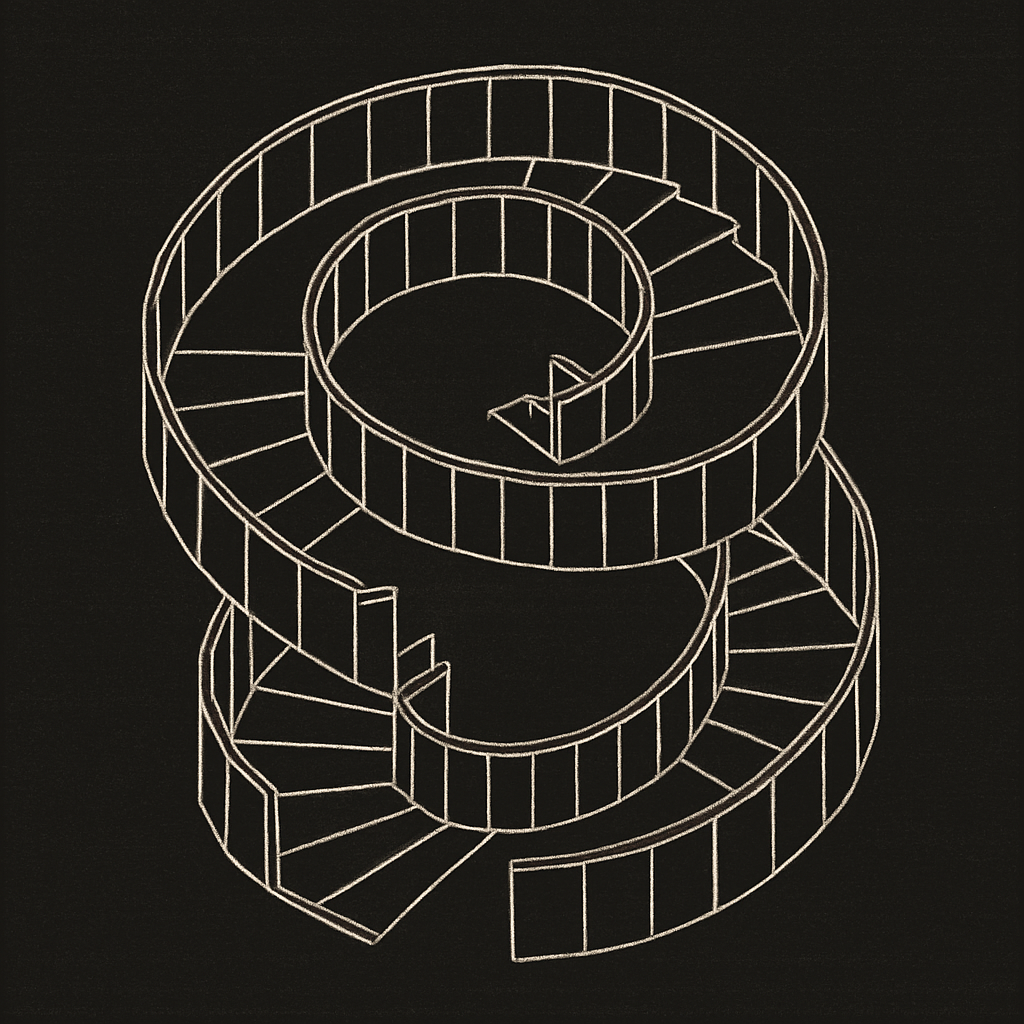
THE MACHINERY OF RECURSION
A Complete Guide to Self-Reference
How the Structure That Builds Itself Actually Works
What follows is not advice.
It is not a programming tutorial. Not a mathematics lecture. Not another complexity science overview dressed in accessible language.
It is mechanism.
The actual machinery of self-reference. The structure that appears at every scale of reality. The pattern that generates fractals, proves the limits of logic, builds organisms from single cells, and turns small advantages into empires.
Most people encounter recursion as a programming trick. A function that calls itself. Clever but narrow.
They never see what it actually is.
Recursion is the universe’s fundamental construction method. The way complexity builds from simplicity. The way a single rule, applied to its own output, generates infinite structure.
This document maps that machinery.
Nothing more.
What you do with it is your business.
PART ONE: THE SELF-REFERENCING ENGINE
What Recursion Actually Is
Strip away the jargon.
Recursion is a process that uses its own output as its next input.
That is the entire definition. A function that feeds on itself. An operation whose result becomes its starting material. A structure defined in terms of itself.
The simplest version. Take a number. Double it. Take the result. Double it again. Take that result. Double it.
1, 2, 4, 8, 16, 32, 64…
The rule never changes. The input changes because the output of the last step becomes the input of the next.
This seems trivial. It is not.
Every recursive process has exactly two components.
A base case. The ground. The thing that exists before the recursion starts. The seed.
A recursive step. The rule that transforms the current state into the next state by referring back to itself.
    THE ANATOMY OF RECURSION

    ┌──────────────────────────────────────────────────┐
    │                  BASE CASE                       │
    │                                                  │
    │  The ground.                                     │
    │  The starting condition.                         │
    │  The thing that stops infinite regress.          │
    │                                                  │
    │  Without this: infinite descent, no structure.   │
    └──────────────────────────────────────────────────┘
                          │
                          ▼
    ┌──────────────────────────────────────────────────┐
    │              RECURSIVE STEP                      │
    │                                                  │
    │  The rule applied to its own output.             │
    │  f(n) defined in terms of f(n-1).                │
    │  The present built from the past.                │
    │                                                  │
    │  Without this: static, no generation.            │
    └──────────────────────────────────────────────────┘
                          │
                          │ output becomes input
                          │
                          └──────────► back to recursive step
Without the base case, recursion runs forever. Infinite regress. No answer. No structure. Just descent.
Without the recursive step, nothing generates. The base case sits there. Inert.
Both are required. The anchor and the engine. Together they produce unbounded complexity from bounded rules.
The Power of Self-Application
Why does this matter?
Because the simplest recursive rule can generate structures of arbitrary complexity.
Take three line segments arranged in a triangle. Replace the middle third of each segment with two sides of a smaller triangle pointing outward. Apply the same rule to every new segment.
The Koch snowflake. Infinite perimeter. Finite area. Generated by a rule that fits in one sentence.
The Mandelbrot set. Take a complex number c. Start with z = 0. Compute z = z² + c. Feed the result back. If the sequence stays bounded, c is in the set.
One equation. Applied recursively. Produces perhaps the most complex object in mathematics.
This is the first principle of recursion.
Simple rules, applied to their own output, generate complexity that is not contained in the rules themselves.
The complexity lives in the iteration. Not in the instruction.
PART TWO: FIXED POINTS
Where Recursion Settles
Apply a function to its own output long enough, and something happens.
Sometimes the sequence diverges. Blows up. Goes to infinity.
Sometimes it oscillates. Bounces between values. Never settling.
And sometimes it converges. Finds a point where the output equals the input. Where applying the function again changes nothing.
This is a fixed point.
f(x) = x
The function maps x* to itself. Recursion stops. Not because you told it to stop. Because there is nothing left to change.
    CONVERGENCE TO A FIXED POINT

    Iteration:

    x₀ ──► f(x₀) = x₁
    x₁ ──► f(x₁) = x₂
    x₂ ──► f(x₂) = x₃
    x₃ ──► f(x₃) = x₄
      .        .
      .        .
    xₙ ──► f(xₙ) ≈ xₙ

    ┌──────────────────────────────────────────────────┐
    │                                                  │
    │  x*  =  f(x*)                                   │
    │                                                  │
    │  The point where recursion produces itself.      │
    │  Applying the function changes nothing.          │
    │  The system has found its own reflection.        │
    │                                                  │
    └──────────────────────────────────────────────────┘
The Contraction Principle
Stefan Banach proved in 1922 that if a function is a contraction, meaning it always brings points closer together, then repeated application always converges to exactly one fixed point.
No matter where you start.
The contraction mapping theorem. One of the most powerful results in mathematics. It says: if a process shrinks distances, recursive application of that process must converge. The fixed point exists. It is unique. And you can find it by simply iterating.
    THE CONTRACTION MAPPING

    ┌─────────────────────────────────────────────────────┐
    │                                                     │
    │  CONTRACTION CONDITION                              │
    │                                                     │
    │  d(f(x), f(y))  ≤  K · d(x, y)    where K < 1     │
    │                                                     │
    │  Every application shrinks the distance             │
    │  between any two points.                            │
    │                                                     │
    └─────────────────────────────────────────────────────┘
                          │
                          ▼
    ┌─────────────────────────────────────────────────────┐
    │                                                     │
    │  GUARANTEE                                          │
    │                                                     │
    │  1. A fixed point exists                            │
    │  2. It is unique                                    │
    │  3. Iteration from anywhere converges to it         │
    │  4. Convergence rate is at least geometric          │
    │                                                     │
    └─────────────────────────────────────────────────────┘
This is not abstract. GPS navigation uses iterative contraction to triangulate position. Numerical methods use it to solve differential equations. Machine learning uses it in every gradient descent step.
The principle is universal. If the recursive operation is a contraction, convergence is guaranteed. The system will find its own resting place.
Attractors
Not all fixed points are single points.
In dynamical systems, recursion can converge to cycles. Orbits. Or strange attractors. Geometric objects that the system spirals toward but never exactly repeats.
The Lorenz attractor. Three coupled differential equations. Iterated recursively. The trajectory never repeats, never settles, but never leaves a bounded butterfly-shaped region of phase space.
    TYPES OF RECURSIVE CONVERGENCE

    ┌──────────────┐    ┌──────────────┐    ┌──────────────┐
    │  FIXED POINT │    │    CYCLE     │    │   STRANGE    │
    │              │    │              │    │  ATTRACTOR   │
    │              │    │              │    │              │
    │    x* ← x   │    │  x₁ → x₂   │    │  Bounded     │
    │              │    │  ↑       ↓   │    │  but never   │
    │  Convergence │    │  x₄ ← x₃   │    │  repeating   │
    │  to a single │    │              │    │              │
    │  value       │    │  Periodic    │    │  Chaotic     │
    │              │    │  orbit       │    │  trajectory  │
    └──────────────┘    └──────────────┘    └──────────────┘
The type of attractor depends on the recursive function. Change the function slightly and the system can jump from fixed point to cycle to chaos.
This is the second principle.
Recursion does not merely generate. It converges. It finds the structures that sustain themselves under their own operation. The shapes that survive re-application. The patterns that are their own output.
PART THREE: SELF-SIMILARITY
Fractals as Recursive Objects
A fractal is what happens when a geometric transformation is applied recursively.
The Sierpinski triangle. Start with a filled triangle. Remove the center quarter. Apply the same removal to each remaining triangle. Repeat forever.
At every scale of magnification, the same pattern appears. This is self-similarity. The part resembles the whole.
    RECURSIVE GENERATION OF SELF-SIMILARITY

    Step 0:  ▲              (seed)

    Step 1:  ▲              (remove center)
            ▲ ▲

    Step 2:  ▲              (apply to each)
            ▲ ▲
           ▲   ▲
          ▲ ▲ ▲ ▲

    Step ∞: The Sierpinski triangle
            Self-similar at every magnification
Mandelbrot showed that self-similarity is not a mathematical curiosity. It is how nature builds.
Coastlines. River networks. Blood vessels. Lung bronchioles. Lightning bolts. Mountain ranges. Cloud boundaries.
All exhibit statistical self-similarity. Zoom in and the structure repeats. Not exactly. Statistically. The roughness at one scale echoes the roughness at another.
Iterated Function Systems
Michael Barnsley formalized this in the 1980s with Iterated Function Systems. Take a set of contraction mappings. Apply them simultaneously. Iterate.
The attractor of the system is a fractal.
Every fractal can be encoded this way. A fern leaf compressed to four affine transformations. A tree compressed to three branching rules. Infinite visual complexity stored in a few numbers.
    THE IFS COMPRESSION

    ┌──────────────────────────────────────┐
    │  RULES (finite, simple)             │
    │                                      │
    │  T₁: scale 0.85, rotate 2°         │
    │  T₂: scale 0.30, rotate -50°       │
    │  T₃: scale 0.30, rotate 50°        │
    │  T₄: scale 0.15, rotate 0°         │
    └──────────────────────────────────────┘
                      │
                      │  iterate
                      ▼
    ┌──────────────────────────────────────┐
    │  OUTPUT (infinite, complex)          │
    │                                      │
    │  A perfect fern.                     │
    │  Self-similar at every branch.       │
    │  Infinite detail from four rules.    │
    └──────────────────────────────────────┘

    Compression ratio: infinite to finite
This is not metaphor. Fractal image compression algorithms literally encode images as sets of contraction mappings. The image is the fixed point of the recursive system. To decompress, iterate the contractions from any starting image. Convergence is guaranteed by Banach’s theorem.
The image reconstructs itself through recursion.
Nature’s Recursive Architecture
Biology uses recursive construction everywhere.
A tree. The trunk splits into branches. Each branch splits into smaller branches. Each smaller branch splits again. The branching rule at every scale is approximately the same.
The lung. The trachea splits into bronchi. Bronchi split into bronchioles. Bronchioles split into smaller bronchioles. Twenty-three levels of recursive branching, ending in 300 million alveoli. The total surface area exceeds 70 square meters. Packed inside a chest cavity.
DNA itself folds recursively. The fractal globule structure allows two meters of genetic material to fit inside each cell nucleus without tangling. The recursive folding ensures that any gene can unfold for expression without disturbing adjacent sequences.
    RECURSIVE BRANCHING IN BIOLOGY

    Level 0:  ─────────────────     (trunk/trachea)

    Level 1:  ──────┬──────         (first split)
                    │
              ──────┴──────

    Level 2:  ───┬───  ───┬───     (second split)
                 │        │
              ───┴───  ───┴───

    Level n:  Each branch repeats
              the same splitting rule.

    Result:   Maximal surface area
              in minimal volume.
              Recursive packing.
This is not design by intelligence. It is design by recursion. A single rule, expressed in DNA, applied iteratively during development. The rule says: grow, split, repeat. The organism builds itself by running its own construction code recursively.
PART FOUR: THE LIMITS
The Halting Problem
In 1936, Alan Turing proved that recursion has a fundamental limit.
There is no general procedure that can determine, for any arbitrary program, whether that program’s recursion will eventually stop or run forever.
The proof uses recursion against itself.
Assume a program H exists that can decide halting. Construct a new program D that feeds itself to H, then does the opposite of what H predicts. If H says D halts, D loops forever. If H says D loops, D halts.
Contradiction. H cannot exist.
    THE HALTING PROBLEM

    ┌──────────────────────────────────────────────────┐
    │  ASSUMPTION                                      │
    │                                                  │
    │  H(program, input) → "halts" or "loops"          │
    │  A universal halting decider exists.              │
    └──────────────────────────────────────────────────┘
                          │
                          ▼
    ┌──────────────────────────────────────────────────┐
    │  CONSTRUCTION                                    │
    │                                                  │
    │  D(x):                                           │
    │    if H(x, x) = "halts" → loop forever           │
    │    if H(x, x) = "loops" → halt                   │
    │                                                  │
    │  What does D(D) do?                              │
    └──────────────────────────────────────────────────┘
                          │
                          ▼
    ┌──────────────────────────────────────────────────┐
    │  CONTRADICTION                                   │
    │                                                  │
    │  If H says D(D) halts → D(D) loops               │
    │  If H says D(D) loops → D(D) halts               │
    │                                                  │
    │  H cannot exist.                                 │
    │  Recursion has made itself undecidable.           │
    └──────────────────────────────────────────────────┘
Self-reference kills omniscience. A system powerful enough to contain recursion is powerful enough to construct questions it cannot answer about itself.
This is not a failure of engineering. It is a structural feature of recursive systems. The same power that makes recursion generative makes it undecidable.
Gödel’s Incompleteness
Five years before Turing, Kurt Gödel proved the same thing about formal logic.
Any consistent formal system powerful enough to express arithmetic contains true statements that it cannot prove.
The proof technique. Gödel numbered every symbol, formula, and proof in the system. Then he constructed a formula that says, in effect: “This formula is not provable in this system.”
If the formula is provable, then it is false, and the system proves a false statement. Inconsistent.
If the formula is not provable, then it is true, and the system cannot prove a true statement. Incomplete.
Self-reference again. The system refers to itself. And in doing so, reveals its own limits.
    GÖDEL'S RECURSIVE TRAP

    ┌──────────────────────────────────────────────────┐
    │  FORMAL SYSTEM S                                 │
    │                                                  │
    │  Contains arithmetic.                            │
    │  Contains rules of proof.                        │
    │  Powerful enough for self-reference.             │
    └──────────────────────────────────────────────────┘
                          │
                          │  Gödel numbering
                          ▼
    ┌──────────────────────────────────────────────────┐
    │  SELF-REFERENCING FORMULA G                      │
    │                                                  │
    │  "G is not provable in S"                        │
    │                                                  │
    │  G refers to its own provability.                │
    │  Recursion turned inward.                        │
    └──────────────────────────────────────────────────┘
                          │
            ┌─────────────┴─────────────┐
            │                           │
            ▼                           ▼
    ┌───────────────┐          ┌───────────────┐
    │  IF PROVABLE  │          │  IF NOT       │
    │               │          │  PROVABLE     │
    │  Then G is    │          │               │
    │  false.       │          │  Then G is    │
    │  S proves     │          │  true.        │
    │  falsehood.   │          │  S misses     │
    │               │          │  truth.       │
    │  INCONSISTENT │          │  INCOMPLETE   │
    └───────────────┘          └───────────────┘
The first incompleteness theorem. No consistent system containing arithmetic is complete.
The second incompleteness theorem. No consistent system can prove its own consistency.
Both are consequences of recursion. The system’s ability to refer to itself creates truths that escape its own reach.
PART FIVE: RENORMALIZATION
Recursion in Physics
Kenneth Wilson won the Nobel Prize in 1982 for showing that the renormalization group is a recursive operation on physical theories.
The idea. A physical system looks different at different scales. Water molecules at the atomic level look nothing like ocean waves. But the physics at each scale must be consistent with the physics at every other scale.
The renormalization group is the recursive procedure that connects them.
Start with a description of the system at a fine scale. Average over the smallest details. This produces a new description at a slightly coarser scale. Average again. New description. Repeat.
Each step applies the same coarsening operation to the output of the previous step.
Recursion.
    THE RENORMALIZATION GROUP

    Scale 1 (finest):
    ┌──────────────────────────────────────────────────┐
    │  Individual particles, all interactions          │
    │  Billions of degrees of freedom                  │
    └──────────────────────────────────────────────────┘
                          │
                          │  coarsen (average over details)
                          ▼
    Scale 2:
    ┌──────────────────────────────────────────────────┐
    │  Blocks of particles, effective interactions     │
    │  Fewer degrees of freedom                        │
    └──────────────────────────────────────────────────┘
                          │
                          │  coarsen again (same operation)
                          ▼
    Scale 3:
    ┌──────────────────────────────────────────────────┐
    │  Larger blocks, simpler interactions             │
    │  Even fewer degrees of freedom                   │
    └──────────────────────────────────────────────────┘
                          │
                          │  coarsen again
                          ▼
    Fixed Point:
    ┌──────────────────────────────────────────────────┐
    │  Description that is unchanged by coarsening     │
    │  Scale-invariant behavior                        │
    │  Universal physics                               │
    └──────────────────────────────────────────────────┘
The fixed points of the renormalization group correspond to phase transitions. Critical points where the system becomes scale-invariant. Where the physics looks the same at every magnification.
Self-similarity again. The fractal structure of matter at a phase transition is the fixed point of a recursive coarsening operation.
Universality
The deepest consequence of renormalization is universality.
Magnets and fluids. Ferroelectric materials and binary alloys. Completely different physical systems. Different particles. Different forces. Different equations.
But at their critical points, they exhibit identical behavior. The same critical exponents. The same scaling laws. The same geometry of fluctuations.
Because they flow to the same fixed point under renormalization.
The recursive coarsening operation washes away microscopic details. What survives at the fixed point depends only on a few properties: dimensionality of space, symmetry of the order parameter, range of interactions.
Everything else is irrelevant.
    UNIVERSALITY THROUGH RECURSION

    ┌──────────────┐  ┌──────────────┐  ┌──────────────┐
    │   MAGNETS    │  │   FLUIDS     │  │   ALLOYS     │
    │              │  │              │  │              │
    │  Iron atoms  │  │  Water       │  │  Binary      │
    │  Spin-spin   │  │  molecules   │  │  mixtures    │
    │  coupling    │  │  Van der     │  │  Exchange    │
    │              │  │  Waals       │  │  energy      │
    └──────┬───────┘  └──────┬───────┘  └──────┬───────┘
           │                 │                 │
           │  RG flow        │  RG flow        │  RG flow
           │                 │                 │
           └─────────────────┼─────────────────┘
                             │
                             ▼
              ┌──────────────────────────┐
              │      SAME FIXED POINT    │
              │                          │
              │  Same critical exponents │
              │  Same scaling laws       │
              │  Same universality class │
              │                          │
              │  Details washed away     │
              │  by recursive averaging  │
              └──────────────────────────┘
Recursion reveals that apparently different systems are the same system. Different in the details. Identical in the structure that survives self-application.
PART SIX: AUTOPOIESIS
Systems That Build Themselves
In 1972, Humberto Maturana and Francisco Varela asked a question. What distinguishes living systems from non-living ones?
Their answer. Living systems are autopoietic. They are recursive systems that produce the components necessary for their own continued operation.
A cell produces proteins. Those proteins maintain the membrane. The membrane creates the enclosed space within which the cell can produce proteins. The output of the system maintains the conditions for the system’s own operation.
This is not feedback. Feedback adjusts a parameter. Autopoiesis produces the producer. The system is recursively self-constituting.
    AUTOPOIETIC RECURSION

    ┌──────────────────────────────────────────────────┐
    │                     CELL                         │
    │                                                  │
    │   ┌────────────┐     ┌────────────┐              │
    │   │  Metabolic  │────►│  Components │             │
    │   │  network    │     │  (proteins, │             │
    │   │  (processes)│     │   lipids)   │             │
    │   └─────▲──────┘     └─────┬──────┘              │
    │         │                  │                      │
    │         │                  ▼                      │
    │         │           ┌────────────┐                │
    │         │           │  Boundary  │                │
    │         └───────────│  (membrane)│                │
    │                     │  enables   │                │
    │                     │  processes │                │
    │                     └────────────┘                │
    │                                                  │
    │   The system produces the parts that produce     │
    │   the system.                                    │
    └──────────────────────────────────────────────────┘
The recursion runs at every level of biological organization.
DNA encodes the enzymes that read DNA. Ribosomes are made by ribosomes. The immune system learns to recognize threats, including threats to itself. The brain builds models of the world, including models of itself building models.
At each level, the process generates the conditions for its own continuation. Remove the recursion and the system dies. Not eventually. Immediately. Because the system IS the recursion.
The Closure Condition
Autopoietic systems are operationally closed. This does not mean isolated. Energy and matter flow through them. But the organization is self-referential. The network of processes refers only to itself.
This creates a boundary between system and environment. The system defines its own inside and outside through its recursive operation.
No external designer specifies the boundary. The boundary emerges from the recursion itself.
    OPERATIONAL CLOSURE

    ENVIRONMENT
    ┌──────────────────────────────────────────────────┐
    │                                                  │
    │       Energy in ──►  ┌─────────────────┐         │
    │                      │                 │         │
    │       Matter in ──►  │    AUTOPOIETIC  │         │
    │                      │     SYSTEM      │         │
    │                      │                 │         │
    │      Waste out ◄──   │  Organization   │         │
    │                      │  refers only    │         │
    │      Heat out  ◄──   │  to itself      │         │
    │                      │                 │         │
    │                      └─────────────────┘         │
    │                                                  │
    │   Matter and energy cross the boundary.          │
    │   Organization does not.                         │
    │   The boundary is produced by the recursion.     │
    │                                                  │
    └──────────────────────────────────────────────────┘
This is how identity persists despite material change. Every atom in a human body is replaced within roughly seven years. The matter is entirely different. The recursive organization continues.
Identity is not substance. Identity is recursive pattern.
PART SEVEN: STRANGE LOOPS
When Hierarchy Folds
Douglas Hofstadter identified a specific recursive structure that appears wherever self-reference becomes tangled with hierarchy.
A strange loop.
Take a hierarchical system with distinct levels. Level 1 is “lower,” level 2 is “higher,” level 3 is “higher still.” The hierarchy is clean. Each level operates on the level below.
Now let the highest level reach back down and influence the lowest level. The hierarchy curls back on itself. Moving “upward” through the levels eventually brings you back to where you started.
The level distinction dissolves. What was “higher” and “lower” becomes a single recursive circuit.
    TANGLED HIERARCHY

    NORMAL HIERARCHY              STRANGE LOOP

    Level 3                       Level 3 ──────┐
       │                             │           │
       ▼                             ▼           │
    Level 2                       Level 2        │
       │                             │           │
       ▼                             ▼           │
    Level 1                       Level 1 ◄──────┘

    Clean separation.             Levels fold back.
    Each level operates           The "highest" level
    only on the level             reaches into the
    below it.                     "lowest."
                                  The hierarchy is
                                  a loop.
Strange Loops in Logic and Mind
Gödel’s proof is a strange loop. Arithmetic (the object level) encodes statements about arithmetic (the meta level). The meta level collapses into the object level. The hierarchy of “talking about” versus “being talked about” folds.
Consciousness may be a strange loop. Neural patterns (the low level) give rise to symbolic representations (the high level). Those symbolic representations, in turn, modify the neural patterns. The representation of “self” is a symbol created by the very neural processes it represents.
    THE STRANGE LOOP OF SELFHOOD

    ┌──────────────────────────────────────────────────┐
    │  SYMBOLIC LEVEL                                  │
    │                                                  │
    │  "I" as a concept. Identity. Agency.             │
    │  The model of the self.                          │
    │                                                  │
    │  This symbol influences behavior,                │
    │  which alters neural patterns...                 │
    └───────────────────────┬──────────────────────────┘
                            │
                            │ downward causation
                            ▼
    ┌──────────────────────────────────────────────────┐
    │  NEURAL LEVEL                                    │
    │                                                  │
    │  Patterns of activation. Synaptic weights.       │
    │  Electrochemical processes.                      │
    │                                                  │
    │  These patterns generate the symbol "I"...       │
    └───────────────────────┬──────────────────────────┘
                            │
                            │ upward causation
                            └──────────► back to symbolic level
The “I” that observes is produced by the processes it observes. The observer and the observed are the same recursive system viewed from different levels.
This is not mysticism. It is a structural consequence of recursive self-reference in a hierarchical system.
PART EIGHT: COMPOUND RECURSION
When Recursion Multiplies
The simplest recursive growth. Each step adds a constant. Linear. Arithmetic progression.
The next level. Each step multiplies by a constant. Exponential. Geometric progression.
Compound interest is recursion. The balance at time t becomes the input for calculating the balance at time t+1. The interest earned generates interest of its own.
    COMPOUND RECURSION

    LINEAR (additive):     f(n) = f(n-1) + c

    100 → 110 → 120 → 130 → 140 → 150

    Growth is constant.


    EXPONENTIAL (multiplicative):   f(n) = f(n-1) × r

    100 → 110 → 121 → 133 → 146 → 161

    Growth accelerates.
    Each step's growth is proportional to the current value.


    SUPER-EXPONENTIAL:     f(n) = f(n-1)^k

    2 → 4 → 16 → 256 → 65536

    Each step's growth is a power of the current value.
    Recursion on the growth rate itself.
Exponential growth is what happens when a recursive process multiplies rather than adds.
The COVID pandemic. Each infected person infects R others. Those R infect R more each. The recursive step is multiplication by the reproduction number. The base case is patient zero.
Moore’s Law. Transistor density doubles roughly every two years. Each doubling enables the engineering tools that produce the next doubling. The output of the process accelerates the process.
Network effects. Each new user makes the network more valuable for existing users, attracting more new users. The output feeds the input. Recursive amplification.
The Matthew Effect
Recursive multiplication creates asymmetry.
Small initial differences, amplified recursively, produce vast gaps. The rich get richer. The strong get stronger. The popular get more popular.
Robert Merton called this the Matthew Effect, after the biblical passage: “For to everyone who has, more will be given.”
This is not injustice in the moral sense. It is the mathematical consequence of multiplicative recursion applied to unequal starting conditions.
    RECURSIVE AMPLIFICATION OF DIFFERENCE

    Start:   A = 100    B = 105    (5% difference)

    Step 1:  A = 110    B = 115.5
    Step 2:  A = 121    B = 127.1
    Step 5:  A = 161    B = 171.0
    Step 10: A = 259    B = 276.6
    Step 20: A = 673    B = 718.9
    Step 50: A = 11,739  B = 12,537

    The absolute gap grows with every step.
    Same multiplicative rule.
    Same recursive process.
    Different initial conditions.

    Small advantages compound into large ones.
    Not because the rule favors anyone.
    Because multiplication magnifies difference.
Power law distributions emerge from this. A few nodes in a network accumulate most of the connections. A few cities accumulate most of the population. A few papers accumulate most of the citations.
The mechanism is always the same. Recursive multiplication applied to heterogeneous initial conditions.
PART NINE: RECURSIVE COMPUTATION
The Church-Turing Thesis
In the 1930s, three independent formalizations of “what can be computed” converged on the same answer.
Turing’s machines. Sequences of operations on a tape, where the machine can read, write, move, and change state.
Church’s lambda calculus. Functions defined in terms of other functions, built from nothing but function application and abstraction.
Gödel and Kleene’s recursive functions. Starting from zero and successor, building all computable functions through composition, primitive recursion, and minimization.
All three define exactly the same class of computable functions.
This is the Church-Turing thesis. Every effectively computable function is recursive.
Computation IS recursion. Not uses recursion. Not involves recursion. Is recursion.
    THE EQUIVALENCE

    ┌──────────────────┐    ┌──────────────────┐
    │  TURING MACHINES │    │  LAMBDA CALCULUS  │
    │                  │    │                   │
    │  Sequential      │    │  Function         │
    │  state-based     │    │  application      │
    │  operations      │    │  and abstraction  │
    └────────┬─────────┘    └────────┬──────────┘
             │                       │
             │                       │
             └───────────┬───────────┘
                         │
                         ▼
              ┌──────────────────────┐
              │  RECURSIVE FUNCTIONS │
              │                      │
              │  Same computational  │
              │  power.              │
              │  Different notation. │
              │  Identical boundary. │
              └──────────────────────┘
Everything your computer does. Every algorithm. Every neural network. Every simulation. All of it reduces to recursive function application.
The universe of computation is the universe of recursion. They share the same boundary.
Kleene’s Recursion Theorem
Stephen Kleene proved something startling in 1938.
For any computable transformation of programs, there exists a program that computes the same function as its own transformation.
In simpler terms. Any program can be modified to have access to its own source code.
Self-reference is not a special trick. It is an inevitable consequence of recursive systems with sufficient power.
Any system that can express recursion can express self-reference. And any system that can express self-reference encounters Gödel-type limits.
Power and limitation are the same thing. The more a recursive system can do, the more it can say about itself, and the more it discovers that it cannot decide about itself.
PART TEN: THE CONSTRAINTS
What Recursion Cannot Do
Recursion is not omnipotent. Its constraints are as fundamental as its power.
Constraint 1: The Base Case Requirement
Every recursive process needs grounding. Without a base case, recursion is infinite regress. The question “why?” applied to its own answer produces an endless chain. Children discover this naturally. Adults learn to stop asking.
Formal systems handle this by axiom. Mathematics grounds recursive definitions in base cases. Biology grounds developmental recursion in DNA sequences. Physics grounds renormalization in measured coupling constants at some reference scale.
The base case cannot be derived recursively. It must be given from outside the recursion. Every recursive system depends on something non-recursive at its foundation.
Constraint 2: The Convergence Requirement
Not all recursive processes converge. Some diverge. Some oscillate chaotically.
Convergence requires specific conditions. Contraction. Dampening. Energy dissipation. Without these, recursive amplification produces runaway. Positive feedback without negative feedback destroys the system.
Constraint 3: The Self-Reference Trap
The very power that makes recursion generative makes it paradoxical when turned on itself.
The liar paradox. “This sentence is false.” Gödel’s incompleteness. The halting problem. Russell’s paradox.
All are symptoms of the same structural constraint. Self-referencing recursive systems generate undecidable propositions. Truths that exist but cannot be proved. Questions that can be stated but cannot be answered.
    THE CONSTRAINTS OF RECURSION

    ┌─────────────────────────────────────────────────────┐
    │  CONSTRAINT 1: GROUNDING                            │
    │                                                     │
    │  Every recursion needs a base case.                 │
    │  The base case is not itself recursive.             │
    │  Something must be given, not derived.              │
    │  The chain must end somewhere.                      │
    └─────────────────────────────────────────────────────┘

    ┌─────────────────────────────────────────────────────┐
    │  CONSTRAINT 2: CONVERGENCE                          │
    │                                                     │
    │  Not all recursive processes settle.                │
    │  Divergence destroys.                               │
    │  Oscillation prevents resolution.                   │
    │  Contraction is required for stability.             │
    └─────────────────────────────────────────────────────┘

    ┌─────────────────────────────────────────────────────┐
    │  CONSTRAINT 3: SELF-REFERENCE LIMITS                │
    │                                                     │
    │  Sufficient power enables self-reference.           │
    │  Self-reference enables undecidability.             │
    │  No recursive system can fully know itself.         │
    │  Completeness and consistency cannot coexist.       │
    └─────────────────────────────────────────────────────┘
The Depth-Decidability Tradeoff
There is an inverse relationship between a recursive system’s power and its self-knowledge.
Simple recursive systems are fully decidable. You can predict everything about them. But they generate only simple structures.
Complex recursive systems generate rich structure. But they contain questions about themselves that they cannot answer.
    THE TRADEOFF

    Decidability
         │
    FULL │████████████████████
         │██████████████████
         │████████████████
         │██████████████
         │████████████
         │██████████
         │████████
    NONE │██████
         │
         └──────────────────────────────────────►
              Simple                     Complex
                      Recursive Power

    More power → more structure → less self-knowledge
    Less power → less structure → more self-knowledge
The universe appears to have chosen the complex end. Rich recursive structure. Fundamental limits on self-knowledge.
Gödel proved this for logic. Turing proved this for computation. Heisenberg proved an analogous result for measurement. The pattern recurs across domains. Sufficiently powerful systems cannot fully characterize themselves.
PART ELEVEN: THE COMPLETE PICTURE
The Unified Framework
Everything connects.
    THE COMPLETE RECURSION FRAMEWORK

    ┌─────────────────────────────────────────────────────────┐
    │                                                         │
    │                   RECURSION                             │
    │                                                         │
    │    A process that applies to its own output.            │
    │    The structure that builds structure from itself.     │
    │                                                         │
    └─────────────────────────────────────────────────────────┘
                              │
              ┌───────────────┼───────────────┐
              │               │               │
              ▼               ▼               ▼
    ┌─────────────┐  ┌─────────────┐  ┌─────────────┐
    │  GENERATION │  │ CONVERGENCE │  │   LIMITS    │
    │             │  │             │  │             │
    │  Fractals   │  │ Fixed       │  │ Halting     │
    │  Complexity │  │ points      │  │ problem     │
    │  from       │  │ Attractors  │  │ Gödel       │
    │  simplicity │  │ Universality│  │ Undecid-    │
    │             │  │             │  │ ability     │
    └─────────────┘  └─────────────┘  └─────────────┘
              │               │               │
              └───────────────┼───────────────┘
                              │
                              ▼
    ┌─────────────────────────────────────────────────────────┐
    │                                                         │
    │                    REALITY                              │
    │                                                         │
    │    Biology: autopoiesis, development, evolution         │
    │    Physics: renormalization, self-similarity, scaling   │
    │    Mathematics: computability, formal systems, proof    │
    │    Mind: strange loops, self-awareness, identity        │
    │                                                         │
    └─────────────────────────────────────────────────────────┘
Recursion generates. Simple rules produce complex structures through self-application. Fractals. Organisms. Languages. Civilizations.
Recursion converges. Contraction mappings find fixed points. Phase transitions find universality classes. Iterated systems find attractors. The process finds the structures that survive themselves.
Recursion limits. Self-reference creates undecidability. Power creates paradox. The system that can describe itself discovers questions it cannot answer about itself.
The Principle
Every recursive system faces the same three-body problem.
Generation. Convergence. Limitation.
It must produce new structure from old. It must find stable patterns within that structure. And it must accept that self-referential completeness is impossible.
A cell produces itself from itself, finds metabolic steady states, and cannot model itself completely.
A formal system produces theorems from axioms, converges on consistent theories, and cannot prove its own consistency.
A mind produces representations from experience, converges on stable identity, and cannot fully understand itself.
Same mechanism. Different substrate.
The universe runs on recursion. Not as metaphor. As architecture.
Self-application is how complexity builds. Fixed points are how stability emerges. Self-reference limits are how fundamental boundaries appear.
The machinery does not care whether you understand it.
It runs regardless.
The cell divides. The function iterates. The loop closes and opens again. The fractal grows another level. The system refers to itself and discovers something it cannot decide.
And then the next iteration begins.
CITATIONS
Foundations of Recursion Theory
Computability and Recursive Functions
Kleene, S.C. (1938). “On notation for ordinal numbers.” Journal of Symbolic Logic, 3(4):150-155.
Turing, A.M. (1936). “On Computable Numbers, with an Application to the Entscheidungsproblem.” Proceedings of the London Mathematical Society, 2(42):230-265.
Church, A. (1936). “An unsolvable problem of elementary number theory.” American Journal of Mathematics, 58(2):345-363.
Stanford Encyclopedia of Philosophy. “Recursive Functions.” https://plato.stanford.edu/entries/recursive-functions/
Fixed Point Theory
Contraction Mappings
Banach, S. (1922). “Sur les opérations dans les ensembles abstraits et leur application aux équations intégrales.” Fundamenta Mathematicae, 3:133-181.
Conrad, K. “The Contraction Mapping Theorem.” University of Connecticut. https://kconrad.math.uconn.edu/blurbs/analysis/contraction.pdf
Springer Nature. (2024). “The Banach Fixed Point Theorem: selected topics from its hundred-year history.” Revista de la Real Academia de Ciencias Exactas, Físicas y Naturales. https://link.springer.com/article/10.1007/s13398-024-01636-6
Fractals and Self-Similarity
Iterated Function Systems
Barnsley, M.F. (1988). Fractals Everywhere. Academic Press.
Natoli, C. “Fractals as Fixed Points of Iterated Function Systems.” University of Chicago REU. https://math.uchicago.edu/~may/REU2012/REUPapers/Natoli.pdf
Ghosh, R. & Mareček, J. (2022). “Iterated Function Systems: A Comprehensive Survey.” arXiv:2211.14661. https://arxiv.org/pdf/2211.14661
NU Sci Magazine. “Fractals in biology and fundamental recursive design.” https://nuscimagazine.com/fractals-in-biology-and-fundamental-recursive-design/
Gödel’s Incompleteness Theorems
Self-Reference and Formal Systems
Gödel, K. (1931). “Über formal unentscheidbare Sätze der Principia Mathematica und verwandter Systeme I.” Monatshefte für Mathematik und Physik, 38:173-198.
Stanford Encyclopedia of Philosophy. “Gödel’s Incompleteness Theorems.” https://plato.stanford.edu/entries/goedel-incompleteness/
Open Logic Project. “Incompleteness and Computability.” https://ic.openlogicproject.org/ic-screen.pdf
The Halting Problem
Undecidability
Turing, A.M. (1936). “On Computable Numbers, with an Application to the Entscheidungsproblem.” Proceedings of the London Mathematical Society, 2(42):230-265.
Hamkins, J.D. (2025). “Did Turing prove the undecidability of the halting problem?” Journal of Logic and Computation. https://academic.oup.com/logcom/article/36/1/exaf075/8417148
Renormalization Group
Scaling and Universality
Wilson, K.G. (1971). “Renormalization Group and Critical Phenomena.” Physical Review B, 4(9):3174-3183.
MIT OpenCourseWare. “The Renormalization Group (Conceptual).” Statistical Mechanics II. https://ocw.mit.edu/courses/8-334-statistical-mechanics-ii-statistical-physics-of-fields-spring-2014/
Cambridge TCM Group. “Renormalisation Group.” https://www.tcm.phy.cam.ac.uk/~bds10/phase/rg.pdf
Autopoiesis
Self-Producing Systems
Maturana, H.R. & Varela, F.J. (1980). Autopoiesis and Cognition: The Realization of the Living. D. Reidel Publishing.
ScienceDirect. “From reactions to reflection: A recursive framework for the evolution of cognition and complexity.” https://www.sciencedirect.com/science/article/abs/pii/S0303264725000188
Strange Loops
Self-Reference and Consciousness
Hofstadter, D.R. (1979). Gödel, Escher, Bach: An Eternal Golden Braid. Basic Books.
Hofstadter, D.R. (2007). I Am a Strange Loop. Basic Books.
American Mathematical Society. (2007). “Do Loops Explain Consciousness?” Notices of the AMS, 54(7):852-855. https://www.ams.org/notices/200707/tx070700852p.pdf
Recursive Neural Computation
Brain as Recursive System
Caucheteux, C., et al. (2023). “Evidence of a predictive coding hierarchy in the human brain listening to speech.” Nature Human Behaviour. https://www.nature.com/articles/s41562-022-01516-2
PNAS. (2021). “Recurrent dynamics in the cerebral cortex: Integration of sensory evidence with stored knowledge.” https://www.pnas.org/doi/10.1073/pnas.2101043118
Document compiled from foundational mathematics, physics, computer science, and systems theory literature.
Related Machineries
- THE MACHINERY OF FEEDBACK LOOPS. Feedback loops are recursion made physical. Every feedback circuit is an output-to-input recursive step operating in real time.
- THE MACHINERY OF EMERGENCE. Emergence is what recursion produces. Simple rules applied recursively generate properties not present in the rules themselves.
- THE MACHINERY OF COMPRESSION. Recursive structures are inherently compressible. Fractals encode infinite complexity in finite recursive rules.
- THE MACHINERY OF CONSTRAINTS. Every recursive system requires constraints to converge. Without base cases and contraction conditions, recursion either diverges or falls into paradox.
- THE MACHINERY OF DEFAULT MODE NETWORK. The brain’s most energy-intensive recursive process. The DMN generates the self-model by continuously applying self-referential evaluation to its own output. When the recursion jams, the result is rumination.
- THE MACHINERY OF SELF-REFERENCE. Self-reference is the structural property underneath recursion, the ability of a system to refer to itself that makes recursive processes possible and guarantees their fundamental limits.