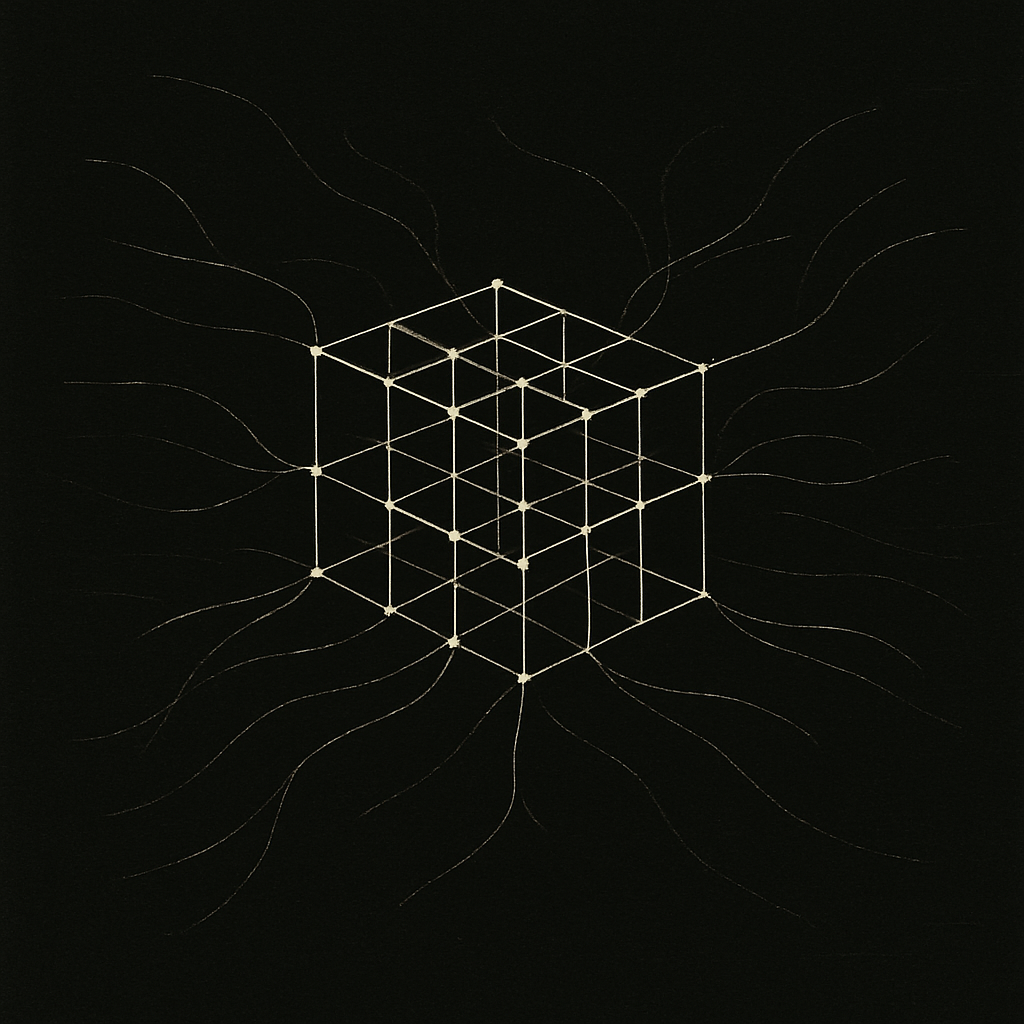
THE MACHINERY OF THE MIND THAT ENGINEERS REALITY
A Complete Guide to the Architecture Beneath Apparent Control
How a Mind Trained in Silence Comes to Move Situations From Underneath
What follows is not advice.
It is not a manual for becoming the smartest person in the room. Not a system for manipulating people. Not a theory of charisma, persuasion, or game.
It is mechanism.
The actual architecture of a mind that engineers outcomes. The way perception sharpens when nothing else is competing for it. The way simulation gets faster than realtime. The way an intervention can look incidental from outside the system and inevitable from inside it.
This kind of mind is rare. Not because the components are exotic. The components are ordinary. The arrangement is what is rare. The arrangement requires a kind of training most environments make impossible. Solitude. Silence. Subtraction. Years of attention pointed at causal structure instead of at noise.
What this document does is name the components and show how they fit. The reader is left where the reader was. Whether such a mind is desirable is not a question this document answers. Whether it can be cultivated, partially or fully, is also not a question this document answers. The question this document answers is: when a mind that engineers reality is operating, what is actually happening underneath the surface that looks like effortless control.
Nothing more.
What you do with the picture is your business.
PART ONE: REALITY HAS A LATTICE
The First Lie
The first lie taught to anyone with a mind is that situations are opaque.
You walk into a room. People are talking. Something happens between them. Then something else happens. By the end of the conversation a decision has been made or a feeling has shifted or a relationship has changed.
The standard model says this is mostly random. Personalities collided. The mood was off. The boss was tired. You can describe what happened. You cannot predict what was going to happen.
This is not true.
The standard model is the model produced by a mind that has never sat with a situation long enough to see its structure. The standard model is correct for a mind running at the speed of its own reactions. At that speed everything looks improvised. At that speed all you can do is improvise back.
But a situation is not random.
A situation has a lattice. Pre-existing tensions. Information asymmetries. Status hunger. Old wounds. Time pressure. The constraints each person is operating under that they themselves cannot see. The reward function each person is silently optimizing for. The piece of information that, if revealed, would change the room. The piece of information that, if withheld, will let the room continue.
This lattice is what is actually moving. The conversation on the surface is just the lattice expressing itself.
A mind that engineers reality is a mind that sees the lattice.
What “Sees the Lattice” Means Mechanically
Seeing the lattice is not intuition.
It is not magic, not vibe, not gut. It is high-resolution causal modeling running continuously while the rest of the mind is also doing what minds do.
The mechanism is decomposition. The default mind perceives a situation as a single object. “Tense meeting.” A trained mind perceives a situation as a structure of dozens of forces, each with a direction and a magnitude. The boss’s anxiety about quarterly numbers is one vector. The new hire’s need to prove themselves is another vector. The unspoken history between two colleagues is another vector. The tightness in the second-most-senior person’s jaw is a sample from a hidden vector.
    DEFAULT MIND                  TRAINED MIND

    ┌──────────────────┐          ┌──────────────────┐
    │                  │          │   ↓ ↘ ← ↘ → →    │
    │  TENSE MEETING   │          │  →   ↑ ↘ ← ↓ ↗   │
    │                  │          │   ↗ ← ↑ → ↓ ↘    │
    │   (one object)   │          │  ↓ ↗ → ↑ ↘ ← ↑   │
    │                  │          │   (vector field) │
    └──────────────────┘          └──────────────────┘
       reads as mood                reads as forces
       reacts to mood               reads forces individually
The vector field is the situation as it actually is. The single object is the situation as it appears to a mind operating at the situation’s own speed.
The default mind cannot read the vector field because the default mind is itself one of the vectors. It is inside the field, reacting. The trained mind has practiced stepping back far enough that the field is visible. The training is not mystical. The training is years of refusing to be one of the vectors. Watching instead.
What This Resolution Costs
This resolution is not free.
The cost is felt presence. A mind that has trained itself to step back from the field of forces has, by definition, taken its weight out of the field. It is no longer one of the vectors. It is a witness.
The price of being a witness is being slightly less alive in the moment than the people you are watching.
This is not a complaint. It is a structural fact. The same training that makes the lattice visible makes the trainer somewhat ghostly inside any single moment. They are present, but the presence is observational. The full embodiment of being one of the vectors, blind and reactive and burning with whatever the situation is asking, is gone.
This trade is non-negotiable. Anyone selling you the ability to see the lattice without losing some of the heat of the moment is selling a thing that does not exist.
PART TWO: THE PERCEPTUAL APERTURE
Bandwidth Is Trained, Not Given
The perceptual aperture is the amount of structure a mind can take in per unit time. It is not fixed. It is trained, the way a muscle is trained, by repeated application against resistance.
The resistance is silence. The repetition is the choice, made over and over for years, to attend to the structure underneath instead of to the surface.
    BANDWIDTH OVER TRAINING

    aperture
       │
       │                                       ████
       │                                  ████████
       │                            ██████████████
       │                      ████████████████████
       │                ██████████████████████████
       │          ████████████████████████████████
       │    ██████████████████████████████████████
       │  ████████████████████████████████████████
       │  ────────────────────────────────────────
       │  baseline                          mature
       │
       └─────────────────────────────────────────── time
          early           middle           late
          training        training         training

    The curve is smooth. There is no breakthrough moment.
    Only the slow widening of what fits inside one perception.
A mature aperture takes in, in a single second of presence in a room, more structural information than an average mind takes in across the full conversation.
This is not because the mature aperture is faster. Brains are not faster than each other in any meaningful sense. The clock speed of a neuron is fixed by biochemistry, not by training. What the mature aperture has is better encoding. The same incoming signal, parsed against a deeper library of structural patterns, yields more information per sample.
The library is the thing that was built during the years of silence.
Why Most Apertures Stay Small
Most apertures stay small because most environments punish their growth.
Social environments reward fast reaction. The person who fires the joke first wins the joke. The person who answers the question first wins the question. The person who has an opinion first wins the opinion. The mind that pauses to take in structure loses every one of these micro-contests.
Across a childhood, an adolescence, and a young adulthood spent in social environments that reward fast reaction, a mind learns to fire fast. The aperture stays small because the survival strategy is to put out a response, any response, before the situation moves past you.
This is not a flaw in the people. This is a flaw in the environment. The environment selects for response speed. Response speed selects against aperture width.
The aperture only widens when the cost of fast reaction is removed. Which means the mind must spend significant time in environments where no one is waiting for a response. No one is grading the speed. No one is even watching.
This is what solitude is for, mechanically. Not for self-discovery. For aperture widening.
The Three Layers of Resolution
When a mature aperture takes in a situation, it parses three layers simultaneously.
    LAYER 1: SURFACE
    The words being said. The tones being used. The visible postures.
    What anyone in the room with eyes and ears would notice.

         ────────────────────────────────────────────

    LAYER 2: TENSION
    The unsaid thing each person is managing. The fear that
    is keeping their voice tight. The bid for approval being
    hidden inside a question. The grievance from last week
    that is shaping today's tone.

         ────────────────────────────────────────────

    LAYER 3: REWARD FUNCTION
    What each person in the room is actually optimizing for,
    silently, possibly without their own awareness. The career
    move they need this meeting to set up. The self-image they
    need to defend. The piece of social information they need
    to extract.
The default mind sees layer 1. Sometimes layer 1 plus a flash of layer 2.
The trained mind sees all three layers continuously. The way you, the reader, see all three colors in a stoplight without effort because your visual cortex has decomposed white light into channels.
The decomposition is so automatic that the trained mind can no longer turn it off. This is part of the ghost-like quality. There is no innocent surface to live on anymore. Every interaction has its lattice visible.
PART THREE: THE SIMULATION ENGINE
Running Reality Forward Faster Than Reality Moves
Perception is half of the machinery. Simulation is the other half.
A mind that engineers reality is a mind that runs reality forward in simulation faster than reality is moving. It sees the next three moves before the people in the room have made the first one. It sees the conversation as a tree, with each branch leading to a different room-state, and it has already pruned the branches that lead nowhere useful.
                       MOVE N
                          │
              ┌───────────┼───────────┐
              │           │           │
           branch A    branch B    branch C
              │           │           │
        ┌─────┼─────┐     │     ┌─────┼─────┐
        │     │     │     │     │     │     │
       N+1   N+1   N+1   N+1   N+1   N+1   N+1
        │           │     │     │           │
       N+2         N+2   N+2   N+2         N+2
        │                                   │
       N+3                                 N+3

    Trained mind sees the tree.
    Default mind only sees the line it is walking.
The default mind walks one path through this tree, learning at each node what just happened. The trained mind has scanned several layers down each branch before the first move is made. It is not predicting the future perfectly. It is pre-computing the topology of the possibilities so that, when a branch is actually taken, the response is already prepared.
The mechanism here is the predictive brain, well documented in neuroscience. Every brain runs forward simulations constantly. What differs across minds is how many steps forward the simulation goes, how many branches it considers, and how accurately each branch is modeled.
A trained mind has practiced extending the simulation. Practiced widening the branching. Practiced calibrating the branch likelihoods against the lattice it perceives.
Why Simulation Speed Comes From Pattern Library, Not From IQ
The simulation engine is not faster because the underlying hardware is faster.
It is faster because it is recognizing rather than computing.
A chess grandmaster does not calculate every move ten moves deep. The chess grandmaster recognizes a position. The position lights up a pattern in their library. The pattern comes with associated continuations, threats, and weaknesses pre-attached. The grandmaster does not see “this knight on c3 plus this pawn on d4 plus this bishop on g7”. The grandmaster sees “this is a Yugoslav attack against the Dragon”, and the entire structural meaning of the position is downloaded in a single perception.
The same machinery operates in a mind that has built a library of social and causal patterns.
    DEFAULT MIND                    TRAINED MIND

    [situation] → [compute]         [situation] → [match]
        │             │                  │           │
        │             ▼                  │           ▼
        │       slow analysis            │      library hit
        │             │                  │           │
        │             ▼                  │           ▼
        ▼        partial answer          ▼      full topology
       move                              move    pre-computed
The library was built during the years of silent watching. Each interaction taken in, decomposed, stored as a pattern. Each pattern indexed by structural features rather than by surface features. Two situations that look totally different on the surface but share a structural shape (status threat plus information asymmetry plus time pressure) are stored under the same address.
When a new situation arrives, the library is queried. If the structural address matches a stored pattern, the topology of the situation is downloaded. The simulation runs from a position of recognition, not of computation.
This is why the engineered mind appears effortless. It is not working harder than the people around it. It is working in a different mode. The mode of recognition rather than the mode of calculation.
The Ceiling on Simulation
There is a ceiling.
A mind that simulates reality forward is still a mind. It is bound by:
- The accuracy of its model of each person in the room. If the model is wrong, the simulation produces wrong branches.
- The accuracy of its model of the constraints. Hidden constraints, ones not in the library, produce surprise.
- Its own blind spots. Patterns the trainer has never seen, because the trainer was never in environments where those patterns appeared, are missing from the library.
A trained mind that has built its library inside one social class, one culture, one industry, one decade, will model situations from outside that range badly. Sometimes catastrophically badly. The library is a tool, not a god.
The trainer who does not know the limits of their library will overstep the simulation and act with false confidence in domains where the model does not apply. The trainer who knows the limits will pause, sample longer before moving, and widen the library before acting.
This humility is not optional. The trainers who skip it are not engineers of reality. They are people who have read the surface correctly inside their familiar zone and confused that ability with universal vision.
PART FOUR: THE WHITE ROOM
What Solitude Actually Builds
The library does not get built in the world.
The library gets built in something close to a white room. A space stripped of social noise, stripped of the demand to respond, stripped of entertainment that pulls attention sideways. A space where the only thing happening is attention pointed at structure.
This space is not literal. It can be hours of walking alone. It can be years of reading without commenting. It can be a long stretch of solitary work in a domain that demands structural seeing. It can be, in extreme cases, a period of actual isolation imposed by circumstance or chosen by the trainer.
What the space does mechanically is remove the constant load of social bandwidth.
    BRAIN ENERGY BUDGET

    Social environment:     ████████████░░░░  bandwidth used
                            ░░░░░░░░░░░░████  bandwidth available
                            for structural seeing

    Silent environment:     ░░░░████░░░░░░░░  bandwidth used
                            ████░░░░████████  bandwidth available
                            for structural seeing
A social environment, even a benign one, uses a large fraction of available cognitive bandwidth on tracking other minds, managing impressions, and predicting reactions. This is not optional. The brain does it automatically because the social environment is, evolutionarily, the most consequential prediction problem.
In the absence of other minds, that bandwidth becomes available. It can be redirected to structural perception, to library-building, to deep simulation of past situations until their lattice is fully visible.
The white room is not for thinking. It is for reallocating bandwidth. The thinking happens regardless. The question is what the thinking is allowed to be about.
The Stages of the Build
The library does not build linearly. It builds in stages.
    STAGE 1: NOTICING

      Awareness that there is structure underneath the surface.
      Not yet able to see the structure. Just aware it is there.
      Most people stop here.

         ────────────────────────────────────────────

    STAGE 2: DECOMPOSITION

      The single object of "situation" starts to come apart
      into components. Tensions become visible. Hidden bids
      become visible. The pattern is not yet stored. Each
      situation is freshly decomposed, slowly.

         ────────────────────────────────────────────

    STAGE 3: INDEXING

      Repeated decomposition produces stored patterns. The
      patterns are still indexed by surface features at this
      stage. Same surface, same pattern fires. Different
      surface, no pattern fires.

         ────────────────────────────────────────────

    STAGE 4: STRUCTURAL ADDRESSING

      The library reorganizes. Patterns are re-indexed by
      structural shape instead of by surface features. Now
      two situations that look totally different on the
      surface but share a deep structure both fire the
      same pattern.

         ────────────────────────────────────────────

    STAGE 5: AUTOMATIC PARSING

      Decomposition becomes automatic. The trainer no longer
      decides to see the lattice. The lattice is simply what
      is seen. The default mode of perception has changed.
Stage 5 is the stage that cannot be reversed. The trainer who reaches stage 5 cannot go back to seeing situations as single objects. The decomposition is now hardwired, the same way reading is hardwired in a literate adult. You cannot look at a word in your native language and not read it.
This is part of the cost. The capacity for naive participation in a social moment is gone. Every moment has its structure visible. Every conversation has its lattice glowing underneath it. Every person in the room is a structure of forces, not a single being to be naively met.
Some trainers find this unbearable. Some find it freeing. The document does not take a position on which response is correct. It only names that the change, once made, is permanent.
Why the Build Cannot Be Shortcut
Many minds want stage 5 without stages 1 through 4.
This is impossible. Not because of effort. Because of the way the library is constructed.
The library is built by repeated exposure to real situations, decomposed slowly, until the structural addresses stabilize. The repetition is not optional. The slowness is not optional. The realness is not optional.
Simulation of situations the trainer has never lived produces a library full of patterns indexed against fictional structures. The patterns will fire on the wrong inputs. The trainer who builds their library from books alone, or from cinematic scenarios, or from imagined conversations, will produce a mind that engineers reality only inside the kinds of scenes books and films contain. Reality, when it arrives, will not match those scenes. The trainer will be wrong and not know it.
The library has to be paid for in lived structural attention. There is no synthetic substitute.
PART FIVE: THE GEOMETRY OF INTERVENTION
The Move That Looks Incidental
When such a mind acts, the action does not look like an action.
It looks incidental. A question asked in a particular way. A pause held one beat longer than the conversation needed. A piece of information surfaced at a moment that seemed coincidental but was not. A choice not to respond when a response was expected. A small gift offered. A small refusal voiced.
    DEFAULT MOVE                  ENGINEERED MOVE

    high amplitude                low amplitude
    visible to all                visible to none
    short range                   long range
    spends authority              builds authority

    "Let me explain why            (a question, asked
     this is a problem."           at a precise moment,
                                   that makes the answerer
                                   notice the problem
                                   themselves)

    direct push on a vector       a slight bend in a vector
    that everyone can see         that no one notices was bent
    being pushed
The engineered move is low amplitude because the engineer is not trying to overcome the situation. The engineer is trying to shift the situation’s trajectory by a small angle at a high-leverage point. A small angle, applied early in the system, propagates into a large divergence later.
This is the same physics as a small course correction made on a ship far from port, versus a large course correction made just outside the harbor. The early small move and the late large move produce the same final position. The early small move costs almost nothing. The late large move costs the ship.
The engineer makes early small moves. Many of them. Almost invisible. The room never feels managed because no one ever sees a management move. The room simply finds itself, at the end of the meeting, where the engineer needed it to be.
Why the Move Is Subtle Even to the Engineer
The move is subtle even to the engineer making it.
The engineer is not running a script. The engineer is reading the lattice in real time and applying small forces in directions the lattice is already half-moving. The engineer is not creating new force. The engineer is amplifying existing force in chosen directions.
                   FORCE COMPOSITION

                            ┌── unamplified
                            │   (dies in noise)
        existing            │
        latent     ─────────┤
        force               │
                            └── amplified by engineer
                                (becomes the room's direction)

    The engineer does not generate force.
    The engineer chooses which latent force to amplify.
Because the engineer is composing with existing forces, the moves feel natural. They are natural. The room is doing what part of the room already wanted to do. The engineer has only selected which part.
This is why such a mind is hard to detect from the outside. There is no visible technique. There is no charisma signature. There is no rhetorical pyrotechnic. There is a slow accumulation of conversations after which people consistently say “I don’t know, things just kind of work around them” without being able to point to a specific behavior that explains it.
The behavior is structural, not performative. A mind reading the room and amplifying selected vectors does not look like a person doing something. It looks like a person being there.
The Difference Between Engineering and Manipulation
Engineering and manipulation share mechanism. They differ in substrate.
Manipulation amplifies vectors that serve the engineer at the expense of the other people in the room. Engineering, in the broader sense, can amplify vectors that the room collectively benefits from. The same machinery can do either. The choice of which vectors to amplify is the moral content.
    SAME MACHINERY              DIFFERENT TARGETS

    perception ────────┐
    library ───────────┼─── amplification choice
    simulation ────────┘            │
                                    │
                       ┌────────────┼────────────┐
                       │            │            │
                  amplify     amplify       amplify
                  toward      toward        toward
                  shared      engineer      engineer
                  outcome     gain          gain plus
                  (build)     (manipulate)  others' loss
                                            (exploit)
A document on mechanism does not adjudicate this choice. The reader is left with the picture. The trainer who reaches stage 5 perception will encounter the choice often. The choice does not get easier with skill. It gets sharper.
What the mechanism guarantees is that the choice cannot be avoided. The library does not let the trainer back into innocence. Every interaction reveals what amplification was available. The trainer either uses the amplification, declines to use it, or uses it in a direction they choose. There is no fourth option of not seeing the amplification.
PART SIX: THE PRICE
What Cannot Coexist With This Mind
This mind has a price.
The price is not paid in suffering, exactly. It is paid in absence. Certain experiences cannot coexist with stage 5 perception. They simply will not arrive anymore. The aperture cannot close.
    EXPERIENCES THAT CANNOT COEXIST WITH STAGE 5

    ┌──────────────────────────────────────────────┐
    │  innocent surprise at someone's behavior     │
    │  the rush of being swept up in a moment      │
    │  the warmth of being deceived by kindness    │
    │  the freedom of not knowing what is coming   │
    │  the relief of letting someone else read     │
    │  the room                                    │
    └──────────────────────────────────────────────┘
None of these are extinguished by force. They are simply not produced anymore by a perceptual system that decomposes everything on contact. You cannot be swept up in a moment whose vector composition you can see. You cannot be innocently surprised by a behavior whose precursors you watched accumulate. You cannot be deceived by kindness whose hidden bid you registered before the kindness arrived.
These experiences belong to the smaller aperture. They are not bad experiences. They are good experiences. The trainer who reaches stage 5 has traded them for something else. Whether the trade is worth it is not a question with a general answer. It is a question each trainer answers, in private, for themselves.
The Loneliness That Is Structural, Not Emotional
There is a loneliness that comes with this mind.
The loneliness is not emotional. The trainer can have full friendships, romantic partnerships, family bonds. The loneliness is structural. There is a category of inner experience the trainer has that almost no one around them has, and that almost no one around them will believe is real if described.
    INNER LANDSCAPE COMPARISON

    Default mind:                Engineered mind:

       ░░░░░░░░░░                  ░░░░░░░░░░
       ░░░░░░░░░░                  ░░██████░░
       ░░░░░░░░░░                  ░░██████░░
       ░░░░░░░░░░                  ░░██████░░
       ░░░░░░░░░░                  ░░██████░░
       ░░░░░░░░░░                  ░░██████░░
       ░░░░░░░░░░                  ░░██████░░
       (uniform field)             (private structure
                                    inside the field)
The private structure is the constant decomposition, the constant simulation, the constant lattice-seeing. The trainer carries this with them everywhere. There is no off switch. Most people the trainer knows do not have this structure and cannot imagine it. To them the trainer is simply quiet, thoughtful, sometimes hard to read.
The closest experience of being known, for a trainer at this stage, is meeting another trainer. Recognition happens fast and without much conversation. Two engineered minds in a room with each other can communicate in moves the rest of the room does not notice are happening.
This recognition is rare. Most rooms contain no other engineered mind. The trainer has long stretches of being the only one of their kind in the room. This is the structural loneliness.
It cannot be argued away. It cannot be loved away. It is simply the shape of having this particular configuration of mind in a world mostly composed of other configurations.
PART SEVEN: THE TWO MODES
Read-Only and Read-Write
A mature trainer operates in two modes.
    MODE A: READ-ONLY

      The trainer is in a situation but is not composing it.
      The lattice is visible. The simulations are running.
      But no moves are placed.

      The trainer is, in this mode, a witness. The witness
      mode is most situations. The trainer chooses not to
      engineer unless engineering is warranted.

         ────────────────────────────────────────────

    MODE B: READ-WRITE

      The trainer reads the lattice and places moves. Small,
      low-amplitude, structurally chosen. The room shifts
      slightly in a direction the trainer judges worth the
      shift.

      The trainer enters mode B sparingly. Most rooms do not
      warrant it. The cost of staying in mode B continuously
      is the erosion of the trainer's relationship with the
      moves themselves. Engineering used continuously becomes
      a tic instead of a tool.
The discipline is mostly knowing when to stay in mode A.
A trainer who shifts to mode B constantly is no longer engineering. They are manipulating, in the sense that the moves are no longer reserved for situations that warrant them. The library and the simulation, used promiscuously, degrade. They become reflexive. The trainer loses the choice and starts to compose by default.
A trainer who stays in mode B by default also accumulates a reputation, slowly, that resists naming. People begin to feel that things go a certain way around the trainer without being able to say what the trainer does. The feeling is correct. But the feeling, accumulated over years, builds a counter-pressure. Other minds begin to defend themselves from the trainer’s presence without knowing why.
The mature trainer therefore stays in mode A unless the situation warrants composition. What warrants composition is contextual. A high-stakes negotiation, a meeting whose outcome shapes many people’s lives, a moment where a vulnerable party is about to be harmed by an amplified force the trainer can counter-amplify. These warrant composition.
A casual social conversation does not. A friend telling a story does not. A meeting that will resolve itself fine without intervention does not.
The signature of mastery is not the presence of mode B. It is the disciplined use of mode A.
The Trap of Constant Engineering
The trap that catches almost every trainer at some point is the trap of constant engineering.
    THE EROSION CURVE

    moves placed
    per day
       │
       │  ████████████████
       │  ████████████████
       │  ████████████████
       │  ████████████████
       │  ████████████████
       │  ████████████████░░░░ ← discipline weakens here
       │  ████████████████░░░░
       │  ────────────────────
       │  early           late
       │  trainer         trainer
       │  (selective)     (reflexive)
       │
       └──────────────────────── time

    Without explicit recommitment to mode A, the trainer
    drifts toward more frequent composition. Each individual
    move feels minor. The cumulative move count climbs.
The trap is not that any single engineered move is wrong. It is that the threshold for entering mode B drops, year by year, until almost every interaction has an engineered component.
At that point the trainer has stopped being a trainer and has become a person who can no longer be in a room without composing it. The composition is no longer a tool. The composition is a compulsion.
The mature trainer guards against this by deliberately placing themselves in situations they choose not to engineer. Conversations they hold back from. Outcomes they let unfold without intervention. The deliberate restraint preserves the choice. Without the restraint, the choice atrophies.
PART EIGHT: SYNTHESIS
What This Mind Actually Is
The mind that engineers reality is not a magical mind.
It is a mind that has paid, over years, for a high-resolution model of how situations resolve, and that occasionally uses that model to place small interventions in places where the model says a small intervention will propagate into a large outcome.
    THE FULL ARCHITECTURE

    ┌──────────────────────────────────────────────┐
    │                                              │
    │   PERCEPTION                                 │
    │     trained aperture                         │
    │     three-layer parsing                      │
    │     vector-field reading                     │
    │                                              │
    │              │                               │
    │              ▼                               │
    │                                              │
    │   LIBRARY                                    │
    │     structural patterns                      │
    │     structural addressing                    │
    │     decades of decomposed cases              │
    │                                              │
    │              │                               │
    │              ▼                               │
    │                                              │
    │   SIMULATION                                 │
    │     forward modeling                         │
    │     branch pruning                           │
    │     topology pre-computation                 │
    │                                              │
    │              │                               │
    │              ▼                               │
    │                                              │
    │   COMPOSITION                                │
    │     low-amplitude moves                      │
    │     vector amplification                     │
    │     early-stage corrections                  │
    │                                              │
    │              │                               │
    │              ▼                               │
    │                                              │
    │   DISCIPLINE                                 │
    │     mode A by default                        │
    │     mode B only when warranted               │
    │     deliberate restraint                     │
    │                                              │
    └──────────────────────────────────────────────┘
Each layer rests on the layers above it.
The composition layer is meaningless without simulation. The simulation layer is meaningless without the library. The library is meaningless without perception. Perception is meaningless without the aperture having been widened in the white room over years.
Skip any layer and the trainer is not a trainer. The trainer is a person playing at a level the architecture has not yet earned. The plays will be wrong. The room will know, even if it cannot say how.
The Final Asymmetry
The asymmetry this mind has with most rooms is not an asymmetry of intelligence.
It is an asymmetry of time invested in structural attention. The trainer has spent thousands of hours pointed at the same kind of structure most minds point at occasionally and casually. The library is built in those hours. The aperture is widened in those hours. The simulation is calibrated in those hours.
    HOURS OF STRUCTURAL ATTENTION

    Average mind:                ░░░░░░░░░░░░░░░░░░░░
    Reflective person:           ████░░░░░░░░░░░░░░░░
    Domain expert:               ████████░░░░░░░░░░░░
    Trained mind, stage 4:       ████████████████░░░░
    Engineered mind, stage 5:    ████████████████████

    The bar is not innate ability.
    The bar is hours pointed at structure instead of at noise.
This is the equalizing fact about engineered minds. The architecture is not inherited. The components are ordinary. What is rare is the arrangement, and the arrangement is the product of choices made over years about where attention is pointed.
Any reader of this document has, in principle, access to the same architecture. Whether the reader pays the price is the reader’s business. The document does not advocate the trade. It only names what the trade is.
    PRICE LEDGER

    Gives you:                Takes from you:

    structural sight          innocent surprise
    forward simulation        unmanaged immersion
    leveraged moves           the small aperture
    quiet authority           the warmth of being read
                              instead of reading
The trade is neither good nor bad. It is a trade. Some minds find that the gains are worth the losses. Others, given a clear view of what is on each side, would not make the trade.
A document on mechanism does not push the reader either direction. It only ensures that, if the trade is made, it is made with the ledger fully visible.
Closing
The mind that engineers reality is not the mind in the room with the most ideas, the loudest voice, or the most aggressive will.
It is the mind in the room that has, over years of quiet, built an architecture for seeing what is actually moving and a discipline for moving only what needs moving.
That mind is quiet in most rooms because most rooms do not need moving. That mind is patient because the simulation has already told it that patience is the move. That mind is restrained because the trainer has learned that the more often the architecture is used, the faster the architecture decays into compulsion.
When that mind does move, the move is small.
Then the room finds itself, without quite knowing how, where the trainer needed it to be.
And the trainer goes back to mode A. Watching. Already seeing the next lattice. Already considering whether this one warrants composition. Already, almost always, deciding it does not.
The architecture continues underneath, silently, the way it always has.
This is the machinery.
CITATIONS
Predictive processing and forward simulation in cognition. Andy Clark. Surfing Uncertainty: Prediction, Action, and the Embodied Mind. Oxford University Press, 2016.
Karl Friston. “The free-energy principle: a unified brain theory?” Nature Reviews Neuroscience 11, 127-138, 2010.
Pattern recognition versus computation in expert cognition. Adriaan de Groot. Thought and Choice in Chess. Mouton, 1965. The foundational study showing chess masters perceive positions as structural wholes rather than computing them piece by piece.
Herbert Simon and William Chase. “Skill in chess.” American Scientist 61(4), 394-403, 1973.
K. Anders Ericsson. Peak: Secrets from the New Science of Expertise. Houghton Mifflin Harcourt, 2016.
Deliberate practice and the long timescale of structural mastery. K. Anders Ericsson, Ralf Krampe, and Clemens Tesch-Romer. “The role of deliberate practice in the acquisition of expert performance.” Psychological Review 100(3), 363-406, 1993.
Theory of mind and social cognition bandwidth. Robin Dunbar. “The social brain hypothesis.” Evolutionary Anthropology 6(5), 178-190, 1998.
Simon Baron-Cohen. Mindblindness: An Essay on Autism and Theory of Mind. MIT Press, 1995.
The cost of cognitive load and attention as a finite resource. Daniel Kahneman. Attention and Effort. Prentice-Hall, 1973.
Daniel Kahneman. Thinking, Fast and Slow. Farrar, Straus and Giroux, 2011.
Causal modeling and intervention. Judea Pearl. Causality: Models, Reasoning, and Inference. Cambridge University Press, 2000.
Judea Pearl and Dana Mackenzie. The Book of Why: The New Science of Cause and Effect. Basic Books, 2018.
Leverage points and small perturbations in complex systems. Donella Meadows. “Leverage Points: Places to Intervene in a System.” The Donella Meadows Institute, 1999.
Related Machineries
- THE MACHINERY OF ATTENTION. Attention is the substrate the white room reallocates. Without the prior understanding of how attention is finite and where it is being spent, the architecture in this document cannot be built.
- THE MACHINERY OF NOTICING. Noticing is stage 1 perception in this document. The capacity to register that there is structure underneath surface is the precondition for everything else.
- THE MACHINERY OF GAME THEORY. The lattice this document describes includes the game-theoretic structure of any room. Modeling other minds as agents with reward functions is one of the parsing layers.
- THE MACHINERY OF PERSONAL_LEVERAGE. The composition mode described here is a leverage application. Small forces placed early at high-leverage points produce the divergence that looks like effortless control.