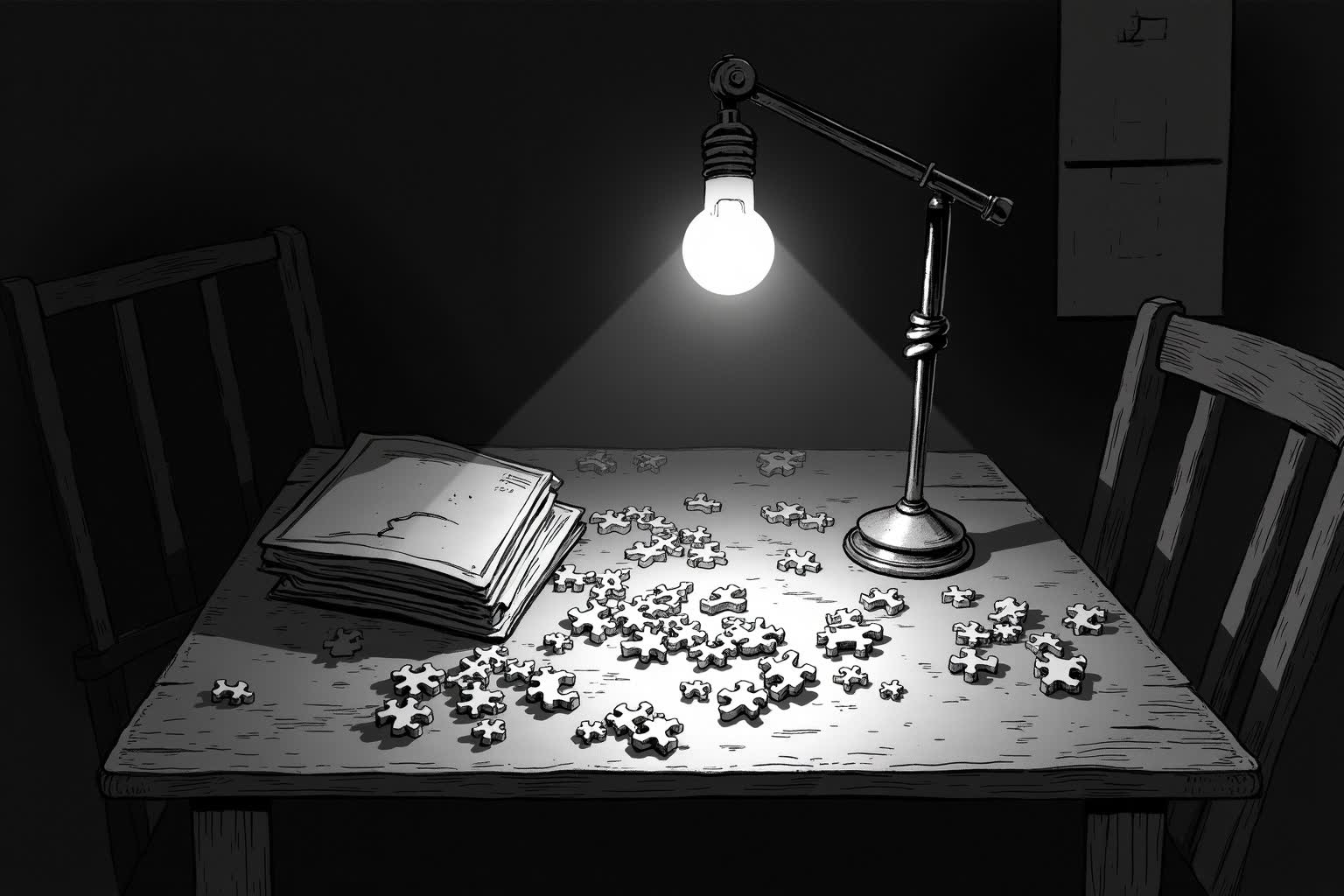
YOU HELD EACH PIECE AND NONE OF THEM TOGETHER
I had four things to decide in March.
Whether to renew the lease on an office I had outgrown.
Whether to hire someone whose start date depended on the office.
Whether to take a project whose scope depended on the hire.
Whether to end a partnership whose terms depended on the project.
Each one, alone, was a thirty minute problem.
I could take any single question and turn it until the answer came loose.
I had done harder thinking on a Tuesday afternoon with a closed door and nothing on the calendar.
But the four questions were not four questions.
Each answer required the other three.
The lease depended on the hire. The hire depended on the project. The project depended on the partnership. The partnership looped back to the lease.
I sat with all four and the thinking became heavy in a way I had never felt with problems I knew were harder.
Not difficult.
Heavy.
The kind of weight that makes the mind slide to something easier not because it lacks discipline but because the energy the operation demanded exceeded the energy the organ had for it.
I closed the laptop.
Opened it.
Closed it again.
Went for a walk that solved nothing because the walk did not change the cost of the computation waiting on the desk.
Each piece was simple.
I am not someone who breaks under simple things.
I called it decision fatigue.
I called it overthinking.
I called it stress.
It was none of those.
It was the weight of computation in a system that runs on twenty watts and cannot run on twenty one.
A surgeon I know holds fourteen variables in simultaneous interaction every Tuesday at seven in the morning.
Blood pressure and anesthesia depth and tissue tension and instrument position and team coordination and bleeding rate and oxygen saturation and the clock on the wall and the anatomy that shifts when she cuts and shifts again when she retracts and shifts a third time in a way the textbook does not address because the textbook was written for a body that holds still.
Fourteen variables.
Every one touching every other.
She does not experience this as heavy.
She experiences it the way you experience a left turn.
Automatic.
Compressed.
Twenty years of cases built the schemas that pack fourteen interacting variables into three or four chunks she holds without effort.
The compression makes the thinking feel weightless.
It is not weightless.
The weight is being paid by structures she built over thousands of repetitions, structures that handle the cost below the floor of her awareness.
I sat with her in November in the parking lot of her lawyer’s office.
Seven variables this time.
Half what she handles every morning in the OR.
Custody schedule. Asset division. The house. Health insurance. The children’s school district. His retirement account. The practice she built before the marriage.
Each one connected to every other.
And no schema existed.
No compression.
No twenty years of cases that had built the codebook turning seven raw elements into two manageable chunks.
She was operating on uncompressed input.
Every connection at full weight.
Every relationship between variables demanding its own slot in a system that has four.
She told me it felt like being stupid in a domain where she should have been competent.
She was not stupid.
She was uncompressed.
The same brain.
The same four slots.
The same twenty watts.
A different domain where every connection arrived unpackaged and the packaging was the only thing that had ever made the weight bearable.
Here is what is underneath.
Thinking costs energy.
Not metaphorically. Not in the way people say a hard day is exhausting. Physically. Measurably. In watts.
The brain runs on twenty watts continuous. Two percent of the body’s mass consuming twenty percent of its energy budget. The budget does not expand when the problem gets harder. It does not surge when you care more about the answer. It redistributes, but the total stays the same.
Every computation draws against that budget.
And the cost of the computation depends on one variable.
Not the number of elements.
The number of connections between them.
Four things that can be understood independently cost four operations. Process one, then the next, then the next. Linear. Manageable.
Four things that interact, where understanding any one requires holding it against the other three, cost eleven operations. Six pairwise relationships. Four triplet combinations. One quartet. The growth is exponential and the exponent does not negotiate.
Six interacting elements: fifty seven operations.
Eight: two hundred forty seven.
Ten: one thousand thirteen.
The weight is not in the pieces.
It is in the web between them.
Working memory holds approximately four items at once. Not seven. That older number included chunking strategies. Strip the strategies away and the raw capacity is three to four.
The limit is not arbitrary biology.
It is the physics of oscillatory timing in neural tissue. Each item encoded in a burst of high frequency activity nested inside a slower wave. Each burst occupying a different phase of the cycle. The cycle divides into three to five usable slots before the bursts overlap and the items bleed into each other.
Four slots.
Set by the ratio of two frequencies in warm tissue.
When the interacting elements exceed the slots, the system does not degrade proportionally. It does not lose ten percent of its capacity for ten percent more load.
It holds.
It holds.
It holds.
Then it collapses.
Discontinuously.
The way a bridge does not sag before it fails.
And the recovery does not mirror the collapse.
To restore function after the system has dropped, the load must fall to levels lower than where the collapse occurred.
Not the same level.
Lower.
The system remembers the crash.
And the memory makes the return more expensive than the crossing.
The industry built to address this mechanism has not identified the mechanism.
Deep work.
Close the door. Block four hours. Protect the calendar. The gospel of undisturbed time sold in hardcover and keynote and podcast and seminar.
The time was never the constraint.
The constraint is the cost of the computation. Four hours of uninterrupted access to an operation that demands more energy than the organ can deliver does not make the operation cheaper. It gives you four hours to sit with the cost instead of twenty minutes.
The pomodoro technique.
Twenty five minutes of work. Five minutes off. A timer as old as the tomato it is named for.
Useful for managing fatigue.
Irrelevant to the weight of what the attention is pointed at.
A timer does not change the cost per operation.
Nootropics.
Supplements that promise to sharpen cognition. Racetams and modafinil and microdosed psilocybin and branded stacks sold by influencers who discovered biochemistry last quarter.
Some of them do something measurable.
None of them expand working memory from four slots to five.
The slot count is set by the physics of phase separation in oscillating neural tissue. No capsule alters the frequency ratio.
Meditation for concentration.
Useful for attentional control.
Attentional control is not the bottleneck.
The bottleneck is the energy cost of maintaining simultaneous relationships between elements that interact. Sharper focus does not make eleven operations cost four. Sharper focus means you are more present for the moment the system exceeds its budget.
Brain training applications.
Games that promise to expand cognitive capacity the way a gym expands muscle.
The capacity they measure is the capacity they train. Their own game. Not the capacity that determines whether you can hold the lease and the hire and the project and the partnership in the same four slots simultaneously.
Transfer has not been demonstrated.
The weight has not been reduced.
The entire industry is treating a physics problem as a focus problem.
The symptom is collapse under cognitive demand.
The assumed cause is insufficient discipline or attention or technique.
The actual cause is a fixed energy budget meeting an exponential cost function.
No habit changes the exponent.
My four decisions in March were not a discipline problem.
They were a web with eleven connections in a system built for four.
I could hold the lease and the hire and see how they touched.
I could hold the project and the partnership and see the loop.
I could not hold all four and their eleven relationships at once because all four and eleven requires a system I do not have and no one has and no one can build because the slot count is written in the oscillatory physics of the tissue.
The collapse arrived on the ninth day of circling.
Not a gradual dimming.
A discontinuous drop.
I stopped being able to hold even two of the four.
Stopped being able to care about the answer.
The glutamate had accumulated in the prefrontal cortex the way exhaust accumulates in a closed garage. Not a metaphor for tiredness. A chemical fact. The primary excitatory neurotransmitter building up from days of sustained demand, signaling that the tissue needed restoration in the only language it knows.
The signal felt like apathy.
It was chemistry.
I did not recover by trying harder.
I recovered by stopping.
By sleeping.
By letting the system drop to a load level low enough to clear the accumulation and restore the coherence that the sustained demand had degraded.
The recovery took longer than the collapse.
Not because I was weak.
Because the system remembers where it crashed and the road back from the crash passes through territory lower than anything I had visited before the problem arrived.
Hysteresis.
The mathematics does not care what the problem meant to me.
I know the mechanism now and the mechanism still runs.
I know that thinking has a weight set by the number of connections between what I am holding and that the weight scales exponentially and that the budget does not.
I know that the schemas which make some thinking feel weightless are purchased with years of repetition in a specific domain and do not travel.
I know that the surgeon in the operating room and the surgeon in the parking lot of her lawyer’s office are the same twenty watts processing different compression ratios.
I know the four slots.
I know the cusp that converts gradual overload into sudden collapse.
I know the hysteresis that makes recovery more expensive than the crossing.
I still sit with problems whose connections exceed my slots.
I still feel the weight arrive when the third relationship touches the fourth and the system registers the cost of all six pairwise interactions and the four triplets and the one quartet and the total lands on a budget that was set before I was consulted.
I still close the laptop.
The difference is smaller than the industry promises and larger than the industry can sell.
I no longer call the weight a weakness.
It is not a weakness.
It is twenty watts meeting an exponential.
The budget is real.
The web is real.
The cost lives in the connections.
Not in the pieces.
Not in the person holding them.
In the mathematics between what I am trying to hold and the physics of the organ holding it.
I hold one piece.
I set it down.
I hold the next.
This is not a strategy.
This is the only honest description of what a system with four slots does when the web has eleven connections.
The knowing does not expand the budget.
It stops me from spending what remains on the wrong diagnosis.
These are words. The mechanism they describe is not words. You will have to look for yourself.