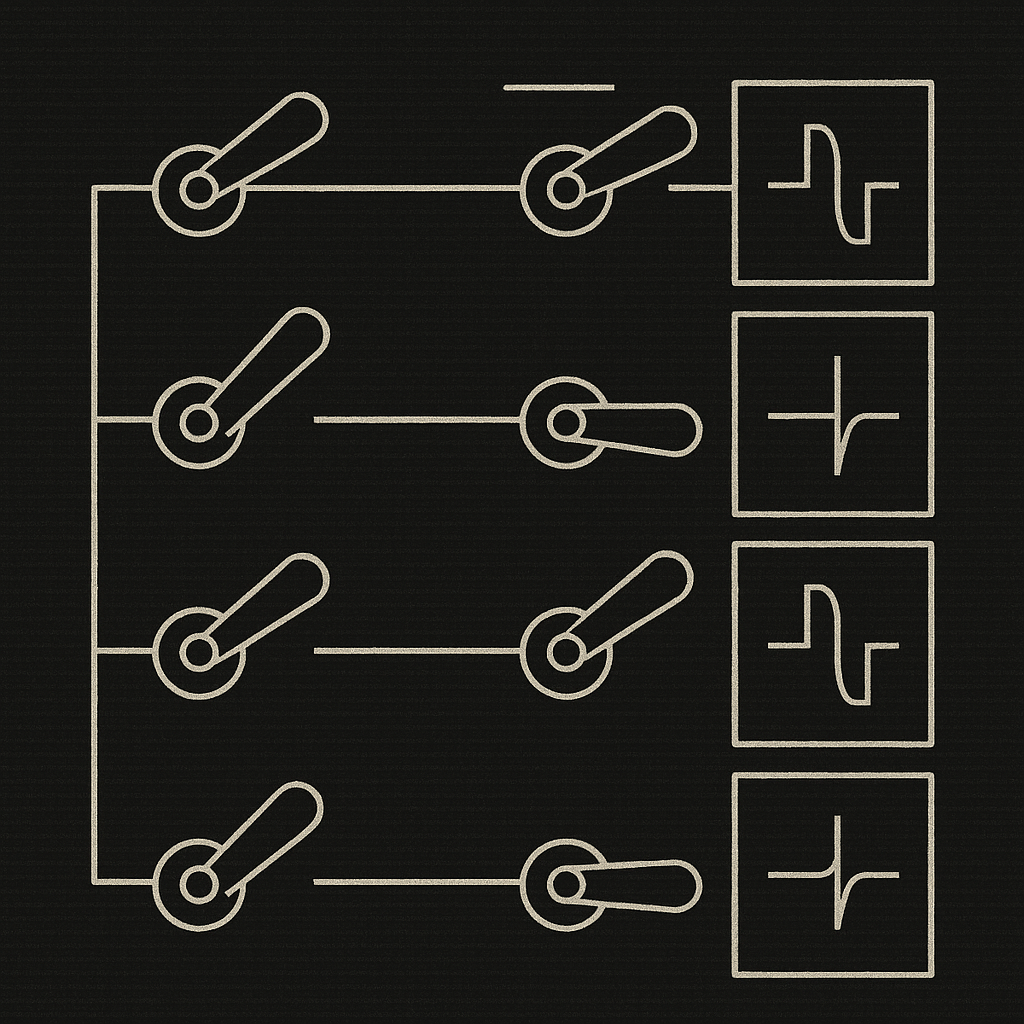
THE MACHINERY OF HYSTERESIS
A Complete Guide to Why Systems Never Go Back the Same Way
How Memory Gets Baked Into Matter
What follows is not advice.
It is not a framework for resilience. Not a model for recovery. Not a guide to bouncing back.
It is mechanism.
The actual machinery of irreversible change. The physics of why going forward and going back are never the same journey. The mathematics of how systems remember what happened to them long after the cause has disappeared.
Most people assume that if you remove the cause, you undo the effect. Push a system one direction, then push it back, and it returns to where it started. Symmetric. Clean. Reversible.
Almost nothing works this way.
The rubber band stretched too far. The economy after a recession. The relationship after the betrayal. The ecosystem after the tipping point. The person after the trauma.
The path forward is not the path back.
This is hysteresis.
Not metaphor. Not analogy. A precise physical phenomenon with mathematical structure, measurable in iron, observable in markets, embedded in neural tissue.
This document maps the machinery.
Nothing more.
PART ONE: THE LOOP THAT NEVER CLOSES
What Hysteresis Actually Is
Take a piece of iron. Apply a magnetic field. The iron magnetizes.
Now remove the field.
The iron does not return to zero. It keeps some of the magnetization. A remnant. A memory of the field that is no longer there.
To bring it back to zero, you must apply a field in the opposite direction. You must actively push it back. And even then, the path it traces going back is different from the path it traced going forward.
This is the hysteresis loop. The most studied example of a universal phenomenon.
    THE MAGNETIC HYSTERESIS LOOP

    Magnetization (M)
         │
         │                    ┌──────── Saturation
         │               ····/
         │           ···/
         │       ···/
    R ───│──····/                         R = Remanence
         │·/                               (memory at zero field)
    ─────┼────────────────────────────── Field (H)
       / │·
      /  │  ···
     /   │      ···                       C = Coercivity
    /    │          ···                    (effort to erase memory)
         │──────────────···──── -C
         │
         │     The area inside = energy lost
         │     The gap between paths = memory
Two features define the loop.
Remanence. The magnetization remaining when the driving force reaches zero. The system remembers. It holds a trace of what happened to it even after the cause is gone.
Coercivity. The opposing force required to bring the system back to its neutral state. Erasing the memory costs energy. The system resists returning.
These are not special properties of magnets. They are structural features of any system where the path forward differs from the path back.
The Formal Definition
A system exhibits hysteresis when its output depends not only on the current input but on the history of inputs.
The same input produces different outputs depending on which direction the system arrived from.
    HISTORY DEPENDENCE

    Output
         │
         │         Going up →
         │         ┌─────────────────────
         │        /
         │       /
         │      /          ← Going down
         │     /     ─────────────────────┐
         │    /     /                      │
         │   /     /                       │
         │  /     /                        │
         │ /     /                         │
         │/     /                          │
    ─────┼─────/───────────────────────────── Input
         │

    Same input value at center.
    Two different output values.
    The difference = what happened before.
At any given input, the system occupies one of two possible states. Which state depends on the direction of approach. On whether the system was pushed up from below or relaxed down from above.
The present state encodes the past.
This is not figurative. It is measurable, physical, mathematical.
PART TWO: THE HYSTERON
The Smallest Unit of Memory
In 1935, Ferenc Preisach proposed a model that remains the most powerful description of hysteresis in any domain. He built everything from a single primitive element.
The hysteron.
A hysteron is the simplest possible memory unit. It has two states. Up or down. On or off. It switches up when input crosses an upper threshold. It switches down when input crosses a lower threshold. Between the two thresholds, it holds whatever state it was in last.
    THE HYSTERON (ELEMENTARY RELAY)

    Output
         │
      +1 │─────────────────┐         ┌──────────────
         │                 │         │
         │                 │         │
         │                 │         │
      -1 │──────────────   └─────────┘
         │
         └────────────────────────────────────── Input
                           β         α

         α = upper threshold (switches ON)
         β = lower threshold (switches OFF)

         Between β and α: output depends on history.
         This gap IS the memory.
The gap between β and α is the dead zone. The region where the hysteron remembers. Input can wander freely within this gap and the output does not change. The system holds its state.
This is not a design choice. It is a consequence of having two stable states separated by an energy barrier. The input must overcome the barrier to flip the state. Below the barrier height, the system persists.
The Preisach Architecture
Preisach’s insight was that any complex hysteretic system can be decomposed into a population of hysterons. Each with its own pair of thresholds. Each contributing a tiny piece of the total memory.
    THE PREISACH DECOMPOSITION

    ┌──────────────────────────────────────────────────┐
    │                                                  │
    │          COMPLEX HYSTERETIC SYSTEM               │
    │                                                  │
    │    = Sum of elementary hysterons                 │
    │                                                  │
    └──────────────────────────────────────────────────┘
                          │
            ┌─────────────┼─────────────┐
            │             │             │
            ▼             ▼             ▼
    ┌──────────────┐ ┌──────────────┐ ┌──────────────┐
    │  Hysteron 1  │ │  Hysteron 2  │ │  Hysteron N  │
    │              │ │              │ │              │
    │  α₁ = 2.0   │ │  α₂ = 3.5   │ │  αₙ = 7.1   │
    │  β₁ = 0.5   │ │  β₂ = 1.2   │ │  βₙ = 4.8   │
    │              │ │              │ │              │
    │  Gap = 1.5   │ │  Gap = 2.3   │ │  Gap = 2.3   │
    └──────────────┘ └──────────────┘ └──────────────┘

    Each hysteron: different thresholds, same binary logic.
    Aggregate output: weighted sum of all hysterons.
    Total memory: distributed across the population.
The mathematical form:
f(t) = ∫∫ μ(α,β) · γ(α,β) · u(t) dα dβ
Where μ(α,β) is the weight function. It specifies how many hysterons exist at each threshold pair. The weight function IS the system’s identity. Two systems with different weight functions exhibit different hysteresis loops, different memories, different personalities.
The Preisach model reveals something important.
Memory is not stored in one place. It is distributed across a population of binary switches, each with its own sensitivity. The aggregate behavior, the smooth-looking hysteresis loop, emerges from the collective action of discrete, simple elements.
This is how iron remembers. It is also how economies remember. How ecosystems remember. How neural tissue remembers.
PART THREE: THE ENERGY LANDSCAPE
Why Systems Get Stuck
Hysteresis is not just a curve on a graph. It is a landscape.
Imagine a ball rolling on a surface with two valleys separated by a hill. The ball sits in one valley. This is a stable state. To move the ball to the other valley, you must push it over the hill. The hill is the energy barrier.
    THE DOUBLE-WELL POTENTIAL

    Energy
         │
         │\                           /
         │ \         Barrier         /
         │  \         /\            /
         │   \       /  \          /
         │    \     /    \        /
         │     \   /      \      /
         │      \_/        \    /
         │    Well A        \__/
         │   (State 1)     Well B
         │                (State 2)
         └────────────────────────────── State Variable

    Ball in Well A: stable. Stays there.
    Push hard enough to cross barrier: falls into Well B.
    Remove push: ball stays in Well B.
    Must push back OVER barrier to return to A.
The barrier explains everything.
Why the system remembers. The ball in Well B stays in Well B even after the push is removed. The barrier prevents spontaneous return. This is remanence.
Why erasing costs energy. You must supply enough force to push the ball back over the barrier. This is coercivity.
Why the path differs. Going A to B requires overcoming the barrier from the left. Going B to A requires overcoming it from the right. If the landscape is asymmetric, these are different journeys.
Why energy dissipates. Each time the ball crosses the barrier and falls into a well, kinetic energy converts to heat through friction. The area inside the hysteresis loop equals the energy lost per cycle. Every cycle of magnetization and demagnetization heats the iron. This is not a side effect. It is the thermodynamic cost of memory.
The Barrier Changes Everything
Without the barrier, the system would be linear. Push right, it goes right. Release, it returns. No memory. No history. No hysteresis.
The barrier introduces asymmetry between forward and backward paths. It creates a region where multiple stable states coexist. And it forces the system to commit. Once past the barrier, the system is in a new basin of attraction and resists leaving.
    BARRIER HEIGHT AND MEMORY STRENGTH

    Barrier Height     Memory         Coercivity     Reversibility
         │
    HIGH │  ████████   Permanent      Very high      Nearly impossible
         │  ████████   Hard magnet    to erase       to undo
         │
    MED  │  ████       Persistent     Moderate       Effortful to
         │  ████       Habit, scar    resistance     reverse
         │
    LOW  │  ██         Transient      Low            Easy to
         │  ██         Soft magnet    resistance     reverse
         │
    ZERO │  (none)     No memory      Zero           Perfectly
         │             Linear         resistance     reversible
         │
         └──────────────────────────────────────────────
The height of the barrier determines the character of the hysteresis.
Hard magnets. Permanent magnets. Deep trauma. Extinct species. High barriers. The memory is essentially permanent because the energy required to erase it exceeds anything the system will encounter naturally.
Soft magnets. Temporary bruises. Mild recessions. Low barriers. The memory fades because thermal fluctuations or small perturbations are sufficient to push the system back.
The distinction between “reversible” and “irreversible” is not binary. It is a function of barrier height relative to available energy.
PART FOUR: BIFURCATION AND THE FOLD
Where Hysteresis Comes From in Dynamical Systems
In the language of dynamical systems, hysteresis arises from bistability. Two stable equilibria coexisting for the same parameter value. The system occupies one or the other depending on its history.
The canonical mechanism is the saddle-node bifurcation on a fold.
    THE FOLD CATASTROPHE

    State
    Variable
         │
         │                         Upper branch
         │                    ·····/···(stable)
         │               ····/
         │          ····/
    B₂ ──│─────····/ ← Fold point (jump DOWN)
         │     :
         │     :  Unstable branch
         │     :  (dashed)
    B₁ ──│─────:····· ← Fold point (jump UP)
         │          \····
         │               \····
         │                    \····(stable)
         │                         Lower branch
         └────────────────────────────────────── Parameter

    Between B₁ and B₂: two stable states coexist.
    This is the bistable region.
    Which state the system occupies = history.
As a parameter increases slowly, the system rides the lower branch. Stable. Predictable. Until it reaches fold point B₂. There, the lower branch disappears. The stable state ceases to exist. The system has no choice but to jump catastrophically to the upper branch.
Now reverse the parameter. The system rides the upper branch. But it does not jump back at B₂. It continues past B₂, still on the upper branch, because that branch remains stable. It only jumps back down at B₁, where the upper branch disappears.
The forward transition happens at B₂. The backward transition happens at B₁. Two different critical points. Two different paths. The gap between B₁ and B₂ is the hysteresis width.
This is not a special case. This is the generic mechanism. Whenever a system has two stable states separated by an unstable one, and a parameter slowly sweeps through the bistable region, hysteresis emerges.
The Catastrophe
The jumps at B₁ and B₂ are discontinuous. The system does not slide smoothly from one branch to the other. It leaps.
This is catastrophe in the mathematical sense. René Thom’s catastrophe theory classifies these jumps. The fold is the simplest. But the mathematics is general. Cusp catastrophes, swallowtail catastrophes, each producing their own signature of hysteresis.
The jumps are also fast. The system was stable for a long time, changing gradually. Then, at the fold point, it transitions abruptly. The timescale of the jump is orders of magnitude faster than the timescale of the parameter change that caused it.
    SLOW-FAST DYNAMICS

    State
         │
         │        Slow drift along branch
         │        ─────────────────────→
         │                               │
         │                               │ FAST
         │                               │ JUMP
         │                               │
         │                               ▼
         │        ←─────────────────────
         │        Slow drift along branch
         │
         └────────────────────────────────── Time

    Slow timescale: parameter change (days, years, decades)
    Fast timescale: transition (seconds, hours)

    The jump is NOT gradual.
    It is a qualitative discontinuity.
This is why tipping points feel sudden. The underlying parameter has been drifting for a long time. Nothing seemed to happen. Then everything happened at once.
The system crossed a fold point.
PART FIVE: THE THERMODYNAMIC COST
Energy Inside the Loop
Every hysteresis loop encloses an area. That area has physical meaning.
It is the energy dissipated per cycle.
When you magnetize iron and demagnetize it, the area inside the B-H loop tells you exactly how much energy was converted to heat. When you stretch rubber and release it, the area inside the stress-strain loop tells you the mechanical energy lost to internal friction. When you cycle a shape-memory alloy through its transformation, the area tells you the thermal energy released.
    ENERGY DISSIPATION PER CYCLE

    ┌────────────────────────────────────────────────┐
    │                                                │
    │          NARROW LOOP                           │
    │          (soft magnet)                          │
    │                                                │
    │          Small area                            │
    │          Low dissipation                       │
    │          Easy to cycle                         │
    │          Weak memory                           │
    │                                                │
    └────────────────────────────────────────────────┘

    ┌────────────────────────────────────────────────┐
    │                                                │
    │          WIDE LOOP                             │
    │          (hard magnet)                          │
    │                                                │
    │          Large area                            │
    │          High dissipation                      │
    │          Expensive to cycle                    │
    │          Strong memory                         │
    │                                                │
    └────────────────────────────────────────────────┘

    Memory and dissipation are coupled.
    Strong memory = high cost per cycle.
    Weak memory = low cost per cycle.
    You cannot have free memory.
This is the second law of thermodynamics expressed through hysteresis.
Every irreversible process produces entropy. Hysteresis is irreversible by definition. The path forward differs from the path back. The difference is entropy production. The difference is heat. The difference is lost work that can never be recovered.
Memory is thermodynamically expensive. Every hysteresis loop is a heat engine running backwards. Information stored in the system’s state was purchased with energy dissipated into the environment.
The Barkhausen Staircase
If you zoom into a hysteresis loop, the smooth curve dissolves.
What looks continuous at the macro scale is discrete at the micro scale. In ferromagnetic materials, magnetization does not change smoothly. It jumps. Tiny, sudden, irreversible jumps called Barkhausen jumps.
Each jump is a domain wall unpinning from a defect in the crystal lattice. The wall was trapped. Energy accumulated. Then the wall broke free and snapped to the next pinning site. Each snap dissipates energy. Each snap is a micro-irreversibility.
    THE BARKHAUSEN STAIRCASE

    Magnetization
         │
         │                          ┌──
         │                     ┌────┘
         │                ┌────┘
         │           ┌────┘
         │      ┌────┘
         │ ┌────┘
         │─┘
         │
         └──────────────────────────────── Field

    Macro view: smooth curve
    Micro view: staircase of discrete jumps

    Each step = one domain wall unpinning
    Each step = one micro-irreversibility
    Sum of all steps = the smooth hysteresis loop
The smooth loop is an average over billions of Barkhausen events. The macro hysteresis emerges from micro irreversibilities. Just as Preisach predicted. The aggregate memory is the sum of elementary binary switches.
This is how the second law works at the microscale. Not through some global decree, but through the accumulation of tiny irreversible events. Each one too small to notice. Together, they add up to the arrow of time.
PART SIX: THE ASYMMETRY OF GOING AND RETURNING
Why Undoing Is Harder Than Doing
The most consequential feature of hysteresis is asymmetry.
It is not that the return path is merely different from the forward path. It is that returning often requires more force, more time, or more energy than the original transition.
This asymmetry has structural reasons.
    THE ASYMMETRY

    ┌──────────────────────────────────────────────────┐
    │                                                  │
    │    FORWARD TRANSITION (doing)                    │
    │                                                  │
    │    Often aided by:                               │
    │    - Positive feedback amplifying the move       │
    │    - Cascading failures of the old state         │
    │    - Cooperative effects (neighbors switching)   │
    │    - Gravity of the new attractor basin          │
    │                                                  │
    │    Timescale: can be fast                        │
    │                                                  │
    └──────────────────────────────────────────────────┘

    ┌──────────────────────────────────────────────────┐
    │                                                  │
    │    REVERSE TRANSITION (undoing)                  │
    │                                                  │
    │    Often resisted by:                            │
    │    - New structures stabilizing the new state    │
    │    - Loss of the preconditions for the old state │
    │    - Adaptation of other components to new state │
    │    - Degradation of the return pathway           │
    │                                                  │
    │    Timescale: often much slower                  │
    │                                                  │
    └──────────────────────────────────────────────────┘
A forest becomes a desert when rainfall drops below a critical threshold. But restoring rainfall to the original level does not restore the forest. The topsoil has eroded. The seed bank has depleted. The albedo has changed, creating a local climate that reinforces aridity. The system has restructured itself around its new state.
The forward transition was a catastrophe at one threshold. The reverse transition requires exceeding a different, much higher threshold. This is the fold catastrophe from Part Four, manifested in an ecosystem.
Rate-Independent Memory
A remarkable property of many hysteretic systems is that the memory is rate-independent.
It does not matter how fast you traverse the loop. The shape of the loop stays the same. Speed the input up by a factor of ten, the output traces the same path. Slow it down by a factor of a hundred, same path.
This distinguishes hysteresis from ordinary lag or delay. A lag disappears if you go slowly enough. Hysteresis does not. The gap between forward and backward paths persists at any speed, including infinitely slow.
    RATE-INDEPENDENT VS RATE-DEPENDENT

    ┌──────────────────────────────────────────────────┐
    │                                                  │
    │    ORDINARY LAG (viscosity, inertia)             │
    │                                                  │
    │    Fast input:  large lag, wide apparent loop    │
    │    Slow input:  small lag, narrow loop           │
    │    Zero speed:  zero lag, loop vanishes          │
    │                                                  │
    │    The memory is an artifact of speed.           │
    │                                                  │
    └──────────────────────────────────────────────────┘

    ┌──────────────────────────────────────────────────┐
    │                                                  │
    │    TRUE HYSTERESIS (bistability, barriers)       │
    │                                                  │
    │    Fast input:  same loop                        │
    │    Slow input:  same loop                        │
    │    Zero speed:  same loop                        │
    │                                                  │
    │    The memory is structural.                     │
    │    It cannot be waited out.                      │
    │                                                  │
    └──────────────────────────────────────────────────┘
This distinction matters. When something appears to have healed because you gave it time, the healing was real. There was no hysteresis. The system had ordinary lag.
When something refuses to heal no matter how long you wait, the memory is structural. The barrier is permanent. The system has been reorganized. Time alone does not cross energy barriers.
PART SEVEN: ECOLOGICAL HYSTERESIS
Regime Shifts
In the 1970s, ecologists discovered that ecosystems could exist in alternative stable states. A shallow lake could be clear or turbid. A grassland could be verdant or desertified. A coral reef could be thriving or algae-dominated.
These are not points on a continuum. They are discrete attractors separated by unstable boundaries. And the transitions between them exhibit hysteresis.
    LAKE EUTROPHICATION HYSTERESIS

    Water Clarity
         │
         │ Clear state
         │ ────────────────────────┐
         │                          │
         │                          │ Collapse
         │                          │ (at high nutrient load)
         │                          ▼
         │            ┌────────────────────────
         │            │ Turbid state
         │            │
         │     Recovery│
         │     (requires│nutrient load much
         │      lower   │than collapse point)
         │            │
         └────────────┼───────────────────────── Nutrient Load
                      │
              Recovery threshold          Collapse threshold
              (much lower)                (higher)

    The gap between thresholds = hysteresis width.
    Reducing nutrients to pre-collapse levels
    does NOT restore the clear state.
A clear lake collapses to a turbid state when phosphorus loading exceeds a critical threshold. Submerged vegetation dies. Sediment resuspends. Algae dominate.
To restore the clear state, phosphorus must be reduced far below the collapse threshold. Sometimes to levels lower than the lake has experienced in decades. Because the turbid state stabilizes itself. Resuspended sediment blocks light. Dead vegetation releases stored phosphorus. Fish communities shift to species that stir sediment.
The turbid state digs its own basin of attraction.
Marten Scheffer’s work on shallow lakes became the paradigm case. But the pattern is everywhere. Saharan desertification. Coral reef bleaching. Rainforest dieback. Each exhibits the same fold catastrophe. Each exhibits the same asymmetry between collapse and recovery.
The Irreversibility Spectrum
Not all ecological hysteresis is equal. The width of the hysteresis loop determines whether recovery is merely difficult or effectively impossible.
    ECOLOGICAL IRREVERSIBILITY SPECTRUM

    ◄──────────────────────────────────────────────────────────►

    NARROW HYSTERESIS              MODERATE                WIDE HYSTERESIS
    (recoverable)                                         (effectively
                                                           irreversible)

    Seasonal algal blooms          Lake eutrophication     Species extinction
    Soil compaction                Coral reef degradation  Soil loss to bedrock
    Temporary overfishing          Grassland to shrubland  Rainforest to savanna
                                                           (in some climates)

    Recovery: reduce pressure      Recovery: reduce        Recovery: requires
    slightly below onset           pressure well below     conditions that may
                                   onset, wait decades     not recur on human
                                                           timescales
The width of the hysteresis loop is not a fixed property. It depends on the system, the severity of the disturbance, and which stabilizing structures were destroyed during the transition.
Destroy the topsoil and the loop widens. The recovery threshold retreats further from the collapse threshold. Push past a certain point and the recovery threshold leaves the physically accessible range. The loop is so wide that the original state is gone.
This is extinction. Not as metaphor. As the mathematical limit of hysteresis width approaching the boundaries of the parameter space.
PART EIGHT: ECONOMIC HYSTERESIS
The Scarring Effect
In 1986, Olivier Blanchard and Lawrence Summers introduced hysteresis into mainstream economics. Their observation was simple and devastating.
Recessions were supposed to be temporary. The economy falls, then recovers to its previous trajectory. The long-run growth path is independent of short-run fluctuations.
This is not what happens.
    ECONOMIC HYSTERESIS

    Output
         │
         │        Pre-recession trajectory
         │        ─ ─ ─ ─ ─ ─ ─ ─ ─ ─ ─ ─ ─ ─
         │                    /
         │                   /
         │                  /
         │    ─────────────/
         │   /        Gap = permanent loss
         │  /
         │ /   Post-recession trajectory
         │/    ─────────────────────────────────
         │
         └──────────────────────────────────────── Time
                         │
                    Recession
After the recession ends, the economy grows again. But it does not return to the pre-recession trajectory. It grows from a lower base. The gap persists. The recession left a scar.
The mechanisms are multiple and reinforcing.
Workers lose skills during extended unemployment. The degradation is real. Neural pathways for complex tasks weaken without practice. Technological change passes them by. When rehired, they are less productive than before. This is not laziness. It is synaptic pruning operating on the labor force.
Firms reduce investment during downturns. Capital stock depreciates. R&D projects are cancelled. The innovations that would have compounded are never made. The potential output surface is permanently lower.
Long-term unemployed workers exit the labor force entirely. They stop searching. Their absence reduces wage pressure, which paradoxically signals to policymakers that the labor market has healed. But the workers are gone. The natural rate of unemployment has shifted. The economy has found a new, worse equilibrium.
The Unemployment Trap
European Central Bank research on 29 OECD countries from 2002 to 2019 confirmed the hysteresis hypothesis quantitatively. Shocks to unemployment permanently raise the non-accelerating inflation rate of unemployment (NAIRU). The new equilibrium does not revert to the old one.
    THE UNEMPLOYMENT RATCHET

    Unemployment
    Rate (%)
         │
    10   │          ┌──┐
         │         /    \         ┌──┐
     8   │        /      \       /    \
         │       /        \     /      \
     6   │──────/          \   /        \──── New "natural rate"
         │                  \_/
     4   │── Original "natural rate"
         │
         └──────────────────────────────────── Time
              Recession 1       Recession 2

    Each recession pushes the ratchet up.
    Recovery never brings it fully back down.
    The "natural rate" absorbs the trauma.
Each recession leaves a residue. The labor market does not heal completely. The natural rate ratchets up. Over decades, the accumulated scarring reshapes what economists consider full employment.
This is the Preisach model operating in a labor market. Each worker is a hysteron. Each has a threshold for exiting the workforce and a different, higher threshold for re-entering. Each recession flips some workers past their exit threshold. Recovery does not provide enough force to flip them back. The aggregate unemployment rate retains a trace of every recession it has lived through.
PART NINE: NEURAL HYSTERESIS
The Brain’s Resistance to State Change
Consciousness itself exhibits hysteresis.
The concentration of anesthetic required to put a person under is different from the concentration required to bring them back. The brain, once in an unconscious state, resists returning to consciousness at the same drug level that originally induced the transition.
This is called neural inertia.
    ANESTHETIC HYSTERESIS

    Consciousness
    Level
         │
    AWAKE│ ────────────────────┐
         │                      │ Loss of
         │                      │ consciousness
         │                      │ (at concentration C₂)
         │                      ▼
    UNDER│                ┌─────────────────
         │                │
         │         Return │ of consciousness
         │         (at    │ concentration C₁)
         │         C₁ < C₂│
         │                │
         └────────────────┼───────────────── Anesthetic
                          │                  Concentration
                   C₁     │     C₂
                (recovery) (induction)

    The gap C₂ - C₁ = neural inertia.
    The brain stabilizes whatever state it's in.
This is not pharmacological delay. It is not the drug taking time to clear. At the same blood concentration, the brain can be in either state depending on which direction the concentration was moving. This is rate-independent hysteresis in neural tissue.
The mechanism involves recurrent excitatory connections. When cortical networks are active, they support each other. Mutual excitation creates a self-sustaining state. Suppressing this requires overcoming the collective drive of the network. But once suppressed, the silent state is also self-sustaining. Inhibitory processes dominate. Restarting the network requires overcoming the collective inhibition.
Two stable states. Two different thresholds for transition. History dependence. The signature of hysteresis.
Synaptic Hysteresis
At the cellular level, individual synapses exhibit hysteresis through bistable plasticity.
Glutamate release at certain synapses can be potentiated by the hormone ghrelin. But when ghrelin is removed, the potentiation persists. For hours. The synapse was flipped to a high-release state and stays there. Returning it to baseline requires an active depotentiating signal, not merely the absence of the original cause.
    BISTABLE SYNAPSE

    Synaptic
    Strength
         │
    HIGH │──────────────────────────── Potentiated state
         │          ▲                  (persists after stimulus)
         │          │
         │          │ Ghrelin flips
         │          │ synapse UP
         │          │
    LOW  │──────────┘                  Baseline state
         │
         └──────────────────────────── Time
                    │            │
               Ghrelin       Ghrelin
               applied       removed

    Removal of cause does NOT reverse the effect.
    Active counter-signal required to return to baseline.
    The synapse remembers.
This is how physiological states become persistent. A transient hormonal signal creates a lasting change in neural circuitry. The circuitry then maintains the state independently of the original signal. The system has crossed a barrier and settled into a new basin.
Feeding behavior, emotional regulation, threat assessment. All exhibit this pattern. The brain does not simply track current conditions. It tracks history through hysteretic synapses that hold their state until actively reset.
PART TEN: THE UNIVERSAL PATTERN
Hysteresis Across Scales
The same mathematical structure appears at every scale of organization.
| Domain | Forward Transition | Reverse Transition | Hysteresis Width |
|---|---|---|---|
| Magnetism | Magnetize at field H₂ | Demagnetize at field H₁ | H₂ - H₁ = coercivity |
| Ecology | Clear lake collapses at phosphorus P₂ | Recovers at P₁ « P₂ | P₂ - P₁ |
| Economics | Jobs lost at recession severity S₂ | Jobs return at recovery strength S₁ » S₂ | S₂ - S₁ = scarring |
| Neuroscience | Consciousness lost at drug level C₂ | Returns at C₁ < C₂ | C₂ - C₁ = neural inertia |
| Climate | Ice melts at temperature T₂ | Reforms at T₁ « T₂ | T₂ - T₁ |
| Electronics | Schmitt trigger flips at V_high | Resets at V_low | V_high - V_low = noise margin |
The same fold catastrophe. The same bistability. The same asymmetry between forward and backward paths.
This is not coincidence. It is mathematical necessity. Any system with two stable states and a parameter that sweeps through the bistable region will exhibit hysteresis. The specific physics differ. The topology is identical.
The Three Requirements
Hysteresis requires exactly three ingredients.
    THE THREE INGREDIENTS OF HYSTERESIS

    ┌────────────────────────────────────────────────────────┐
    │                                                        │
    │   1. MULTIPLE STABLE STATES                            │
    │                                                        │
    │   The system must have more than one equilibrium.      │
    │   Two wells. Two attractors. Two self-sustaining       │
    │   configurations. Without multiplicity, there          │
    │   is nothing to remember.                              │
    │                                                        │
    ├────────────────────────────────────────────────────────┤
    │                                                        │
    │   2. ENERGY BARRIERS                                   │
    │                                                        │
    │   The stable states must be separated by barriers.     │
    │   Without barriers, the system slides freely between   │
    │   states. No commitment. No persistence.               │
    │   No memory.                                           │
    │                                                        │
    ├────────────────────────────────────────────────────────┤
    │                                                        │
    │   3. SLOW PARAMETER VARIATION                          │
    │                                                        │
    │   An external parameter must change slowly enough      │
    │   that the system tracks a stable branch until the     │
    │   branch disappears. Fast variation produces chaos.    │
    │   Slow variation produces the classic loop.            │
    │                                                        │
    └────────────────────────────────────────────────────────┘
Remove any one and hysteresis vanishes.
Remove the multiple states. The system has one equilibrium. It tracks input monotonically. No memory.
Remove the barriers. The system jumps freely between states. Each input maps to a unique output regardless of history. No memory.
Remove the slow variation. The system cannot track a branch. It bounces chaotically. The clean loop dissolves into noise.
All three present, hysteresis is inevitable.
PART ELEVEN: THE COMPLETE PICTURE
What Hysteresis Reveals
Hysteresis is the physical expression of a simple truth.
The universe is not symmetric in time.
Going forward and going back are different operations. Not because of some philosophical principle, but because of energy barriers, entropy production, and the mathematics of multistable systems.
    THE COMPLETE FRAMEWORK

    ┌──────────────────────────────────────────────────────────┐
    │                                                          │
    │                    HYSTERESIS                             │
    │                                                          │
    │    Systems that remember their history through           │
    │    structural reorganization, not mere recording         │
    │                                                          │
    └──────────────────────────────────────────────────────────┘
                              │
              ┌───────────────┼───────────────┐
              │               │               │
              ▼               ▼               ▼
    ┌────────────────┐ ┌────────────────┐ ┌────────────────┐
    │                │ │                │ │                │
    │   BISTABILITY  │ │   BARRIERS     │ │  IRREVERSIBLE  │
    │                │ │                │ │  DISSIPATION   │
    │   Two or more  │ │  Energy cost   │ │                │
    │   stable       │ │  of switching  │ │  Every cycle   │
    │   states       │ │  between       │ │  loses energy  │
    │   coexist      │ │  states        │ │  to heat       │
    │                │ │                │ │                │
    └────────────────┘ └────────────────┘ └────────────────┘
              │               │               │
              └───────────────┼───────────────┘
                              │
                              ▼
    ┌──────────────────────────────────────────────────────────┐
    │                                                          │
    │                 PATH ≠ PATH⁻¹                            │
    │                                                          │
    │    The forward journey and the reverse journey           │
    │    trace different curves through state space.           │
    │    The gap between them is memory.                       │
    │    The area between them is dissipated energy.           │
    │    The asymmetry between them is the arrow of time.      │
    │                                                          │
    └──────────────────────────────────────────────────────────┘
The Implications
Hysteresis means that history is physically real.
Not as a narrative. Not as a record stored somewhere. As a structural deformation of the system itself. The iron is shaped by its magnetic history. The economy is shaped by its recessions. The brain is shaped by its experiences. The ecosystem is shaped by its disturbances.
The shape IS the memory.
And the memory cannot be erased by merely removing the cause. Because the cause changed the landscape. It moved the barriers. It deepened some wells and filled others. The system that exists after the event is a different system than existed before.
This is why “just go back to how things were” is not a viable strategy in any domain.
Because “how things were” was a state maintained by a landscape that no longer exists. The system crossed a fold point. The old branch terminated. The old equilibrium disappeared. Returning to the old parameter value does not resurrect the old equilibrium. It was a mathematical object that the transition destroyed.
Recovery, when it occurs, is not return. It is the construction of a new state that resembles the old one closely enough to serve the same function. But it is a new state. Built from different initial conditions. Stabilized by different mechanisms. Arrived at through a different path.
The path back is never the path forward, reversed.
It is a new path entirely.
Final Synthesis
A piece of iron sits on a table.
It looks inert. Passive. Waiting for inputs.
It is none of these things.
Inside, it contains the record of every magnetic field it has ever experienced. Encoded not in some separate memory bank but in the orientation of its magnetic domains. In the pinned positions of its domain walls. In the crystallographic defects where Barkhausen jumps happened and never unhappened.
The iron does not have memory.
The iron IS memory.
Every system that exhibits hysteresis is the same. It is not a system that remembers. It is a system whose present structure is the memory. The scar tissue is not a record of the wound. It is the wound, transformed into a permanent feature of the landscape.
Understanding this changes the nature of every question about change, recovery, and reversibility.
Not “can we go back?” but “what new state can we build from here?”
Not “how do we remove the cause?” but “what opposing force is sufficient to cross the barrier?”
Not “why hasn’t it recovered?” but “what new structures are stabilizing the current state?”
The machinery does not care about the answers.
It runs regardless.
But seeing the loop. Knowing the fold. Understanding why the path back is not the path forward.
That changes what questions you ask.
And the questions you ask determine the solutions you find.
Citations
Physics and Magnetism
Preisach, F. (1935). “Über die magnetische Nachwirkung.” Zeitschrift für Physik, 94:277-302. The original Preisach model paper.
Jiles, D.C. & Atherton, D.L. (1986). “Theory of ferromagnetic hysteresis.” Journal of Magnetism and Magnetic Materials, 61(1-2):48-60.
Bertotti, G. (1998). Hysteresis in Magnetism: For Physicists, Materials Scientists, and Engineers. Academic Press.
Barkhausen, H. (1919). “Zwei mit Hilfe der neuen Verstärker entdeckte Erscheinungen.” Physikalische Zeitschrift, 20:401-403. Discovery of Barkhausen jumps.
Mathematics and Dynamical Systems
Mayergoyz, I.D. (2003). Mathematical Models of Hysteresis and Their Applications. Academic Press. The definitive mathematical treatment.
Visintin, A. (1994). Differential Models of Hysteresis. Springer. Comprehensive mathematical framework.
Thom, R. (1972). Stabilité structurelle et morphogénèse. W.A. Benjamin. Foundation of catastrophe theory and the fold.
Morris, K.A. (2011). “What is Hysteresis?” Applied Mechanics Reviews, 64(5):050801. University of Waterloo. Clear mathematical introduction.
Ecology and Regime Shifts
Scheffer, M. et al. (2001). “Catastrophic shifts in ecosystems.” Nature, 413:591-596. The landmark paper on ecological bistability.
Scheffer, M. & Carpenter, S.R. (2003). “Catastrophic regime shifts in ecosystems: linking theory to observation.” Trends in Ecology & Evolution, 18(12):648-656.
Beisner, B.E., Haydon, D.T. & Cuddington, K. (2003). “Alternative stable states in ecology.” Frontiers in Ecology and the Environment, 1(7):376-382.
Folke, C. et al. (2004). “Regime shifts, resilience, and biodiversity in ecosystem management.” Annual Review of Ecology, Evolution, and Systematics, 35:557-581.
Economics
Blanchard, O.J. & Summers, L.H. (1986). “Hysteresis and the European unemployment problem.” NBER Macroeconomics Annual, 1:15-78. The paper that brought hysteresis into economics.
Cross, R. (1993). “On the foundations of hysteresis in economic systems.” Economics and Philosophy, 9(1):53-74.
Cerra, V. & Saxena, S.C. (2008). “Growth dynamics: The myth of economic recovery.” American Economic Review, 98(1):439-457.
European Central Bank. (2021). “Hysteresis in unemployment: evidence from OECD estimates.” Working Paper Series, No. 2625.
Neuroscience
Friedman, E.B. et al. (2010). “A conserved behavioral state barrier impedes transitions between anesthetic-induced unconsciousness and wakefulness: evidence for neural inertia.” PLOS ONE, 5(7):e11903.
Proekt, A. & Hudson, A.E. (2018). “Mechanisms of hysteresis in human brain networks during transitions of consciousness and unconsciousness.” PNAS, 115(48):E10464-E10473.
Yang, Y. et al. (2011). “Bhimani. Synaptic Plasticity of Feeding Circuits: Hormones and Hysteresis.” Frontiers in Neuroendocrinology, 32(3):284-295.
Thermodynamics
Bertotti, G. & Mayergoyz, I.D. (2006). The Science of Hysteresis. 3 volumes. Academic Press. Comprehensive treatment of hysteresis across physics.
Hao, Y. et al. (2026). “Generalized Mechanism Model for Ecosystem Hysteresis.” Advanced Science. Wiley. DOI: 10.1002/advs.202509008.
Related Machineries
-
THE MACHINERY OF PATH DEPENDENCE. Path dependence is the broader category of which hysteresis is the most structurally precise instance. Where path dependence says history matters, hysteresis specifies exactly how: through bistability, barriers, and the fold catastrophe.
-
THE MACHINERY OF PHASE TRANSITIONS. Phase transitions are the abrupt jumps at the fold points of the hysteresis loop. Every hysteretic cycle contains at least two phase transitions, one forward and one backward, occurring at different parameter values.
-
THE MACHINERY OF EQUILIBRIUM. Hysteresis is what happens when a system has multiple equilibria and must choose between them based on history. The equilibrium concept alone is incomplete without understanding which equilibrium the system occupies and why.
-
THE MACHINERY OF ENTROPY. The area inside the hysteresis loop is dissipated energy. Every hysteretic cycle produces entropy. The second law of thermodynamics and hysteresis are two views of the same irreversibility.
-
THE MACHINERY OF BIFURCATION. Hysteresis is the memory left behind by fold bifurcations, the gap between forward and return thresholds.