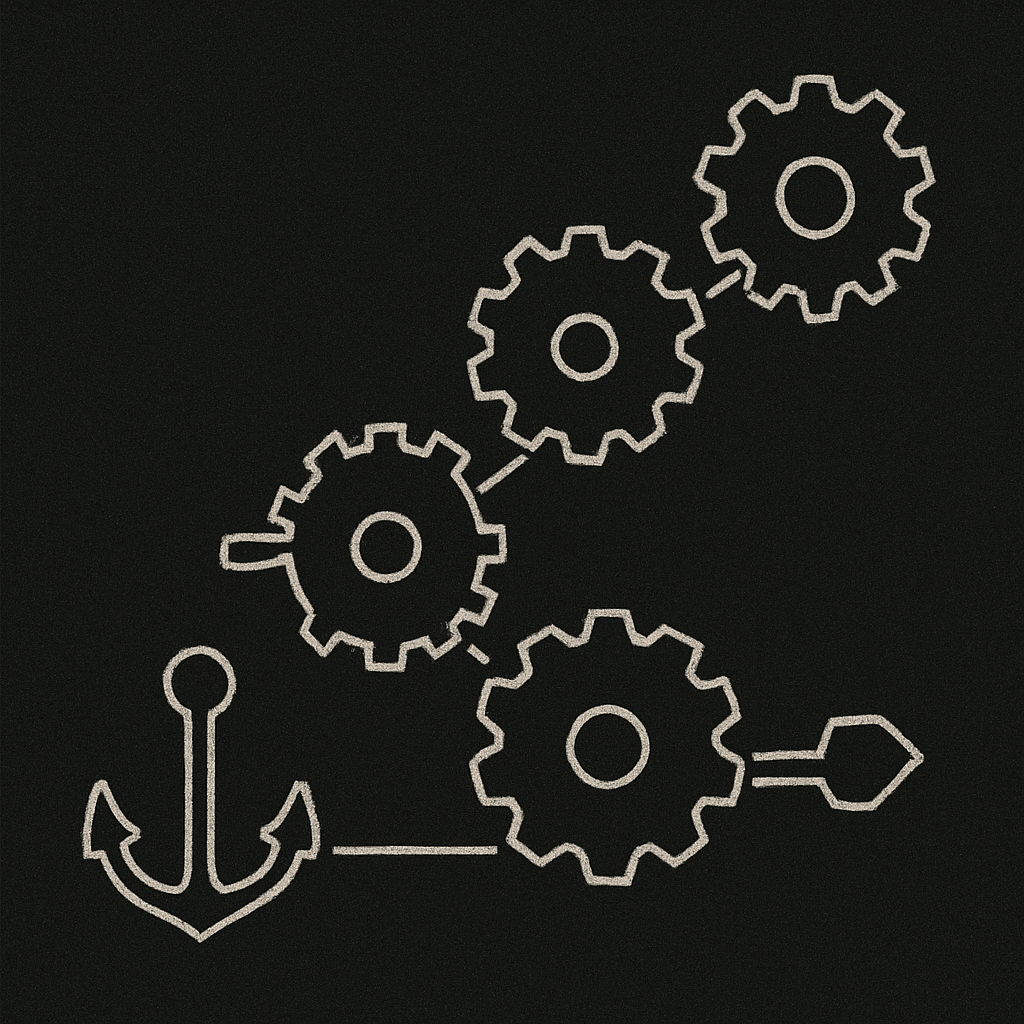
THE MACHINERY OF THE ENGINE OF ENDLESS ACTION
How Five Stages Gate the Capacity to Do One Thing Forever
Why most attempts to be more disciplined break at a link no one can see
A man decides he will write every day.
He means it. He has read the books on habit. He has the app with the streak counter, the notebook, the pen he likes, the hour blocked out. The first week is easy because the deciding is fresh and the deciding does the work. He writes Monday. He writes Tuesday. By the second Thursday the deciding has gone quiet, and on the gray morning when nothing inside him wants to write, there is nothing there to make him. He skips one day. The streak breaks. The whole thing is dead inside a month.
He reaches for the explanation that costs the least. He lacks discipline. He is the kind of person who starts things and does not finish them. Something in his character is missing that other people have.
He is wrong on every count.
His character is not the problem. He has done other things every single day for twenty years without once calling it discipline. He brushes his teeth. He checks his phone the instant he wakes. He has built unbreakable daily actions by accident and cannot build one on purpose, and that gap is not a flaw in him. It is a specific stage of an engine sitting below threshold while the others stand ready.
A different person. She can start anything. Give her a new practice and she will throw herself at it with everything she has, hard, for two weeks. Then the intensity that launched it is the same intensity that burns it down. She does not drift away from the action. She flames out of it. Every new beginning is total and every ending is total and she walks away certain she is someone who cannot sustain.
She lands on the same verdict he did. Something is wrong with me. I cannot keep anything going.
She is wrong in the same way he is. She can sustain. She sustains resentment for years, a grudge held with perfect daily fidelity. Her capacity to repeat is enormous and it is pointed at the wrong stage. Her starting is strong and the thing that would let the action cost her nothing was never built, and the two failures feel identical from the inside and are nothing alike underneath.
Two people, both certain they lack “discipline,” as though discipline were one thing you have or do not have.
Endless action is not one thing. It is a chain. The chain has five stages, each one a different capacity, each one sitting at its own height, and the first stage below threshold sets the whole output no matter how strong the rest of the chain is.
What follows is not advice.
It is not a program for being more consistent. Not a set of tricks for building habits. Not a routine to run tomorrow morning.
It is mechanism.
The actual chain beneath the capacity to perform one action across a lifetime without spending will on it. The five stages, in the order they get built. The threshold that gates each one. The reason the whole chain collapses at a single hidden link while the rest of it stands idle and ready. The reason the broken link is invisible to the person living inside it.
There is a claim you will have heard, that the self cannot change itself. That the part that wants to be consistent is the same part that fails, so the wanting goes in circles and nothing holds. As a description of one specific failure it is exactly right. As a verdict on whether you are stuck it is a lie, and this document is the proof, because the engine that produces endless action does not run on the self at all.
This document is that chain, laid open.
Nothing more.
What you do with it is your business.
PART ONE: THE FIVE STAGES
The Chain That Produces an Action That Runs Itself
Endless action is usually treated as a single trait, a reserve of willpower that is either strong or weak. The science does not describe it that way, and neither does the experience of building it. The capacity to do one thing forever is a sequence of distinct stages, each one feeding the next, each one able to fail on its own while the others stand ready.
 doing one thing forever

 ┌────────────────────┐
 │  1. THE ANCHOR     │
 │  the cue           │
 └─────────┬──────────┘
   below? nothing fires.
   the action waits on a
   decision that never
   reliably comes.
           │
 ┌─────────▼──────────┐
 │  2. THE START      │
 │  friction near zero│
 └─────────┬──────────┘
   below? the cue fires
   but the action stalls
   at the cost of
   beginning.
           │
 ┌─────────▼──────────┐
 │  3. THE CHUNK      │
 │  it runs itself    │
 └─────────┬──────────┘
   below? every rep is
   paid for in willpower
   and the account
   empties.
           │
 ┌─────────▼──────────┐
 │  4. THE STAMP      │
 │  the loop closes   │
 └─────────┬──────────┘
   below? the chunk
   never hardens. it
   decays between reps.
           │
 ┌─────────▼──────────┐
 │  5. THE CLAIM      │
 │  it becomes you    │
 └────────────────────┘
   below? the action
   stays optional and
   dies the first hard
   day.

 Chain evaluates top-down.
 First stage below threshold
 is the constraint.
 Everything below it is
 irrelevant until fixed.
The chain has the three properties every causal chain has. It is sequential. Each stage has a threshold. The first stage below threshold sets the output of the whole system, no matter how much capacity is stacked behind it.
The output of this chain is simple to name and hard to earn. Reps that cost the self nothing. The quantity of repetitions of one action a person can produce without spending will to produce them. A streak of three hundred days that took three hundred acts of willpower is not endless action. It is a war of attrition that will be lost. Endless action is the streak that costs nothing, because by the end no one is deciding anything.
And like every chain worth mapping, this one hides which link is starving. The man buys a new habit app. The woman tries to begin again with more intensity. Both are pouring effort into a stage that was never the constraint, because the brain that runs the chain cannot see the chain. The next several pages are about finding the starved link before it costs you another decade of trying harder at the wrong thing.
PART TWO: WHAT EACH STAGE REQUIRES AND WHAT BREAKS WITHOUT IT
Stage One: The Anchor
The anchor is the cue. The fixed, recurring thing in the world that fires the action without a decision being made.
An action attached to a decision is an action you must re-win every day, and the day you lose the decision is the day the action stops. An action attached to an anchor fires the way salivation fires at a bell. You do not decide to feel hungry when the smell of food reaches you. The cue does the work the will was failing to do.
The strongest anchors are not times on a clock. They are existing actions you already perform without fail, used as the trigger for the new one. After I pour the morning coffee, I write one line. The coffee is already unbreakable, so it drags the new action behind it. Psychologists call the deliberate version an implementation intention, an if-then link between a specific cue and a specific act, and the research on it is among the most replicated in the field. The if-then group does the thing two to three times as often as the group that merely intended to.
What requires the anchor: every stage downstream. Chunking needs reps, reps need starts, starts need a trigger. With no stable cue the action fires at random, gets too few reps to ever automate, and stays forever in the expensive zone where the self has to carry it.
What breaks without it: everything, silently. The person with no anchor believes they have a discipline problem. They have a trigger problem. The action was never wired to anything that would reliably set it off.
Stage Two: The Start
The start is the cost of beginning. The activation energy between the cue firing and the action actually moving.
A cue can fire perfectly and the action can still stall, because the first move is too large. The mind, presented with “write the chapter,” runs a fast unconscious cost calculation, finds the cost high, and flinches away into something cheaper. This is not laziness. It is the same physics as a chemical reaction that will not proceed until the activation barrier is lowered. Raise the barrier and the reaction stops even when all the ingredients are present.
The collapse of the start is the most counterintuitive move in the engine, because it looks like aiming too low. Write one sentence. Do one push-up. Read one page. The person serious about the outcome resists this, certain that one sentence is not enough to matter. They have the logic exactly backward. The one sentence is not the point. The one sentence is the defeat of the activation barrier, and once the action is moving it tends to continue, because stopping a moving action also has a cost. The size of the first move is set low enough that beginning is never worth avoiding.
What requires the start: the chunk. An action that is never reliably begun is never repeated enough to automate.
What breaks without it: the cue fires and nothing happens. The person feels the trigger, feels the resistance, and waits for a motivation that the design was supposed to make unnecessary. They conclude they lack drive. They lack a small enough first move.
Stage Three: The Chunk
The chunk is automation. The compression of the action sequence into a single unit that runs without deliberate control.
The first hundred times you perform an action, the deliberate, effortful part of the brain is steering every step. This is expensive. It draws on the same limited executive resource that decision-making and self-control draw on, which is why a new habit feels like it is costing you something real. It is. But with repetition the sequence migrates. The basal ganglia, a set of structures deep beneath the cortex, take a behavior that was a string of separate decisions and weld it into one chunk that fires as a unit. Neuroscientists watching this in the lab can see the brain’s activity collapse from a busy, effortful pattern across the whole behavior to two sharp bursts, one at the start and one at the end, with the middle running on its own. The action has stopped costing the deciding mind anything.
This is the stage that converts a habit from a tax into a free action. Before the chunk forms, every rep is paid for in willpower. After it forms, the action runs itself and the willpower is released. A behavior that is not yet chunked cannot be done daily for long, because the daily willpower cost compounds and the account empties. The person quits not from weakness but from depletion, having paid full price for every single rep because the discount the chunk provides never arrived.
What requires the chunk: the stamp and the claim. An action that still costs the self cannot yet be reinforced into permanence or absorbed into identity, because it is still experienced as something effortful you do, not something that simply happens.
What breaks without it: the action survives as long as motivation subsidizes it and collapses the moment motivation withdraws. The person mistakes the depletion for a lack of want. The want was never the issue. The action never automated, so it never stopped costing, so it could never be afforded indefinitely.
Stage Four: The Stamp
The stamp is reinforcement. The felt signal at the close of the action that tells the brain the loop was worth completing and should be wired deeper.
A behavior is not consolidated by repetition alone. It is consolidated by repetition that ends in a reward signal. When an action concludes and something registers as better-than-expected, the brain releases a pulse of dopamine, and that pulse is not the feeling of pleasure people assume it is. It is a teaching signal. It stamps the preceding behavior as worth repeating and strengthens the wiring that produced it. This is the mechanism, traced precisely in the work on reward prediction error, by which the brain decides which of its actions to keep.
The trouble with most self-imposed actions is that they end in nothing. You write the page and close the laptop and there is no signal, no close, no mark that the loop completed. The action is real but it is not stamped, so it does not deepen with repetition the way it should, and it stays fragile far longer than the rep count predicts. The fix is to give the action a definite ending that registers. Marking the day done. The check, the cross, the streak advancing. A felt moment of completion. It seems trivial and it is not, because it is supplying the teaching signal the action needs to harden. The loop must close on something the brain reads as a small win.
What requires the stamp: the claim. An action that is not reinforced does not accumulate the evidence from which a new identity is built. The reps stay weak and the self never reclassifies.
What breaks without it: the action is performed but never deepens. Months in, it still feels as effortful as the first week, because the consolidation that repetition was supposed to produce never got the reinforcement it required. The person concludes the habit “just never clicked.” It never closed.
Stage Five: The Claim
The claim is identity absorption. The migration of the action out of the category of things you do and into the category of who you are.
This is the stage that makes the action permanent, and it is the one almost everyone skips, because it cannot be willed and it cannot be rushed. An action you merely perform is optional. On a hard enough day, the cost-benefit tips and you skip it, and the skip costs you nothing but a little guilt you can rationalize away. An action that has been absorbed into identity is defended differently. Skipping it now is not a failure of a task. It is a small act of self-betrayal, a contradiction of who you take yourself to be, and the mind will go to real lengths to avoid that kind of dissonance. The runner who has become a runner does not decide whether to run in the rain. Not running would require being, for a day, someone they are not.
The claim forms from accumulated evidence. Each rep, especially each reinforced rep, is a small piece of proof submitted to the self about what kind of person this is. Enough proof and the self quietly reclassifies. I am someone who writes. After the reclassification the action no longer needs to be motivated, because it is now downstream of identity, and identity defends itself for free. This is the deepest meaning of the saying that the self cannot change itself. It is true. The self does not change itself by deciding to. It is changed, from below, by the weight of evidence the engine keeps producing, until one day it has become the thing the action implied all along.
What requires the claim: nothing downstream. This is the terminal stage. When it is reached, the action has left the domain of effort entirely.
What breaks without it: the action stays a behavior instead of becoming a person, and behaviors are negotiable. The first genuine crisis, the move, the newborn, the loss, the stretch of weeks where everything is hard, and the un-absorbed action is the first thing cut, because it was never load-bearing to the self. The person had every earlier stage working and still lost the action, and never understood that reinforced reps without identity absorption produce a strong habit, not a permanent one.
PART THREE: THE THREE MOST COMMON CONSTRAINT LOCATIONS
The chain has five links, but in practice the breaks cluster. Three locations account for the overwhelming majority of failed attempts at endless action.
The first is the anchor. This is the constraint for the planner, the optimizer, the person who decides their way through life. They never wire the action to a cue, because deciding feels like the responsible, deliberate thing to do, and so the action lives on the most unreliable trigger there is, a fresh act of will each day. They have not failed to act. They have failed to attach the action to anything that would act for them. This is the single most common break, and the most invisible, because the person experiences it as a motivation problem and pours years into manufacturing motivation that a cue would have made unnecessary.
The second is the start. This is the constraint for the ambitious, the serious, the person who respects the outcome too much to begin small. They set the first move at the size of the goal, “write the chapter,” “train for an hour,” and the activation barrier sits so high that the cue, even when it fires, cannot push the action over it. They are not lazy. They have set the cost of beginning above the threshold at which beginning happens, and they have done it out of seriousness, which is why telling them to aim lower feels like an insult instead of the fix it is.
The third is the claim. This is the constraint for the person who does everything right for months and still loses the action. They anchored it, shrank it, repeated it, even stamped it, and it ran beautifully, and then a hard season came and it vanished, because it had never crossed from behavior into identity. It was a strong habit, and a strong habit is still optional, and optional things are what get cut when the load gets heavy. This break is the cruelest, because it comes latest and feels the most like proof of some permanent personal defect, when it is only the final stage left unbuilt.
PART FOUR: HOW THE BRAIN HIDES THE CONSTRAINT
The chain has a property that makes it nearly impossible to debug from the inside. Every one of its five failures produces the identical conscious experience. I did not do the thing.
From inside, the anchor failure, the start failure, the chunk failure, the stamp failure, and the claim failure all feel the same. They all feel like “I lacked the discipline.” The single output of all five breaks is the same absence of action, and so the mind, reaching for a cause, reaches for the one explanation that fits every case, a deficiency of character. Discipline. Willpower. Drive. A single missing virtue blamed for five mechanically distinct faults.
This is a category error of the same kind that the word “attention” produces. There is no single faculty called discipline any more than there is a single faculty called attention. There is a five-stage engine, and “I lack discipline” is the name the mind gives to its own failure to see which stage is starved. The explanation feels true precisely because it is unfalsifiable. It fits every failure equally, which means it distinguishes none of them, which means it is useless for repair.
And the false explanation is expensive, because it points at the only tool that cannot help. If you believe the problem is discipline, you will try to apply more discipline, which is willpower, which is the single lever that reaches exactly one of the five stages and reaches even that one poorly. Four of the five breaks do not respond to effort at all. They respond to redesign. A cue added. A first move shrunk. Reps accumulated past the automation point. A close that stamps. Evidence allowed to accumulate until the self reclassifies. None of that is willpower, and all of it is invisible to a person who has named the whole problem with a word that means “try harder.”
PART FIVE: FINDING YOUR CONSTRAINT
The repair is impossible until the starved stage is named, and the starved stage cannot be named from the felt experience, because the felt experience is the same for all five. It has to be found by interrogating each stage directly. Five questions, asked in order, each one isolating one link.
Does the action have a fixed cue, or do you decide it each day? If you are relying on remembering, on feeling like it, on a daily choice, the anchor is below threshold and nothing downstream matters yet. This is the first thing to check because it is the most common break and the most disguised. An action that fires on a decision has no anchor, however sincere the decision.
When the cue does fire, do you begin, or do you stall? If the trigger arrives and you feel the resistance and slide into something easier, the start is the constraint. The first move is too large. Notice that this is a different failure from the first one. Here the cue works and the beginning does not.
Once you have begun, does the action run on its own, or are you steering every step effortfully? If the action, even after weeks, still feels like it is costing your deciding mind on every rep, the chunk has not formed, and the likely reason is too few reps, which usually traces back up the chain to a weak anchor or a high start. An action that still feels expensive after a month either is not being done often enough or is being killed before automation.
When the action ends, is there a close, or does it just stop? If the action concludes into nothing, no mark, no felt completion, the stamp is missing, and the action will stay fragile far past the point the rep count would predict. The reps are happening and not depositing.
If you skip a day, what do you feel? Mild, rationalizable guilt, or the specific discomfort of having acted against who you are? If skipping costs you nothing but a guilt you can talk your way out of, the claim has not formed. The action is still a behavior, not a self, and it remains optional, and optional is what dies under load.
The first question that returns a failing answer is your constraint. Stop there. The stages below it are not your problem yet, and working on them is the precise form of wasted motion this whole document exists to prevent.
PART SIX: WHY THE STAGES CANNOT BE BUILT OUT OF SEQUENCE
The order of the chain is not a suggestion. It is a set of dependencies, and building downstream of a broken upstream stage is effort poured into a stage that cannot yet hold it.
You cannot chunk an action you do not reliably start. Automation is a product of repetition, repetition is a product of reliable beginning, and reliable beginning is a product of a cue plus a low enough first move. Try to automate before the reps are flowing and there is simply nothing to automate. The chunk forms from volume, and volume comes from the two stages above it.
You cannot stamp a chunk that does not run. Reinforcement strengthens an existing behavior. If the behavior is not yet occurring with regularity, there is nothing for the reward signal to deepen. The stamp is a multiplier on reps, and a multiplier on zero is zero.
You cannot claim an identity the evidence does not support. This is the one people most want to skip, because the modern advice says to start from identity, to “be the kind of person who,” before any of the action exists. It does not work that way, because identity is built from accumulated evidence, and an action you have performed three times submits almost no evidence. The self does not reclassify on a declaration. It reclassifies under the weight of a long record of reinforced reps. Trying to install the identity before the reps exist is trying to read a verdict off an empty trial. The claim is the last stage because it is made of everything the first four stages produce.
So the construction order is fixed. Wire the cue. Collapse the start. Let the reps accumulate until the chunk forms and the action stops costing. Make sure the loop closes on something that stamps. And then, only then, after a long enough record has been written, the self quietly reclassifies and the action becomes permanent, not because you declared it but because the evidence finally outweighed the old self-image. Build in this order and each stage stands on a finished one beneath it. Build out of order and you are stacking on air.
PART SEVEN: WHAT HAPPENS AFTER EACH STAGE IS BUILT
Fixing the constraint does not finish the work. It relocates the work to the next-weakest stage. This is the property that makes the chain an engine and not a checklist, and missing it is how people fix their real bottleneck, feel the surge of progress, and then are baffled when the action still does not become permanent.
Fix the anchor and the action starts firing daily, and almost immediately the start becomes the constraint, because now the cue is dragging the action up against an activation barrier that was never tested before, since previously the action rarely fired at all. The win at stage one exposes the weakness at stage two.
Collapse the start and the reps begin to flow, and now the constraint moves to the chunk, which simply needs time and volume, a stretch of weeks where the action still costs something and the only task is to keep the reps coming until the cost falls away. This is the stage that cannot be hurried, only fed.
The chunk forms and the action goes quiet and free, and now, surprisingly to most, the constraint can move to the stamp, because an action that has become easy can also become invisible, performed on autopilot with no felt close, and an action with no close can plateau and slowly decay even while it runs. The fix is to restore a real ending that registers.
And once the action is anchored, easy, automatic, and stamped, the final constraint is the claim, which is not built by any single move but allowed, by letting the long record of reinforced reps accumulate until the self gives way and reclassifies. After that the constraint leaves this action entirely. It moves off this behavior and onto the next one you want to make endless, and you run the chain again, faster now, because you have done it before and you know it is an engine and not a question of character.
PART EIGHT: THE ENGINE IN FULL
The Complete Chain
                  THE ENGINE OF ENDLESS ACTION

  ┌───────────────────────────────────────────────────────────┐
  │  1. THE ANCHOR   the action is welded to an existing cue   │
  │                  >> fires without a decision               │
  └───────────────────────────┬───────────────────────────────┘
                              │  produces reliable triggering
  ┌───────────────────────────▼───────────────────────────────┐
  │  2. THE START    the first move is shrunk below the        │
  │                  activation barrier                        │
  │                  >> beginning is never worth avoiding       │
  └───────────────────────────┬───────────────────────────────┘
                              │  produces volume of reps
  ┌───────────────────────────▼───────────────────────────────┐
  │  3. THE CHUNK    repetition welds the sequence into one    │
  │                  automatic unit                            │
  │                  >> the action stops costing the self       │
  └───────────────────────────┬───────────────────────────────┘
                              │  produces a free, repeatable act
  ┌───────────────────────────▼───────────────────────────────┐
  │  4. THE STAMP    the loop closes on a felt completion      │
  │                  >> the behavior consolidates and deepens   │
  └───────────────────────────┬───────────────────────────────┘
                              │  produces accumulating evidence
  ┌───────────────────────────▼───────────────────────────────┐
  │  5. THE CLAIM    the weight of evidence reclassifies the   │
  │                  self                                       │
  │                  >> the action is now who you are, and       │
  │                     defends itself for free                 │
  └───────────────────────────────────────────────────────────┘

         output: reps that cost the self nothing,
                 sustained across a lifetime,
                 because no one is deciding anymore
Read as a system, the engine says one thing. At no point does endless action run on the self deciding to act. The anchor replaces the decision with a cue. The start removes the resistance the decision would have had to overcome. The chunk removes the cost the self would have had to pay. The stamp deepens the action without the self’s involvement. And the claim moves the action into identity, where it is defended automatically, by what you are rather than by what you choose. Every stage is a transfer of the action off the deliberate self and onto a piece of machinery that does not get tired, does not run out of willpower, and does not have bad days.
The Shift
Before the engine, the action sits on the self, and the self is the weakest possible foundation, because the self is exactly the part that fails under load, goes quiet on the gray mornings, and cannot reliably command itself. Every day is a small war, and the war is lost the first day the will does not show up, which it eventually will not.
After the engine, the action sits on the chain, and the self is not the thing carrying the action. The self is the thing the action carries, reshaped by it, until being the kind of person who does this is simply what is true.
This is the answer to the claim that the self cannot change itself. The claim is correct and it is not the obstacle it pretends to be. The self never had to change itself. You were never asked to lift yourself by deciding to be different. You were asked to build a five-stage engine, one stage at a time, in order, below the self, and then to let it run. The engine changes the self. The self is the output, not the operator.
Doing one thing forever is not a feat of will sustained across ten thousand mornings. No one has that much will, and the people who appear to are not using it. It is an engine, built once, left running, producing reps that cost nothing, until the person who built it has quietly become someone who does the thing, and could not stop without ceasing to be themselves.
That is not discipline.
It is engineering.
And it was always available to you, because it never ran through the part of you that fails.
CITATIONS
Implementation intentions and cue-based action: P. Gollwitzer, “Implementation Intentions: Strong Effects of Simple Plans,” American Psychologist, 1999. The if-then plan reliably doubles or triples follow-through across dozens of studies.
Habit, cues, and context: W. Wood and D. Neal, “A New Look at Habits and the Habit-Goal Interface,” Psychological Review, 2007; W. Wood, Good Habits, Bad Habits, 2019.
Time to automaticity: P. Lally et al., “How Are Habits Formed,” European Journal of Social Psychology, 2010. Median time to automaticity roughly two months, with wide individual spread.
Activation energy and minimal first action: B. J. Fogg, Tiny Habits, 2019. Behavior fires when a sufficiently small action meets a reliable prompt.
Chunking in the basal ganglia: A. Graybiel, “Habits, Rituals, and the Evaluative Brain,” Annual Review of Neuroscience, 2008. Procedural learning collapses a behavior into a chunk bracketed by start and stop activity.
Reward prediction error: W. Schultz, P. Dayan, P. Montague, “A Neural Substrate of Prediction and Reward,” Science, 1997. Dopamine encodes a teaching signal that stamps preceding behavior.
Identity, self-perception, and the flywheel of habit: D. Bem, “Self-Perception Theory,” 1972; W. James, “Habit,” in The Principles of Psychology, 1890.
RELATED MACHINERIES
THE MACHINERY OF THE OVERRIDE. The same principle on the scale of a single moment. Reach below the self that cannot change itself and move the layer underneath it.
THE MACHINERY OF ENDLESS ACTION. The shift from fuel to structure, and the crossing threshold where the decider disappears.
THE MACHINERY OF IDENTITY TRANSFORMATION. The fifth stage in full. How accumulated evidence reclassifies the self.
THE MACHINERY OF CONSTRAINTS. The governing logic. One bottleneck sets the output of any chain.