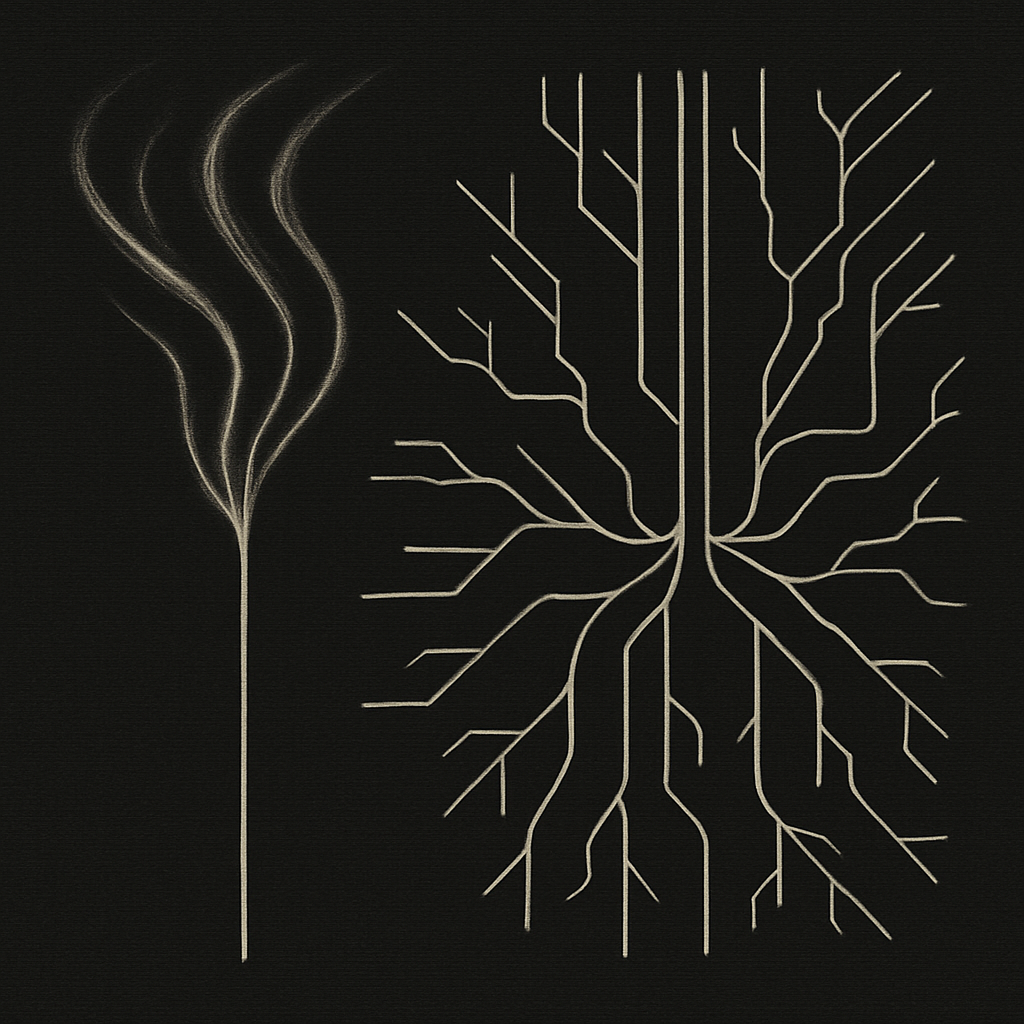
THE MACHINERY OF THE OVERRIDE
A Complete Guide to the Bottom-Up Reset
How the Body Changes the Mind When the Mind Cannot Change Itself
There is a claim that sounds like wisdom and functions like a prison.
The self cannot change itself.
You have heard it from the contemplatives. You have heard it from the cynics. The thing that wants to change is the same thing that needs changing, so the wanting goes in circles and nothing moves. The hand cannot grip itself. The eye cannot see itself. The will cannot will itself into a different shape.
As a description of one specific failure, it is correct.
As a conclusion about whether you are stuck, it is a lie.
Because the claim assumes there is only one door. It assumes that the only way in is through the front, through thought, through decision, through the part of you that narrates and resolves and tries. And it is true that this door is often locked from the inside, and locked hardest at the exact moment you need it open.
But there is more than one door.
This document is about the other doors. The ones that do not go through the self at all. The ones that reach into the machinery from below, through the body, through the breath, through the nervous system, and change the state of the whole system before the self has a vote.
Not metaphor. Mechanism.
You are about to learn that the panic you cannot think your way out of can be ended in ninety seconds through your exhale. That a bowl of cold water can drop your heart rate by a quarter. That the brain you cannot argue with takes orders from the body it sits inside.
And then you will learn why this is not a trick for emergencies.
It is the proof of concept for everything you ever wanted to become.
What you do with it is your business.
PART ONE: THE THING THAT CANNOT CHANGE ITSELF
The Front Door Is Locked Exactly When You Need It
Picture the standard advice for a person coming apart.
Calm down. Take a breath. Think rationally. See it in perspective. Remember that this feeling will pass.
Every word of it is aimed at the thinking mind. The reasoning, narrating, perspective-taking self. The advice assumes that this self is online and able to act. That if you just point it at the problem, it will turn the dials and bring the system back.
The cruelty is that at the moment of greatest need, that self is the first thing to go offline.
This is not a character flaw. It is architecture.
The prefrontal cortex is the seat of deliberate control. Planning, reasoning, perspective, the deliberate regulation of emotion. It is also the most fragile node in the network under stress. Amy Arnsten’s work at Yale mapped the mechanism precisely. Under high levels of the stress chemicals norepinephrine and dopamine, the prefrontal cortex does not work harder. It shuts down. The very circuits that hold your goals and your reason and your perspective go dark, and control passes to faster, older, blunter structures. The amygdala. The brainstem. The systems that do not deliberate.
    WHERE CONTROL LIVES UNDER STRESS

    LOW / MODERATE STRESS
    ┌────────────────────────────────────────────────┐
    │  Prefrontal cortex ONLINE                       │
    │  Goals held. Reason available. Self in command. │
    │  The front door is open. Advice can work.       │
    └────────────────────────────────────────────────┘

    HIGH STRESS  (norepinephrine + dopamine flood)
    ┌────────────────────────────────────────────────┐
    │  Prefrontal cortex OFFLINE                       │
    │  Amygdala / brainstem in command.                │
    │  Reflex, not reason. Reaction, not regulation.   │
    │  The front door is locked. Advice bounces off.   │
    └────────────────────────────────────────────────┘
So when someone in a panic attack is told to think rationally, the instruction is addressed to a faculty that has been taken offline by the very state it is meant to fix. You are knocking on a door behind which no one is home. And the harder the panic, the more certainly no one is home.
This is the real content of the old saying. The self cannot change itself, because under load the self is exactly the part that fails first.
If the front door were the only door, the saying would be the end of the story.
It is not the only door.
What Stays Online
Notice what does not shut down.
Your heart keeps beating. Your lungs keep moving. The brainstem that runs them does not go offline under stress. It runs the body without consulting the self at all, every second, asleep or awake, panicking or calm.
And here is the seam in the machinery that almost nobody sees.
That brainstem traffic is not one-way.
The body reports upward as constantly as the brain commands downward. Heart rate, breath, the chemistry of the blood, the tension in the muscles, all of it streams up into the brain and shapes what the brain feels and decides. The vagus nerve, the great wandering cable between body and brainstem, carries far more signal up than down. The body is talking to the brain more than the brain is talking to the body.
Which means there is a control surface that does not run through the self.
You cannot decide to be calm. But you can do something with your body that the brain will read as calm, and the reading will change the state, and the changed state will bring the self back online.
You do not argue with the locked door.
You go in through the wall.
PART TWO: THE OVERRIDE EXISTS
The Sigh Was Always There
Watch a child who has been crying hard. As they settle, the breath does a particular thing on its own. A big inhale, then a second smaller inhale stacked on top of it, then a long release.
A double inhale, one long exhale.
That is a sigh. The body does it automatically, roughly every five minutes, all day, without instruction. For a long time it was treated as noise, a quirk of the breath with no function. It is not noise. It is the nervous system’s built-in reset, and you can fire it on command.
Here is the mechanism, and the mechanism is the whole point.
Your lungs are not empty bags. They are filled with hundreds of millions of tiny sacs called alveoli, where oxygen crosses into the blood and carbon dioxide crosses out. Under stress, breathing goes fast and shallow, and many of these sacs collapse and stay collapsed. The surface available for gas exchange shrinks. Carbon dioxide builds up in the blood. And rising carbon dioxide is one of the body’s most primal alarm signals. It is the actual trigger of the feeling of air hunger, of suffocation, of mounting panic. Much of what panic feels like is the body screaming about a gas it cannot offload.
The double inhale pries the collapsed sacs back open. The first breath fills what is already open. The second breath, stacked on top, pops open the sacs that had collapsed. Now the full surface is available again. And the long, slow exhale does two things at once. It dumps the built-up carbon dioxide, killing the alarm at its source. And the act of a long exhale itself pulls the vagal brake on the heart, slowing it down on every breath out.
    THE PHYSIOLOGICAL SIGH

    INHALE 1   ████████████░░░░░░░░   fills open alveoli
    INHALE 2   ░░░░░░░░░░░░████████░   pops collapsed alveoli open
                                       (max surface restored)
    EXHALE     ████████████████████   long, slow, complete
                                       → offloads CO2  (kills alarm)
                                       → vagal brake    (heart slows)

    Repeat 1 to 3 times.
    State shift begins inside one to three breaths.
You do not have to believe it will work. You do not have to feel calm first. You do not have to get your thinking mind back online to do it, which is the entire point, because your thinking mind is the part that is gone. You move air in a specific pattern, and the chemistry changes, and the heart slows, and the alarm quiets, and the self walks back into the room it had been locked out of.
This is the override. A body action that changes the brain state without going through the self.
It Beat Meditation In The Lab
This is not folk wisdom dressed in anatomy.
In 2023, a team at Stanford, working with Andrew Huberman and led by Melis Balban, published a controlled trial in Cell Reports Medicine. They took over a hundred people and assigned them five minutes a day for a month of one of several practices. One group did mindfulness meditation. Other groups did specific breathing patterns. One of those patterns was cyclic sighing, the deliberate, repeated version of the physiological sigh, weighted toward long exhales.
Cyclic sighing produced the largest improvement in mood and the greatest reduction in physiological arousal. It lowered resting breathing rate. It beat mindfulness meditation, the gold-standard intervention, on the measures that matter, for the same five minutes of daily effort.
The slow exhale wins because of where it reaches. Mindfulness asks the mind to relate differently to its own contents, which is real and valuable and also routes through the higher faculties that stress takes offline. The sigh does not ask the mind for anything. It reaches into the brainstem through the diaphragm and the vagus and resets the arousal system from underneath. Bottom-up beats top-down because bottom-up does not depend on the part that breaks.
PART THREE: TWO MORE DOORS IN THE SAME WALL
Cold On The Face
There is a reflex you share with every diving mammal, with seals and whales and otters, installed long before there was a self to override.
Put cold water on the face, around the eyes and the bridge of the nose, while holding the breath, and the body executes an automatic sequence. The heart slows, sometimes by ten to twenty-five percent within seconds. Blood pulls in from the limbs toward the core. The whole system shifts into a conservation state.
This is the mammalian dive reflex. Its original job was to let a diving animal survive underwater on a single breath by slamming the metabolic rate down. It is triggered through the trigeminal nerve in the face, which routes straight to the vagus and the brainstem. Cold plus the bridge of the nose plus breath-hold, and the brainstem throws the parasympathetic switch. No decision required. The reflex does not care whether you believe in it.
Clinical psychology already uses this. In dialysis-resistant tachycardia and in the skill set called DBT, there is a technique known by the letters TIPP. The T stands for temperature. The instruction for an emotional crisis, for the moment of a person who is about to do something they cannot undo, is to fill a bowl with cold water and put the face in it, or to press a cold pack to the eyes and upper cheeks while holding the breath. The dive reflex fires. The heart drops. The arousal that was driving the crisis falls through the floor. The window in which the thinking mind can come back reopens.
    THREE DOORS, ONE ROOM

    BREATH  ──┐
              │   trigeminal / vagal / diaphragmatic routes
    COLD    ──┼──────────────►  BRAINSTEM AROUSAL SYSTEM
              │                 (parasympathetic switch)
    MUSCLE  ──┘                          │
                                         ▼
                              state drops, self returns
Tension Out Of The Muscles
The third door runs through the muscles, and it exposes a loop most people never suspect they are caught in.
A threatened body tenses. Shoulders rise, jaw clenches, fists tighten. This is automatic, part of the readiness for fight or flight. What almost nobody notices is that the loop runs the other way too. The brain reads the tension in the muscles as ongoing evidence of threat. Tense body, therefore danger, therefore stay alarmed, therefore keep the body tense. A self-feeding circle with no event at the center of it. The threat is gone and the body is still reporting threat to the brain through its own held tension.
In the 1920s and 1930s a physician named Edmund Jacobson worked out how to break the loop directly. Progressive muscle relaxation. You take one muscle group at a time. Clench it hard for a few seconds, then release it completely and feel the difference. Hands, then arms, then shoulders, then face, then down through the body. Tense, release, move on.
The deliberate clench matters as much as the release. By driving the muscle to maximum tension on purpose, you trigger a deeper rebound when you let go, and you teach the nervous system the contrast between held and free. As the muscles go slack, the threat evidence streaming up to the brain dries up. The brain stops being told it is in danger by the body, and the alarm has nothing left to feed on.
Jacobson’s method became one of the foundations of modern anxiety treatment, and it is still in every clinician’s toolkit a century later, because it works on the loop rather than on the story. It does not ask you to stop believing you are in danger. It removes the bodily signal that was generating the belief.
PART FOUR: WHICH DIRECTION IS REAL
The Body Comes First
The reason all three doors work is a fact about the mind that runs against the grain of how it feels from the inside.
It feels like emotion flows in one direction. Something happens, you feel afraid, and because you are afraid your heart pounds and your breath goes short and your muscles tense. Mind first, body second. The feeling causes the physical state.
In 1884, William James proposed that this is backward. The event triggers the bodily response first, automatically, beneath awareness. The pounding heart, the fast breath, the tensed muscles. And the emotion is the mind’s reading of that bodily state. You do not tremble because you are afraid. You feel afraid because you notice yourself trembling. The body moves first, and the feeling is the interpretation.
For a long time this was a curiosity. Modern neuroscience has filled in the mechanism and largely vindicated the direction. The brain runs a continuous channel called interoception, the sensing of the body’s own internal condition, gathered through the insula. Bud Craig mapped how the body’s internal signals climb into the insula and become the raw material of feeling. Lisa Feldman Barrett showed that emotions are not pre-built reactions waiting to be released, but constructions the brain assembles in the moment, and a primary ingredient in the construction is the state of the body right now. Sarah Garfinkel demonstrated that people more accurate at reading their own heartbeats experience anxiety more intensely, because they have more bodily signal feeding the construction.
The picture that emerges is not that the body whispers a little to the mind. It is that the body’s state is a load-bearing input into what you feel and therefore into what you decide.
    THE FOLK MODEL (feels true, is incomplete)

    EVENT ──► FEELING ──► BODY
              (mind first)

    THE ACTUAL MODEL (interoception)

    EVENT ──► BODY ──► INTEROCEPTION ──► FEELING
              (body first)   (insula reads state)

    Change the body, and you change an input
    the feeling is built from.
    This is why the override works.
This is why you cannot reliably feel your way to a calmer body, but you can reliably body your way to a calmer feeling. The arrow that runs from body to feeling is faster, more automatic, and more available under stress than the arrow that runs the other way. The override is not a hack that happens to work. It is operating the system in the direction the system actually runs.
PART FIVE: THE SAME MOVE ACROSS TIME
Endless Action Is One Override Repeated
Here is where the emergency technique turns into something much larger.
You wanted to know how a person makes themselves do one thing forever. How someone keeps an action going across years when motivation comes and goes and the self that decided is not the self that has to show up on the cold gray morning when it would be so easy not to.
The standard answer is willpower. Decide hard enough, want it badly enough, and force the action out of the deciding self every single day. And the standard answer fails for the exact reason the panic advice fails. It routes everything through the front door, through the deliberate self, the part that is unreliable, that gets tired, that goes offline under load, that is not even present on most of the days you need it.
If the self could reliably make itself act, it would have already. The self trying harder is the locked door rattling.
The move is the same as the override. You stop demanding that the deliberate self carry the action, and you push the action down onto a layer that does not require the self to be present.
Watch how this works with the smallest possible example. You do not decide to brush your teeth each night. You do not summon willpower or weigh the costs or recommit to oral hygiene. The action fires off a context. You enter the bathroom at a certain hour, and the brush is in your hand before any deciding has occurred. The action has been moved below the self, into a circuit the neuroscientist Ann Graybiel and others traced into the basal ganglia, where a learned sequence runs as a single chunk, triggered by a cue, needing no decision in the middle.
    WHERE AN ACTION LIVES

    EFFORTFUL ACTION (the willpower model)
    ┌──────────────────────────────────────────────┐
    │  Self must decide, every time.                 │
    │  Depends on the part that fails under load.     │
    │  Breaks on the hard day. Cannot last.           │
    └──────────────────────────────────────────────┘

    OVERRIDDEN ACTION (the durable model)
    ┌──────────────────────────────────────────────┐
    │  Cue fires the action below the self.           │
    │  Basal ganglia run the chunk. No decision.      │
    │  Survives the hard day BECAUSE the self          │
    │  was never the thing carrying it.                │
    └──────────────────────────────────────────────┘
Endless action is not one heroic decision sustained for ten thousand days. That is impossible, and the people who seem to manage it are not managing it that way. Endless action is the same bottom-up override applied across time. You do not change the self that does not want to act. You change the substrate the action sits on. You attach the action to a fixed cue, you make the environment fire it, you let it run beneath the deliberate self exactly the way the sigh runs beneath the panicking one. You do the override once a day on the small scale of a single trigger, and across enough days the action no longer needs you. It belongs to the machinery now, not to your willpower.
The breath proved the principle in ninety seconds. The habit proves the same principle across ninety months. The lever is the same lever. Reach below the layer that cannot move itself, and move the layer underneath it instead.
PART SIX: THE REBUTTAL, EXACT
You Were Never The Lever
Now the saying can be answered precisely, on its own terms, without softening it.
The self cannot change itself. Correct. Left there, it is a sentence that ends effort. The thing that wants to change is the thing that needs changing, the hand cannot grip itself, and so people conclude that nothing can be done, and they call the conclusion wisdom and they stop.
But look at what the saying smuggles in. It assumes the self is the lever. It assumes that if change happens, the self must be the thing doing the lifting, and since the self cannot lift itself, the case is closed.
You are not the lever. You are what the lever moves.
The breath is a lever, and it sits below the self, and it moves the self out of panic without the self lifting anything. The cold is a lever. The muscles are a lever. The cue and the environment and the fixed time and the laid-out shoes are levers, and every one of them sits below the deliberate self, and every one of them moves it.
The mistake was never that change is impossible. The mistake was looking for the controls in the one place they are not, the deliberate narrating self, and concluding from its failure that there were no controls at all. The controls were one layer down the entire time. In the body. In the brainstem. In the substrate the self is built on top of and is moved by.
So the rule is not give up. The rule is push the layer below the locked one.
When the self cannot calm itself, do not order the self to calm down. Move air, splash cold, drop tension, and let the changed body hand the calm back to the self.
When the self cannot make itself act, do not order the self to want it more. Move the cue, fix the time, arrange the room, and let the changed environment fire the action the self could not summon.
You do not win by becoming a stronger self. You win by reaching past the self to the machinery the self rides on, and operating that.
The contemplatives were right that the front door is locked.
They were wrong that locked was the same as no way in.
There was always a way in.
It just never went through you.
What you do with it is your business.