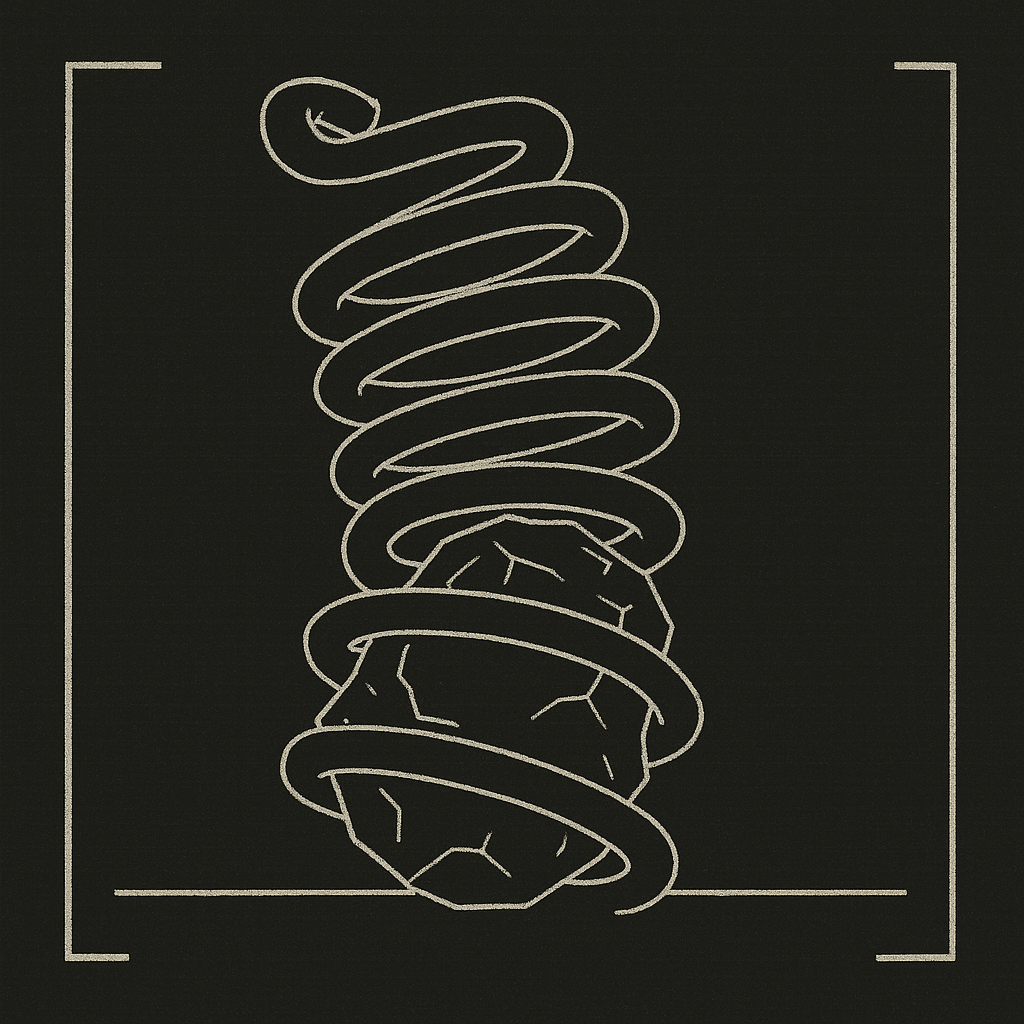
THE MACHINERY OF ANTIFRAGILITY
A Complete Guide to What Gains from Disorder
How Systems That Need Damage Actually Work
What follows is not advice.
It is not a resilience framework. Not a motivational argument for hardship. Not another misappropriation of “what doesn’t kill you makes you stronger” dressed in scientific clothing.
It is mechanism.
The actual mathematics of systems that improve when hit. The physics of structures that require disruption. The thermodynamics of order that emerges only through dissipation.
Most people understand two categories. Things that break when stressed. Things that resist stress. Fragile and robust. Glass and steel.
They miss the third category entirely.
There exist systems that need the stress. That get worse without it. That treat volatility not as threat but as input. And the mathematics of why they work is precise, verifiable, and general across every domain where it appears.
This document is that mathematics, laid bare.
Nothing more.
What you do with it is your business.
PART ONE: THE CONVEXITY PRINCIPLE
The Shape of Response
Everything in the universe has a response function. Apply input. Observe output. Map the relationship.
The shape of that curve determines everything.
Three shapes exist. Three, and only three.
A concave curve bends downward. Small inputs produce proportionally large outputs, but large inputs produce proportionally smaller outputs. Eventually the curve flattens. Then it drops. The system suffers accelerating harm from increasing volatility.
A linear curve runs straight. Double the input, double the output. The system is indifferent to how the input arrives. One large shock or many small ones produce the same total effect.
A convex curve bends upward. Small inputs produce proportionally small outputs, but large inputs produce proportionally larger outputs. The curve accelerates. The system gains disproportionately from volatility.
    THE THREE RESPONSE CURVES

    Output
         │
         │                                    ╱ CONVEX
         │                                  ╱   (antifragile)
         │                               ╱
         │                            ╱
         │                        ╱╱
         │                   ╱╱       ╱ LINEAR
         │              ╱╱          ╱   (robust)
         │         ╱╱             ╱
         │     ╱╱               ╱
         │  ╱╱               ╱       ╲ CONCAVE
         │╱                ╱           ╲  (fragile)
         │               ╱              ╲
         │             ╱                  ╲
         │           ╱                      ╲
         │         ╱                          ╲
         │       ╱
         │     ╱
         └──────────────────────────────────────────► Input
                        (stress, volatility, disorder)
This is not metaphor. This is the fundamental mathematical classification.
Jensen’s inequality makes it rigorous. For a convex function f, the expected value of the function exceeds the function of the expected value. In notation: E[f(X)] >= f(E[X]).
Translation. If your response function is convex, randomness in the input produces a net gain in the output. Variability itself becomes a resource. Disorder becomes fuel.
For a concave function, the inequality reverses. Variability produces net loss. The system pays a tax on every fluctuation.
This is not philosophy. It is calculus.
The Detection Heuristic
Nassim Taleb and Raphael Douady formalized the detection test in 2013. Given a system with response function f, evaluate at three points.
Take the current state a. Perturb by delta in both directions. Compute:
H = [f(a - delta) + f(a + delta)] / 2 - f(a)
H is negative. The system is fragile. The average of the perturbed outputs falls below the unperturbed output. The system loses from volatility.
H is zero. The system is robust. Perturbation in either direction averages out. The system is indifferent.
H is positive. The system is antifragile. The average of the perturbed outputs exceeds the unperturbed output. The system gains from volatility.
No model required. No probability distribution assumed. The test works on any measurable system.
    THE HEURISTIC

    ┌──────────────────────────────────────────────────────┐
    │                                                      │
    │   H = [f(a - δ) + f(a + δ)] / 2  -  f(a)           │
    │                                                      │
    │   H < 0    FRAGILE        Loses from volatility      │
    │   H = 0    ROBUST         Indifferent to volatility  │
    │   H > 0    ANTIFRAGILE    Gains from volatility      │
    │                                                      │
    └──────────────────────────────────────────────────────┘
The second derivative tells the same story. Where f’‘(x) > 0, the function is convex. The system is locally antifragile. Where f’‘(x) < 0, the function is concave. The system is locally fragile.
Most real systems are not uniformly one or the other. They are convex in some range and concave in another. This is the critical insight that most discussions of antifragility miss entirely.
PART TWO: THE HORMETIC ZONE
The Biphasic Response
In 1888, Hugo Schulz observed something that did not fit. Low doses of toxic substances stimulated yeast growth. High doses killed it. The relationship between dose and response was not monotonic. It reversed.
For fifty years, mainstream toxicology ignored this. The linear no-threshold model dominated. More poison equals more damage. Simple. Clean. Wrong.
Edward Calabrese and Linda Baldwin changed the field. They analyzed 20,285 published dose-response studies. Found 668 that met strict criteria for hormesis. The U-shaped response was not anomaly. It was pattern.
Three zones emerge from the data.
Zone one. Deficiency. Insufficient stress. The system declines. Bone demineralizes without load. Muscles atrophy without resistance. Immune systems malfunction without microbial exposure.
Zone two. Hormesis. Moderate stress. The system overcompensates. Response typically peaks at 130 to 160 percent of control levels. The system becomes stronger than it was before the stressor.
Zone three. Toxicity. Excessive stress. The system collapses. Overcompensation fails. Damage exceeds repair capacity. The concave region of the response curve.
    THE HORMETIC DOSE-RESPONSE CURVE

    Response
    (% of
    control)
         │
    160% │              ┌────────┐
         │             ╱          ╲
    140% │           ╱              ╲
         │         ╱                  ╲
    120% │       ╱                      ╲
         │     ╱                          ╲
    100% │────╱─────────────────────────────╲──────────────
         │  ╱       HORMETIC ZONE            ╲
     80% │╱                                    ╲
         │   DEFICIENCY                          ╲ TOXICITY
     60% │                                        ╲
         │                                          ╲
     40% │                                            ╲
         │                                              ╲
     20% │                                                ╲
         │
         └──────────────────────────────────────────────────► Dose
              Low                                     High
The hormetic zone is the convex region of the curve. Here, H > 0. Here, perturbation produces net benefit. But this zone has boundaries. Step outside them and the mathematics reverses.
This is the first constraint of antifragility. It operates within a domain. Not beyond it.
The Molecular Machinery
The overcompensation is not magical. Specific molecular pathways execute it.
The Nrf2 transcription factor activates in response to oxidative stress. It upregulates a battery of antioxidant genes. The result. The cell produces more antioxidant defense than the stress required. It emerges with greater capacity than before.
Heat shock proteins activate under thermal or proteotoxic stress. They repair misfolded proteins. But they also protect proteins that were never damaged. Prophylactic defense, triggered by challenge.
Autophagy increases under nutrient stress. The cell digests its own damaged components. Clears accumulated debris. Emerges cleaner and more efficient than before the stress arrived.
Each pathway follows the same logic. Detect stress. Overcompensate. End up stronger.
But each pathway has a saturation point. Beyond it, the stress overwhelms the repair machinery. The convex region gives way to concavity. The system breaks.
PART THREE: DISSIPATIVE STRUCTURES
Order Through Dissipation
Ilya Prigogine won the Nobel Prize in Chemistry in 1977 for a discovery that contradicted intuition.
Classical thermodynamics teaches that disorder increases. The second law. Entropy rises. Systems run down. Order decays.
Prigogine showed the opposite can occur, but only under specific conditions. Far from thermodynamic equilibrium, with continuous energy flow through the system, order can spontaneously emerge. Not despite the energy dissipation. Because of it.
The system must be open. It must have energy flowing through it. It must be far from equilibrium.
Under these conditions, fluctuations do not decay. They amplify. They organize. They create structure where none existed.
    DISSIPATIVE STRUCTURE FORMATION

    ┌──────────────────────────────────────────────────────┐
    │                                                      │
    │                 NEAR EQUILIBRIUM                     │
    │                                                      │
    │   Energy flow: minimal                               │
    │   Fluctuations: dampened                             │
    │   Structure: decays toward uniformity                │
    │   Second law: dominates                              │
    │                                                      │
    └──────────────────────────────────────────────────────┘
                            │
                            │  Increase energy throughput
                            ▼
    ┌──────────────────────────────────────────────────────┐
    │                                                      │
    │               FAR FROM EQUILIBRIUM                   │
    │                                                      │
    │   Energy flow: continuous                            │
    │   Fluctuations: amplified                            │
    │   Structure: spontaneously emerges                   │
    │   Entropy: exported to environment                   │
    │                                                      │
    │   Local order increases.                             │
    │   Total entropy still increases.                     │
    │   The system NEEDS the flow to maintain form.        │
    │                                                      │
    └──────────────────────────────────────────────────────┘
Rayleigh-Benard convection provides the cleanest demonstration. Heat a fluid layer from below. Below a critical temperature gradient (Rayleigh number Ra = 1,708), the fluid conducts heat quietly. No structure. No pattern.
Cross the threshold. Suddenly, hexagonal convection cells appear. Spontaneous spatial order from a uniform system. The fluid self-organizes into rolling columns. Structure from nothing. Order from energy flow.
Remove the heat source. The cells collapse. Uniformity returns.
The structure requires the stress. It does not merely survive it. It is constituted by it. Cut the energy flow and the order dies. This is not robustness. This is a system whose existence depends on its own far-from-equilibrium condition.
Every living cell is a dissipative structure. Every organism. Every ecosystem. Life itself requires continuous energy throughput to maintain its order. Remove the flow and the system reaches equilibrium. Equilibrium, in biological terms, is death.
PART FOUR: STOCHASTIC RESONANCE
When Noise Improves Signal
In 1981, Roberto Benzi, Alfonso Sutera, and Angelo Vulpiani proposed a mechanism to explain the periodicity of ice ages. Their answer was counterintuitive. Noise helped.
Stochastic resonance occurs when a weak periodic signal, too faint to cross a detection threshold alone, combines with random noise to produce reliable detection. The noise boosts the signal over the threshold.
Three ingredients are required. A weak signal below threshold. A nonlinear threshold detector. Noise.
Too little noise. Signal stays below threshold. Undetected.
Optimal noise. Signal rides the noise fluctuations above threshold. Detected reliably.
Too much noise. Signal drowns in randomness. Undetected.
    STOCHASTIC RESONANCE

    Detection
    Quality
         │
         │              ┌──────┐
         │             ╱        ╲
    HIGH │           ╱            ╲
         │         ╱                ╲
         │       ╱                    ╲
    MED  │     ╱                        ╲
         │   ╱                            ╲
         │  ╱                               ╲
    LOW  │╱                                   ╲───────
         │
         └──────────────────────────────────────────────► Noise
                                                    Intensity
              Too         Optimal            Too
              little      noise              much
The curve is hormetic. The same biphasic shape. An optimal dose of noise improves performance. Too little or too much degrades it.
Crayfish mechanoreceptors demonstrate this biologically. Their ability to detect weak water currents improves with the addition of random vibration. Fourfold improvement in detection sensitivity at optimal noise levels.
Human balance works the same way. Frank Moss demonstrated that vibrating insoles adding subthreshold noise to the soles of elderly subjects improved their postural stability. Noise made them steadier.
The mathematics is precise. In a double-well potential, noise enables transitions between states. The Kramers escape rate determines transition frequency. At resonance, the transition rate matches the signal frequency. Maximum signal-to-noise ratio.
This is antifragility in information theory. The system does not merely tolerate noise. It requires noise to function optimally. Remove the noise and performance degrades.
PART FIVE: THE OVERCOMPENSATION ENGINE
Bone, Muscle, Metal
Three physical systems demonstrate the overcompensation principle with different materials and timescales. Each reveals the same underlying logic.
Julius Wolff stated his law in 1892. Bone remodels in response to the loads placed upon it. Apply cyclic loading. Osteocytes sense fluid flow through the canalicular network. They signal osteoblasts to deposit new mineral. The bone grows denser and stronger than the load required.
The tennis player’s racquet arm carries measurably more bone density than the non-dominant arm. Not because it was built that way. Because it was stressed that way.
Remove the load. Astronauts in microgravity lose 1 to 2 percent of bone mass per month. The system does not merely stop building. It actively dismantles. Without stress, the machinery runs in reverse.
Harold Frost’s mechanostat model provides the thresholds. Below the minimum effective strain, bone resorbs. Above minimum effective strain but below the fracture threshold, bone deposits. Above the fracture threshold, bone breaks. Three zones. Deficiency, hormesis, catastrophe. The hormetic curve, expressed in mineral.
    OVERCOMPENSATION IN THREE SYSTEMS

    ┌──────────────────────────────────────────────────────┐
    │                                                      │
    │                      BONE                            │
    │                                                      │
    │   Sensor:   Osteocytes (fluid flow detection)        │
    │   Builder:  Osteoblasts (mineral deposition)         │
    │   Remover:  Osteoclasts (mineral resorption)         │
    │   Signal:   Cyclic mechanical loading                │
    │   Result:   Density exceeds load requirement         │
    │   Reverse:  Microgravity = 1-2% loss per month       │
    │                                                      │
    └──────────────────────────────────────────────────────┘

    ┌──────────────────────────────────────────────────────┐
    │                                                      │
    │                     MUSCLE                           │
    │                                                      │
    │   Sensor:   Mechanotransduction in sarcomere         │
    │   Builder:  Satellite cells + protein synthesis      │
    │   Signal:   Mechanical tension beyond threshold      │
    │   Result:   Cross-sectional area exceeds demand      │
    │   Window:   Supercompensation (48-72 hrs)            │
    │   Reverse:  Immobilization = atrophy in days         │
    │                                                      │
    └──────────────────────────────────────────────────────┘

    ┌──────────────────────────────────────────────────────┐
    │                                                      │
    │                     METAL                            │
    │                                                      │
    │   Mechanism: Dislocation multiplication              │
    │   Process:   Strain hardening                        │
    │   Formula:   τ = τ₀ + Gαb√ρ                         │
    │   Result:    Yield strength increases                │
    │   Cost:      Ductility consumed                      │
    │   Limit:     Ultimate tensile strength → fracture    │
    │                                                      │
    └──────────────────────────────────────────────────────┘
Muscle follows the Yakovlev supercompensation model. Training depletes glycogen and damages myofibrils. Recovery restores baseline. But the system overshoots. It rebuilds to a level above baseline. A window of enhanced capacity opens, typically 48 to 72 hours post-stimulus.
Train during the window. The new baseline is higher. Train again during the window from the new baseline. The baseline rises again. This is how adaptation compounds.
Miss the window. Baseline returns to where it started. Train before recovery completes. The system degrades. Overtraining. The hormetic zone violated from the time dimension.
Metal provides the cautionary case. Strain hardening in metals increases yield strength through dislocation multiplication. The material gets stronger under deformation. But it pays for that strength with ductility. Each increment of strength consumes adaptive capacity. Eventually the material reaches its ultimate tensile strength and fractures.
The metal becomes stronger. Then it shatters. Antifragility consumed itself.
PART SIX: THE SCALE PARADOX
Individual Fragility Enables Population Antifragility
Evolution is the largest antifragile system on Earth. It has been gaining from disorder for 3.8 billion years.
But its mechanism requires a specific sacrifice. Individual organisms must be fragile. They must be capable of dying. Selection cannot operate on an indestructible unit.
The stressor kills the less fit. The more fit survive. The population improves. The information about what works propagates. The information about what fails is eliminated by the elimination of its carrier.
    THE SCALE PARADOX

    ┌──────────────────────────────────────────────────────┐
    │                                                      │
    │               POPULATION LEVEL                       │
    │                                                      │
    │   Response to stress: ANTIFRAGILE                    │
    │   Mechanism: Selection and adaptation                │
    │   Result: Population improves after perturbation     │
    │                                                      │
    │   Requires ▼                                         │
    │                                                      │
    └──────────────────────────────────────────────────────┘
                            │
                            ▼
    ┌──────────────────────────────────────────────────────┐
    │                                                      │
    │              INDIVIDUAL LEVEL                        │
    │                                                      │
    │   Response to stress: FRAGILE                        │
    │   Mechanism: Death, failure, elimination             │
    │   Result: Individual destroyed by perturbation       │
    │                                                      │
    │   Enables ▲                                          │
    │                                                      │
    └──────────────────────────────────────────────────────┘
This is general. Not specific to biology.
Restaurants are fragile. Individual restaurants fail constantly. The restaurant industry is antifragile. Each failure produces information about what customers want. The survivors improve. The cuisine gets better. The industry strengthens precisely because its members are expendable.
Startups are fragile. The startup ecosystem is antifragile. Each failure reallocates capital and talent away from what does not work. The system learns by sacrificing its components.
The mathematics here connects directly to information theory. Each failure reduces uncertainty about what works. The information entropy of the system decreases. But only because energy was expended in the form of the destroyed component. The second law holds. Local order increases through global entropy production. Dissipative structures at the population level.
Mass extinction events demonstrate the principle at maximum scale. The end-Permian event eliminated roughly 90 percent of marine species. What followed was the most dramatic adaptive radiation in Earth’s history. The Mesozoic era. Dinosaurs. Mammals. Flowering plants. Complexity that exceeded anything that existed before the catastrophe.
The Cretaceous-Paleogene extinction removed the dinosaurs. Within 10 million years, mammals diversified into every ecological niche the dinosaurs had occupied. And more. The catastrophe did not merely reset the system. It enabled configurations that were impossible under the prior regime.
The stressor did not just fail to kill the system. It moved the system to a region of the fitness landscape that was previously inaccessible.
PART SEVEN: SELF-ORGANIZED CRITICALITY
The Sandpile
In 1987, Per Bak, Chao Tang, and Kurt Wiesenfeld published a paper in Physical Review Letters that introduced a new concept. Self-organized criticality.
Drop sand grains one at a time onto a pile. The pile grows. Occasionally, a grain triggers an avalanche. Small avalanches are frequent. Large avalanches are rare. The distribution follows a power law.
The critical insight. The pile tunes itself to a critical state. Not too steep (which would be unstable). Not too flat (which would accumulate energy). Exactly at the threshold where avalanches of all sizes become possible.
No external tuning required. The system finds criticality on its own.
    AVALANCHE SIZE DISTRIBUTION

    Frequency
    (log scale)
         │
         │█
         │██
         │████
         │████████
         │████████████████
         │████████████████████████████████
         │
         └──────────────────────────────────────────────► Size
              Small                              Large     (log scale)

    Power law: P(s) ~ s^(-τ)

    Many small events. Few large events.
    Both emerge from the same dynamics.
Now apply this to systems where small stressors are suppressed.
Forest fire ecology provides the demonstration. Fire is the avalanche. Small fires are frequent under natural conditions. They clear undergrowth. Consume dead fuel. Create heterogeneous landscapes with natural firebreaks.
The United States implemented fire suppression policy throughout the 20th century. Every fire detected was extinguished. Small fires stopped happening. Fuel accumulated. The landscape became homogeneous. Dense. Connected.
Yellowstone, 1988. Eight hundred thousand acres burned in a single catastrophic event.
The suppression of small stressors did not eliminate stress. It stored it. Converted many small events into few catastrophic ones. Transformed a power-law distribution into one with a heavy tail.
Indigenous peoples understood this without the mathematics. Controlled burns had been standard practice for millennia. Regular, small, managed disruptions that prevented catastrophic accumulation.
    SUPPRESSION CONVERTS DISTRIBUTION

    NATURAL (small fires allowed):

    Damage │
           │█
           │██
           │████
           │████████
           │██████████████████████████
           └──────────────────────────────► Event size
              Many small, few large

    SUPPRESSED (small fires prevented):

    Damage │
           │                              █████████████
           │
           │
           │
           │██████████████████████████████
           └──────────────────────────────► Event size
              Nothing, nothing, CATASTROPHE
The mechanism is general. Any system that suppresses small stressors accumulates hidden fragility. Financial regulation that prevents small bank failures produces systemic crises. Antibiotics that prevent minor infections produce resistant superbugs. Parenting that eliminates all childhood setbacks produces adults who shatter at the first real difficulty.
The safe path and the dangerous path are the same path. It only matters when you walk it.
PART EIGHT: THE ARCHITECTURE OF OPTIONALITY
Convex Tinkering
A system with optionality has a specific mathematical property. It captures the upside of volatility while limiting the downside. The payoff function is asymmetric.
The right to try something, with limited cost of failure and unlimited potential for success, creates a convex position. The more volatility in the environment, the more valuable the option becomes.
This is the Black-Scholes insight applied beyond finance. An option increases in value with volatility because it captures the favorable tail while the loss is capped at the premium.
Evolution operates on this principle. Each mutation is an option. Cost of a failed mutation. The organism dies. Cost is bounded. Benefit of a successful mutation. A new adaptation that propagates through the entire population. Benefit is unbounded.
The ratio of upside to downside determines whether a system of options is antifragile.
    OPTIONALITY = ASYMMETRIC PAYOFF

    Payoff
         │
         │                                    ╱
         │                                  ╱
         │                               ╱
         │                            ╱
         │                        ╱╱
         │                   ╱╱
         │              ╱╱
         │         ╱╱
    0    │────────╱─────────────────────────────────────
         │       ╱
         │      ╱
    -c   │─ ─ ─╱─ ─ ─ ─ ─ ─ ─ ─ ─ ─ ─ ─ ─ ─ ─ ─ ─ ─
         │    ╱   (loss capped at cost c)
         │
         └──────────────────────────────────────────────► Outcome
              Bad                                  Good

    Downside: bounded at -c
    Upside: unbounded
    More volatility = more value
The barbell strategy formalizes the positioning. Place most resources in the extremely safe position. Place a small fraction in the extremely volatile position. Avoid the middle entirely.
The middle ground looks reasonable. It is the worst position under fat-tailed distributions. It captures neither the safety of the conservative position nor the convexity of the speculative position. It is exposed to moderate harm with moderate gain. Linear. Robust at best. More often fragile.
The barbell produces antifragility. The safe portion survives any shock. The volatile portion benefits from extreme events. The combination gains from disorder.
Via Negativa
Negative knowledge is more robust than positive knowledge. Knowing what does not work is more durable than knowing what does.
This follows from the logical asymmetry of falsification. One counterexample eliminates a theory permanently. No number of confirmations establishes a theory permanently.
Applied to systems. Removing sources of fragility is more reliable than adding sources of strength. Subtracting harm compounds with certainty. Adding benefit compounds with uncertainty.
The Lindy effect formalizes the relationship between time and robustness. For non-perishable entities, life expectancy increases with age. A book that has survived 100 years is expected to survive another 100. A technology that has survived 1,000 years is expected to survive another 1,000.
Time is the ultimate stressor. Each day that an entity survives is evidence that it can survive another day. Duration is a proxy for the number of stressors weathered. The longer something has lasted, the more disorder it has absorbed without breaking.
    THE LINDY EFFECT

    Expected
    Remaining
    Life
         │
         │                                         ╱
         │                                       ╱
         │                                    ╱
         │                                 ╱
         │                              ╱
         │                           ╱
         │                        ╱
         │                     ╱
         │                  ╱
         │               ╱
         │            ╱
         │         ╱
         │      ╱
         │   ╱
         │╱
         └──────────────────────────────────────────────► Current
                                                      Age

    For non-perishable entities:
    E[remaining life] = proportional to current age

    Time survived = evidence of antifragility
This is the inverse of perishable entities, where life expectancy decreases with age. A human who has lived 80 years does not expect another 80. But a religion that has survived 2,000 years has better odds of surviving another 2,000 than a religion founded yesterday.
The mechanism is selection. Time eliminates the fragile. What remains has demonstrated convexity under real-world stressor distributions. Duration is not a guarantee. It is a Bayesian update.
PART NINE: THE BOUNDARY CONDITION
Where Antifragility Breaks
Every antifragile system has a domain. Beyond the domain boundary, the response function transitions from convex to concave. The system that gained from small shocks is destroyed by large ones.
The hormetic curve demonstrates this explicitly. The zone of beneficial stress occupies a specific range. Below it, deficiency. Above it, catastrophe.
Strain hardening in metals follows the same pattern. Each deformation increases yield strength. But each deformation also consumes ductility. The material’s capacity to absorb future deformation shrinks as it gets stronger. Eventually it reaches its ultimate tensile strength and fractures without warning.
    THE BOUNDED DOMAIN OF ANTIFRAGILITY

    Response
         │
         │                     ╱╲
         │                   ╱    ╲
         │                 ╱        ╲
         │               ╱            ╲
         │             ╱                ╲
         │           ╱     ANTIFRAGILE    ╲
    0    │─────────╱──────────────────────── ╲──────────
         │       ╱                            ╲
         │     ╱                                ╲
         │   ╱   DEFICIENCY              CATASTROPHE
         │  ╱                                      ╲
         │╱                                          ╲
         │                                             ╲
         │
         └──────────────────────────────────────────────► Stressor
              None          Optimal          Extreme     Magnitude

    ◄── Convex (H > 0) ──►◄── Concave (H < 0) ──►
The boundary is not always obvious from within the convex region. A system that has been gaining from stress has no internal signal that it is approaching its limit. Bone gets denser until it fractures. Muscle grows until it tears. Markets rally until they crash.
The transition from antifragile to catastrophically fragile can be abrupt. In dynamical systems terms, this is a bifurcation. A smooth parameter change produces a discontinuous state change. The system that was gaining from disorder suddenly collapses under it.
This creates a specific type of danger. Systems that have been antifragile develop track records of gaining from stress. This track record becomes the basis for confidence. Which becomes the basis for increasing the stress. Which works until it does not.
The Recovery Constraint
Antifragility requires recovery intervals. This is not optional. It is structural.
The supercompensation model makes this explicit. The system must complete repair before the next stressor arrives. Compress the interval and the system degrades instead of improving.
    RECOVERY REQUIREMENT

    Capacity
         │
         │       ╱╲          ╱╲          ╱╲
         │      ╱  ╲        ╱  ╲        ╱  ╲
    BASE │─────╱────╲──────╱────╲──────╱────╲──────
         │   ╱       ╲   ╱       ╲   ╱       ╲
         │  ╱         ╲ ╱         ╲ ╱         ╲
         │ ╱   Stress  ╲  Recovery ╲   Stress  ╲
         │╱    applied  ╲ complete  ╲  applied  ╲
         │              ╲           ╲           ╲
         └──────────────────────────────────────────────► Time

    ▲ ─── Supercompensation (above baseline = antifragile)
    ▼ ─── Depletion (below baseline = fragile)

    Without recovery:
    baseline degrades with each stressor.
    Antifragility inverts to fragility.
The immune system requires this spacing. Vaccines work because the interval between exposures allows the adaptive immune system to build memory B cells and T cells. Each subsequent exposure triggers a faster and more powerful response. But only with adequate spacing.
Continuous high-dose pathogen exposure does not produce superimmunity. It produces immune exhaustion. The T cells enter a state of anergy. They stop responding. The antifragile system has been driven past its boundary by compression of recovery intervals.
The mathematics is the same as the hormetic curve, but in the time dimension rather than the dose dimension. There is an optimal interval. Shorter intervals degrade the system. Longer intervals lose the supercompensation window.
PART TEN: THE COMPLETE ARCHITECTURE
The Unified Framework
Everything connects through the convexity principle.
    THE COMPLETE ANTIFRAGILITY FRAMEWORK

    ┌──────────────────────────────────────────────────────┐
    │                                                      │
    │              THE CONVEXITY PRINCIPLE                  │
    │                                                      │
    │   Systems with convex response functions gain        │
    │   from volatility within their domain boundary       │
    │                                                      │
    └──────────────────────────────────────────────────────┘
                            │
            ┌───────────────┼───────────────┐
            │               │               │
            ▼               ▼               ▼
    ┌──────────────┐  ┌──────────────┐  ┌──────────────┐
    │              │  │              │  │              │
    │  BIOLOGICAL  │  │   PHYSICAL   │  │ INFORMATION  │
    │              │  │              │  │              │
    │  Hormesis    │  │  Dissipative │  │  Stochastic  │
    │  Wolff's law │  │  structures  │  │  resonance   │
    │  Immunity    │  │  Work        │  │  Optionality │
    │  Evolution   │  │  hardening   │  │  Lindy       │
    │              │  │  Convection  │  │  effect      │
    │              │  │              │  │              │
    └──────────────┘  └──────────────┘  └──────────────┘
            │               │               │
            └───────────────┼───────────────┘
                            │
                            ▼
    ┌──────────────────────────────────────────────────────┐
    │                                                      │
    │              BOUNDED BY THREE CONSTRAINTS            │
    │                                                      │
    │   1. Domain boundary (hormetic range)                │
    │   2. Recovery interval (supercompensation)           │
    │   3. Scale sacrifice (individual fragility           │
    │      enables population antifragility)               │
    │                                                      │
    └──────────────────────────────────────────────────────┘
The mechanism is the same everywhere it appears.
Hormesis is convex dose-response. Stochastic resonance is convex noise-response. Work hardening is convex strain-response. Evolution is convex mortality-response. Dissipative structures are convex energy-throughput-response. The Lindy effect is convex time-response.
Same mathematics. Different substrates.
The Operating Constraints
    THE BOUNDARIES OF ANTIFRAGILITY

    ┌──────────────────────────────────────────────────────┐
    │                                                      │
    │   CONSTRAINT 1: DOMAIN BOUNDARY                     │
    │                                                      │
    │   Every convex response function has a range         │
    │   Beyond it, concavity takes over                    │
    │   Gain from disorder inverts to collapse             │
    │   The boundary is often invisible from within        │
    │                                                      │
    └──────────────────────────────────────────────────────┘

    ┌──────────────────────────────────────────────────────┐
    │                                                      │
    │   CONSTRAINT 2: RECOVERY REQUIREMENT                 │
    │                                                      │
    │   Overcompensation requires repair time              │
    │   Compress intervals and gains invert to losses      │
    │   Continuous stress produces exhaustion, not growth   │
    │   The time dimension has its own hormetic curve      │
    │                                                      │
    └──────────────────────────────────────────────────────┘

    ┌──────────────────────────────────────────────────────┐
    │                                                      │
    │   CONSTRAINT 3: SCALE SACRIFICE                     │
    │                                                      │
    │   Population antifragility requires individual       │
    │   fragility. The components must be expendable.      │
    │   Systems that protect every component from          │
    │   failure become fragile at the system level.        │
    │   The unit of sacrifice defines the unit of gain.    │
    │                                                      │
    └──────────────────────────────────────────────────────┘

    ┌──────────────────────────────────────────────────────┐
    │                                                      │
    │   CONSTRAINT 4: SUPPRESSION DANGER                  │
    │                                                      │
    │   Preventing small stressors stores energy           │
    │   Stored energy releases catastrophically            │
    │   Self-organized criticality cannot be cheated       │
    │   The power law reasserts through the tail           │
    │                                                      │
    └──────────────────────────────────────────────────────┘
The Two Errors
All misunderstandings of antifragility reduce to two errors.
    THE TWO ERRORS

    ═══════════════════════════════════════════════════════

    ERROR 1: CONFUSING ROBUSTNESS WITH ANTIFRAGILITY

    Robust systems resist damage.
    Antifragile systems require damage.

    A stone wall is robust. It takes hits without changing.
    A bone is antifragile. It gets denser when loaded.

    Robustness is survival despite stress.
    Antifragility is improvement because of stress.

    The wall does not get stronger.
    The bone does.

    ═══════════════════════════════════════════════════════

    ERROR 2: REMOVING THE DOMAIN BOUNDARY

    "What doesn't kill you makes you stronger."

    This is wrong. What doesn't kill you makes you
    stronger IF AND ONLY IF it falls within the
    hormetic zone AND is followed by adequate recovery.

    What almost kills you often leaves you permanently
    damaged. The concave region is real. The boundary
    is real. The fracture point is real.

    Antifragility is not infinity.
    It is convexity within a bounded domain.

    ═══════════════════════════════════════════════════════
Final Synthesis
The universe contains three categories of response to disorder.
Fragile systems lose from volatility. Their response functions are concave. They need calm. Stability. Predictability. Every fluctuation costs them.
Robust systems are indifferent to volatility. Their response functions are linear or flat. They withstand shock. They do not change. They survive the storm and emerge unchanged.
Antifragile systems gain from volatility. Their response functions are convex. They need disorder. Require it. They use stress as raw material for improvement.
But the convexity is bounded. Every antifragile system sits inside a hormetic envelope. Within the envelope, disorder is fuel. Outside the envelope, disorder is destruction. The transition between these regimes can be sudden.
The bone that gets denser under load will fracture under excessive load. The species that improves through selection will go extinct under sufficient catastrophe. The economy that innovates through failure will collapse under systemic crisis. The cell that upregulates its defenses under mild stress will die under overwhelming stress.
The machinery does not moralize. It does not prefer antifragility. It does not tell you whether to stress the system or protect it.
It computes a response function. Applies Jensen’s inequality. Returns a sign.
Positive. The system gains.
Zero. The system endures.
Negative. The system breaks.
Same mathematics. Every substrate. Every scale.
The sign depends on the shape of the curve. The shape depends on the system. The outcome depends on whether the stressor falls inside or outside the domain.
That is the entire machinery.
Nothing more.
Citations
Foundational Mathematics
Taleb, N.N. & Douady, R. (2013). “Mathematical Definition, Mapping, and Detection of (Anti)Fragility.” Quantitative Finance, 13(11):1677-1689. https://doi.org/10.1080/14697688.2013.800219
Taleb, N.N. (2012). Antifragile: Things That Gain from Disorder. Random House.
Jensen, J.L.W.V. (1906). “Sur les fonctions convexes et les inegalites entre les valeurs moyennes.” Acta Mathematica, 30(1):175-193.
Hormesis and Dose-Response
Calabrese, E.J. & Baldwin, L.A. (2002). “Defining Hormesis.” Human & Experimental Toxicology, 21(2):91-97. https://doi.org/10.1191/0960327102ht217oa
Calabrese, E.J. (2008). “Hormesis: Why It Is Important to Toxicology and Toxicologists.” Environmental Toxicology and Chemistry, 27(7):1451-1474.
Mattson, M.P. (2008). “Hormesis Defined.” Ageing Research Reviews, 7(1):1-7. https://doi.org/10.1016/j.arr.2007.08.007
Thermodynamics and Dissipative Structures
Prigogine, I. & Stengers, I. (1984). Order Out of Chaos: Man’s New Dialogue with Nature. Bantam Books.
Prigogine, I. (1977). “Time, Structure and Fluctuations.” Nobel Lecture, December 8, 1977. https://www.nobelprize.org/prizes/chemistry/1977/prigogine/lecture/
Nicolis, G. & Prigogine, I. (1977). Self-Organization in Nonequilibrium Systems. Wiley.
Stochastic Resonance
Benzi, R., Sutera, A. & Vulpiani, A. (1981). “The Mechanism of Stochastic Resonance.” Journal of Physics A, 14(11):L453-L457.
Moss, F., Ward, L.M. & Sannita, W.G. (2004). “Stochastic Resonance and Sensory Information Processing: A Tutorial and Review of Application.” Clinical Neurophysiology, 115(2):267-281. https://doi.org/10.1016/j.clinph.2003.09.014
Self-Organized Criticality
Bak, P., Tang, C. & Wiesenfeld, K. (1987). “Self-Organized Criticality: An Explanation of 1/f Noise.” Physical Review Letters, 59(4):381-384.
Bak, P. (1996). How Nature Works: The Science of Self-Organized Criticality. Copernicus Press.
Bone Remodeling and Mechanotransduction
Wolff, J. (1892). Das Gesetz der Transformation der Knochen. Hirschwald.
Frost, H.M. (1987). “Bone ‘Mass’ and the ‘Mechanostat’: A Proposal.” The Anatomical Record, 219(1):1-9.
Complex Adaptive Systems
Kauffman, S. (1993). The Origins of Order: Self-Organization and Selection in Evolution. Oxford University Press.
Holland, J.H. (1995). Hidden Order: How Adaptation Builds Complexity. Addison-Wesley.
Materials Science
Dieter, G.E. (1986). Mechanical Metallurgy. 3rd ed. McGraw-Hill. Chapter 6: Strain Hardening.
Hollomon, J.H. (1945). “Tensile Deformation.” Transactions of AIME, 162:268-290.
Evolution and Adaptive Radiation
Erwin, D.H. (2001). “Lessons from the Past: Biotic Recoveries from Mass Extinctions.” Proceedings of the National Academy of Sciences, 98(10):5399-5403. https://doi.org/10.1073/pnas.091092698
Supercompensation
Yakovlev, N.N. (1955). “Survey on Sport Biochemistry.” Moscow: FiS Publisher. (Translated and cited in Zatsiorsky & Kraemer, 2006, Science and Practice of Strength Training.)
Related Machineries
- THE MACHINERY OF RESILIENCE. Resilience absorbs shock and returns to baseline. Antifragility absorbs shock and exceeds baseline. The distinction between robustness and antifragility is the distinction between the response curve being flat versus convex.
- THE MACHINERY OF ENTROPY. Antifragile systems export entropy to maintain and increase internal order. Dissipative structures require entropy production as the cost of self-organization.
- THE MACHINERY OF CONSTRAINTS. The domain boundary of antifragility is itself a constraint. Within the constraint, the system gains from stress. The constraint defines where convexity ends and concavity begins.
- THE MACHINERY OF EQUILIBRIUM. Antifragile systems operate far from equilibrium. Equilibrium is the state where the dissipative structure collapses. The system that needs disorder is the system that needs to stay away from equilibrium.