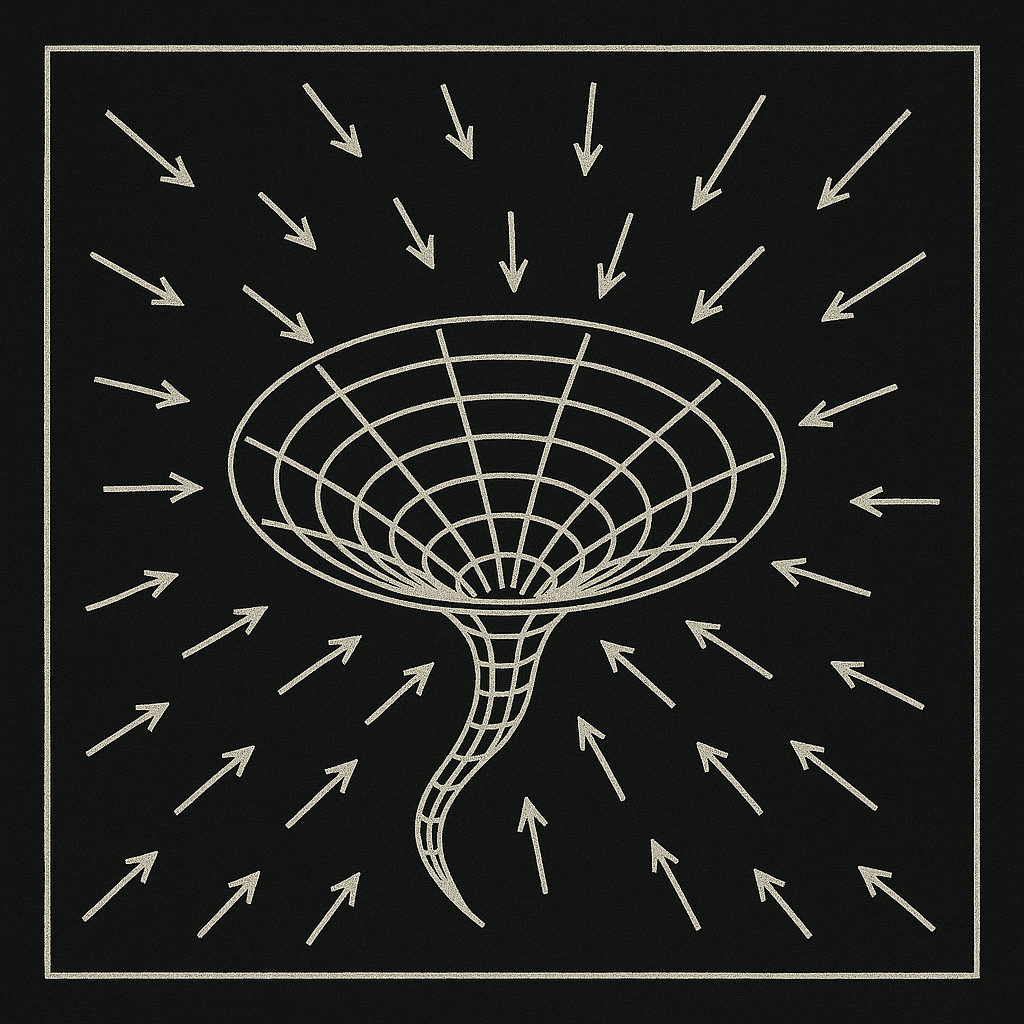
THE MACHINERY OF ATTRACTOR
A Complete Guide to Where Systems End Up
How Dynamical Landscapes Pull Everything Toward Their Valleys
What follows is not metaphor.
It is not a motivational framework about gravitational pull. Not a self-help analogy about being drawn toward your purpose. Not another repurposing of physics vocabulary to dress up folk wisdom.
It is mechanism.
The actual mathematics of where systems go. The geometry of long-term behavior. The physics of why a dripping faucet settles into rhythm, why a pendulum finds its rest, why a climate can snap from one stable state to another, and why, once it does, it stays.
Every system you have ever watched stabilize was approaching an attractor. Every system you have ever watched resist change was sitting in one. Every system you have ever watched collapse was being kicked out of one basin and falling into another.
The attractor was always there. Written into the equations. Governing the long-term fate of the system before the system had taken its first step.
This document maps that machinery.
Nothing more.
What you do with it is your business.
PART ONE: THE PLACE WHERE THINGS END UP
What an Attractor Actually Is
A dynamical system is a rule that tells you where a state goes next. Given the current configuration of everything that matters, the rule produces the next configuration. Then the next. Then the next. A trajectory through a space of possible states.
The attractor is where the trajectory ends up.
Not where it starts. Not where it visits along the way. Where it goes as time extends toward infinity. The set of states that the system eventually approaches, settles into, and never leaves.
The formal definition requires three properties.
First, the attractor must be invariant. Once the system is on the attractor, it stays on the attractor. The rule that governs the dynamics maps points on the attractor to other points on the attractor. It is a closed world.
Second, the attractor must attract. There must be an open set of initial conditions. Start from any of them and the trajectory converges to the attractor. This set is the basin of attraction. The attractor pulls its neighbors toward itself.
Third, the attractor must be minimal. No proper subset has both of the above properties. You cannot break the attractor into a smaller piece that is itself invariant and attracting. The attractor is irreducible.
    THE THREE PROPERTIES

    ┌──────────────────────────────────────────────────────┐
    │                                                      │
    │  1. INVARIANT                                        │
    │     Once there, stays there.                         │
    │     The dynamics map the attractor to itself.        │
    │                                                      │
    ├──────────────────────────────────────────────────────┤
    │                                                      │
    │  2. ATTRACTING                                       │
    │     Nearby states converge toward it.                │
    │     An open basin of initial conditions leads here.  │
    │                                                      │
    ├──────────────────────────────────────────────────────┤
    │                                                      │
    │  3. MINIMAL                                          │
    │     Cannot be decomposed further.                    │
    │     No proper subset is both invariant and           │
    │     attracting.                                      │
    │                                                      │
    └──────────────────────────────────────────────────────┘
John Milnor formalized this in 1985. His definition resolved decades of ambiguity about what should and should not count as an attractor. Before Milnor, the term was used loosely. After Milnor, it was precise.
The precision matters because the attractor is not just a destination. It is the organizing principle of the entire system. Everything the system does in the long run is determined by its attractors and the geometry of their basins.
The Simplest Case
A marble in a bowl.
Release the marble anywhere on the inner surface. It rolls downhill, oscillates, loses energy to friction, and comes to rest at the bottom.
The bottom of the bowl is a fixed-point attractor. One point. Invariant, because a marble at rest at the bottom stays at rest. Attracting, because any initial position on the inner surface leads here. Minimal, because a single point has no proper subsets.
The bowl itself is the basin of attraction.
Every initial condition inside the bowl converges to the same point. Every initial condition outside the bowl does not.
This is the simplest attractor. It is also, by far, the most common. Most stable configurations in physics, chemistry, and engineering are fixed-point attractors. A thermostat holding a temperature. A chemical reaction reaching equilibrium. A population stabilizing at carrying capacity.
The system moves. Energy dissipates. Motion dies. What remains is the fixed point.
PART TWO: THE TAXONOMY
Four Kinds of Attractor
Not all long-term behavior is stillness. Some systems settle into motion that repeats. Others settle into motion that never repeats but remains bounded. The taxonomy maps these possibilities.
Fixed Point. The system stops. All variables reach constant values. A damped pendulum. A capacitor discharging to zero. A population at carrying capacity.
Limit Cycle. The system oscillates. The trajectory traces a closed loop in state space and repeats exactly, forever. A beating heart. A circadian clock. The Belousov-Zhabotinsky chemical oscillation. The system does not stop moving, but it moves in the same path, again and again.
Torus. The system oscillates at multiple incommensurable frequencies. The trajectory wraps around a torus in state space, never exactly repeating but filling the surface densely. Quasiperiodic motion. Two pendulums with irrational frequency ratios. Planetary orbits with non-resonant periods.
Strange Attractor. The system never repeats, never settles, yet never leaves a bounded region. The trajectory is aperiodic and sensitive to initial conditions. Two trajectories that start infinitesimally close diverge exponentially. Yet both remain on the same bounded geometric object. The attractor has fractal structure. Its dimension is not an integer.
    THE ATTRACTOR TAXONOMY

    ┌──────────────────┐  ┌──────────────────┐
    │                  │  │                  │
    │   FIXED POINT    │  │   LIMIT CYCLE    │
    │                  │  │                  │
    │       •          │  │     ╭───╮        │
    │                  │  │    │     │       │
    │   Dimension: 0   │  │     ╰───╯        │
    │   Behavior:      │  │   Dimension: 1   │
    │   Stillness      │  │   Behavior:      │
    │                  │  │   Periodic       │
    │                  │  │                  │
    └──────────────────┘  └──────────────────┘

    ┌──────────────────┐  ┌──────────────────┐
    │                  │  │                  │
    │     TORUS        │  │    STRANGE       │
    │                  │  │   ATTRACTOR      │
    │    ╭─────╮       │  │                  │
    │   ╭┤     ├╮      │  │   ~*bg%#~*~      │
    │    ╰─────╯       │  │   *~#~bg*%~      │
    │   Dimension: 2   │  │   Dimension:     │
    │   Behavior:      │  │   Fractal        │
    │   Quasiperiodic  │  │   Behavior:      │
    │                  │  │   Chaotic        │
    │                  │  │                  │
    └──────────────────┘  └──────────────────┘
The taxonomy is not arbitrary. It follows from the mathematics of how dimensions of long-term behavior increase.
A fixed point is zero-dimensional. A limit cycle is one-dimensional. A torus is two-dimensional. A strange attractor has fractional dimension. The Lorenz attractor has a Hausdorff dimension of approximately 2.06. The Henon attractor, approximately 1.26.
These are not metaphors. They are measured quantities. The fractal dimension tells you precisely how much of the available state space the attractor occupies. Not a plane. Not a line. Something in between.
PART THREE: THE BASIN
The Geometry of Fate
The attractor is where you end up. The basin is who ends up there.
Every attractor has a basin of attraction. The set of all initial conditions from which the system’s trajectory converges to that attractor. If you start inside the basin, you go to the attractor. If you start outside, you go somewhere else.
When a dynamical system has multiple attractors, the state space is partitioned into basins. Each basin belongs to one attractor. The boundaries between basins are called separatrices.
    BASINS OF ATTRACTION

    ┌─────────────────────────────────────────────────────────┐
    │                                                         │
    │          BASIN A               │          BASIN B       │
    │                                │                        │
    │                                │                        │
    │      ╲   ╲   ╲                │         ╱   ╱   ╱     │
    │       ╲   ╲   ╲               │        ╱   ╱   ╱      │
    │        ╲   ╲   ╲              │       ╱   ╱   ╱       │
    │         ╲   ╲   ╲             │      ╱   ╱   ╱        │
    │          ▼   ▼   ▼            │     ▼   ▼   ▼         │
    │            •                  │          •             │
    │        Attractor A            │      Attractor B       │
    │                                │                        │
    │                                │                        │
    │                        separatrix                       │
    │                                                         │
    └─────────────────────────────────────────────────────────┘
The separatrix is a knife edge. An infinitesimal displacement to one side sends the system to attractor A. The same displacement to the other side sends it to attractor B. The long-term fate of the system is determined entirely by which side of the separatrix it starts on.
This is where initial conditions become fate.
Two systems with identical dynamics, identical parameters, identical everything. One starts a fraction to the left of the separatrix. The other starts a fraction to the right. They end up in completely different states. Forever.
The geometry of basins can be simple. Two smooth regions divided by a clean boundary. Or it can be fractal. Basins interleaved at every scale, so that no finite measurement of initial conditions can determine which attractor the system will reach. This is called basin riddling. It occurs in coupled oscillators, in ecological models, in driven nonlinear systems.
When basins are riddled, prediction becomes impossible in practice even though the dynamics are perfectly deterministic.
PART FOUR: DISSIPATION AND THE ARROW
Why Only Losers Have Attractors
This heading is precise.
Attractors exist only in dissipative systems. Systems that lose energy. Systems where friction, viscosity, radiation, or some other mechanism removes energy from the dynamics.
Conservative systems, where energy is perfectly conserved, do not have attractors. A frictionless pendulum swings forever. It never settles. A planet in a Newtonian two-body problem orbits forever at the same energy. There is no convergence, no settling, no long-term simplification.
The reason is Liouville’s theorem.
In a conservative (Hamiltonian) system, the flow in phase space preserves volume. A cloud of initial conditions retains its volume as it evolves. It may stretch and fold, but it cannot shrink. And an attractor requires shrinkage. It requires that a volume of initial conditions contract down to the lower-dimensional set that is the attractor.
    CONSERVATIVE VS. DISSIPATIVE

    ┌───────────────────────────┐  ┌───────────────────────────┐
    │                           │  │                           │
    │      CONSERVATIVE         │  │       DISSIPATIVE         │
    │                           │  │                           │
    │  Phase space volume       │  │  Phase space volume       │
    │  is preserved.            │  │  contracts.               │
    │                           │  │                           │
    │  ┌───────┐   ┌───────┐   │  │  ┌───────┐    ┌───┐      │
    │  │       │ → │       │   │  │  │       │ →  │   │      │
    │  │       │   │       │   │  │  │       │    │   │      │
    │  └───────┘   └───────┘   │  │  └───────┘    └───┘      │
    │                           │  │                           │
    │  Same area.               │  │  Smaller area.            │
    │  No attractor possible.   │  │  Attractor exists.        │
    │                           │  │                           │
    └───────────────────────────┘  └───────────────────────────┘
Dissipation is the precondition.
Energy must leave the system. Volume in phase space must shrink. Trajectories must converge. Only then can there be a set of states that the system approaches in the long run.
This is why attractors are connected to thermodynamics. Dissipation increases entropy in the environment. The system itself becomes more ordered, more predictable, more compressed into its attractor. The cost is paid in heat, radiated away. The attractor is the ordered structure that remains after the disorder has been exported.
Every attractor is a dissipative structure. A pattern maintained by the continuous flow of energy through it and out of it. Stop the dissipation and the attractor dissolves. The system returns to conservative dynamics, to volume-preserving flow, to wandering without convergence.
PART FIVE: THE STRANGE KIND
Lorenz’s Accident
In 1963, Edward Lorenz was running a simplified model of atmospheric convection on a Royal McBee computer at MIT. Twelve equations, later reduced to three. He wanted to rerun a simulation from the middle. He typed in the numbers from a printout, rounding from six decimal places to three.
The trajectory diverged completely.
Not gradually. Exponentially. Within a short time, the new trajectory bore no resemblance to the original. The same equations, the same parameters, initial conditions differing by one part in a thousand, producing utterly different behavior.
This was not a bug. It was a discovery.
The system was deterministic. Given exact initial conditions, the future was uniquely determined. But any imprecision in those conditions, no matter how small, grew exponentially. Practical prediction became impossible beyond a finite horizon.
Yet the trajectories did not fly off to infinity. They stayed bounded. They traced and retraced a butterfly-shaped region of state space, never repeating, never leaving. The same region, forever, but never the same path twice.
    THE LORENZ ATTRACTOR

         BOUNDED                 SENSITIVE
    ┌──────────────────┐   ┌──────────────────┐
    │                  │   │                  │
    │  Trajectories    │   │  Nearby paths    │
    │  stay within a   │   │  diverge at      │
    │  bounded region  │   │  rate e^(λt)     │
    │  forever.        │   │                  │
    │                  │   │  λ ≈ 0.9056      │
    │  Never escape.   │   │  (largest        │
    │                  │   │   Lyapunov       │
    │                  │   │   exponent)      │
    │                  │   │                  │
    └────────┬─────────┘   └────────┬─────────┘
             │                      │
             └──────────┬───────────┘
                        │
                        ▼
              ┌──────────────────┐
              │                  │
              │  STRANGE         │
              │  ATTRACTOR       │
              │                  │
              │  Dimension:      │
              │  ≈ 2.06          │
              │                  │
              │  Deterministic   │
              │  yet             │
              │  unpredictable   │
              │                  │
              └──────────────────┘
David Ruelle and Floris Takens gave it the name in 1971. Strange attractor. Strange because its geometry was unlike anything in classical mathematics. Not a point. Not a curve. Not a surface. A fractal. An object with dimension between two and three. Something that could not exist in the mathematics of smooth manifolds.
The Lorenz attractor has Hausdorff dimension approximately 2.06. It is more than a surface but less than a solid. It has infinite length but zero volume. It has structure at every scale of magnification.
And it governs the weather.
The Paradox of Chaos
Strange attractors contain a paradox that deserves precise statement.
The system is unpredictable. Sensitivity to initial conditions means that any finite measurement error grows exponentially. Practical forecasting has a finite horizon. For the Lorenz system, that horizon is measured in days. For the actual atmosphere, roughly two weeks.
Yet the system is constrained. The trajectories never leave the attractor. The butterfly shape is fixed. The statistical properties of the system are stable and reproducible. The average behavior, the distribution of states visited, the frequency of switching between lobes. All of this is predictable.
Unpredictable in detail. Predictable in distribution.
    THE CHAOS PARADOX

    ┌─────────────────────────────────────────────────────────┐
    │                                                         │
    │  WHAT IS UNPREDICTABLE             WHAT IS PREDICTABLE  │
    │                                                         │
    │  Where the trajectory will         The shape of the     │
    │  be at time t.                     attractor itself.    │
    │                                                         │
    │  Which lobe the system             The fraction of      │
    │  will visit next.                  time spent in        │
    │                                    each lobe.           │
    │                                                         │
    │  The exact sequence of             The statistical      │
    │  oscillations.                     distribution of      │
    │                                    amplitudes.          │
    │                                                         │
    │  The specific future.              The climate.         │
    │                                                         │
    └─────────────────────────────────────────────────────────┘
This is the distinction between weather and climate in its purest mathematical form.
Weather is the current position on the attractor. Unpredictable beyond a few days.
Climate is the attractor itself. The geometric object in state space. The shape of the butterfly. Stable, measurable, characterizable. Changed only by changing the parameters of the system.
This distinction generalizes. In any chaotic system, the individual trajectory is unpredictable. The attractor is not.
PART SIX: THE LANDSCAPE
Potential Landscapes and Multistability
When a dynamical system can be derived from a potential function, the attractor structure becomes visual.
The potential is a surface. Valleys are stable attractors. Hills and ridges are unstable fixed points. The system moves downhill, descending the gradient, losing energy to dissipation, settling into the nearest valley.
    THE POTENTIAL LANDSCAPE

    Potential
    Energy
         │
         │    ╲         ╱╲         ╱
         │     ╲       ╱  ╲       ╱
         │      ╲     ╱    ╲     ╱
         │       ╲   ╱      ╲   ╱
         │        ╲ ╱        ╲ ╱
         │         V          V
         │      Valley A   Valley B
         │     (attractor) (attractor)
         │
         └─────────────────────────────────►
                                      State
The depth of the valley measures stability. A deep valley requires a large perturbation to escape. A shallow valley can be exited by a small kick. The width of the valley is the basin.
Multistability means multiple valleys exist simultaneously. The system’s current state depends on where it started. Two systems with identical parameters, identical rules, but different histories can sit in different valleys indefinitely. This is the physics of lock-in.
Noise and Escape
Real systems are noisy. Thermal fluctuations, external perturbations, internal randomness. Noise kicks the system around within its basin. Most of the time, the kicks are small and the system returns to the attractor.
But occasionally, a sufficiently large fluctuation pushes the system over the ridge between basins.
Hendrik Kramers formalized this in 1940. The rate of escape from a potential well depends exponentially on the ratio of the barrier height to the noise intensity.
    KRAMERS ESCAPE

    Rate of escape ∝ exp(−ΔV / D)

    ΔV = barrier height
    D  = noise intensity

    ┌─────────────────────────────────────────────────┐
    │                                                 │
    │  HIGH BARRIER, LOW NOISE                        │
    │  Rate ≈ 0. System stays for geological time.    │
    │                                                 │
    │  LOW BARRIER, HIGH NOISE                        │
    │  Rate is high. Frequent switching.              │
    │                                                 │
    │  INTERMEDIATE                                   │
    │  Rare but consequential transitions.            │
    │  Tipping points.                                │
    │                                                 │
    └─────────────────────────────────────────────────┘
This formula governs transitions everywhere. Chemical reaction rates. Protein folding. Climate tipping points. Neural state switching. Market crashes. The mathematics are identical. Only the barrier height and the noise intensity change.
When the barrier is high and the noise is low, the system is effectively trapped. It will sit in its attractor for longer than the age of the universe. The attractor might as well be permanent.
When the barrier is low and the noise is high, the system flickers between attractors. It never fully commits to either. This is the regime of bistable oscillation, of indecision, of systems that seem unable to settle.
Between these extremes lies the regime of tipping points. Rare transitions with enormous consequences. The system sits in one attractor for a long time, then crosses in a geological instant. The transition, once made, is difficult to reverse because the system is now deep inside a different basin.
PART SEVEN: THE BIOLOGICAL ATTRACTOR
Waddington’s Landscape
In 1957, Conrad Hal Waddington published “The Strategy of the Genes” and introduced an image that became one of the most influential metaphors in biology.
A ball rolling down a landscape of branching valleys.
The ball represents a developing cell. The landscape represents the gene regulatory network. The valleys represent differentiated cell types. The ball starts at the top, undifferentiated, totipotent. As it rolls downhill, it enters one valley or another. Each branching point commits the cell further. At the bottom, it has become a neuron, or a muscle cell, or a blood cell. A specific type. A specific fate.
Waddington drew this as metaphor. The mathematics came later.
    WADDINGTON'S EPIGENETIC LANDSCAPE

                        ○  ← Stem cell
                       ╱╲
                      ╱  ╲
                     ╱    ╲
                    ╱      ╲
                   ╱        ╲
                  ╱╲        ╱╲
                 ╱  ╲      ╱  ╲
                ╱    ╲    ╱    ╲
               ╱      ╲  ╱      ╲
              V        VV        V
           Neuron    Muscle    Blood
           cell      cell      cell

    Each valley = an attractor of the gene
    regulatory network.

    Each branching = a bifurcation point
    where one attractor splits into two.
Stuart Kauffman made it mathematical. In the 1960s and 1970s, he modeled gene regulatory networks as Boolean networks. Each gene is on or off. Each gene’s next state depends on the current states of K other genes. The network iterates. It converges to limit cycles.
These limit cycles are attractors.
Kauffman’s key finding: the number of attractors scales as approximately the square root of the number of genes. A network of N genes has roughly √N attractors. For the human genome, with approximately 20,000 protein-coding genes, this predicts roughly 140 attractors. The number of distinct human cell types is approximately 200 to 300.
The order of magnitude match is striking. Cell types are not designed. They are attractors of the gene regulatory network. The genome does not encode a list of cell types. It encodes a dynamical system whose attractors happen to be the cell types.
PART EIGHT: THE NEURAL ATTRACTOR
Memory as Convergence
In 1982, John Hopfield published a paper that changed how neuroscience thinks about memory.
He proposed a network of interconnected neurons where each neuron is either firing or silent. The connections between neurons are set by a learning rule. The network has stored patterns. Specific configurations of firing and silence that correspond to memories.
These stored patterns are attractors.
Present the network with a partial or noisy version of a stored pattern. The dynamics of the network complete the pattern. Neurons flip states, one by one, always decreasing the network’s energy function. The system descends the energy landscape until it reaches a minimum. That minimum is the stored memory.
    HOPFIELD NETWORK

    ┌─────────────────────────────────────────────────┐
    │                                                 │
    │  INPUT: Partial / noisy pattern                 │
    │                                                 │
    │  ○ ● ○ ● ? ? ○ ● ○ ?                           │
    │                                                 │
    │              │                                  │
    │              │ Network dynamics                  │
    │              │ (descend energy landscape)        │
    │              ▼                                  │
    │                                                 │
    │  OUTPUT: Complete stored pattern                 │
    │                                                 │
    │  ○ ● ○ ● ● ○ ○ ● ○ ●                           │
    │                                                 │
    │  The attractor completed the pattern.            │
    │                                                 │
    └─────────────────────────────────────────────────┘
Memory recall is not retrieval from storage. It is convergence to an attractor. The network does not look up the memory. It falls into it.
This reframes memory errors. A false memory is not a corruption of a stored file. It is convergence to the wrong attractor. The noisy input was closer to a different stored pattern, and the dynamics carried it there. The network did exactly what it was designed to do. It just converged to the wrong valley.
Decision-making operates on the same principle. The brain accumulates evidence, which acts as a noisy input to a network with multiple attractor states representing different choices. The dynamics converge toward one attractor. The decision is made when the system crosses the separatrix between basins and commits to one attractor.
This is why decisions feel sudden after slow deliberation. The evidence accumulation is gradual. The commitment is a basin crossing. The system was near the separatrix for a long time, then crossed it, and the dynamics accelerated toward the chosen attractor.
PART NINE: THE LOCK-IN
Social and Economic Attractors
In 1985, Brian Arthur published work on increasing returns and path dependence in economics that paralleled the mathematics of attractor theory precisely.
When a technology is adopted, its adoption makes further adoption more likely. More users mean more software, more trained technicians, more compatible infrastructure, more network effects. The technology deepens its own basin.
QWERTY is the canonical example.
The QWERTY keyboard layout was designed in the 1870s for mechanical typewriters. It was not optimized for speed. It was optimized to prevent jamming by separating frequently paired letters. The mechanical constraint disappeared decades ago. The layout persists.
Not because it is optimal. Because it is an attractor.
Millions of trained typists. Millions of keyboards manufactured. Billions of dollars of infrastructure. Software designed around it. Education systems teaching it. Each user who learns QWERTY deepens the basin for the next user.
    TECHNOLOGICAL LOCK-IN

    Potential
         │
         │  ╲                              ╱
         │   ╲                            ╱
         │    ╲                          ╱
         │     ╲         ╱╲             ╱
         │      ╲       ╱  ╲           ╱
         │       ╲     ╱    ╲         ╱
         │        ╲   ╱      ╲       ╱
         │         ╲ ╱        ╲     ╱
         │          V          ╲   ╱
         │       QWERTY         ╲ ╱
         │      (deep basin)     V
         │                    DVORAK
         │                   (shallow
         │                    basin)
         │
         └────────────────────────────────────►
The Dvorak layout is measurably faster for English text. It exists. It is available. It does not matter. The basin around QWERTY is deep enough that no reasonable perturbation can push the system over the ridge.
This is the attractor operating at the level of social systems. The same mathematics. The same geometry. The same exponential relationship between barrier height and escape probability.
Poverty traps are the same structure. A region with low education, low infrastructure, low investment. Each factor reinforces the others. The basin deepens. Escaping requires a coordinated perturbation that pushes multiple variables simultaneously over the separatrix. Small interventions are absorbed. The system returns to its attractor.
Climate tipping points are the same structure at planetary scale. The Atlantic Meridional Overturning Circulation has two attractors. One where the circulation runs. One where it does not. The barrier between them depends on freshwater input from melting ice. As the ice melts, the barrier lowers. At some threshold, the noise of natural variability is enough to push the system across. The transition, once made, is effectively irreversible on human timescales.
PART TEN: THE CONSTRAINTS
The Paradox of the Attractor
Attractors constrain. They confine the system to a subset of all possible states. A system on its attractor cannot explore the rest of state space. It is trapped.
And yet attractors enable.
A system without an attractor is a system without stable behavior. Without pattern. Without predictability. Without function. The conservative system that preserves phase space volume wanders ergodically through all accessible states, never settling, never organizing, never producing anything recognizable as structure.
The attractor is the structure. The constraint is the function.
    CONSTRAINT AND FUNCTION

    ┌───────────────────────────┐  ┌───────────────────────────┐
    │                           │  │                           │
    │  WITHOUT ATTRACTOR        │  │  WITH ATTRACTOR           │
    │                           │  │                           │
    │  All states accessible.   │  │  Subset of states.        │
    │  No stable behavior.      │  │  Stable behavior.         │
    │  No pattern.              │  │  Recognizable pattern.    │
    │  No function.             │  │  Specific function.       │
    │  Maximum freedom.         │  │  Reduced freedom.         │
    │  Zero organization.       │  │  High organization.       │
    │                           │  │                           │
    └───────────────────────────┘  └───────────────────────────┘
A heartbeat is a limit cycle attractor. It constrains the heart to one pattern of contraction. But that constraint is the function. Without the attractor, the heart fibrillates. All muscle cells firing independently, exploring the full state space. Maximum freedom. Zero pumping.
A cell type is an attractor of the gene regulatory network. It constrains which genes are expressed. But that constraint is the identity. Without the attractor, gene expression drifts chaotically. No stable phenotype. No function.
A personality is an attractor of neural dynamics. It constrains responses, preferences, habitual patterns. But that constraint is the self. Without it, there is no coherent agent. No predictable behavior. No identity.
The attractor is where constraint and function become the same thing.
Broken Ergodicity
In statistical mechanics, an ergodic system is one that visits all accessible states given enough time. Its time average equals its ensemble average. The system explores everything.
Attractors break ergodicity.
A system with multiple attractors does not explore all accessible states. It explores only the states within its current basin. The other basins exist. They are dynamically accessible in principle. But the barriers between them are so high that the time required to cross them exceeds any practical timescale.
The system is trapped. Not by a physical wall. By a dynamical landscape.
    BROKEN ERGODICITY

    ┌─────────────────────────────────────────────────────────┐
    │                                                         │
    │  ERGODIC                                                │
    │  System visits all states.                              │
    │  Time average = ensemble average.                       │
    │  History does not matter.                               │
    │                                                         │
    ├─────────────────────────────────────────────────────────┤
    │                                                         │
    │  BROKEN ERGODICITY                                      │
    │  System visits only states in current basin.            │
    │  Time average ≠ ensemble average.                       │
    │  History determines which basin.                        │
    │  History becomes fate.                                  │
    │                                                         │
    └─────────────────────────────────────────────────────────┘
This is the deep connection between attractors and path dependence.
In an ergodic system, where you start does not matter. You will visit every state eventually. The past washes out.
In a system with broken ergodicity, where you start determines everything. The initial basin assignment persists indefinitely. The past is encoded permanently in the present.
Every attractor is a little death of ergodicity. A reduction of the possible to the actual. A commitment that cannot be undone without energy sufficient to cross the barrier.
What It Takes to Escape
Escaping an attractor requires one of three things.
First: sufficient noise. Random perturbations large enough to push the system over the separatrix. Kramers rate. Exponentially unlikely for deep basins. But given enough time, it happens.
Second: parameter change. The control parameter shifts, the landscape reshapes, the basin shrinks or disappears. This is bifurcation. The attractor does not survive the parameter change. The system is released, not because it escaped, but because the prison dissolved.
Third: external forcing. An outside agent applies a directed perturbation large enough to cross the barrier. Not random noise. Deliberate, targeted intervention. This is the physics of revolution, of shock therapy, of phase-transition engineering.
    THREE ESCAPE ROUTES

    ┌──────────────────┐  ┌──────────────────┐  ┌──────────────────┐
    │                  │  │                  │  │                  │
    │  NOISE           │  │  PARAMETER       │  │  EXTERNAL        │
    │                  │  │  CHANGE          │  │  FORCING         │
    │  Random kicks    │  │  Landscape       │  │  Directed push   │
    │  that exceed     │  │  reshapes.       │  │  across the      │
    │  barrier.        │  │  Basin vanishes. │  │  separatrix.     │
    │                  │  │                  │  │                  │
    │  Exponentially   │  │  Bifurcation.    │  │  Requires        │
    │  rare for deep   │  │  System is       │  │  knowing the     │
    │  basins.         │  │  released.       │  │  geometry.       │
    │                  │  │                  │  │                  │
    └──────────────────┘  └──────────────────┘  └──────────────────┘
Most attempts at change fail because they are insufficient perturbations to a deep basin. The system absorbs the kick and returns to its attractor. The intervention feels significant from the inside. But the basin is deep, and the perturbation is small relative to the barrier.
This is not resistance. It is geometry.
PART ELEVEN: THE COMPLETE PICTURE
The Unified Structure
Everything connects.
    THE COMPLETE ATTRACTOR FRAMEWORK

    ┌─────────────────────────────────────────────────────────┐
    │                                                         │
    │                  DYNAMICAL SYSTEM                       │
    │                                                         │
    │    A rule that evolves states through time.             │
    │    Deterministic or stochastic. Continuous or           │
    │    discrete. The rule produces trajectories.            │
    │                                                         │
    └─────────────────────────────────────────────────────────┘
                              │
                              │ dissipation
                              ▼
    ┌─────────────────────────────────────────────────────────┐
    │                                                         │
    │                  ATTRACTOR LANDSCAPE                    │
    │                                                         │
    │    Phase space partitioned into basins.                 │
    │    Each basin belongs to one attractor.                 │
    │    Separatrices divide basins.                          │
    │    Barrier heights determine stability.                 │
    │                                                         │
    └─────────────────────────────────────────────────────────┘
                              │
              ┌───────────────┼───────────────┐
              │               │               │
              ▼               ▼               ▼
    ┌─────────────┐  ┌─────────────┐  ┌─────────────┐
    │             │  │             │  │             │
    │  PHYSICS    │  │  BIOLOGY    │  │  SOCIETY    │
    │             │  │             │  │             │
    │  Pendulums  │  │  Cell types │  │  Lock-in    │
    │  Climate    │  │  Memory     │  │  Poverty    │
    │  Weather    │  │  Decisions  │  │  Norms      │
    │             │  │             │  │             │
    └─────────────┘  └─────────────┘  └─────────────┘
              │               │               │
              └───────────────┼───────────────┘
                              │
                              ▼
    ┌─────────────────────────────────────────────────────────┐
    │                                                         │
    │              THE SAME MATHEMATICS                       │
    │                                                         │
    │    Basins. Barriers. Noise. Escape rates.              │
    │    Bifurcation. Phase transition. Lock-in.             │
    │    Different substrates. Identical geometry.            │
    │                                                         │
    └─────────────────────────────────────────────────────────┘
The attractor is one of the most universal structures in the mathematical description of reality.
It appears wherever a system dissipates energy and evolves in time. Wherever transients die and long-term behavior remains. Wherever the question “what does this system do eventually?” has a definite answer.
The fixed point. The limit cycle. The strange attractor. Three answers to the same question. Three kinds of long-term fate.
And surrounding each: a basin. A region of state space from which all paths lead to the same destination. A commitment that was made not by choice but by initial conditions. A geometry that determines which perturbations are absorbed and which are transformative.
The Translation Table
| Common Understanding | Actual Mechanism |
|---|---|
| “Things settle down” | Dissipation contracts phase space onto the attractor |
| “Stuck in a rut” | The system is in a deep basin with high barriers |
| “Tipping point” | The separatrix has been crossed. New basin, new attractor |
| “Chaos” | Deterministic dynamics on a strange attractor. Bounded yet unpredictable |
| “Destiny” | Basin assignment by initial conditions |
| “Resistance to change” | The basin is deeper than the perturbation |
| “Lock-in” | Positive feedback has deepened the basin during occupation |
| “Habit” | Neural dynamics have converged to a limit cycle or fixed-point attractor |
| “Cell type” | An attractor of the gene regulatory network |
| “Weather vs. climate” | Trajectory on the attractor vs. the attractor itself |
Final Synthesis
The attractor is not a destination. It is a mathematical object. A set in state space with specific properties. Invariant, attracting, minimal.
But its implications are universal.
Every system that dissipates energy develops attractors. Every system with attractors has basins. Every system with basins has separatrices. Every system with separatrices has a geometry of fate.
The fixed point is where motion dies. The limit cycle is where motion repeats. The strange attractor is where motion persists without repeating. All three are the same idea: the structure that survives after the transients are gone.
And the transients are always gone eventually.
Because the system dissipates.
Because phase space contracts.
Because what remains, after all the energy that can be lost has been lost, is the attractor.
The marble finds the bottom of the bowl. The heart finds its rhythm. The climate finds its state. The cell finds its type. The technology finds its standard. The society finds its norms.
Not because anyone chose. Not because there was a plan. Not because the outcome was optimal.
Because the dynamics had an attractor. And the system was in its basin.
That is the machinery. The geometry of where things end up.
Not why they should.
Just where they do.
Citations
Foundational Mathematics and Dynamical Systems
Milnor, J. (1985). “On the concept of attractor.” Communications in Mathematical Physics, 99(2), 177-195. https://doi.org/10.1007/BF01212280
Strogatz, S.H. (2015). Nonlinear Dynamics and Chaos: With Applications to Physics, Biology, Chemistry, and Engineering. 2nd Edition. Westview Press.
Poincaré, H. (1890). “Sur le problème des trois corps et les équations de la dynamique.” Acta Mathematica, 13, 1-270.
Smale, S. (1967). “Differentiable dynamical systems.” Bulletin of the American Mathematical Society, 73(6), 747-817.
Strange Attractors and Chaos
Lorenz, E.N. (1963). “Deterministic Nonperiodic Flow.” Journal of the Atmospheric Sciences, 20(2), 130-141. https://doi.org/10.1175/1520-0469(1963)020<0130:DNF>2.0.CO;2
Ruelle, D. & Takens, F. (1971). “On the Nature of Turbulence.” Communications in Mathematical Physics, 20(3), 167-192.
Feigenbaum, M.J. (1978). “Quantitative universality for a class of nonlinear transformations.” Journal of Statistical Physics, 19(1), 25-52. https://doi.org/10.1007/BF01020332
Grassberger, P. & Procaccia, I. (1983). “Measuring the strangeness of strange attractors.” Physica D, 9(1-2), 189-208.
Dissipative Systems and Thermodynamics
Liouville, J. (1838). “Note sur la Théorie de la Variation des constantes arbitraires.” Journal de Mathématiques Pures et Appliquées, 3, 342-349.
Kramers, H.A. (1940). “Brownian motion in a field of force and the diffusion model of chemical reactions.” Physica, 7(4), 284-304.
Biological Attractors
Waddington, C.H. (1957). The Strategy of the Genes. George Allen & Unwin.
Kauffman, S.A. (1969). “Metabolic stability and epigenesis in randomly constructed genetic nets.” Journal of Theoretical Biology, 22(3), 437-467.
Kauffman, S.A. (1993). The Origins of Order: Self-Organization and Selection in Evolution. Oxford University Press.
Huang, S. (2009). “Reprogramming cell fates: reconciling rarity with robustness.” BioEssays, 31(5), 546-560. https://doi.org/10.1002/bies.200800189
Neural Attractors
Hopfield, J.J. (1982). “Neural networks and physical systems with emergent collective computational abilities.” Proceedings of the National Academy of Sciences, 79(8), 2554-2558. https://doi.org/10.1073/pnas.79.8.2554
Amit, D.J. (1989). Modeling Brain Function: The World of Attractor Neural Networks. Cambridge University Press.
Wang, X.-J. (2002). “Probabilistic decision making by slow reverberation in cortical circuits.” Neuron, 36(5), 955-968.
Economic and Social Lock-In
Arthur, W.B. (1989). “Competing Technologies, Increasing Returns, and Lock-In by Historical Events.” The Economic Journal, 99(394), 116-131.
David, P.A. (1985). “Clio and the Economics of QWERTY.” The American Economic Review, 75(2), 332-337.
Climate Attractors
Stommel, H. (1961). “Thermohaline convection with two stable regimes of flow.” Tellus, 13(2), 224-230.
Lenton, T.M. et al. (2008). “Tipping elements in the Earth’s climate system.” Proceedings of the National Academy of Sciences, 105(6), 1786-1793. https://doi.org/10.1073/pnas.0705414105
Related Machineries
-
THE MACHINERY OF BIFURCATION. Bifurcation is how the attractor landscape changes. When a control parameter crosses a critical value, attractors are born, destroyed, or change stability. Every qualitative shift in a system’s long-term behavior is a change in its attractor structure.
-
THE MACHINERY OF EQUILIBRIUM. Equilibrium is the simplest attractor. A fixed point where all forces cancel and all flows cease. The relationship between equilibrium and attractor illuminates why equilibrium is both destination and trap.
-
THE MACHINERY OF PHASE TRANSITIONS. A phase transition is a jump between attractors driven by parameter change. The order parameter marks which attractor the system occupies. The critical point is where the landscape reshapes.
-
THE MACHINERY OF PATH DEPENDENCE. Path dependence is broken ergodicity applied to history. Initial conditions determine basin assignment, and basin assignment determines fate. The attractor explains why history matters and why it cannot be undone by wishing.
-
THE MACHINERY OF RESILIENCE. Resilience is the basin geometry around the attractor. The attractor is the destination; resilience is the landscape’s tolerance for perturbation.