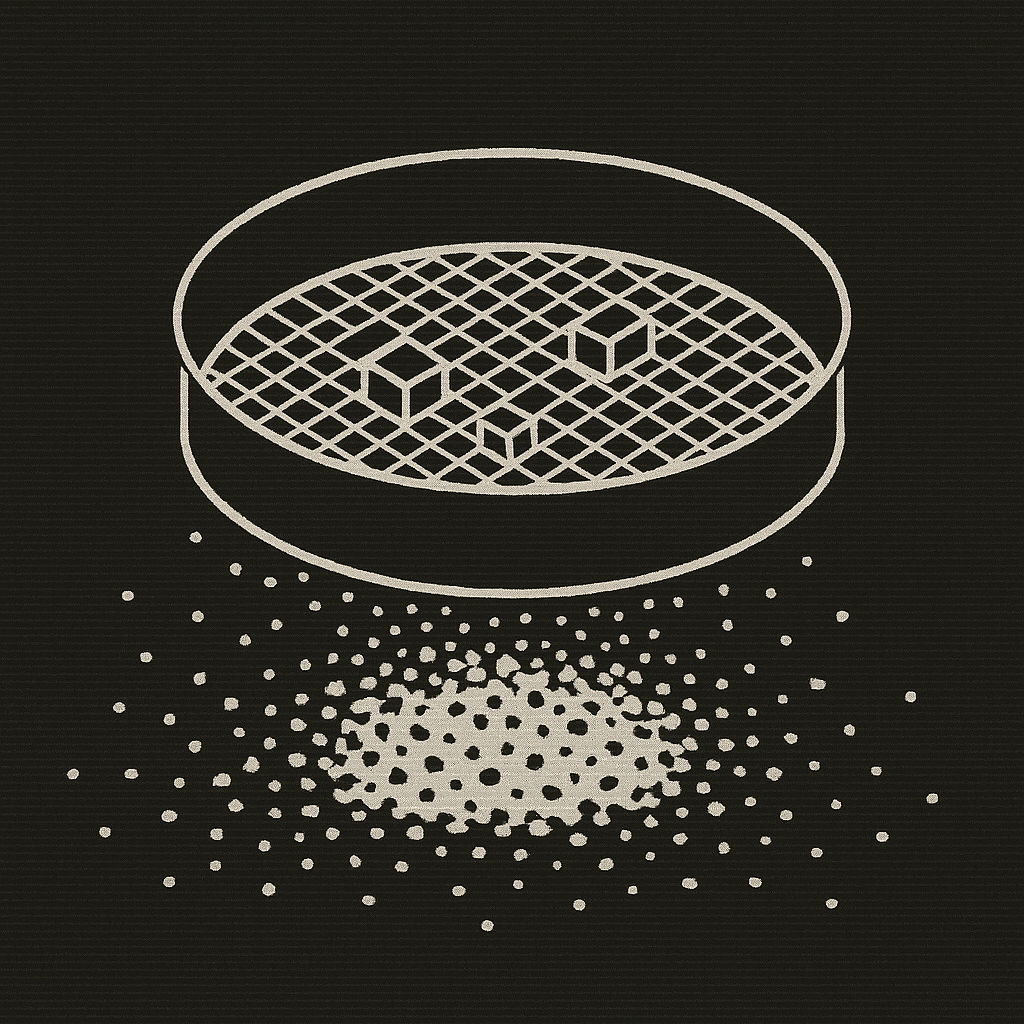
THE MACHINERY OF ELIMINATION
A Complete Guide to Inhibitory Control
What the Brain Removes to Function
What follows is not advice.
It is not a detox plan. Not a decluttering system. Not a productivity framework repackaged with neuroscience vocabulary.
It is mechanism.
The actual machinery underneath the act of removal. How the brain selects by suppressing. How expertise is defined by what gets cut. How performance scales with what gets left out.
Most people think the mind works by adding. More information. More options. More processing power. More strategy.
This is wrong.
The brain’s most fundamental operation is not addition.
It is elimination.
Everything you perceive, every decision you make, every skill you develop, every memory that matters – each one is defined not by what the brain includes but by what it removes.
This document is that removal, observed.
What you do with it is your own business.
PART ONE: THE SIGNAL-TO-NOISE PROBLEM
Too Much Input
The nervous system receives approximately 11 million bits of information per second.
Conscious awareness processes approximately 50.
This gap is not a design flaw.
It is the design.
The brain is not trying to process everything. It never was. The goal of the nervous system is not comprehensive input. The goal is survival-relevant output.
To do that, 99.9995% must go.
The question that defines how everything else works is not “what gets in?”
It is “what gets eliminated?”
    THE ELIMINATION PROBLEM

    SENSORY INPUT                    CONSCIOUS PROCESSING

    11,000,000 bits/sec       -->    ~50 bits/sec
         |                               |
         |      +------------------+     |
         +----->|   ELIMINATION    |---->+
                |   FILTER         |
                |                  |
                |  99.9995% removed|
                +------------------+

    What gets through is not what is strongest.
    It is what survives the selection process.
Raw signal does not confer relevance.
The brain does not read what’s loudest. It reads what passes through layers of inhibitory filtering built to remove everything that does not matter right now.
The Noise Problem
Neural noise is substantial.
Signal-to-noise ratios in sensory cortex range from negative 10 to negative 28 decibels.
The raw data the brain works with is, by any engineering standard, garbage.
Yet perception is precise.
This is only possible because of elimination.
Three mechanisms run simultaneously:
Lateral inhibition: When a neuron fires, it activates surrounding inhibitory interneurons that suppress neighboring neurons tuned to similar stimuli. This sharpens tuning curves. Adjacent signals that would blur the perception are actively cancelled.
Sparse coding: Olshausen and Field showed in 1996 that the brain encodes information using the minimum number of simultaneously active neurons. Any given stimulus activates a small fraction of available neurons. The rest are suppressed. This achieves three things simultaneously: metabolic efficiency, pattern separation, and noise tolerance.
Alpha oscillations: At any moment, regions not currently needed are actively gated off by synchronized alpha-frequency (8-13 Hz) oscillations. The pulsed inhibition is not passive silence. It is active suppression applied to the wrong regions.
    THREE LAYERS OF NOISE ELIMINATION

    +--------------------------+
    |   LATERAL INHIBITION     |
    |   Suppresses neighboring |
    |   neurons tuned to       |
    |   similar stimuli.       |
    |   Sharpens tuning curves.|
    +--------------------------+
              |
              v
    +--------------------------+
    |   SPARSE CODING          |
    |   Only a small fraction  |
    |   of neurons fire at any |
    |   moment. The rest are   |
    |   suppressed.            |
    +--------------------------+
              |
              v
    +--------------------------+
    |   ALPHA GATING           |
    |   Active oscillatory     |
    |   suppression of entire  |
    |   regions not relevant   |
    |   to current task.       |
    +--------------------------+
Signal is not extracted by amplification.
It is extracted by eliminating what is not signal.
PART TWO: THE STOP SIGNAL
Two Pathways, Not One
Every action you take is the output of a competition.
Not a single pathway from intention to movement. Two parallel pathways, simultaneously active, racing to determine the outcome.
The Go pathway: prefrontal cortex signals the striatum, which releases the thalamus from inhibition, which activates the motor cortex. Movement begins.
The No-Go pathway: prefrontal cortex signals the striatum, which amplifies inhibition on the thalamus, which suppresses motor cortex. Movement is cancelled.
What you do at any given moment is not what you decided to do.
It is what won the competition between these two pathways.
    THE GO / NO-GO COMPETITION

                 +------------------------+
                 |   PREFRONTAL CORTEX    |
                 +------------------------+
                 |               |
                 | GO            | NO-GO
                 v               v
    +------------+---+   +-------+----------+
    | DIRECT PATHWAY |   | INDIRECT PATHWAY  |
    | (action)       |   | (suppression)     |
    +----------------+   +-------------------+
                 |               |
                 v               v
           THALAMUS  <-- suppressed by No-Go
                 |
                 v
           MOTOR CORTEX
                 |
                 v
             ACTION
          (only if Go wins)
This is not metaphor.
This is the physical architecture of basal ganglia computation.
The Hyperdirect Stop
When a stop signal arrives – a sound, a flash, a sudden change – the brain has two options.
Wait for the slow inhibitory process. Or bypass it.
The hyperdirect pathway bypasses it.
The right inferior frontal cortex (rIFC) sends a signal directly to the subthalamic nucleus (STN), which projects to the globus pallidus interna (GPi), which floods the thalamus with inhibition.
The whole cascade: approximately 200 milliseconds.
This is fast enough to cancel an action already in progress.
Adrian Aron and Russell Poldrack mapped this circuit in 2004. They used the stop-signal task: subjects press a button when they see a stimulus, but must stop if they hear a tone. Damage to the right inferior frontal gyrus specifically impairs stopping. The rest of cognition stays intact.
The stop signal is not general-purpose inhibition. It is a dedicated circuit for fast elimination of an ongoing action.
    THE HYPERDIRECT PATHWAY

    RIGHT INFERIOR                SUBTHALAMIC
    FRONTAL CORTEX    -------->   NUCLEUS (STN)
    (rIFC)                             |
                                       | excites
                                       v
                              GLOBUS PALLIDUS
                              INTERNA (GPi)
                                       |
                                       | suppresses
                                       v
                                  THALAMUS
                                       |
                                       x (motor output cancelled)
The subthalamic nucleus receives the fastest prefrontal input in the brain.
It is the emergency brake.
What This Tells You About Action
Every action is never just a go signal.
It is always the result of a go signal winning over an active no-go signal.
And the no-go signal is always running.
When someone says they cannot control an impulse, the accurate statement is: the go pathway is winning the competition. The no-go pathway is losing. Or the stop signal circuit cannot execute fast enough.
This is not a character description.
It is a circuit description.
PART THREE: THE PRUNING MECHANISM
Overproduction and Selection
The brain does not grow by adding.
It grows by producing too much, then eliminating what does not survive.
The newborn brain contains approximately 100 billion neurons. By adulthood, roughly 40% have been eliminated through programmed cell death (apoptosis).
But neuron count is not the interesting story.
The synapse count is.
The developing brain produces an enormous excess of synaptic connections. Far more than any adult brain retains. The number peaks in early childhood, then undergoes systematic elimination across childhood, adolescence, and into the mid-twenties.
The prefrontal cortex reaches peak synaptic density at approximately 12 years old.
By early adulthood, it has lost roughly 40% of those synapses.
The result is not a brain with less capacity.
The result is a brain with more precision.
The Molecular Machinery
Synaptic elimination is not random.
It is targeted.
The complement system, normally part of immune defense, plays the critical role.
Beth Stevens’ lab showed in 2007 that the C1q protein localizes specifically to weaker, less-active synapses. It tags them. C3 amplifies the tag. Microglia (the brain’s immune cells) express complement receptor CR3 and phagocytose the C3-tagged synapses.
They eat the tagged connections.
    SYNAPTIC ELIMINATION MECHANISM

    LESS ACTIVE              MORE ACTIVE
    SYNAPSE                  SYNAPSE
        |                        |
        | tagged with C1q + C3   | not tagged
        |                        |
        v                        |
    MICROGLIA (CR3 receptor)     | (protected)
        |                        |
        v                        v
    PHAGOCYTOSED             SURVIVES AND
    (eliminated)             STRENGTHENS
Dorothy Schafer’s 2012 Neuron paper confirmed the activity-dependence: more active retinal ganglion cell axons were protected from elimination. Less active axons were pruned. The brain is not eliminating randomly.
It is eliminating specifically what does not fire.
Use determines survival.
Disuse determines elimination.
What Pruning Produces
The adolescent PFC is processing faster than the child PFC.
Not because it has more connections. Because it has fewer, better-calibrated ones.
The pruning converts a generalist network into a specialist network.
Wide, weak, distributed connectivity becomes narrow, strong, targeted connectivity.
This is not loss. It is refinement.
The computational analog: pruned recurrent neural networks (RNNs) outperform dense ones on working memory tasks. The pruning itself is the improvement mechanism.
    BEFORE PRUNING              AFTER PRUNING

    A --+-- B                   A ------ B
        |                           |
    C --+-- D                   C       D
        |
    E --+-- F

    Many weak paths.            Fewer paths.
    High interference.          Lower interference.
    Slow, effortful.            Fast, efficient.
Schizophrenia illuminates this by inversion.
The leading hypothesis of schizophrenia involves excessive synaptic pruning in the prefrontal cortex during adolescence. Too much elimination. The resulting network lacks the connectivity density needed for coherent executive function.
The pathology is over-pruning.
Which proves that the mechanism is load-bearing.
PART FOUR: ALPHA AND THE GATING OF ATTENTION
The Suppression Oscillation
Attention is usually described as a spotlight.
This is half the story.
The full story: the spotlight is not what you illuminate. The spotlight is what you simultaneously extinguish everywhere else.
Ole Jensen and Ali Mazaheri proposed the framework in 2010: alpha oscillations (8-13 Hz) implement pulsed inhibition across cortical regions. When alpha power increases over a region, that region is gated off. When alpha power decreases, the region opens.
This is not what people imagine when they think of brain waves.
These are not ambient rhythms. They are directed suppression.
    ALPHA GATING IN SELECTIVE ATTENTION

    TASK: Attend to visual stimulus on LEFT

    LEFT VISUAL              RIGHT VISUAL
    CORTEX                   CORTEX
        |                        |
    alpha DECREASES          alpha INCREASES
    (region opens)           (region suppressed)
        |                        |
    SIGNAL PASSES            SIGNAL BLOCKED
When you attend to something on your left, alpha increases over your right visual cortex.
Not because you are ignoring the right.
Because the brain is actively blocking the right to protect the left signal.
Attention and suppression are the same operation. Not two operations. One.
Proactive vs. Reactive Suppression
There are two modes of distractor suppression.
Reactive suppression: A distractor appears. The brain detects it. Suppression begins after the distractor has already partially processed.
Proactive suppression: Before any stimulus arrives, the brain pre-suppresses locations or categories where distractors are expected.
Wang and colleagues showed this in 2021. When subjects knew where distractors would appear, they pre-loaded alpha suppression to that location. Performance improved significantly compared to reactive suppression.
The brain can learn suppression maps.
What to eliminate, learned in advance, applied before the distraction arrives.
    REACTIVE vs. PROACTIVE SUPPRESSION

    REACTIVE:
    Distractor arrives --> detected --> suppression begins
    (distractor has already partially entered processing)

    PROACTIVE:
    [experience with distractors]
          |
          v
    Suppression map stored
          |
          v
    Alpha pre-loaded to distractor location
          |
          v
    Distractor arrives --> immediately blocked
    (distractor never enters processing)
The experienced person is not just faster at reacting.
They have built libraries of pre-programmed suppressions.
They eliminate before the stimulus has a chance.
Working Memory and Active Suppression
Adam Gazzaley’s lab ran the definitive experiment in 2005.
Subjects held faces or places in working memory while viewing task-irrelevant stimuli.
When holding faces in memory and viewing places: the fusiform face area (FFA) increased in activity. The parahippocampal place area (PPA) was actively suppressed.
When holding places in memory and viewing faces: the opposite.
The brain does not just amplify the signal it needs.
It actively suppresses the signals it does not.
And aging showed exactly what happens when this mechanism fails.
Older adults showed the same target enhancement as younger adults.
But their distractor suppression was degraded.
The result: working memory decline.
Not because the storage capacity shrank.
Because the gate broke.
Working memory fails not because the bucket gets smaller.
Because the filter fails.
PART FIVE: THE FORGETTING MECHANISM
Forgetting Is a Feature
Forgetting is not a failure of memory.
It is a mechanism of memory.
Robert Bjork established this in 1989. Retrieval inhibition serves a specific adaptive function: when you retrieve one memory, competing memories that were not retrieved become harder to access.
This is not a side effect. This is the point.
Interference between competing memories degrades all of them.
Suppressing competitors during retrieval reduces interference.
The result: the retrieved memory is sharper, more precise, less contaminated.
Forgetting is what makes remembering work.
The Active Suppression of Unwanted Memories
Michael Anderson and Collin Green showed in 2001 that humans can actively suppress access to specific memories.
They designed the Think/No-Think paradigm.
Subjects learned word pairs. Then they were shown cues and told either to retrieve the target (Think) or to suppress it (No-Think).
Suppressed items showed significantly worse recall at test.
The more times a subject successfully suppressed a memory, the less accessible it became.
The suppression was not just absence of retrieval.
It was active inhibition.
    THE THINK / NO-THINK PARADIGM

    CUE: "OCEAN - ___"

    THINK CONDITION:              NO-THINK CONDITION:
    --> Retrieve "wave"            --> Suppress "wave"
    --> Memory trace               --> Right DLPFC activates
        strengthened                   Hippocampus suppressed
                                   --> Memory trace weakened
The 2004 fMRI follow-up identified the circuit.
Right dorsolateral prefrontal cortex (DLPFC) increased in activity during No-Think trials.
Hippocampal activation decreased.
And the magnitude of DLPFC-hippocampus anticorrelation predicted the degree of forgetting.
The prefrontal cortex can gate the hippocampus.
It can suppress the retrieval of memories it flags as unwanted.
Retrieval-Induced Forgetting
Suppression does not only happen intentionally.
It happens automatically, every time you remember.
When you retrieve one item from a category, competing items in that same category that you did not retrieve become harder to access afterward.
This is retrieval-induced forgetting (RIF).
Not pathology. Normal function.
The mechanism: when you retrieve item A from category X, the retrieval process activates and then suppresses competing items B, C, and D from category X. This reduces their accessibility.
The cleaner version of A is maintained.
The competitors are cleared.
    RETRIEVAL-INDUCED FORGETTING

    CATEGORY: "Fruits you know well"

    Recall "apple" repeatedly
          |
          v
    "apple" trace strengthens
    "banana", "grape", "mango" traces SUPPRESSED
          |
          v
    Next recall of "apple": faster, cleaner
    Next recall of "banana": slower, less accessible
Every act of remembering is simultaneously an act of forgetting.
What you rehearse, you sharpen.
What you rehearse against, you suppress.
Memory is not a library where everything is retained equally.
It is a system that actively thins what is not consistently needed.
PART SIX: THE DEFAULT MODE PROBLEM
Two Networks, One Brain
The brain has two large-scale networks that cannot run simultaneously.
The task-positive network (TPN): dorsolateral prefrontal cortex, frontal eye fields, intraparietal sulcus, supplementary motor area. Active during externally directed cognition. Planning, reasoning, attending to the world.
The default mode network (DMN): posterior cingulate cortex, medial prefrontal cortex, lateral parietal cortex, medial temporal lobe. Active at rest. Self-referential processing, memory consolidation, future simulation, social reasoning.
Marcus Raichle named the DMN in 2001.
Michael Fox confirmed in 2005 what the structure implied: these two networks are anticorrelated. Not just independently active. Mutually inhibitory.
When the TPN activates, the DMN suppresses.
When the DMN activates, the TPN suppresses.
    TPN / DMN ANTICORRELATION

                  TPN Activity     DMN Activity

    AT REST:
    +------------+--------------+------------------+
    |            |  low         |  high            |
    +------------+--------------+------------------+

    DURING TASK:
    +------------+--------------+------------------+
    |            |  high        |  low             |
    +------------+--------------+------------------+

    MIND WANDERING:
    +------------+--------------+------------------+
    |            |  low         |  high            |
    +------------+--------------+------------------+
Productive external cognition requires eliminating self-referential processing.
The brain cannot think about the world and think about itself at the same time.
The Cost of DMN Intrusion
When the DMN fails to suppress during a task, accuracy drops.
This is not speculation. It is measured in the fMRI literature consistently.
The ratio of TPN activation to DMN suppression predicts task accuracy.
When DMN activity persists during task performance, error rates increase.
Mind-wandering is not neutral rest.
It is active interference with the current task.
Sleep deprivation impairs DMN suppression specifically. After sleep loss, the DMN continues firing during tasks, creating interference. The tired brain cannot eliminate itself from what it is trying to do.
    WHAT HAPPENS WHEN DMN FAILS TO SUPPRESS

    WELL-RESTED BRAIN:              SLEEP-DEPRIVED BRAIN:

    Task demand -->                 Task demand -->
    TPN activates                   TPN activates (weakly)
    DMN suppresses                  DMN continues firing
    |                               |
    Task accuracy: HIGH             Task accuracy: DEGRADED
    Mind quiet                      Mind wandering
                                    "Where was I?"
The failure to eliminate self-reference is not introspection.
It is interference.
The Transition Failure
The DMN is not the problem.
It is essential.
For autobiographical memory, for imagining the future, for understanding other people, for making meaning from experience, the DMN is the task-relevant network.
The issue is not DMN activity.
The issue is failure to transition.
The failure to eliminate it when external attention is required.
This is a switching failure. A suppression failure. A failure of the same inhibitory machinery that runs the stop signal, the attention gating, the working memory filter.
Same mechanism. Different domain.
PART SEVEN: HICK’S LAW AND THE COST OF OPTIONS
The Logarithmic Penalty
In 1952, W.E. Hick ran an experiment with 10 lamps and 10 Morse keys.
He varied the number of lamp-key pairs that were active.
The finding: reaction time increased logarithmically with the number of alternatives.
Not linearly. Logarithmically.
RT = b x log2(n), where n is the number of equally probable alternatives.
Ray Hyman extended this in 1953 using Shannon information theory. Each additional option adds bits of uncertainty. The brain must resolve the uncertainty before executing.
Proctor and Schneider’s 2018 review confirmed the law holds across 65+ years of research and across modalities, populations, and tasks.
    HICK'S LAW

    Reaction
    Time
         |
         |                                *
         |                           *
         |                      *
         |                 *
         |            *
         |       *
         |  *
         +---------------------------------------------------->
              1    2    4    8    16    32    64
                   Number of Alternatives

    Each doubling of options adds a fixed increment of time.
    The cost compounds. Options do not add linearly.
What does the brain do when it has 8 options instead of 2?
It cannot just “be faster.”
The basal ganglia selection mechanism must resolve more uncertainty. More alternatives require more inhibitory suppression of competing candidates before one wins.
More options means more elimination work before any action is possible.
The Jam Study
Sheena Iyengar and Mark Lepper ran the study in 2000 at a Menlo Park grocery store.
24-jam display: 60% of shoppers stopped. 3% bought.
6-jam display: 40% stopped. 30% bought.
Ten times the purchase rate with one-quarter the options.
Meta-analyses have debated generalizability. Chernev and colleagues in 2015 identified the boundary conditions.
Choice overload is robust when:
- Options are complex (attributes are hard to compare)
- Preferences are uncertain
- The goal is to maximize rather than satisfice
Under these conditions, eliminating options actively improves decision quality and satisfaction with the outcome.
The mechanism: each additional option requires inhibitory suppression of all the others before a choice is made. When options are complex and preferences are unclear, the suppression work exceeds available cognitive capacity. The system stalls.
    CHOICE OVERLOAD MECHANISM

    SIMPLE CHOICE (2 options):
    Options: A, B
    Suppress B, select A. Or suppress A, select B.
    Low suppression demand.
    Decision completes.

    COMPLEX CHOICE (24 options, complex attributes):
    Options: A through X
    Each candidate requires suppressing all others.
    Preferences unclear. Maximizing goal.
    Suppression demand exceeds capacity.
    --> System fails to decide, or regrets the decision.
Fewer options is not simplicity for simplicity’s sake.
It is reduced suppression demand.
The brain can eliminate one from two efficiently.
It cannot eliminate twenty-three from twenty-four under complexity and uncertainty.
PART EIGHT: EXPERTISE IS ELIMINATION
De Groot’s Finding
In the 1940s and 50s, Adriaan de Groot studied how chess grandmasters think.
The expected finding: grandmasters search more moves, go deeper, consider more possibilities.
The actual finding was the opposite.
Grandmasters searched fewer moves than experts.
They found better moves.
They did not search more broadly.
They eliminated wrong paths before exploring them.
A grandmaster evaluates roughly 4-5 candidate moves. A strong amateur evaluates a similar number. The difference is which 4-5 they evaluate.
The grandmaster’s pattern recognition pre-eliminates everything except the high-probability candidates.
The amateur’s pattern recognition is weaker. The search space remains open longer. More possibilities remain active. More suppression work is required per decision.
Chase and Simon: The Chunk
William Chase and Herbert Simon formalized the mechanism in 1973.
They ran the memory experiment.
Expert chess players and novices were shown board positions for 5 seconds, then asked to reconstruct them.
When positions were from real games: grandmasters recalled nearly perfectly. Novices recalled 4-6 pieces.
When positions were random: grandmasters recalled no better than novices.
The conclusion: grandmasters do not have better visual memory.
They have better pattern recognition.
The expert sees not 32 pieces but 5-7 chunks. Meaningful configurations. Patterns encountered thousands of times and stored as single units.
    NOVICE vs. EXPERT PERCEPTION

    NOVICE VIEW of chessboard:
    [P] [P] [P] [P] [P] [P] [P] [P]
    8 separate items to process
    Exceeds working memory capacity

    EXPERT VIEW of same board:
    +--------------------+  +------------------+
    | "Sicilian pawn     |  | "Kingside castle  |
    |  formation"        |  |  with fianchetto" |
    +--------------------+  +------------------+
    2 chunks to process
    Well within working memory capacity
Chunking is the storage-side of elimination.
The expert has eliminated all the weaker, incorrect patterns through years of exposure.
What remains are the high-probability, high-fidelity chunks.
The novice’s mind is cluttered with possibilities.
The expert’s mind has been systematically cleared.
The Recognition Heuristic
Gerd Gigerenzer and Daniel Goldstein showed in 2002 that sometimes knowing less is computationally superior.
The recognition heuristic: if you recognize one of two options and not the other, choose the recognized one. Stop there.
German students, who knew less about American cities, outperformed American students on questions about which American city had a larger population.
More knowledge created more interference. More possibilities that had to be weighed. More suppression work per decision.
The German students solved the suppression problem by having nothing to suppress.
One recognized item. One unknown item. Clear choice.
The less-is-more effect is not paradox.
It is a case where eliminating information reduces the suppression load enough to improve the outcome.
The signal survived because there was less noise to eliminate.
PART NINE: THE COST OF FAILURE TO ELIMINATE
Four Failure Modes
The elimination machinery fails in identifiable ways.
Each failure has a specific profile.
Each profile maps to a specific break in the mechanism.
Failure Mode 1: Schizophrenia (over-pruning)
Current evidence suggests schizophrenia involves excessive synaptic pruning in the prefrontal cortex during adolescence. The complement system eliminates too many connections. The PFC network becomes too sparse.
The result: disorganized thought, impaired executive function, weakened coherence between brain regions.
Too much elimination produced a network that cannot maintain the predictions needed for organized cognition.
Failure Mode 2: ADHD (insufficient response inhibition)
The right inferior frontal gyrus and its connections to the STN are structurally and functionally different in ADHD.
Stop-signal reaction times are significantly longer.
The go pathway wins the competition more easily when the stop signal is too slow.
Not a motivation problem. Not a discipline problem.
A circuit problem: the hyperdirect stop signal pathway cannot execute fast enough.
Failure Mode 3: Aging-related cognitive decline (suppression failure)
Gazzaley’s 2008 PNAS study showed that older adults maintain target enhancement during working memory tasks.
What they lose is distractor suppression.
The FFA continues responding to irrelevant stimuli when irrelevant stimuli should be gated.
Working memory capacity declines not because the storage shrinks but because the filter degrades.
The brain cannot keep irrelevant information out.
The irrelevant information competes with the relevant information.
Performance drops.
Failure Mode 4: Rumination (failure of active forgetting)
Anderson’s Think/No-Think work showed that the DLPFC-hippocampus suppression pathway is essential for clearing access to unwanted memories.
When this pathway underperforms, memories intrude despite the attempt to suppress them.
Rumination is not excessive thinking.
It is insufficient suppression of a thought that keeps reactivating.
The thought returns not because it is so important.
Because the prefrontal mechanism is not executing strongly enough.
    FOUR FAILURE MODES OF ELIMINATION

    +--------------------+-------------------+---------------------+
    | CONDITION          | MECHANISM FAILED  | RESULT              |
    +--------------------+-------------------+---------------------+
    | Schizophrenia      | Synaptic pruning  | Over-eliminated:    |
    |                    | (too much C1q/C3) | PFC too sparse      |
    +--------------------+-------------------+---------------------+
    | ADHD               | Hyperdirect stop  | Under-eliminated:   |
    |                    | signal (rIFC-STN) | actions not halted  |
    +--------------------+-------------------+---------------------+
    | Aging WM decline   | Top-down alpha    | Under-eliminated:   |
    |                    | distractor        | noise enters WM     |
    |                    | suppression       |                     |
    +--------------------+-------------------+---------------------+
    | Rumination         | DLPFC-hippocampus | Under-eliminated:   |
    |                    | suppression       | memories intrude    |
    |                    | pathway           |                     |
    +--------------------+-------------------+---------------------+
Each pathology is a case of the same thing.
Elimination that did not happen when it should have. Or happened when it should not have.
What the Failure Modes Prove
Every pathology above is defined by what the brain could not remove.
Schizophrenia: could not stop removing synapses.
ADHD: cannot remove the ongoing motor program fast enough.
Aging WM decline: cannot remove irrelevant information from the working memory filter.
Rumination: cannot remove a memory from active access.
These are not personality differences. Not motivation failures. Not moral failures.
They are mechanism failures.
The elimination machinery is specific. It is anatomically locatable. It is measurable.
And its failures are specific, anatomically locatable, and measurable.
PART TEN: CONSTRAINTS ON ELIMINATION
The Capacity Constraint
Elimination has limits.
The brain cannot suppress everything it needs to suppress, simultaneously, indefinitely.
The suppression mechanisms have metabolic costs and capacity limits.
Working memory holds approximately 4 items. This is not a property of storage. It is a property of the active maintenance system. Maintaining each item requires ongoing neural activity and ongoing suppression of competing items.
Nelson Cowan’s 2001 review confirmed the true capacity is 3-4 chunks. The limit is real. It is metabolic. More active items means more suppression work per item.
Every time a new item must enter awareness, the elimination system must find something to displace. If the system is already at capacity, something leaks or suppression fails.
    THE FOUR-SLOT LIMIT

    +-------+  +-------+  +-------+  +-------+
    |       |  |       |  |       |  |       |
    | item  |  | item  |  | item  |  | item  |
    |       |  |       |  |       |  |       |
    +-------+  +-------+  +-------+  +-------+

    Each slot requires active maintenance
    AND active suppression of competitors.
    Exceed capacity and suppression fails.
    Suppression fails and interference rises.
The Pruning Window
Synaptic pruning is not available on demand.
It is a developmental process with a window.
The PFC pruning window runs from approximately puberty through the mid-twenties.
What gets pruned in that window reflects the neural activity of that window.
Connections exercised frequently are protected.
Connections exercised rarely are eliminated.
This is why the environments a young person inhabits during adolescence matter beyond the psychological.
They are determining, at the molecular level, which neural pathways survive and which are eliminated.
The environment is writing the elimination pattern.
After the window closes, gross synaptic elimination at this scale does not continue.
What was kept in the pruning window becomes the structural substrate of the adult brain.
The Elimination Paradox
There is a limit below which elimination becomes dysfunction.
Schizophrenia is its clearest demonstration.
But it runs in subtler forms.
Excessive distractor suppression produces narrowed attention that misses relevant peripheral information.
Excessive response inhibition produces hesitation and decision paralysis.
Excessive retrieval-induced forgetting can eliminate memories that would be needed in adjacent contexts.
The system needs to eliminate. It also needs to calibrate how much to eliminate.
    THE ELIMINATION CALIBRATION

    Too little                              Too much
    elimination:                            elimination:

    Noise floods signal              Signal starved of context
    Actions uncontrolled             Paralysis, over-inhibition
    Working memory overloaded        Missing peripheral relevance
    Distractors overwhelm            Rigidity, narrow bandwidth
    Rumination persists              Loss of needed adjacency

                    |
                    v
           CALIBRATED ELIMINATION:
           Remove enough to maintain
           signal clarity, not so much
           that the signal loses context.
The precision of the elimination matters as much as the elimination itself.
PART ELEVEN: THE COMPLETE PICTURE
One Principle at Multiple Timescales
Everything in this document is the same principle at different timescales.
    ELIMINATION ACROSS TIMESCALES

    MILLISECONDS:
    +------------------------------------------+
    | Alpha oscillations gate cortical regions  |
    | Lateral inhibition sharpens tuning        |
    | Sparse coding removes redundancy          |
    +------------------------------------------+
                      |
                      v
    SECONDS:
    +------------------------------------------+
    | Stop signal cancels ongoing actions       |
    | Distractor suppression in working memory  |
    | DMN suppressed during tasks               |
    +------------------------------------------+
                      |
                      v
    MINUTES TO HOURS:
    +------------------------------------------+
    | Task-switching reorganizes suppression    |
    | Active forgetting of unwanted memories    |
    | Focus maintained by ongoing alpha gating  |
    +------------------------------------------+
                      |
                      v
    MONTHS TO YEARS:
    +------------------------------------------+
    | Expertise pruning of wrong search paths   |
    | Chunking eliminates item-by-item parsing  |
    | Retrieval-induced forgetting thins        |
    |  competing memory traces                  |
    +------------------------------------------+
                      |
                      v
    DEVELOPMENTAL:
    +------------------------------------------+
    | Synaptic pruning refines PFC circuits     |
    | Apoptosis removes excess neurons          |
    | Complement system tags weak synapses      |
    +------------------------------------------+
The molecular machinery of complement C1q and the oscillatory machinery of alpha gating are not analogies for one another.
They are the same solution, implemented at different timescales, in different substrates, solving the same problem.
Too much is active.
Not everything that is active serves the goal.
Remove what does not serve.
Protect what does.
The Unified Framework
    THE MACHINERY OF ELIMINATION

    +-----------------------------------------------------------+
    |                     THE PROBLEM                           |
    |                                                           |
    |  Too much input. Too much noise. Too many options.        |
    |  Too many competing pathways. Too many active memories.   |
    |  Too many active synapses. Too much self-reference.       |
    +-----------------------------------------------------------+
                               |
                               v
    +-----------------------------------------------------------+
    |                   THE PRINCIPLE                           |
    |                                                           |
    |  Signal is extracted not by amplifying the signal         |
    |  but by eliminating what is not signal.                   |
    +-----------------------------------------------------------+
                               |
              +----------------+----------------+
              |                |                |
              v                v                v
    +---------------+  +----------+  +---------------+
    | STRUCTURAL    |  | DYNAMIC  |  | FUNCTIONAL    |
    +---------------+  +----------+  +---------------+
    | Synaptic      |  | Alpha    |  | Expertise     |
    | pruning       |  | gating   |  | = pruned      |
    |               |  |          |  | search        |
    | Apoptosis     |  | Stop     |  |               |
    |               |  | signal   |  | Choice        |
    | Sparse        |  |          |  | reduction     |
    | coding        |  | Active   |  |               |
    |               |  | forget-  |  | DMN           |
    |               |  | ting     |  | suppression   |
    +---------------+  +----------+  +---------------+
              |                |                |
              +----------------+----------------+
                               |
                               v
    +-----------------------------------------------------------+
    |                    THE RESULT                             |
    |                                                           |
    |  Clarity. Precision. Speed. Focus. Expertise.             |
    |  The quiet that is not emptiness but the absence          |
    |  of everything that was not needed.                       |
    +-----------------------------------------------------------+
Performance is not a property of what was added.
It is a property of what was successfully removed.
The Translation Table
| Common Understanding | Actual Mechanism |
|---|---|
| “Focus harder” | Increase DLPFC-mediated alpha suppression over task-irrelevant regions |
| “I can’t stop thinking about it” | DLPFC-hippocampus suppression pathway failing to execute |
| “Experts just know” | Pruned search space + chunked pattern recognition eliminates wrong candidates before search |
| “Too many choices overwhelm me” | Suppression demand of N-1 competitors exceeds available inhibitory capacity |
| “I’m easily distracted” | Proactive distractor suppression maps not established; reactive suppression too slow |
| “My memory isn’t what it used to be” | Aging degradation of top-down distractor suppression, not storage loss |
| “He’s impulsive” | Hyperdirect pathway (rIFC-STN) cannot execute stop signal within action window |
| “I learn best by doing” | Activity-dependent synaptic protection: active connections survive pruning |
Final Synthesis
The machinery of elimination is not metaphor.
It is the physical, molecular, oscillatory, behavioral mechanism that makes every cognitive function possible.
Perceiving a signal requires eliminating noise.
Making a decision requires eliminating competing options.
Developing expertise requires eliminating wrong pathways.
Maintaining focus requires eliminating self-reference.
Holding a memory requires eliminating competitors.
Stopping an action requires eliminating the ongoing motor program.
Developing a precise brain requires eliminating 40% of its synapses.
Every capacity that matters is downstream of successful elimination.
Every pathology that matters is downstream of elimination that failed.
The brain is not a computer that runs on information.
It is a filter that runs on removal.
Not what the brain contains.
What the brain refuses to contain.
The man who cannot decide has too many competing options surviving suppression.
The person who cannot focus has too many competing signals surviving alpha gating.
The child who struggles to learn has too few connections being protected and too many being retained indiscriminately.
They are not failures of effort.
They are failures of elimination.
That is not diagnosis. Not judgment. Not prescription.
Just the machinery, observed at the level it actually operates.
What you do with that observation is your business.
CITATIONS
Response Inhibition and the Stop Signal
Right Inferior Frontal Cortex and the Stop Signal
Aron, A.R. & Poldrack, R.A. (2004). “Inhibition and the right inferior frontal cortex.” Trends in Cognitive Sciences, 8(4). The foundational localization of response inhibition to rIFC using the stop-signal task.
Aron, A.R., Robbins, T.W. & Poldrack, R.A. (2014). “Inhibition and the right inferior frontal cortex: one decade on.” Trends in Cognitive Sciences, 18(4):177-185.
Verbruggen, F. & Logan, G.D. (2008). “Response inhibition in the stop-signal paradigm.” Trends in Cognitive Sciences, 12(11):418-424.
Hyperdirect Pathway
Aron, A.R. (2011). “From reactive to proactive and selective control: developing a richer model for stopping.” Biological Psychiatry, 69(12). PMC3021925.
Synaptic Pruning
Complement-Mediated Elimination
Stevens, B., et al. (2007). “The classical complement cascade mediates CNS synapse elimination.” Cell, 131(6):1164-1178.
Schafer, D.L., et al. (2012). “Microglia sculpt postnatal neural circuits in an activity and complement-dependent manner.” Neuron, 74(4):691-705.
Adolescent Pruning
Huttenlocher, P.R. (1979). “Synaptic density in human frontal cortex: developmental changes and effects of aging.” Brain Research, 163(2):195-205.
Gogtay, N., et al. (2004). “Dynamic mapping of human cortical development during childhood through early adulthood.” PNAS, 101(21):8174-8179.
Alpha Oscillations and Selective Attention
Alpha Gating
Jensen, O. & Mazaheri, A. (2010). “Shaping functional architecture by oscillatory alpha activity: gating by inhibition.” Frontiers in Human Neuroscience, 4:186. PMC2990626.
Distractor Suppression
Moorselaar, D. & Slagter, H.A. (2020). “Inhibition in selective attention.” Annals of the New York Academy of Sciences, 1464(1):204-221.
Wang, B., et al. (2021). “Strategic distractor suppression improves selective control in human vision.” Journal of Neuroscience, 41(33):7091-7103.
Working Memory and Aging
Gazzaley, A., Cooney, J.W., Rissman, J. & D’Esposito, M. (2005). “Top-down suppression deficit underlies working memory impairment in normal aging.” Nature Neuroscience, 8(10):1298-1300.
Gazzaley, A., et al. (2008). “Age-related top-down suppression deficit in the early stages of cortical visual memory processing.” PNAS, 105(35):13122-13126.
Active Forgetting
Think/No-Think Paradigm
Anderson, M.C. & Green, C. (2001). “Suppressing unwanted memories by executive control.” Nature, 410:366-369.
Anderson, M.C., et al. (2004). “Neural systems underlying the suppression of unwanted memories.” Science, 303(5655):232-235.
Retrieval-Induced Forgetting
Anderson, M.C. & Bjork, R.A. (1994). “Remembering can cause forgetting: retrieval dynamics in long-term memory.” Journal of Experimental Psychology: Learning, Memory, and Cognition, 20(5):1063-1087.
Adaptive Forgetting
Bjork, R.A. (1989). “Retrieval inhibition as an adaptive mechanism in human memory.” In H.L. Roediger & F.I.M. Craik (Eds.), Varieties of Memory and Consciousness (pp. 309-330). Erlbaum.
Default Mode Network
DMN Characterization
Raichle, M.E., et al. (2001). “A default mode of brain function.” PNAS, 98(2):676-682.
TPN-DMN Anticorrelation
Fox, M.D., et al. (2005). “The human brain is intrinsically organized into dynamic, anticorrelated functional networks.” PNAS, 102(27):9673-9678.
Hick’s Law and Choice Overload
Hick-Hyman Law
Hick, W.E. (1952). “On the rate of gain of information.” Quarterly Journal of Experimental Psychology, 4(1):11-26.
Hyman, R. (1953). “Stimulus information as a determinant of reaction time.” Journal of Experimental Psychology, 45(3):188-196.
Proctor, R.W. & Schneider, D.W. (2018). “Hick’s law for choice reaction time: a review.” Quarterly Journal of Experimental Psychology, 71(6):1281-1299.
Choice Overload
Iyengar, S.S. & Lepper, M.R. (2000). “When choice is demotivating: can one desire too much of a good thing?” Journal of Personality and Social Psychology, 79(6):995-1006.
Chernev, A., Bockenholt, U. & Goodman, J. (2015). “Choice overload: a conceptual review and meta-analysis.” Journal of Consumer Psychology, 25(2):333-358.
Expertise and Chunking
Chess Expertise
De Groot, A.D. (1965). Thought and Choice in Chess. Mouton. Amsterdam.
Chase, W.G. & Simon, H.A. (1973). “Perception in chess.” Cognitive Psychology, 4(1):55-81.
Reingold, E.M., et al. (2001). “Visual span in expert chess players: evidence from eye movements.” Psychological Science, 12(1):48-55.
Recognition Heuristic
Goldstein, D.G. & Gigerenzer, G. (2002). “Models of ecological rationality: the recognition heuristic.” Psychological Review, 109(1):75-90.
Sparse Coding and Neural Signal-to-Noise
Sparse Coding
Olshausen, B.A. & Field, D.J. (1996). “Emergence of simple-cell receptive field properties by learning a sparse code for natural images.” Nature, 381(6583):607-609.
Olshausen, B.A. & Field, D.J. (2004). “Sparse coding of sensory inputs.” Current Opinion in Neurobiology, 14(4):481-487.
Executive Function and Inhibitory Control
Core Framework
Diamond, A. (2013). “Executive functions.” Annual Review of Psychology, 64:135-168. PMC4084861.
Working Memory Capacity
Cowan, N. (2001). “The magical number 4 in short-term memory: a reconsideration of mental storage capacity.” Behavioral and Brain Sciences, 24(1):87-114.
Document compiled from peer-reviewed neuroscience, cognitive psychology, and behavioral research.
Related Machineries
- THE MACHINERY OF ATTENTION. Attention is precision weighting of prediction error signals. The alpha gating that directs suppression in this document is the same mechanism that controls what captures attention in that one.
- THE MACHINERY OF DISCIPLINE. The stop signal circuit (rIFC-STN) is the substrate of self-control. Discipline is not force of will applied after the impulse. It is the speed and strength of the hyperdirect pathway executing before the impulse completes.
- THE MACHINERY OF HABIT. Habit formation is the progressive elimination of deliberate processing. The expert’s automatic chunked recognition is the end-state of a habit loop that began with conscious effortful step-by-step processing.
- THE MACHINERY OF COGNITIVE BANDWIDTH. Working memory’s 4-slot limit is the bandwidth ceiling within which all suppression operates. Every failure to eliminate is a bandwidth consumption problem that reduces what can be held.
- THE MACHINERY OF MEMORY. Retrieval-induced forgetting and the Think/No-Think suppression mechanism are the elimination operations within long-term memory. Memory is not a storage problem. It is a retrieval and suppression problem.