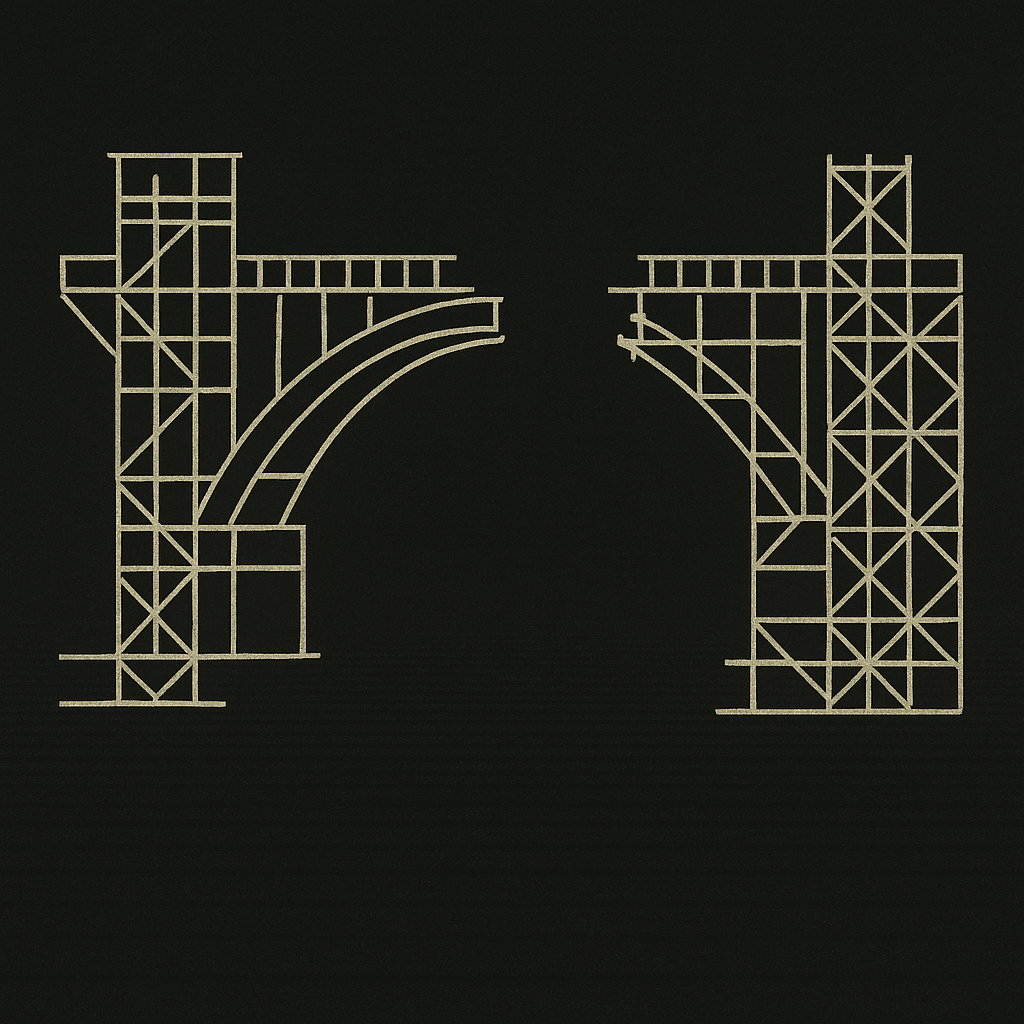
THE MACHINERY OF TRANSFER
A Complete Guide to Moving Understanding Between Minds
How One Brain Reconstructs What Another Brain Sees
What follows is not advice.
It is not a communication tip. Not a teaching strategy. Not a presentation framework dressed up in cognitive science.
It is mechanism.
The actual machinery running beneath every moment one person tries to make another person understand something. The architecture that determines whether a pattern in your head arrives intact in someone else’s head or arrives as noise.
Most people think explaining is about clarity. Choosing the right words. Being articulate. Speaking slowly.
It is none of these things.
Transfer is a reconstruction problem. The listener does not receive your understanding. They build their own. And they build it entirely from materials already in their head. Your job is not to transmit. Your job is to trigger the correct assembly sequence in a brain you cannot see inside.
This document is that machine, laid open.
Nothing more.
What you do with it is your business.
PART ONE: THE RECONSTRUCTION PROBLEM
Why Transmission Is a Myth
There is a model of communication so deeply assumed that almost no one questions it.
The model says: I have an idea. I encode it into words. I send the words. You decode the words. You now have my idea.
Encoding. Channel. Decoding. The Shannon model. It works for telegraph signals and digital packets.
It does not work for meaning.
The failure is not in the channel. It is not that your words were unclear. It is not that the listener was not paying attention. The failure is in the model itself.
Meaning is not a signal. It is a structure. A pattern of relationships between concepts, built over years of experience, wired into a specific neural architecture that is unique to each brain. When you say the word “strategy,” the pattern that fires in your head is different from the pattern that fires in the listener’s head. Not slightly different. Architecturally different. Because the word is a pointer, not a payload. And the thing it points to was built by a life you did not live.
Transfer is not moving a thing from one place to another.
Transfer is triggering a construction process in someone else’s brain using the only tools available to you. Words. Gestures. Sequences. Timing. And hoping that what they build from their own materials resembles what you see from yours.
The Architecture
    THE TRANSFER PROBLEM

    ┌──────────────────────────────────────────────┐
    │              SPEAKER'S BRAIN                 │
    │                                              │
    │   Pattern P exists as a web of              │
    │   relationships between concepts,            │
    │   memories, sensory associations,            │
    │   emotional weights, and hierarchies         │
    │   built over decades of experience.          │
    │                                              │
    │   This structure is non-linguistic.           │
    │   It exists before and beneath words.         │
    └──────────────────────┬───────────────────────┘
                           │
                    encoding (lossy)
                    words, gesture,
                    sequence, tone
                           │
                           ▼
    ┌──────────────────────────────────────────────┐
    │               THE CHANNEL                    │
    │                                              │
    │   Language. Visual aids. Demonstrations.      │
    │   Analogies. Examples. Drawings.             │
    │   The medium carries pointers,               │
    │   not the pattern itself.                    │
    └──────────────────────┬───────────────────────┘
                           │
                   decoding (constructive)
                   listener builds from
                   their own materials
                           │
                           ▼
    ┌──────────────────────────────────────────────┐
    │             LISTENER'S BRAIN                 │
    │                                              │
    │   Pattern P' is CONSTRUCTED, not received.   │
    │   Built from the listener's own concepts,    │
    │   memories, associations, and frameworks.    │
    │                                              │
    │   P' ≈ P  only if speaker aimed at           │
    │   materials the listener already has.         │
    │   Otherwise P' ≠ P. Silently.                │
    └──────────────────────────────────────────────┘
The gap between P and P’ is the transfer gap. Every failed explanation, every misunderstood instruction, every meeting where people walked away with different versions of what was agreed upon. All of it traces back to this single architectural fact.
You cannot give someone your understanding.
You can only create conditions under which they construct their own.
PART TWO: THE FIVE MECHANISMS OF TRANSFER
Mechanism One: Anchoring
Every new idea must attach to something old.
This is not a teaching strategy. It is a neurological constraint. The brain does not add new structures from scratch. It modifies existing ones. New neural patterns form by extending, branching, or recombining patterns that already exist. There is no blank canvas. There is no empty slot where new knowledge simply lands.
When you explain something to someone, you are not pouring water into an empty glass. You are grafting a new branch onto an existing tree. And if you do not know what the tree looks like, you cannot know where to graft.
The most common failure in explanation is this: the speaker starts from their own anchor points. They explain what makes sense given their own tree. But the listener’s tree has different branches. Different roots. Different architecture entirely. The branch you are grafting has no place to attach.
The graft falls off. The listener nods politely. Nothing transferred.
Anchoring means starting from where the listener’s structure already exists. Not where yours does. Not where the “logical beginning” is. Where they are.
A mechanic explaining engine timing to a musician does not start with combustion theory. They start with rhythm. With timing. With the idea that components must fire in sequence, and when the sequence is wrong, everything sounds wrong. The anchor is music. The graft is engineering. And it holds because the root is the listener’s.
Mechanism Two: Progressive Loading
The brain has a loading order.
You cannot understand a complex structure all at once. Not because you are not smart enough. Because the architecture does not allow it. Each layer of understanding requires the previous layer to be in place before it can attach.
Progressive loading is the transfer mechanism that respects this constraint.
It works like this. First, deliver the simplest version that is still true. Not dumbed down. Not a lie that will need to be corrected later. The simplest accurate frame. This becomes the scaffold.
Then add load. One element at a time. Each new element attaches to the scaffold that is already in place. The listener’s brain integrates it, tests it against what is already built, adjusts the scaffold, and signals readiness for the next element.
The signal is not verbal. The listener does not say “I am ready for the next layer.” The signal is visible in their questions. Good questions mean the scaffold is holding. The listener is testing load-bearing walls. Bad questions mean the scaffold is incomplete. They are looking for a floor that was never laid.
Most failed transfer happens because the speaker skips layers. They jump from scaffold to roof. They deliver the sophisticated version first because it is the version they find interesting. The listener hears words but cannot attach them to anything. The words float. They are remembered temporarily and forgotten permanently, because they never bonded to structure.
Mechanism Three: Model Donation
This is the most powerful transfer mechanism. And the most rare.
Model donation is the act of giving the listener a thinking tool. Not a conclusion. Not a fact. Not an explanation. A lens.
When you say “think of the economy as plumbing,” you have donated a model. The listener can now route economic concepts through spatial reasoning. Where does money flow? Where is it blocked? Where is the pressure building? They can generate new understanding from the model without you being present. The model does your work after you leave the room.
Facts transfer knowledge of what.
Explanations transfer knowledge of how.
Models transfer the ability to think.
The difference is generative capacity. A fact is inert. It sits in memory. An explanation is a sequence. It can be replayed. A model is a machine. It can be run on new inputs the original speaker never considered.
    GENERATIVE CAPACITY OF TRANSFER

    ┌─────────────────┐
    │      FACT        │   "The market dropped 3%"
    │   (inert)        │   Can be recalled. Cannot generate.
    └─────────────────┘

    ┌─────────────────┐
    │   EXPLANATION    │   "The market dropped because
    │   (sequence)     │    rates rose and bonds became
    │                  │    more attractive than equities"
    │                  │   Can be replayed. Cannot predict.
    └─────────────────┘

    ┌─────────────────┐
    │      MODEL       │   "Money flows like water.
    │   (generative)   │    It moves toward the lowest
    │                  │    friction path to returns."
    │                  │   Can be run on any scenario.
    │                  │   Generates new understanding
    │                  │   without the speaker present.
    └─────────────────┘
The power of model donation is that it scales. Once the model is constructed in the listener’s brain, it runs forever. They can think about problems you never discussed. They can extend the understanding in directions you never imagined. The model became theirs. Not a copy of yours. Theirs.
This is what the best teachers actually do. They do not transfer knowledge. They build thinking machines in other people’s heads.
Mechanism Four: Contrastive Framing
The brain understands what something is by understanding what it is not.
This is not a rhetorical device. It is how the neural architecture works. Categories are defined by boundaries. The concept “chair” exists in the brain not as a positive definition but as a region in concept space bounded by “not table,” “not stool,” “not bench.” The boundaries are the definition.
Contrastive framing exploits this. Instead of explaining what something is, you explain the boundary between it and the thing it is most easily confused with.
“Strategy is not planning.” Four words. And they do more transfer work than a twenty-minute definition of strategy. Because the listener already has a model of planning. It is rich. It is detailed. It is wrong. The contrast carves the new concept out of the old one. The boundary creates the shape.
Every category in the brain is a carved space. Not a filled one. You do not build a concept by adding features. You build it by drawing borders.
The most effective explanations are often the shortest. “This is like X, except for Y.” The listener’s existing model of X does 90% of the construction. The exception Y carves the final shape. Transfer complete. Not because more information was given. Because the right cut was made.
Mechanism Five: Emotional Tagging
Information without emotional weight is information the brain deprioritizes.
This is not about making content exciting. It is about a biological mechanism. The amygdala modulates memory consolidation. When an experience carries emotional charge, the amygdala signals the hippocampus to strengthen the encoding. The memory becomes more durable. More accessible. More integrated with existing knowledge structures.
Transfer that ignores this mechanism is transfer that evaporates.
The dry lecture. The technical manual. The dispassionate explanation. They carry information but no signal to the brain that this information matters. And the brain’s default response to information that does not matter is clear. Discard it.
Emotional tagging does not mean drama. It does not mean storytelling for its own sake. It means that at the moment of critical transfer, there must be something at stake. A problem that matters. A contradiction that disturbs. A gap that the listener feels. The emotion is not decoration. It is the phosphorylation signal that says: keep this.
The sequence matters. The emotional tag must arrive at or just before the key transfer moment. Not after. A story told after the explanation is entertainment. A story told before the explanation is a primer. It opens the gate. The explanation walks through. And the gate closes behind it, locking the understanding in place.
PART THREE: THE CONSTRAINTS
The Curse of Knowledge
There is a transfer failure so pervasive it has a name.
The curse of knowledge is the inability to reconstruct what it was like to not know something you now know. Once a pattern is built in your brain, you cannot unbuild it. You cannot see the world as it looked before the pattern existed. The pattern is now part of how you see. And you forget that it was ever not there.
This is not a personality flaw. It is an architectural constraint. The brain does not maintain a history of its own previous states. It runs on its current wiring. The previous wiring is overwritten. The experience of not-knowing is genuinely inaccessible to the knower.
This is why experts are often the worst explainers. Not because they lack communication skills. Because the very expertise that makes them knowledgeable makes them unable to model the listener’s state. They skip steps they cannot see. They use vocabulary that became invisible to them years ago. They start from foundations that exist in their brain but nowhere else.
The curse of knowledge is the single largest source of transfer failure. Not lack of clarity. Not lack of vocabulary. Not lack of effort. The inability to remember what it was like to not know.
    THE CURSE OF KNOWLEDGE

    EXPERT'S VIEW OF THE CONCEPT:
    ┌────────────────────────────────────────┐
    │  A ── B ── C ── D ── E ── F ── G     │
    │  │    │    │    │    │    │    │       │
    │  Everything connected. Obvious.        │
    │  "Start anywhere, it all makes sense." │
    └────────────────────────────────────────┘

    NOVICE'S VIEW OF THE SAME EXPLANATION:
    ┌────────────────────────────────────────┐
    │  ?    ?    C ── ?    ?    ?    G       │
    │            │                   │       │
    │  Two islands. Vast darkness.           │
    │  "I got pieces. I got nothing."        │
    └────────────────────────────────────────┘

    THE GAP:
    The expert does not see the darkness.
    They see A through G lit up.
    They literally cannot perceive the novice's view.
    This is not negligence. It is architecture.
The Abstraction Trap
There is a level of abstraction at which communication becomes efficient between peers and useless to everyone else.
Abstraction is compression. The word “strategy” compresses thousands of concepts into one handle. Between two people who have both unpacked that handle, the compression saves time. Between one person who has unpacked it and one who has not, the compression creates an illusion of transfer. The handle was passed. The contents were not.
The abstraction trap is the tendency to communicate at the abstraction level that is comfortable for the speaker rather than the level that is constructive for the listener. And the trap is invisible because the speaker feels the conversation is going well. The words are flowing. The sentences are coherent. The logic tracks. From the speaker’s side, everything looks clean.
From the listener’s side, it is a stream of handles they cannot unpack. Each word points to a structure they do not have. The sentence is grammatically perfect and semantically empty.
The way out of the trap is not to avoid abstraction. It is to calibrate it. Every explanation has an optimal abstraction layer. Too abstract and the words are empty pointers. Too concrete and the details obscure the structure. The skill is reading the listener’s current abstraction level and matching it. Then, slowly, ratcheting upward.
The Linearity Constraint
Understanding is a graph. Explanation is a line.
This is the fundamental structural mismatch of transfer. The concept you want to explain exists in your head as a web. Multiple connections. Multiple entry points. Simultaneous relationships. Non-linear dependencies.
But language is sequential. One word after another. One sentence after another. You must linearize a graph. And every linearization is a distortion. You must choose what comes first. And what comes first changes what everything after it means.
The order of explanation is not neutral.
If you explain the problem first, then the solution, the listener evaluates the solution against the problem. If you explain the solution first, then the problem, the listener evaluates the problem against the solution. The information is identical. The understanding constructed is different.
    THE LINEARIZATION PROBLEM

    THE CONCEPT (in your head):

         A ←──→ D
         │ ╲    ↑
         │   ╲  │
         ▼    ╲ │
         B ──→ C
         │
         ▼
         E

    THE EXPLANATION (in speech):

    A → B → C → D → E

    or

    D → A → B → E → C

    or

    C → D → A → B → E

    Each linearization creates different understanding.
    None of them ARE the concept.
    All of them are paths through the concept.
    The path you choose determines what gets built.
The best explainers know this. They choose the linearization that front-loads the scaffolding the listener needs for everything that follows. Not the logical order. Not the chronological order. The constructive order. The sequence in which each piece becomes load-bearing for the next.
PART FOUR: THE TWO MODES
Transfer as Weapon
Transfer can be wielded.
Every mechanism described above can be used to build accurate understanding. And every mechanism can be used to build inaccurate understanding that feels accurate. The architecture does not distinguish between true models and false ones. It builds whatever is triggered.
Anchoring becomes manipulation when the anchor is chosen to bias rather than to illuminate. “Think of immigration as an invasion.” The anchor is military. Everything that follows inherits the frame. The listener builds a model where immigrants are combatants, borders are battle lines, resources are contested territory. The model is coherent. The model feels true. The model was constructed from a deliberate anchor.
Model donation becomes propaganda when the donated model is a distortion engine. “The economy is a household budget.” The model is intuitive, simple, and wrong. National economics does not function like household spending. But the model runs. And every time the listener thinks about the economy, it runs the donated model. Generating conclusions that feel reasonable and are structurally flawed.
Contrastive framing becomes a straw man when the contrast is engineered. “Unlike those who believe in chaos, we believe in order.” The contrast carves a space that did not exist. An opponent who was never that extreme. A position that was never that simple. But the carving feels like clarification. And the listener does not notice they are standing in a manufactured space.
The mechanisms are agnostic. They build. What they build depends entirely on what is fed into them.
Transfer as Liberation
The same mechanisms, aimed at accuracy instead of advantage, produce something different.
When anchoring connects to the listener’s genuine existing understanding and extends it honestly, the listener gains a structure they can test. They can push on it. Find where it bends. Find where it breaks. The transfer is not an imposition. It is an offering of architecture.
When model donation gives a model that mirrors reality rather than distorting it, the listener gains generative capacity. They can think about problems the speaker never raised. They can question the speaker’s own conclusions using the speaker’s own model. The model liberates rather than constrains.
Transfer aimed at accurate reconstruction is the rarest form of communication. It requires the speaker to hold their own certainty lightly. To prefer the listener’s understanding over the listener’s agreement. To accept that if the model is transferred successfully, the listener may use it to arrive at conclusions the speaker does not like.
This is why most transfer fails not from lack of skill but from lack of courage. Accurate transfer means giving someone a tool you cannot control.
PART FIVE: SYNTHESIS
The Unified Architecture
Transfer is not a single act. It is a construction protocol.
The speaker reads the listener’s current state. Identifies existing structures that can serve as anchors. Selects an abstraction level that matches the listener’s architecture. Chooses a linearization that front-loads scaffolding. Delivers in progressive layers that respect the brain’s loading order. Donates models that generate rather than constrain. Uses contrast to carve boundaries rather than fill space. Tags critical moments with emotional weight to signal the consolidation system.
And through all of it, operates under the curse of knowledge. Unable to see what the listener does not see. Unable to hear what the listener does not understand. Guessing, adjusting, reading signals, and hoping.
This is what transfer actually is.
Not eloquence. Not clarity. Not vocabulary.
A blind construction project in a building you cannot enter, using materials you cannot see, following a blueprint that only exists in your head.
The best transferrers are not the best speakers. They are the best modelers. They build the most accurate internal representation of the listener’s current architecture. And they aim every word at that architecture, not at their own.
    THE TRANSFER PROTOCOL

    ┌────────────────────────────────────┐
    │   1. MODEL THE LISTENER           │
    │      What do they already know?    │
    │      What is their abstraction     │
    │      level? What are their         │
    │      anchor points?                │
    ├────────────────────────────────────┤
    │   2. SELECT ENTRY POINT           │
    │      Start from THEIR structure.   │
    │      Not yours. Not the            │
    │      "beginning." Theirs.          │
    ├────────────────────────────────────┤
    │   3. PROGRESSIVE LOAD             │
    │      Simplest true frame first.    │
    │      Add one element. Check.       │
    │      Add one element. Check.       │
    ├────────────────────────────────────┤
    │   4. DONATE MODELS                │
    │      Give thinking tools,          │
    │      not conclusions.              │
    │      "Think of it like..."         │
    ├────────────────────────────────────┤
    │   5. CARVE WITH CONTRAST          │
    │      Define by boundary.           │
    │      "It is not X. Here is why."   │
    ├────────────────────────────────────┤
    │   6. TAG EMOTIONALLY              │
    │      At the critical moment,       │
    │      make it matter.               │
    │      Stakes. Tension. Gap.         │
    ├────────────────────────────────────┤
    │   7. VERIFY CONSTRUCTION          │
    │      Ask them to explain it back.  │
    │      Not recall. Explain.          │
    │      What they build tells you     │
    │      what transferred.             │
    └────────────────────────────────────┘
The protocol is not linear. It is recursive. At every stage, the speaker is modeling the listener’s state and adjusting. Stage 7 feeds back into stage 1. The model updates. The approach shifts. This is why transfer is exhausting. It is real-time computation against an invisible target.
And this is why the best explanations feel effortless to the listener but cost the speaker everything. The work is hidden. The scaffolding is invisible. The listener experiences a smooth ramp into understanding and has no idea how much architecture was built beneath their feet.
The Final Constraint
Transfer is always lossy.
P’ never equals P. The listener’s reconstruction is always a version. An interpretation. A structure built from different materials in a different architecture. Perfect transfer is a theoretical limit, not an achievable state.
This is not a failure. It is a feature. Because the listener’s version, built from their own materials, is integrated into their existing architecture in a way that the speaker’s version never could be. P’ is not a degraded copy of P. P’ is a native structure. It belongs to the listener. It connects to everything else they know in ways the speaker cannot predict.
The goal of transfer is not fidelity. It is functional equivalence. Not “do they have my exact pattern” but “can they use their pattern to do the same work.”
When that happens, transfer has occurred.
Not perfectly. Not completely. Not in the way the speaker imagined.
But the machine was built. And it runs.
Citations
Cognitive Architecture and Knowledge Transfer Clark, A. (2013). Whatever next? Predictive brains, situated agents, and the future of cognitive science. Behavioral and Brain Sciences, 36(3), 181-204. Bransford, J.D., Brown, A.L., & Cocking, R.R. (2000). How People Learn: Brain, Mind, Experience, and School. National Academies Press.
The Curse of Knowledge Camerer, C., Loewenstein, G., & Weber, M. (1989). The curse of knowledge in economic settings. Journal of Political Economy, 97(5), 1232-1254. Hinds, P.J. (1999). The curse of expertise: The effects of expertise and debiasing methods on prediction of novice performance. Journal of Experimental Psychology: Applied, 5(2), 205-221.
Mental Models and Model Donation Gentner, D. & Stevens, A.L. (1983). Mental Models. Lawrence Erlbaum Associates. Johnson-Laird, P.N. (1983). Mental Models: Towards a Cognitive Science of Language, Inference, and Consciousness. Harvard University Press.
Emotional Modulation of Memory McGaugh, J.L. (2004). The amygdala modulates the consolidation of memories of emotionally arousing experiences. Annual Review of Neuroscience, 27, 1-28. Phelps, E.A. (2004). Human emotion and memory: Interactions of the amygdala and hippocampal complex. Current Opinion in Neurobiology, 14(2), 198-202.
Progressive Disclosure and Cognitive Load Sweller, J. (1988). Cognitive load during problem solving: Effects on learning. Cognitive Science, 12(2), 257-285. Kalyuga, S. et al. (2003). The expertise reversal effect. Educational Psychologist, 38(1), 23-31.
Analogical Reasoning and Contrastive Learning Holyoak, K.J. & Thagard, P. (1995). Mental Leaps: Analogy in Creative Thought. MIT Press. Gentner, D. (1983). Structure-mapping: A theoretical framework for analogy. Cognitive Science, 7(2), 155-170.