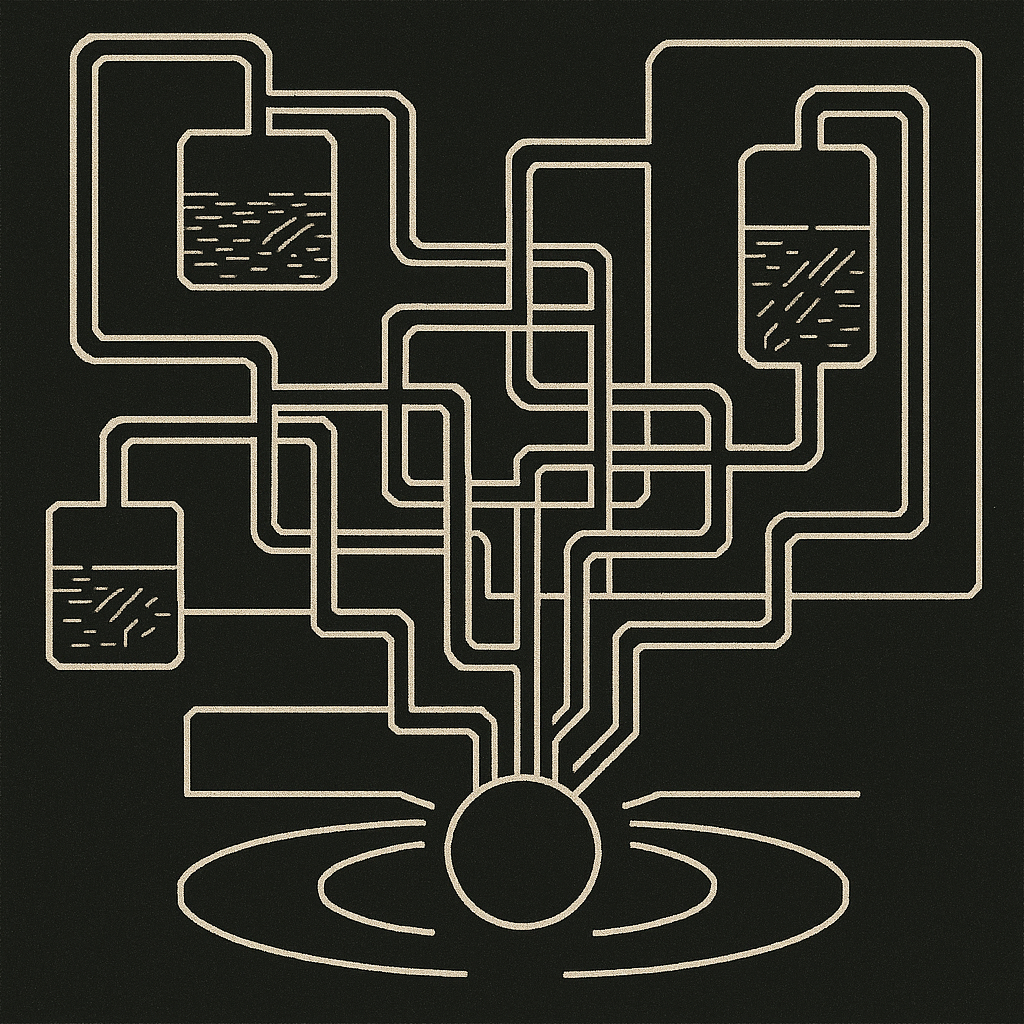
THE MACHINERY OF THE SYSTEM OF DEVOTION
A Complete Guide to How Devotion Behaves and Where It Can Be Controlled
Why every attempt to make yourself more loyal is swallowed by the system and the scattered set point snaps back
You treat your loyalties as a series of choices.
This commitment kept, that one abandoned, this person you stayed for, that calling you let go. You explain each one by its own story, the reasons it worked or failed, and because you explain devotion by individual choices, you try to fix devotion by making better individual choices, and you have noticed, if you are honest, that it does not work. You resolve to be more committed and the resolution dissolves. You choose a center and your life keeps orbiting its old one. You arrange the choices and the scattering returns anyway, from a different direction, as if the choices were never the point.
The choices were never the point.
Your devotion is not a list of loyalties chosen one at a time. It is a system. A structure with a stock that accumulates, flows that fill and drain it, feedback loops that lock a center in or erode it, delays that make the payoff arrive long after the cost, and an attractor your life settles into regardless of what you decide at the surface. The system produces your pattern of devotion and abandonment. The individual choices are just what it happens to be metabolizing this year. Change the choices and the system finds new ones to run the same pattern through.
This document is the structure. The whole system, mapped, and the precise points where it can be reached. You will learn where every attempt you have made to be more devoted sits on the map of leverage, why almost all of them sit at the shallowest point, why the system swallows them, and where the one real leverage point is, which you will not be able to pull, for reasons the map itself will make clear.
PART ONE: THE SYSTEM
Your Loyalties Are Not a List of Choices
A system is a set of parts whose relationships produce a behavior none of the parts has alone.
Your capacity for devotion is exactly this. It is not located in your willpower, your character, or your luck with worthy objects. It is located in the relationships between a stock of accumulated investment, the loops that feed or drain it, the delays that govern when its rewards arrive, and the attractor the whole thing settles toward. The pattern you live, the bright starts that fade, or the one center everything orbits, is the output of this structure, and the structure is what you have been ignoring while you adjusted the choices.
PART TWO: WHAT THE SYSTEM IS
Function One: State
Every system has a state, the value of its key variable at a moment in time. The state variable of devotion is the strength of the return, how reliably and how independently the system comes back to its center.
At low state, the return fires only when the object is charged and pays. At high state, the return fires on its own, through the dry seasons, without being summoned. Your devotion at any moment is a reading on this one variable, and most people read the wrong gauge. They read the feeling. The feeling is weather. The state is climate, the underlying return-strength, and it changes slowly and structurally, not with the mood of the day.
Function Two: Coupling
A system’s parts are coupled, each one’s state depending on the others. Devotion couples the subsystems of a life. Time, money, attention, ambition, other relationships, all become linked to the center once it is chosen, each one’s allocation now depending on the others through the center that ranks them.
In a scattered life the subsystems are uncoupled, each pulling independently, no center to relate them, and the result is a person spread across competing loyalties that do not know about each other. In a devoted life the subsystems are tightly coupled through the center, and a change in one propagates to all. This coupling is why devotion feels like integrity, literally integration, the parts made into one thing, and why its absence feels like being pulled apart.
Function Three: Purpose
Every system has a purpose, the state it servos toward, visible not in what it says but in what it does. The purpose of a devoted system is the maintenance of the center. It corrects deviations, pulls resources back, restores the orbit, and you can read the real purpose of any life by watching what it always returns to when disturbed.
This is the diagnostic that cuts through self-deception. Whatever your system actually orbits, whatever it restores itself toward after every disruption, is its true center, regardless of what you claim to be devoted to. Many people discover, watching their own corrections, that the center their life servos toward is not the one they named. The system’s purpose is in its behavior, not its stated commitments.
PART THREE: HOW THE SYSTEM BEHAVES
Function Four: Stocks and Flows
A stock is an accumulation. A flow fills or drains it. The central stock of devotion is invested life, the irreversible accumulation of time, sacrifice, history, and identity poured into the center over years.
The inflow is everything given to the center. The outflow is neglect, the slow draining of the stock when the return stops firing and the investment goes elsewhere. The crucial property of a stock is that it changes slowly, governed by the difference between inflow and outflow, and cannot jump. This is why devotion cannot be installed in a day, and why it cannot be destroyed in a day either. A deep stock of invested life produces a stability that no single bad season can drain, because the outflow of one season is small against a stock built over decades. People with no stock mistake their emptiness for a lack of feeling. It is a lack of accumulation.
Function Five: Feedback
Feedback loops are where the system’s behavior is generated. Devotion runs on two.
The reinforcing loop: the return is made, the investment grows, the grown investment makes the next return more natural, which grows the investment further. This is the loop that locks a center in. Past a certain point it becomes self-sustaining, the devoted life feeding its own devotion, and the center becomes nearly impossible to leave not through willpower but through the accumulated gravity of the loop.
The balancing loop: as investment in the center rises, the cost rises too, the things given up, the narrowing of the life, and the cost pulls back against the investment, draining it. In a healthy devotion the reinforcing loop dominates and the center deepens. In a failing one the balancing loop dominates, the cost outweighs the return, and the system drains back to scattered. Which loop dominates is not about how much you care. It is about the gain on each loop, and the gain is set by structure, not sentiment.
Function Six: Delays
Delays are the most treacherous feature of any system, the lag between an action and its consequence. Devotion’s central delay is the long gap between investment and payoff. You pour years into a center before the meaning it generates becomes load-bearing, and during the gap the cost is fully present while the reward has not yet arrived.
This delay destroys more devotion than any failure of feeling. The system pays in advance and is reimbursed late, and a person who reads only the present balance sees cost without return and concludes the devotion is not working. They quit inside the delay, at the exact moment the stock was about to start paying, because they could not see across the lag. Every long devotion has a valley in it, a stretch where the investment is high and the return has not yet compounded, and the valley is not a sign of a wrong center. It is the delay, and the systems that survive are the ones that keep the inflow up across a payoff they cannot yet feel.
PART FOUR: WHERE THE SYSTEM GOES
Function Seven: Attractor and Equilibrium
A system settles into an attractor, a state it returns to regardless of where it starts. Your life has a devotional attractor, a default arrangement it falls back into, and for most people it is the scattered state, a low-investment, high-optionality, many-shallow-loyalties equilibrium that feels like freedom and produces emptiness.
The devoted life is a different attractor, a deep basin where the life orbits one center and resists displacement. The crucial fact is that you do not live in the state you intend. You live in the state your system’s structure makes into an attractor. Intending devotion while your structure makes scattering the attractor produces exactly what you have, a life that keeps falling back to scattered no matter how sincerely you reach for a center. The attractor wins, every time, because an attractor is just where the structure goes when you stop forcing it.
Function Eight: Stability and Resilience
Stability is how well a system holds its state against shocks. Resilience is how well it returns after being displaced. A devotion’s resilience comes from redundancy, the number of independent reasons the center holds.
A devotion supported by one reason, a single feeling, a single benefit, is brittle. Remove the reason and the whole thing collapses. A devotion supported by many independent reasons, history and identity and meaning and shared life and accumulated investment, survives the loss of any one, because the others still hold the center in place. This is why mature devotions are hard to kill and why infatuations die at the first real shock. The infatuation has one support. The mature devotion has a dozen, and you cannot bring it down by removing one, which is what people are trying to do when they look for the single flaw that would justify leaving.
Function Nine: Thresholds and Bifurcation
Systems have thresholds, points where a small change tips the whole into a different regime. Devotion has a bifurcation between the wavering attachment, which can still go either way, and the locked devotion, where the reinforcing loop has taken over and leaving is no longer a live option.
Below the threshold, the center is held by ongoing choice, and every difficulty re-opens the question. Above it, the accumulated investment and the closed exit have tipped the system into a basin it does not climb out of, and the center is held by structure, not by daily decision. The tip is often invisible when it happens. People rarely notice the moment a wavering attachment became a locked devotion, or the moment a strained one crossed the other way into a decay it would not recover from. The threshold is real, and crossing it changes everything downstream, and it is almost never felt as it occurs.
Function Ten: Emergence
The behavior of a system is emergent, present in the whole and in no part. Devotion is emergent. It is not in the feeling, not in the choice, not in the object. It is in the orbiting structure as a whole, and this is why you cannot find it by examining any single component.
You look for devotion in your feelings and do not find it, because it is not there. You look in your choices and find only the surface. The devotion is the shape of the whole system, the stock and the loops and the attractor operating together, and the meaning it generates is an emergent property of that operation, not a thing stored anywhere inside it. This is why the meaning evaporates when you try to extract it directly, and only appears when the whole structure is running. You cannot have the emergent product without building the system that emits it.
PART FIVE: READING THE SYSTEM YOU ARE IN
Mapping Your Own Devotion Onto the Ten Functions
Take the pattern of loyalty and abandonment you actually live and read it through the functions.
What is your state, the real return-strength, not the feeling. What does your life couple through, or is it uncoupled and pulling apart. What does your system servo toward when disrupted, and is that the center you would name. How large is your stock of invested life, or is your emptiness a lack of accumulation rather than a lack of feeling. Which feedback loop dominates, the reinforcing one that deepens or the balancing one that drains. Where are you in the delay, and have you been quitting inside valleys. What is your devotional attractor, the state you keep falling back to. How resilient are your devotions, how many independent reasons hold each one. And have you crossed the threshold into locked devotion anywhere, or do you live entirely below it, remaking every choice daily and exhausting yourself.
The map will show you that your problem is structural and locatable, not a deficiency of character. And it will show you something harder, which is where the real leverage is.
PART SIX: THE LEVERAGE POINTS
Where to Reach In, Ranked From Shallow to Deep
There is a hierarchy of places to intervene in a system, and the effective ones are the opposite of the obvious ones.
Shallowest, and where almost everyone works: the parameters. Trying harder, spending more time, feeling more intensely, summoning more loyalty. These adjust the numbers without touching the structure, and the system swallows them whole. You can max out every parameter and the attractor does not move.
Deeper: the stocks and buffers. Building up invested life so the center has accumulated weight. This works, slowly, but cannot be rushed, because stocks change only at the rate of their flows.
Deeper: the feedback loop strengths. Closing the exit raises the gain on the reinforcing loop and lowers it on the balancing one, and this is the highest-leverage structural move most people never make, because closing the exit is the one thing the self refuses.
Deeper: the rules and constraints. The closed exit as a standing rule that removes the daily renegotiation, so the return no longer has to be re-decided.
Deeper: the goal of the system. Changing what the center actually is, which reorders everything downstream of it.
Deepest, and the one you cannot pull on purpose: the paradigm, the frame from which the whole system is generated. The paradigm beneath a scattered life is that you are a sovereign chooser who must keep his options open to stay free. As long as that paradigm holds, the system will regenerate the scattered attractor no matter what you do at the shallower levels, because every structural change you make will be made by a self committed to keeping the exit open, and undone by the same self the moment it binds.
PART SEVEN: THE CONTROL MOVES
Why the System Swallows Every Shallow Move, and Why You Cannot Pull the Deep One
The shallow moves fail by design. When you try harder to be devoted, you raise a parameter, and the attractor is not set by parameters. The system absorbs the extra effort, runs it through the same structure, and returns to its set point, leaving you tired and unchanged and concluding you lack the capacity. You do not lack the capacity. You are pushing on the part of the system that was built to absorb pushing.
The deep move would work, and you cannot make it on purpose, because the deepest leverage point is the paradigm that you must keep your options open to be free, and that paradigm is held by the very self that would have to do the changing. A self organized around open options cannot author the closing of its own exit, because the closing would end the self that values the openness. The paradigm cannot be argued away from inside the paradigm. It shifts, when it shifts, the way paradigms shift, through an accumulation of contradiction the old frame cannot absorb, a slow loading toward a threshold, and then a reorganization that the self watches rather than performs.
What you can do is stop defending the open exit so hard. You can stop rescuing your own optionality every time a center starts to bind. You can let the contradiction accumulate, the growing evidence that the scattered, optioned life produces exactly the emptiness you keep trying to choose your way out of. You cannot pull the deep lever. You can stop holding it in the position that keeps the scattered attractor in place.
PART EIGHT: THE SYSTEM IN FULL
The Complete Map
   ┌──────────────────────────────────────────────────────────┐
   │                  THE DEVOTIONAL SYSTEM                     │
   │                                                            │
   │   INFLOW ──►  [ STOCK: invested life ]  ──► OUTFLOW        │
   │  (return,         │            ▲          (neglect)        │
   │   sacrifice)      │            │                           │
   │                   ▼            │                           │
   │            REINFORCING      BALANCING                      │
   │            (locks center)   (cost drains it)               │
   │                   │            │                           │
   │                   ▼            ▼                           │
   │              [ ATTRACTOR: scattered  vs  devoted ]         │
   │                   │                                        │
   │                   ▼                                        │
   │              PARADIGM: "I must keep my options open"       │
   │              (deepest lever, cannot be pulled by the       │
   │               self the paradigm generates)                 │
   └──────────────────────────────────────────────────────────┘
Everything you can feel sits near the top, the inflow, the cost, the present balance. Everything that determines the outcome sits at the bottom, the dominant loop, the attractor, the paradigm. The work is always below where the feeling is, and the deepest work is below where the will can reach.
The Shift
When you stop treating your loyalties as a series of choices and start seeing the system that produces them, the whole problem reorganizes. Your scattering is not a character flaw or a failure of feeling. It is an attractor, generated by a structure, defended by a paradigm, and it will keep reasserting itself until the structure changes. You stop trying to choose your way to devotion, which is a parameter move the system swallows, and you start watching for the slow accumulation of contradiction that loads the paradigm toward its threshold, and you stop rescuing the open exit that holds the scattered attractor in place.
You cannot make yourself devoted. You can stop running the structure that keeps making you scattered, and let the contradiction build, and wait, without rescuing yourself, for the frame to give.
CITATIONS
Systems dynamics
- Meadows, D. H. (1999). Leverage Points: Places to Intervene in a System. The ranked hierarchy of intervention, from parameters to paradigms.
- Meadows, D. H. (2008). Thinking in Systems: A Primer. Stocks, flows, feedback, delays, and attractors.
- Forrester, J. W. (1961). Industrial Dynamics. Foundational treatment of stocks, flows, and delay-driven instability.
Commitment and investment
- Rusbult, C. E. (1980). The investment model of commitment. Commitment as an accumulating stock that resists dissolution.
- Ericsson, K. A., et al. (1993). The role of deliberate practice in the acquisition of expert performance. The structural return across years of delayed payoff.
Relationships over time
- VanLaningham, J., Johnson, D. R., & Amato, P. (2001). Marital happiness across the life course. The mid-life dip and later recovery, the delay made visible.
Resilience and meaning
- Walsh, F. (2003). Family resilience. Redundancy of supports as the source of resilience under shock.
RELATED MACHINERIES
- THE MACHINERY OF DEVOTION. The mechanism of the chosen center, mapped here as a dynamical system.
- THE MACHINERY OF THE ENGINE OF DEVOTION. The same phenomenon seen as a staged pipeline rather than a system.
- THE MACHINERY OF FEEDBACK LOOPS. The reinforcing and balancing loops that lock or drain a center.
- THE MACHINERY OF EQUILIBRIUM. The attractor a devoted life settles into and resists leaving.